StarTalk Radio comes down to Earth as astrophysicist Neil deGrasse Tyson and comic co-host Chuck Nice answer fan questions about our home planet. How was Earth formed? What is the earliest limit of the fossil and tectonic record? How does the high proportion of landmass in the Northern Hemisphere affect Earth’s rotation? Which will happen first – the Sun’s expansion into a red giant or the death of the dynamo inside Earth? Could a shift in magnetic poles happen in the near future, and what would that mean? In terms of natural disasters, where is the safest place to live? Does the full Moon affect tides? What would carbon-based life be like if Earth had double the gravity? Were there red sunsets in prehistoric times, before human pollution? All this, plus Neil’s classic answer to the question, “If the moon is getting further away from the Earth each year, how can we have a Super Moon?”
Astronomers using the NASA/ESA Hubble Space Telescope have, for the first time, determined the true colour of a planet orbiting another star. If seen up close this planet, known as HD 189733b, would be a deep azure blue, reminiscent of Earth’s colour as seen from space.
But that’s where the similarities end. This “deep blue dot” is a huge gas giant orbiting very close to its host star. The planet’s atmosphere is scorching with a temperature of over 1000 degrees Celsius, and it rains glass, sideways, in howling 7000 kilometre-per-hour winds [1].
At a distance of 63 light-years from us, this turbulent alien world is one of the nearest exoplanets to Earth that can be seen crossing the face of its star. It has been intensively studied by Hubble and other telescopes, and its atmosphere has been found to be dramatically changeable and exotic, with hazes and violent flares (heic0720, heic1209). Now, this planet is the subject of an important first: the first measurement of an exoplanet’s visible colour.
“This planet has been studied well in the past, both by ourselves and other teams,” says Frédéric Pont of the University of Exeter, UK, leader of the Hubble observing programme and an author of this new paper. “But measuring its colour is a real first — we can actually imagine what this planet would look like if we were able to look at it directly.”
In order to measure what this planet would look like to our eyes, the astronomers measured how much light was reflected off the surface of HD 189733b — a property known as albedo [2].
HD 189733b is faint and close to its star. To isolate the planet’s light from this starlight, the team used Hubble’s Space Telescope Imaging Spectrograph (STIS) to peer at the system before, during, and after the planet passed behind its host star as it orbited. As it slipped behind its star, the light reflected from the planet was temporarily blocked from view, and the amount of light observed from the system dropped. But this technique also shows how the light changes in other ways — for example, its colour [3].
“We saw the brightness of the whole system drop in the blue part of the spectrum when the planet passed behind its star,” explains Tom Evans of the University of Oxford, UK, first author of the paper. “From this, we can gather that the planet is blue, because the signal remained constant at the other colours we measured.”
The planet’s azure blue colour does not come from the reflection of a tropical ocean, but is due to a hazy, turbulent atmosphere thought to be laced with silicate particles, which scatter blue light [4]. Earlier observations using different methods have reported evidence for scattering of blue light on the planet, but these most recent Hubble observations give robust confirming evidence, say the researchers.
HD 189733b presented a favourable case for these kinds of measurements as it belongs to a class of planets known as “hot Jupiters”. These massive planets are similar in size to the gas giants in the Solar System, but instead lie very close to their parent star — this size and proximity to their star make them perfect subjects for exoplanet hunting. We know that hot Jupiters are numerous throughout the Universe. As we do not have one close to home in our own Solar System, studies of planets like HD 189733b are important to help us understand these dramatic objects.
“It’s difficult to know exactly what causes the colour of a planet’s atmosphere, even for planets in the Solar System,” says Pont [5]. “But these new observations add another piece to the puzzle over the nature and atmosphere of HD 189733b. We are slowly painting a more complete picture of this exotic planet.”
====
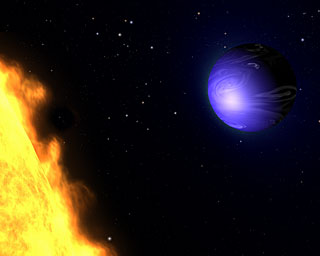
Artist’s impression of HD 188733b:
This illustration shows a “hot Jupiter” planet known as HD 189733b orbiting its star, HD 189733. The NASA/ESA Hubble Space Telescope measured the actual visible light colour of the planet, which is deep blue. This colour is not due to the presence of oceans, but is caused by the effects of a scorching atmosphere where silicate particles melt to make “raindrops” of glass that scatter blue light more than red light.
The planet HD 189733b was discovered in 2005 and is so close to its star that it is gravitationally “tidally locked”, so that one side always faces the star and the other side is always dark.
Because the planet is only 63 light-years from Earth, a visitor would see many of the same stars we see in our nighttime sky, though the constellation patterns would be different. Our Sun and the nearest star to our Sun, Alpha Centauri, appear as two faint stars near the centre of the image.
Credit:
NASA, ESA, and G. Bacon (AURA/STScI)
===
This video shows where the Hubble telescope finds this star:
After receiving numerous requests from folks that barely missed the campaign close, those in Europe that were not able to attend the live cast, and those that had Kickstarter payment snags, we’ve decided to provide select rewards through PayPal for a limited extension period. Simply choose your desired pledge level and quantity below. You’ll be taken to Paypal to checkout. For additional details on the campaign, translations, and the pledge rewards, visit our Kickstarter campaign page.
Pricing of our reward levels during this limited extension does not reflect an additional discount provided to our early Kickstarter backers.
If you’re in interested in our Education Packages (Education Supporter/Ambassador, etc.), click here to contact us. If you have other questions about the Kickstarter campaign or pledge levels, please click here.
a freeware space simulation software that lets you explore the universe in three dimensions, starting from planet Earth to the most distant galaxies. Areas of the known universe are represented using actual astronomical data, while regions uncharted by astronomy are generated procedurally. Millions of galaxies, trillions of stars, countless planets – all available for exploration.
Here are a couple of videos describing the program: