— First crewed Boeing Starliner docks with the International Space Station – VideoFromSpace
NASA astronauts Butch Wilmore and Suni Williams have arrived at the International Space Station aboard Boeing Starliner. The spacecraft docked with the orbital outpost on June 6, 2024.
— Boeing Starliner crew enters space station after docking – VideoFromSpace
NASA astronauts Butch Wilmore and Suni Williams completed ingress onto the International Space Station shortly after docking on June 6, 2024.
** A view of the Starliner docked to the ISS:
Maxar demonstrates the ability of its imaging satellites to view not just earth but other spacecraft as well by releasing an image of the Boeing Starliner crew vehicle docked to the ISS.
In-space of @Boeing Starliner’s first-ever astronaut mission!
Taken June 7, these satellite images show the spacecraft docked to the International Space Station (ISS).
This type of imagery collection, known as non-Earth imaging (NEI), is a breakthrough capability that… pic.twitter.com/zfpP14GRCx
** Technology Advancement and Applied Research Leveraging the ISS National Lab: 2024-7 – ISS National Lab
On May 22, 2024, the ISS National Lab held a webinar is to discuss the ISS National Lab Research Announcement (NLRA) 2024-7 soliciting proposals focused on applied research and development, translational medicine, technology readiness level maturation, and technology demonstration.
** NASA Astronaut Butch Willmore Answers Tennessee Student Questions – Tuesday, June 11, 2024 – NASA Video
NASA astronaut Butch Wilmore discussed living and working in space as part of the Crewed Flight Test (CFT) of the Boeing Starliner spacecraft during an in-flight interview with Tennessee Tech University on June 11. Wilmore is an alumnus of the school and is the midst of completing a test flight to check out Starliner’s systems ahead of spacecraft certification. Wilmore will remain at the space station for about a week to complete a series of test objectives before departing the complex for a landing in the southwestern United States alongside NASA astronaut Suni Williams.
** Metal 3D printing in microgravity has been accomplished aboard the ESA’s Columbus laboratory module by an industrial team led by Airbus:
The Metal 3D Printer’s design is based on stainless-steel wire being fed into the printing area, which is heated by a high-power laser, about a million times time more powerful than a standard laser pointer. As the wire dips into the melt pool, the end of the wire melts so that metal is added to the print.
The print process is overseen entirely from the ground. All the onboard crew has to do is open a nitrogen and venting valve before the printing starts. For safety reasons the printer operates within a fully sealed box, preventing excess heat or fumes from escaping.
Four shapes have been chosen for subsequent full-scale 3D printing, which will later be returned to Earth to be compared with reference prints made on the ground in normal gravity.
—- 3D printing metal in space! Tech developed by Airbus – VideoFromSpace
Airbus is developing a 3D printer that heats up metal to “1,200 degrees Celsius to produce new parts such as radiation shields, tooling or equipment directly in orbit.”
Watch the replay as ESA Director General Josef Aschbacher announces the first two astronaut missions for the new ESA astronaut class of 2022 on the first day of the Space Council, held in Brussels on 22 and 23 May 2024.
ESA’s most recent class of astronauts selected in 2022 includes Sophie Adenot, Pablo Álvarez Fernández, Rosemary Coogan, Raphaël Liégeois, and Marco Sieber. They recently completed one year of basic training and graduated as ESA astronauts on 22 April at ESA’s European Astronaut Centre in Germany, making them eligible for spaceflight. During their missions aboard the International Space Station, ESA astronauts will engage in a diverse range of activities, from conducting scientific experiments and medical research to Earth observation, outreach and operational tasks.
—- Update from Axiom on module construction: Axiom Station Update | Habitat One – Axiom Space Youtube
Axiom Station’s ‘Habitat One’ module has taken another major step towards completion at the Thales Alenia Space production facility in Turin, Italy. Take a look at the module bulkhead and forward cone coming together as Axiom Space expands global access to low Earth orbit.
will be the first commercial space laboratory. He and his colleagues have big dreams for the structure, which will enable new innovations in physics, biology, and other sciences that thrive in microgravity. They want this next-generation orbital platform to be useful and comfortable— one step closer to our science fiction dreams.
—- Axiom EVA spacesuit update: AxEMU Artemis III Integrated Test – Axiom Space Youtube
The first Artemis III Integrated Test is now complete. Axiom Space, along with NASA and SpaceX, tested how the #AxEMU and elements such as Starship will work together during the Artemis III mission. Axiom Space’s Director of Human Spaceflight, Peggy Whitson, and NASA astronaut Douglas Wheelock donned the AxEMU, providing crucial data and expertise.
Learn more about how we’re suiting humanity’s return to the moon with #AxEMU: https://bit.ly/3VsF0F1.
Our LIFE285 Ultimate Burst Pressure test article’s softgoods integration instrumentation, painting and photogrammetry preparation has been completed. The test article passed a rigorous inspection prior to being transported for a low pressurization test located at @NASA_Marshall. pic.twitter.com/KrPjxNlClt
—- The Exploration Company provide cargo supply services for Vast’s second orbital station. The Exploration Company, which is based in Europe, is developing the uncrewed Nyx vehicle for orbital supply operations.
–— The European Space Agency (ESA) becomes a Vast partner. ESA will use the Haven-1 station “for astronaut missions and research activities as well as commercial business development“. ESA will also help enable European companies to “supply subsystems and equipment for future Vast space stations“. ESA will also encourage the development and use of European crew and cargo transport services to support Vast stations.
—- Free-Flying Stations, with Jed McCaleb & Max Haot (Vast) – Payload on Youtube
This week on Pathfinder, we’re joined by Jed McCaleb, Founder, and Max Haot, CEO, the leaders behind VAST, a company advancing the development of commercial space stations. Jed, a seasoned software entrepreneur, and Max, a veteran in space and internet ventures, bring their unique expertise to the ambitious goal of advancing human habitation in space.
Our conversation covers the critical aspects of creating economically viable space stations, the strategic role of life support systems, and the significance of reducing transportation costs. We also explore:
– Space station economics, pros/cons of competition – Military opportunities and sensitivities in space station use – Integration of Launcher post-acquisition – Challenges and excitement of Haven One’s launch – Vast’s product roadmap
And much more…
• Chapters • 00:00 Intro 00:53 Jed’s career path and creating Vast 02:57 Balancing aspirations and making money 04:57 Max’s history building business and how he came to Vast 08:49 Max’s primary objective at Vast 11:22 Jed’s experience building a hardware company 12:31 Market opportunity for a free flying space station 15:20 Haven 1 19:17 Building components in house 21:07 Materials use and construction safety 23:03 Vast’s approach vs competitors 29:45 Importance of being first in the market 31:41 Is the market large enough to sustain multiple station providers? 33:25 Common misconceptions of space station investment 38:02 Vast x SpaceX partnership 40:55 Product roadmap 43:22 Coinciding with Starship timelines 45:06 Will Starship be converted into a space station? 46:10 Fundraising 47:09 Economics around Haven 1 51:37 Military applications 53:30 Utilization after acquisition 54:13 What excites you and keeps you up at night?
** China’s space station crew conducts spacewalk to install ‘space debris protection devices’ – VideoFromSpace
Spacewalking astronauts Ye Guangfu and Li Guangsu successfully installed space debris protection devices and more outside the Tiangong space station on May 28, 2024. Astronaut Li Cong assisted from inside the orbital outpost.
** See zebrafish swim in space on China’s Tiangong space station – ISS Above
** Shenzhou-18 Crew Conducts Maintenance, Scientific Experiments Aboard Tiangong Space Station – CCTV Video News Agency
The Shenzhou-18 mission crew has been busy conducting various facility maintenance works and scientific experiments aboard China’s Tiangong space station over the past month.
Long-term human space migration has always been tempered by the challenge of a microgravity environment. This webinar, moderated by BE’s Senior Technical Advisor, Steve Hoeser, will focus on the pathways forward for mitigating the effects of microgravity. Panelists will discuss the value of revisiting investigations into spin gravity as an avenue to address the microgravity problem.
Panelists: -Steve Hoeser (Moderator) – Senior Technical Advisor, Beyond Earth Institute -Donna Roberts, MD, MS – Deputy Chief Scientist, ISS National Lab -Dr. Dana Levin – Chief of Space Medicine, Vast Space -Gary Hudson – President, Space Studies Institute -Dr. Ted Hall – Extended Reality Software Developer, University of Michigan
** TransAstra: Revolutionizing Asteroid Mining and the Future of Space Economy | Presented by Celestron – Cosmos Safari
Check out this Celestron Cosmos Safari podcast interview with Joel Sercel, CEO of TransAstra, which is developing technologies to access and utilize the resources of space:
Prepare to ignite your cosmic curiosity as we join forces with Joel Sercel, the visionary CEO of TransAstra, to navigate the extraordinary complexities and boundless opportunities of space engineering. Our interstellar conversation steers us through the nuances of space junk cleanup, asteroid mining, and the potential gold rush lurking in the cosmos. Joel describes how our future in space is sooner than we can imagine, as we harness the vast resources of space to sustain humanity’s future. Discover the sheer brilliance behind technologies reshaping our celestial pursuits, from AI-enhanced telescope arrays to propulsion systems that could rewrite the rules of space travel.
Have you ever gazed up at the night sky and yearned for the secrets it holds? This episode grants you access to the pioneering minds and technologies that are making the stars a little closer to home. Joel provides a guided tour of TransAstra’s four-pronged strategy for space resource utilization; detect, move, capture, and process. We traverse the philosophical corridors of terraforming ethics and the practical concerns of low-gravity health implications, leaving no asteroid unturned in our quest to comprehend humanity’s place in the cosmos.
Our journey culminates in a thoughtful exploration of mankind’s innate drive to explore the unknown. Uncover the entrepreneurial spirit that propels us toward the stars, consider the future of space colonization, and ponder the impact of AI on the space industry’s trajectory. With each revelation from our episode, we invite you to stretch your imagination across the galaxy, and in doing so, find inspiration to be part of the next chapter in our cosmic safari.
Join us each month as we continue to explore the universe’s greatest mysteries, with experts like Joel Sercel guiding the way.
0:00 Engineering the Future of Space 15:57 Space Exploration and Conversation 32:04 Space Force-Funded TKO Turnkey Observatory 41:06 Overview of RASA Astrograph Telescope 48:57 Asteroid Mining for Space Exploration 59:33 Future of Space Colonization and Exploration 1:09:42 Asteroid Prospect Telescopes in Space 1:17:00 Asteroid Mining and Rocket Propulsion Future 1:29:32 Vision of Human Expansion Into Space 1:43:54 Values, AI Impact, Cosmos Safari Podcast 1:50:10 Great Chat and Podcast Announcement
=== Other space habitat and settlement news and articles:
Timelapse video of aurora streaming behind Starliner taken from a Dragon window with Butch and Suni in the window of Starliner. Their flashlights light up the cabin.
** Timelapse NRAL Canadarm2 05 29 2024 – ISS Above
Just a quick little (5 hour) Canadarm2 operation to move an experiment payload from one port on the Nanoracks Airlock (NRAL) to another.
** Highlight: Night Buenos Aires Argentina – Jun 2 2024 – 23:58 ART – ISS Above
** Live Video from the International Space Station (Official NASA Stream) – NASA
Watch live video from the International Space Station, including inside views when the crew aboard the space station is on duty. Views of Earth are also streamed from an external camera located outside of the space station. During periods of signal loss due to handover between communications satellites, a blue screen is displayed.
The space station orbits Earth about 250 miles (425 kilometers) above the surface. An international partnership of five space agencies from 15 countries operates the station, and it has been continuously occupied since November 2000. It’s a microgravity laboratory where science, research, and human innovation make way for new technologies and research breakthroughs not possible on Earth. More: https://go.nasa.gov/3CkVtC8
Did you know you can spot the station without a telescope? It looks like a fast-moving star, but you have to know when to look up. Sign up for text messages or email alerts to let you know when (and where) to spot the station and wave to the crew: https://spotthestation.nasa.gov
Check out the night sky this month, June 2024. Here are videos highlighting the top sights to observe.
** What’s Up: June 2024 Skywatching Tips from NASA – NASA JPL
What are some skywatching highlights in June 2024?
Saturn and Mars continue to dominate the a.m. sky, but they’re joined by Jupiter as the month goes on. And some tips for identifying some commonly seen objects in the night sky.
0:00 Intro 0:14 Moon & planet highlights 1:03 Identifying common objects 4:14 June Moon phases
“Planet Parade” note: Some online sources have shared excitement about a “parade of planets” visible in the morning sky in early June. In reality, only two of the six planets supposedly on display will actually be visible. Jupiter and Mercury will be at or below the horizon in morning twilight and not visible; Uranus and Neptune are far too faint to see without a telescope, especially as the morning sky brightens. The real planet parade will be June 29, when Saturn, the Moon, Mars, and Jupiter will line up across the morning sky. We’ll talk more about that lineup in the July “What’s Up” video.
Additional information about topics covered in this episode of What’s Up, along with still images from the video, and the video transcript, are available at https://solarsystem.nasa.gov/skywatch….
Though the nights are shorter in June, they are filled with fine sights. Look for the Hercules constellation, which will lead you to a globular star cluster with hundreds of thousands of densely packed stars. You can also spot Draco the dragon, which will point you to the Cat’s Eye Nebula. Keep watching for space-based views of globular star clusters and the nebula.
About this Series … “Tonight’s Sky” is a monthly video of constellations you can observe in the night sky. The series is produced by the Space Telescope Science Institute, home of science operations for the Hubble Space Telescope, in partnership with NASA’s Universe of Learning. This is a recurring show, and you can find more episodes—and other astronomy videos—at https://hubblesite.org/resource-gallery/tonights-sky.
Pete Lawrence and Paul Abel reveal what’s in the night sky this month, including how to find Comet C/2023 A3 Tsuchinshan-ATLAS, how to locate the T Coronae Borealis nova event, Ceres at opposition and noctilucent clouds.
00:00 Intro 00:15 Inner planets 06:12 Outer planets 09:52 The Moon 10:59 Comet C/2023 A3 Tsuchinshan-ATLAS 14:56 Daytime Moon 16:36 Summer Solstice 17:05 Einstein crater, Mare Orientale 18:49 Ceres at opposition 19:34 Noctilucent clouds 20:55 Arcturus and Boötes 21:50 T Coronae Borealis nova 25:31 Spica and Antares 27:27 Ophiuchus
** Sky & Telescope’s Sky Tour Podcast – June 2024 | Summer Solsctice and a Snake-handler in the Sky. – Sky & Telescope Youtube
Our monthly Sky Tour #astronomy #podcast provides an informative and entertaining 10-minute guided tour of the nighttime sky. Join us for the June 2024 episode where we time this month’s #solstice, trace the #Moon’s cycle of phases, spot three #planets before dawn, and track down a snake-handler in the early summer #sky.
** Space to Ground: The ISS Toolbox: May 17, 2024 – NASA Johnson
** Space to Ground: Preparing for Guests: May 10, 2024 – NASA Johnson
** NASA Astronaut Matt Dominick Talks with KMGH, Denver – Friday, May 10, 2024 – NASA Video
Aboard the International Space Station, NASA Expedition 71 Flight Engineer Matt Dominick discussed living and working in space during an in-flight interview with KMGH-TV/ABC Denver May 10. Dominick is in the midst of a long duration mission living and working aboard the microgravity laboratory to advance scientific knowledge and demonstrate new technologies for future human and robotic exploration missions as part of NASA’s Moon and Mars exploration approach, including lunar missions through NASA’s Artemis program.
Join NASA as we go forward to the Moon and on to Mars — discover the latest on Earth, the Solar System and beyond with a weekly update in your inbox.
** Space Station Crew Answers Tucson AZ Student Questions – Tuesday May 14, 2024 – NASA Video
Aboard the International Space Station, Expedition 71 Flight Engineers Tracy Dyson and Jeanette Epps of NASA discussed life and work aboard the orbital outpost during an in-flight interview May 14 with students participating in the TRiO Upward Bound program at the Desert Vista campus of the Pima Community College in Tucson, Arizona. Dyson and Epps are in the midst of a long-duration mission aboard the microgravity laboratory to advance scientific knowledge and demonstrate new technologies for future human and robotic exploration flights as part of NASA’s Moon and Mars exploration approach, including lunar missions through NASA’s Artemis program.
✨ Gateway Assemble! ️ With our international and industry partners, we’re constructing the first space station in lunar orbit. As Gateway expands, module by module, our capacity to explore and unravel the secrets of deep space will grow alongside it. https://t.co/OWVIgYbHAwpic.twitter.com/EoDGZrDb2S
— NASA’s Gateway Program (@NASA_Gateway) May 16, 2024
Axiom Space was founded in 2016, so it’s coming up on that 10-year mark — and the Houston-based company has already checked off a lot of boxes that were likely on its milestone list.
For example, Axiom has organized three all-private crewed missions to the International Space Station (ISS) and obtained a NASA contract to send the first commercial module to the ISS. The company is also building the spacesuits that NASA’s Artemis astronauts will use during their exploration of the lunar surface.
Blue Origin is one of a number of private-sector actors aiming to harbor commercial activities in low Earth orbit (LEO) as the creaking and leaking International Space Station (ISS) approaches its drawdown. Partners in Blue Origin’s Orbital Reef program, including firms Redwire, Sierra Space, and Boeing, are each reporting progress in their respective components of the program. The collaboration itself may not be on such strong ground. Such endeavors may also end up slowed and controlled by regulation so far absent from many new, commercial areas of space.
Orbital Reef recently aced testing milestones for its critical life support system, with assistance from NASA. These included hitting targets for trace contaminant control, water contaminant oxidation, urine water recovery, and water tank tests—all of which are required to operate effectively and efficiently to enable finite resources to keep delicate human beings alive in orbit for long timeframes.
** VAST Spacemaking progress on the Haven-1 habitat:
—- Haven-1’s solar wing completed its qualification testing. – VAST Youtube
The first Haven-1 solar wing has completed its qualification campaign, culminating in a deployment test performed at Vast in Long Beach with support from our partner, DHV.
The wing’s six deployable solar panels produce 1.2kW of power in standard orbit conditions. With Haven-1 set to fly twelve wings, a total of 14.4kW is available to power avionics, payloads, and everything in between.
Check out the @vast Haven-1 primary structure pathfinder! The world’s first private space station. Taking reservations today! pic.twitter.com/zsg6gCsN8x
** How Polaris Dawn Will Do The First Commercial Spacewalk! – Everyday Astronaut
I got to speak with the crew of Polaris Dawn to learn more about their exciting mission including the features of the brand new SpaceX EVA suit and all the details about the first commercial spacewalk from a Crew Dragon capsule!
** Why China’s Shenzhou is Better Than Russia’s Soyuz – Scott Manley
China’s Shenzhou spacecraft is heavily inspired from Soyuz, and there are likely systems copied directly from Soyuz. However, with the benefits of 21st century development it’s not wedded to many of the limitations imposed by the Soyuz heritage.
Which oddly enough means that between the last flight of Shuttle and the first Crewed flight of Dragon it was the best operational human rated spacecraft…. I never thought about that until I wrote this description.
** Highlight: Desert Agriculture – Egypt (close to the River Nile) and Saudi Arabia – Mar 21, 2024 – ISS Above
** Live Video from the International Space Station (Official NASA Stream) – NASA
Watch live video from the International Space Station, including inside views when the crew aboard the space station is on duty. Views of Earth are also streamed from an external camera located outside of the space station. During periods of signal loss due to handover between communications satellites, a blue screen is displayed.
The space station orbits Earth about 250 miles (425 kilometers) above the surface. An international partnership of five space agencies from 15 countries operates the station, and it has been continuously occupied since November 2000. It’s a microgravity laboratory where science, research, and human innovation make way for new technologies and research breakthroughs not possible on Earth. More: https://go.nasa.gov/3CkVtC8
Did you know you can spot the station without a telescope? It looks like a fast-moving star, but you have to know when to look up. Sign up for text messages or email alerts to let you know when (and where) to spot the station and wave to the crew: https://spotthestation.nasa.gov
Such technology should eventually lead to space transports with aircraft-like operation. That is, orbital flight and return followed by rapid reflight with minimal preparation. Vehicles should fly thousands of times with only occasional refurbishment and, most importantly, spacefare should fall to levels similar to long distance airfare.
In the decades following the launch of Sputnik 1, missile derived expendable launchers dominated and progress towards reusable transports moved at a slow crawl. The one major attempt at reusablity, the Space Shuttle, was a major disappointment, providing no reduction in space transport costs due to the lengthy refurbishment and component replacements after each flight. However, progress sped up considerably in the past decade with the arrival of the SpaceX Falcon 9, whose boosters have achieved 276 reflights and 305 landings as of May.8.2024.
Reusable rocket powered vehicle designs fall roughly into the following five categories:
Below are reports on several projects and programs that fall into at least one of these categories.
** SpaceX Starship – Preparations for 4th test flight, Elon Musk design update, construction of new launch tower, etc.
Starship news highlights since the last update:
The 4th test flight is expected by end of May and could happen as early as the middle of the month.
Elon Musk gave an update to an assembly of workers at Starbase in Boca Chica, Texas. Some items of interest:
The 4th test flight will attempt a soft landing of the booster onto the Gulf of Mexico waters.
The sea landing will emulate the return of a booster into the grasp of the mounting arms (i.e. the flycatcher) on the launch tower. If this goes well, the fifth test mission may attempt an actual booster catch on the launch tower at Starbase.
The priority for the Starship upper stage is to survive reentry and a soft landing on the water.
Starship will need to survive several ocean returns before attempting a tower catch.
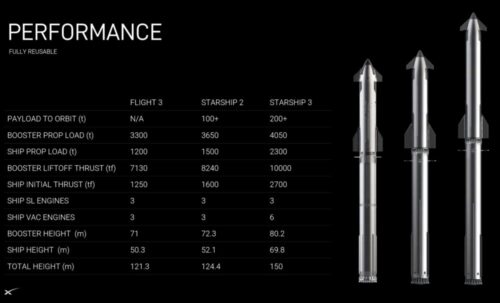
The Starship Version 3 will take 200+ tons to orbit using upgraded Raptor engines, 6 engines instead of 3 in ship stage, and longer stages. (See Starship Performance table below.)
Establishing a self-sustainable city on Mars remains the top priority.
A lunar base will be a side-benefit of the Mars program.
The fluid transfer test on the 3rd test flight went well.
The transfer of propellants between two Starships in orbit will be tested in 2025.
The uncrewed Starship lunar landing demo mission will also include lifting off from the lunar surface.
The goal of SpaceX is to build the technologies necessary to make life multiplanetary. This is the first time in the 4-billion-year history of Earth that it’s possible to realize that goal and protect the light of consciousness.
At Starbase on Thursday, April 4, SpaceX Chief Engineer Elon Musk provided an update on the company’s plans to send humanity to Mars, the best destination to begin making life multiplanetary.
All of SpaceX’s current programs, including Falcon, Dragon, Starlink, and Starship are integral to developing the technologies necessary to make missions to Mars a reality. The update included near-term priorities for Starship that will unlock its ability to be fully and rapidly reusable, the core enabler for transforming humanity’s ability to send large amounts of payload to orbit and beyond. With more flight tests, significant vehicle upgrades, and missions returning astronauts to the surface of the Moon with NASA’s Artemis Program all coming soon, excitement will continue to be guaranteed with Starship.
The talk also includes the mechanics and challenges of traveling to Mars, along with what we’re building today to enable sending around a million people and several million tonnes to the Martian surface in the years to come.
At Starbase, @ElonMusk provided an update on the company’s plans to send humanity to Mars, the best destination to begin making life multiplanetary pic.twitter.com/PiX8XOgQs5
** Some slides and videos of interest from Elon Musk’s presentation:
Starship upgrades
A comparison of the performance for three generations of Starship designs. Table shown by Elon Musk in Starbase talk on April 4th. Credit: SpaceX
Catching a Super Heavy booster:
The update included near-term priorities for Starship that will unlock its ability to be fully and rapidly reusable, the core enabler for transforming humanity’s ability to send large amounts of payload to orbit and beyond pic.twitter.com/bkxS7fNSnt
The propellant transfer test on third flight apparently went well according to Amit Kshatriya, the deputy associate administrator for NASA’s Moon to Mars Program:
“He also noted that the inter-tank cryogenic propellant transfer test on the third Starship flight last month was successful by all accounts, although analysis of data from it is ongoing.” – Jeff Foust on Twitter
Kshatriya provide two slides outlining the propellant transfer demonstration mission:
** Kshatriya confirmed the fourth flight test should happen in May:
NASA’s Amit Kshatriya says at an advisory committee meeting this morning that the agency expects SpaceX to attempt its next Starship/Super Heavy test flight by the end of May.
On March 14, 2024, Starship successfully lifted off at 8:25 a.m. CT from Starbase in Texas and went on to accomplish several major milestones and firsts.
Starship’s six second stage Raptor engines all started successfully and powered the vehicle to its expected orbit, becoming the first Starship to complete its full-duration ascent burn. Starship went on to experience its first ever entry from space, providing valuable data on heating and vehicle control during hypersonic reentry. Live views of entry were made possible by Starlink terminals operating on Starship.
This rapid iterative development approach has been the basis for all of SpaceX’s major innovative advancements, including Falcon, Dragon, and Starlink. Recursive improvement is essential as we work to build a fully reusable transportation system capable of carrying both crew and cargo to Earth orbit, help humanity return to the Moon, and ultimately travel to Mars and beyond.
** “Ellie in Space” interview with Eric Berger, who is following up on his book Liftoff[commission link] about the early days of SpaceX with a new book titled Reentry [commission link], which focuses on the development of the reusable Falcon 9 and its impact on the space industry.
For lots of background info on Starship, see the SpaceX Starship report, which is published by NewSpace Global and for which I was the primary author. The initial version came out in March 2023 and then we updated it in May 2023 to include coverage of the first flight test.
==================
Check out the The Lurio Report
for news and analysis of key developments in NewSpace
The latest issue: Starlink’s Progress, Vulcan, Moon Landing Attempts
Vol. 19, No. 1, February 2, 2024
Space Frontier Foundation Award for NewSpace Journalism
— Falcon 9 booster achieves 20 flights for the first time.
Since its first mission in November 2020, this single first stage has launched eight astronauts and more than 500 satellites, totaling 261+ metric tons to orbit in under four years pic.twitter.com/FVQwhAJto6
As of May 2nd, three boosters had reached 20 flights. Flying 20 times was the most recent milestone for F9 booster reuse. Elon Musk in January said the next goal is to qualify F9 boosters for 40 flights.
The engines on the boosters can be swapped out between flights and used on different boosters. Some engines have now been reused more than the most-flown booster:
Main engine cutoff and stage separation. One of the nine Merlin engines powering tonight’s first stage is our flight leader, powering its 22nd mission to Earth orbit pic.twitter.com/xkTrPdOdsW
… SpaceX is now launching at a rate of one mission every 2.7 days this year. Consider that, from the mid-1980s through the 2010s, the record for the total number of launches worldwide in any given year was 129. This year alone, SpaceX is on pace for between 130 and 140 total launches.
But with Tuesday evening’s mission, there was a singular number that stood out: 300. The Falcon family, which includes the Falcon 9 and Falcon Heavy boosters, recorded its 300th successful first-stage landing.
…
In the fleet’s lifetime, then, SpaceX has landed about 85 percent of the Falcon rockets it has launched. These days, more than 90 percent of all its missions launch on previously flown boosters. So rocket recycling is totally a thing.
** More Falcon 9 news and articles:
With the Maxar-1 launch of two Worldview satellites on May 2nd, “Falcon 9 has now successfully delivered payloads into orbit successfully 300 times in a row since the Amos 6 explosion.” – Alejandro Alcantarilla Romera (Alex)
it is returning a previously flown Electron rocket first stage tank into the Electron production line for the first time in preparation for reflying the stage. The step is a significant milestone in Rocket Lab’s development program to make Electron the world’s first reusable small orbital launch vehicle.
The booster was recovered from mission in January. This is the same booster structure but presumably with different engines and/or other supporting subsystems.
Rocket Lab has successfully recovered multiple Electron first stages from previous missions by returning them to Earth under a parachute after launch, splashing them down in the ocean, then collecting them onto a specially modified boat for transfer back to Rocket Lab’s production complex. All previously recovered boosters have undergone extensive analysis to inform an iterative development process to make Electron reusable, but this is the first time a tank has been moved back onto the standard production line in preparation for reflight.The stage was successfully launched and recovered as part of the ‘Four of a Kind’ mission on 31 January 2024 and has already passed more acceptance tests than any other recovered Electron stage, including:
Tank pressurization test – a process that filled the carbon composite tank with inert gas and held it in excess of maximum operating pressure for more than 20x longer than the standard Electron flight duration;
Helium leak check – a stringent process that determines there are no leaks in the tank; and
Carbon fiber structural testing – including ultrasonic assessment and other non-destructive tests to confirm no delamination of the carbon composite tank fibers.
The tank will
undergo final fit out and rigorous qualification and acceptance testing to the same standard as a brand-new Electron tank to determine the recovered stage’s suitability for reflight.
If successful, this would be the second rocket to reuse a liquid fuel booster tank following SpaceX’s success with reuse of the Falcon 9 first stages.
** Testing begins for first complete Archimedes engine. Nine of Archimedes engines will power the first stage of the reusable Neutron rocket and one in a configuration for vacuum will power the second stage.
Isn’t it beautiful!? Say hello to our first complete Archimedes engine.
It’s already out the door of our Engine Development Complex in Long Beach and installed on the test stand in Mississippi at @NASAStennis ready for first hot fire.
Fun Fact: The photo below was taken just a few hours from the one above. Engine went from checkout tests in Kent, WA to the test site in Moses Lake, WA & installed on the stand all within a day. A huge advantage to our speed is proximity of our test site. #rapidbydesignpic.twitter.com/lXgf1vushg
** Relativity Space– Focus on Terran R development with initial launch in 2026
Relativity is making progress on development of the Terran R mid-range launcher with a reusable first stage. The current expectation is for the first launch to happen in 2026. The company recently chose not to compete for a military launch contract since it required launches in 2025: Relativity Space delays NSSL bid, focuses on 2026 Terran R debut | SpaceNews – Apr.10.2024
— Progress on Cape Canaveral launch facility:
Soarin’ over Launch Complex 16, Cape Canaveral, FL. – making room for something big, #TerranR launch pad in progress.
✔️ Site cleared
✔️ Site grubbed
Waterline install in progress pic.twitter.com/WxQyoWxYVg
— Relativity tests the aerodynamics of the Terran R design: Relatively Speaking: Wind Tunnel Terran R Testing Explained
Join the aerodynamics team on a behind the scenes deep dive into Terran R wind tunnel testing at NASA Langley Unitary Plan Wind Tunnel facility.
Simulating a Terran R flight, the data collected is crucial in determining driving load cases for a reliable and reusable Terran R, informing critical design points and cases to ensure stage 1 landing back on Earth.
00:00 – 00:44 Why invest in a model and wind tunnel testing? 00:45 – 1:04 What are the key advantages of wind tunnel testing? 1:05 – 1:43 What is a wind tunnel? 1:44 – 2:10 NASA Langley UPWT facilities overview 2:11 – 2:55 Testing objectives 2:55 – 3:31 Units of measurement: Mach, Reynolds, and Schlieren 3:32 – 4:13 End goal: Stage 1 safe re-entry
The sounds of @NASA Stennis Space Center—from E1 thrust chamber assembly testing to E2 gas generator and R Stand engine testing—enjoy. 1,000+ tests in the books including over 50 Aeon R engine tests and counting since the R Stand was activated in October 2023.
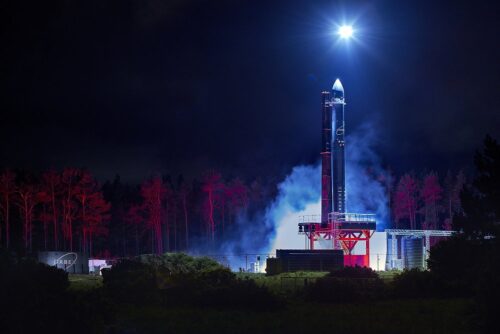
Orbex is a UK company based in Scotland that is developing a two-stage rocket vehicle they call Orbex Prime. The Prime’s first stage is reusable. The 19 meter tall rocket will put payloads up to 180 kg into a sun-synchronous orbits when launched from the company’s spaceport, currently under construction in Sutherland, Scotland. The company was founded in 2015 and has raised backing from private and government sources including ESA and UK.
The company has developed its own engines. The first stage uses six engines and the upper stage one. The engines burn a bio-propane fuel, which the company says is “that cuts carbon emissions by 90% compared to old-fashioned hydrocarbons“.
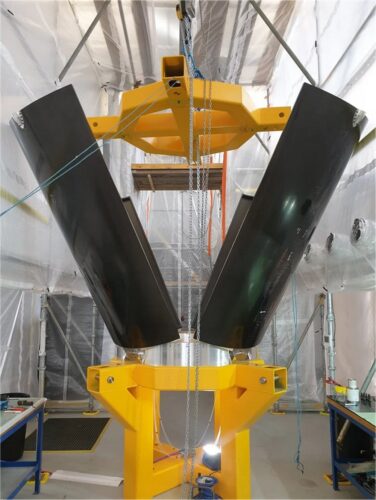
Orbex’s Prime rocket will consist of two stages, and the REFLIGHT system repurposes the interstage structure located between the stages. After Stage 1 detaches from Stage 2, the interstage on top of Stage 1 reconfigures into four ‘petals’ which fold out and create drag forces that passively reorients and slows the spent rocket stage’s descent to Earth.
The company claims this technology
enables recovery of the launch vehicle by repurposing existing structural features, while adding very little additional weight to the vehicle. It thereby enables reusability with very limited overall performance penalty and no additional rocket propulsion emissions in the upper atmosphere during re-entry. This should be compared to other reusable launch systems using powered descent (rocket engine firings) to slow down the vehicle during re-entry and landing.
A prototype of the Petal Fold drag brake system for Orbex Prime rocket: Credits: Orbex
The stage will be recovered at sea:
In combination with a lightweight parachute the drag created by the petals will enable Stage 1’s to perform a low velocity landing at sea.
Orbex will then recover the floating Stage 1 and return it to its factory in Forres for refurbishment and/or recycling. During descent and recovery, there will be no debris left in orbit, on land or in sea, creating a ‘circular rocket economy’.
The company was also awarded a patent for “coaxial tank structure” design that situates the fuel tank within the liquid oxygen tank: Coaxial Tank Patent Orbex | Orbex – Feb.2024
Very small rockets which copy the traditional `stacked` tank architecture of larger rockets are less efficient and cost-effective than their larger counterparts, because they carry much less fuel per unit of ‘dry mass’. This central inefficiency was the major engineering challenge that the Orbex team set out to solve with the Orbex Prime architecture.
The Orbex team created a unique answer to that challenge, by nesting the fuel tank within an outer tank of liquid oxygen. This tank arrangement has unique synergies with Orbex’s choice of bio-propane as a rocket fuel because bio-propane does not freeze solid when chilled to the same temperature as liquid oxygen. The coaxial tank structure thus removes surplus components and sub-systems such as insulation, extra bulkheads, external pipework, heavy tank walls and thermal conditioning equipment.
The first launch of Prime should be within the next year or so.
** Radian Aerospace – Single-stage-to-orbit (SSTO) spaceplane with sled launch
A rocket-driven sled would hurl the Radian One winged vehicle on a trajectory to orbit after a quick trip down a 2-mile long track. (Arguably, the sled is a booster stage.)
Five methane/liquid oxygen engines power the vehicle in the latest design. The sled would used three of the same engines. Radian One is designed to carry as many as 5 passengers to LEO and a total payload of up to 2270 kg . The vehicle can return from orbit with up to 4540 kg and land at any airport with a long enough runway. The goal is a 48-hour turnaround for reflight.
Introducing #RadianOne! Today, we’re revealing the latest renders of Radian One’s groundbreaking design as well as our new website! We’re thrilled to unveil the revolutionary capabilities of the world’s first fully integrated #spaceplane.
The company aims to fly by 2030 and provide transportation services to the commercial space stations that are expecting to be operating by then. The company raised $27M in 2022 and is currently pursuing a new funding round.
Here is an interview with Livingston Holder, Radian’s CTO and a cofounder (posted Apr.30.2024):
The first single-stage-to-orbit (SSTO) space plane? That’s exactly what we’re discussing on this week’s Pathfinder podcast. We interview Livingston Holder, cofounder and CTO of Radian Aerospace, which is developing a fully reusable space plane designed for horizontal launch and landing.
SSTO? Essentially, SSTO vehicles are designed to reach orbit using a single stage without discarding any hardware.
We explore Livingston’s background as a former USAF astronaut as well as the Seattle-based startup’s roadmap to build the world’s first SSTO space transport vehicle. In addition, we cover:
– Radian’s technology advantage – Cultural and operational shifts in space missions – Market positioning of SSTO – Future applications and impact on space ops
** Boeing Starliner crew vehicle is scheduled to launch no earlier than May 10th on a ULA Vulcan rocket for its first crewed mission to the ISS. The original target launch date was May 6th but it was aborted due to a valve problem on the Vulcan upper stage.
This is a demonstration mission and so has two astronauts (Barry “Butch” Wilmore and Suni Williams) on board. The operational missions will carry four. After leaving the ISS, the reusable spacecraft will return for a touch down on dry land via parachutes and airbag cushioning.
— Watch Boeing Starliner fly to space in ascent profile animation – VideoFromSpace
This animation shows Boeing Starliner launching to space on board a United Launch Alliance Atlas V rocket. Starliner is one of two spacecraft built to carry astronauts to and from the International Space Station.
— NASA’s Boeing Crew Flight Test Readiness Review (April 25, 2024) – NASA Video
NASA and Boeing leadership will discuss the flight test readiness review for the first crewed launch of the company’s Starliner spacecraft to the International Space Station. NASA’s Boeing Crew Flight Test will carry NASA astronauts Butch Wilmore and Suni Williams to and from the microgravity laboratory on an end-to-end test of the Starliner system.
Participants: • Jim Free, NASA associate administrator • Ken Bowersox, associate administrator, NASA’s Space Operations Mission Directorate • Steve Stich, manager, NASA’s Commercial Crew Program • Dana Weigel, manager, NASA’s International Space Station Program • Mark Nappi, vice president and program manager, Boeing Commercial Crew Program
** ULA considering multi-mission scenarios for Vulcan upper stage:
Faced with competitors building their own reusable heavy-lift rocket, United Launch Alliance is devising plans to keep the upper stage of its Vulcan Centaur rockets in space, where they might tug satellites or counter Chinese threats.
These upper stages could be loaded with more propellant than needed for their initial launch duties, allowing them to stay in orbit and handle other tasks for weeks or months, ULA CEO Tory Bruno told Defense One on the sidelines of the Space Symposium conference.
“I can go off and serve a spacecraft and move spacecraft and get in between Chinese anti-satellite weapons on orbit and things we’re trying to protect. I can do all kinds of missions that are with a reusable upper stage,” Bruno said.
A project at ULA designed a version of the Centaur that could remain in space for long periods and provide space tug, satellite refueling, and other in-orbit service. Called the Advanced Cryogenic Evolved Stage (ACES), the Integrated Vehicle Fluids system would use the liquid Hydrogen/Oxygen propellants not only for propulsion but also to fuel internal combustion engines that would drive electric generators in place of batteries. The boil off gases from the two cryogenic-propellants would also be used for attitude thrusters and to self-pressurize the propellant tanks (see autogenous pressurization), eliminating the need for hydrazine fuel and helium, resp.
Unfortunately, neither ULA’s owners (Boeing and Lockheed-Martin) nor the military decided to fund the project beyond the study phase. The Centaur V does have some of the features of ACES such as a larger diameter but not the IVF systems.
** Sierra Space’s Dream Chaser crew vehicle debut flight slips till at least September:
According to the above article, the ULA Vulcan rocket
which had its maiden flight in January, likely won’t fly again until the fall, in part due to delays with the payload: Sierra Space’s Dream Chaser vehicle.
…
ULA needs this second certification flight before it can start flying missions for the Space Force. Company officials previously said they plan to fly four national security missions this year, but “with Sierra Space on the Cert-2 mission now moving to no earlier than September, we have three Vulcan NSSL missions planned for the remainder of the year but will fly when our customers are ready,” the company said in a statement.
We have a special On Orbit episode from SATELLITE 2024 this week, a fireside chat with Impulse Space CEO Tom Mueller. Mueller is considered one of the world’s leading spacecraft propulsion experts. As one of SpaceX‘s founding members, he led the development of propulsion systems for the Falcon 1, Falcon 9, Falcon Heavy, and Starship Launch Vehicles, as well as the Dragon line of spacecraft. His work was crucial in the development of reusable rocket technology.
Mueller spoke with Via Satellite editor-in-chief Mark Holmes during SATELLITE about his new company Impulse Space, an in-space transportation company working to deliver payloads to LEO, GEO, the Moon, Mars and beyond. Mueller describes his vision for Impulse Space to provide the transportation for the space economy of the future with Mira and the recently announced Helios kick stage.
** Portal Space Systems developing in-space vehicles powered by solar thermal propulsion:
Portal Space emerged from stealth mode on April 30th and revealed the design of their Supernova satellite bus, which
… is engineered from the ground up for maneuverability and features a novel solar-thermal propulsion system. With a payload-agnostic design and 500 kg mass, Supernova boasts a remarkable 6 km/s delta-v, setting a new standard for in-space mobility with 50 times the range of existing products on the market.
That means that the system can perform currently impossible mission needs, like moving from Low Earth Orbit to geostationary orbit in hours or even the moon in just days.
“The space industry hasn’t fundamentally improved satellite bus technology in decades. Our nation is developing 6th-generation fighter aircraft technology but still uses 1st-generation satellite buses. Portal’s Supernova is designed around the customer need for unparalleled mobility and extended mission life,” said Jeff Thornburg, CEO of Portal Space Systems and former architect of SpaceX’s Raptor Engine. “Our novel solar-thermal propulsion system and bus design, combined with our compatibility to support any customer payload, sets us apart. We provide an over 50x improvement in current spacecraft mobility. For our customers, that means the ability to have spacecraft on orbit that are able to respond in real-time to events in any orbital regime.”
New funding for PLD lifts total investment to 120 Million euros. The latest funding will go primarily to expanding facilities needed to support development and operations of the Miura 5 small launcher. The vehicle’s first stage booster will be recovered via parachute return into the ocean.
** LandSpace – Vertical takeoff and landing test flight to 10 km planned for June
LANDSPACE also mentions the hopper will land on a newly built pad ~5km from the mission control center, which can be seen on the Sentinel-2 satellite images. https://t.co/82NmfTKLMqpic.twitter.com/xPflTtT3cn
— China ‘N Asia Spaceflight ️ (@CNSpaceflight) April 17, 2024
** 130-ton reusable engine by CNSA completes 15 tests, paving way for reusable carrier rockets – CNSA Watcher – Archives
Exciting breakthrough! The 130-ton reusable liquid oxygen kerosene engine independently developed by the Sixth Academy of Aerospace Technology Group has completed 15 repeated tests, laying the foundation for the maiden flight of reusable carrier rockets. (Source: Sixth Academy of Aerospace Technology Group)
** China to use adjustable ‘net’ to catch reusable rockets – See an animation – VideoFromSpace
[China’s primary government space organization, China Aerospace Science and Technology Corporation (CASC),] is developing reusable rockets to launch in 2025 and 2026. See the ‘net’ technology they will use to catch the booster when it returns to Earth in this animation.
The six spaceflight participants include Ed Dwight, who was a candidate for the NASA astronaut corp in the early 1960s. If selected he would have been the first African American astronaut.
—- This would be the second flight since the booster failure on Sept. 12.2022 and the first with passengers on board.
SERA aims to make spaceflight available to as wide an array of people around the world as possible.
“Despite the trillions spent by governments, there have usually been only a handful of people in space at any given time over the last three decades,” says Sam Hutchison, Co-Founder of SERA. “The unimaginably rich material and energy resources of the solar system remain entirely untapped. With launch costs coming down this is all about to change, and SERA wants to make sure that everyone on Earth has the chance to participate in the growth of the offworld economy.”
Excited to team with SERA, the Space Exploration & Research Agency, to support such an inspiring initiative that makes space more accessible to so many countries! We’re looking forward to flying these future astronauts on #NewShepard and hearing their perspectives about the… https://t.co/R3XEtVkRow
VG announced that the flight window for the ‘Galactic 07’ commercial mission will open Saturday, June 8, 2024. This will be the Company’s second spaceflight for 2024. Commercial flights began with Galactic 01 on May 25, 2023. VSS Unity has flown 12 flights to suborbital space in total since December 2018. Galactic 07 will be the final flight for VSS Unity and the first-gen vehicle design.
Virgin Galactic’s top priority goal is operational status for the Delta class version of the SpaceShipTwo vehicles by 2026. The Delta spaceships will be capable of eight space missions per month with up to six passengers per flight. Such can make VG’s suborbital flight business profitable. Flight tests should begin in 2025. The company says it has “cash equivalents and marketable securities of $982 million as of December 31, 2023“, which they believe is sufficient to sustain VG through the inauguration of Delta class operations.
[Virgin Galactic] announced that it has opened a new system integration facility in Southern California for the Company’s Delta Class spaceships. This ground-based test facility, which houses a testing platform known as an “Iron Bird,” has begun tests of initial subsystems and will add components over the course of the year to increase its scope and effectiveness.
Using an Iron Bird test rig is common practice in aerospace development programs and allows Virgin Galactic to test and verify the operation of dozens of Delta subsystems – including avionics, feather actuation, pneumatics and hydraulics. This strategic investment is an important building block to ensure efficient production and safe operations of the Delta Class spaceships, allowing the team to validate the functionality of components early in the development process.
The Iron Bird is just one ground testing method used in the development of the Delta spaceship. A static test article will stress major structural components to verify structural integrity data and determine the design and ultimate limit loads of the structure, which will both optimize the flight test program and support our overall turn time objectives.
Final assembly of the Delta ships will take place at Virgin Galactic’s new Delta facility in Phoenix, Arizona.
VG is posting occasional reports on Youtube about the development of the Delta vehicles. Here are three posted so far:
The Delta class spaceships will be powered by our record-breaking hybrid rocket system. In this installment of #DeltaDiaries, Byron Henning, Vice President, Rocket Systems gives insights into the next generation system for Delta.
— #DeltaDiaries: What is a Digital Thread? – Virgin Galactic
What is a digital thread? A digital thread allows us to track the full lifecycle and performance of every vehicle part, from design to manufacturing, to quality control, to spaceflight operations. It tracks and displays everything we need to know about our Delta spaceships. Gabe Williams, Sr. Chief Engineer, Spaceships tells us more on #DeltaDiaries.
The simulator, essential for pilot training, also plays a pivotal role in designing our new Delta fleet. It’s used by various engineering disciplines to ensure systems are spaceflight-ready. Join us in #DeltaDiaries as Virgin Galactic Pilot Jameel Janjua discusses its importance in developing our Delta Class spaceships.
Doug makes many good points but I always feel compelled to respond to such critiques of the field. In the early 2000s, I and many others in the New Space community were enthusiastic promoters of suborbital human spaceflight. The expectation was that reusable suborbital vehicles for space tourism would provide the key first step to eventual development of commercial reusable orbital space transportation. Suborbital transports would provide key technical knowledge about how to build and operate rocket powered vehicles with the fast turnaround times and robustness of aircraft. Perhaps most importantly, the profits from this market would fund the development of the more challenging orbital transports.
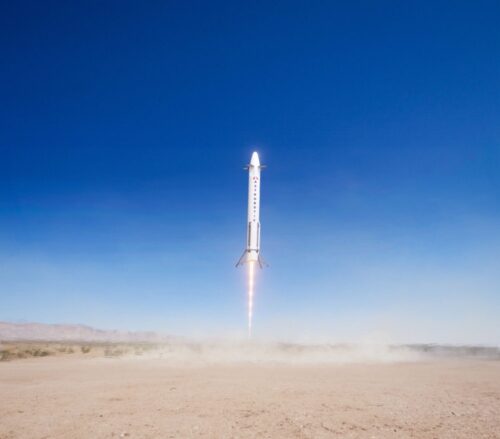
However, things did not work out this way. SpaceX proved that with enough capital and will power, a company could go directly to orbit without an intermediate suborbital phase. (Will note that even SpaceX practiced landing with the low altitude Grasshopper vehicle.)
There were several companies that took on the challenge of suborbital spaceflight. I think an appropriate metaphor for the creation of a new technological market like this one is that of a group of people attempting to run across a wide field filled with booby traps, land mines, poisonous snakes, Komodo dragons, and other nasties. Most will fall victim to a fatal hazard but usually a couple make it across to the treasures awaiting them. However, there’s a finite chance that they all are victimized. The field of suborbital spaceflight certainly left all the entrants inactive or damaged to some degree:
Blue Origin came closest to expectations in the way the company learned a great deal from New Shepard about reusable rocket engines and flying, landing and reusing a rocket vehicle. Blue has always been secretive but it’s known that they lost at least a couple of test vehicles. It’s clear also that early on they made suborbital a sideline activity of lower priority to the New Glenn orbital program.
Virgin Galactic made bad design choices with the selection of hybrid propulsion, which they struggled to scale up from the SpaceShipOne system. The air-launched winged vehicle configuration did not lead to a viable orbital system. In retrospect, it was certainly unusual that such a project remained funded for nearly 20 years between its founding and the first revenue from commercial flights. The two accidents that Doug mentions were certainly disasters but difficult to argue they were due to a rush to launch.
XCOR and several other startups came up with designs that were probably technically viable but they never raised sufficient capital or made enough money from initiatives like rocket racing to sustain development of their vehicles.
All this being said, I remain convinced that suborbital flight services for adventurous private individuals, i.e. space tourism, and for science experiments and technology tests will gradually become a sustainable industry. Space tourist suborbital flights remain infrequent and very expensive but prices are set by supply and demand. The fact that Blue and VG easily find customers for their infrequent flights even at extravagant ticket prices indicates that demand is there. If the flight rate eventually rises, then ticket prices will fall accordingly. Orbital flight tickets will also fall in price but suborbital looks always to be substantially cheaper. And some people will prefer a brief adventure to a multi-day stay in orbit.
Finally, I’ll note that luck plays a big role in successfully traversing a dangerous field even for those extremely agile in avoiding pitfalls. For example, Elon Musk often talks about the situation at the end of 2008 when he was out of money and sleeping on the couches of friends. With a deep recession underway, finding new private investors was unlikely. Fortunately, the success of the fourth Falcon 1 launch, which came after three failures, gave SpaceX just enough credibility to win the NASA contract for commercial ISS cargo services. As recounted in Eric Berger’s book, Liftoff[commission link], that fourth flight very nearly didn’t happen. If it had not, then SpaceX probably would not have survived 2008 and Elon would be portrayed as just another amateur space mogul like Andrew Beal and Walter Kistler who promised affordable space transportation but fell far short. Rockets with reusable boosters that land vertically 20 times or more (see above) would remain dismissed by most aerospace pundits as fantasies. Fortunately, SpaceX did survive and we can hope they and others successfully traverse the hazardous passage to fully reusable, low-cost space transports.
Astrobotic and the U.S. Air Force Research Laboratory (AFRL) Rocket Propulsion Division at Edwards Air Force Base have entered into a Cooperative Research & Development Agreement (CRADA) to enhance both organizations’ capabilities and collaborate in the development of advanced liquid rocket engine, rotating detonation rocket engine (RDRE) technologies, and on-base rocket flight testing capabilities using Astrobotic reusable rockets.
“This agreement between Astrobotic and AFRL will enable joint work on new rocket engine technologies, including their applications to in-space propulsion, along with their early flight demonstrations. For Astrobotic, working with AFRL, this rocket-engine flight testbed will demonstrate future capabilities in rocket propulsion such as RDREs and novel additively manufactured materials for high-temperature, high-pressure, chemically-reacting gas environments,” said Dr. Javier Urzay, Chief of the Combustion Devices Branch at AFRL, “These technologies are still at a relatively early development stage but have potential game-changing impacts for liquid and solid rocket propulsion systems relevant for Air and Space Force’s missions.”
The collaboration will help Astrobotic design, develop, test, and demonstrate emerging commercial capabilities with critical applications to air and space military operations, including tactically responsive space access, hypersonic propulsion and testing, and tactical point-to-point rocket transport of cargo. Under the CRADA, AFRL and Astrobotic plan to use Astrobotic’s Xodiac and Xogdor-class vertical-takeoff, vertical-landing (VTVL) rockets to flight test new liquid rocket engines, integrated systems, payloads, and concepts of operation to mature these types of capabilities.
A rendering of the Xogdor rocket in development at Astrobotic. Credits: Astrobotic
=== Other reusable rocket and space vehicle related news, articles, etc:
Was great to spend some time at NASA’s Stennis Space Center with @launcher (@vast) team yesterday as they tested the fully-integrated E-2 engine for a two-minute burn — blue flame achieved with kerosene! pic.twitter.com/WfzPLx9TP4
** Space Station Crew Talks with Syracuse.com – The Post-Standard – Friday, May 3, 2024 – NASA Video
Aboard the International Space Station, Expedition 71 Flight Engineers Jeanette Epps and Matt Dominick of NASA discussed life and work aboard the orbital outpost during an in-flight interview May 3 with the Post-Standard/Syracuse.com. Epps and Dominick are in the midst of a long-duration mission aboard the microgravity laboratory to advance scientific knowledge and demonstrate new technologies for future human and robotic exploration flights as part of NASA’s Moon and Mars exploration approach, including lunar missions through NASA’s Artemis program.
SpaceX’s Crew-8 “Endeavour” Crew Dragon spacecraft, with NASA astronauts Matthew Dominick, Michael Barratt, Jeanette Epps and Roscosmos cosmonaut Alexander Grebenkin, was relocated from the forward-facing port to the space-facing port of the International Space Station’s Harmony module, on 2 May 2024. The relocation was performed in order to make way for the arrival of for the CST-100 Starliner spacecraft on Boeing’s Crew Flight Test, currently scheduled for 6 May 2024. The “Endeavour” Crew Dragon previously supported the Demo-2, Crew-2, Ax-1 and Crew-6 missions. Credits: NASA/SpaceX
.@Axiom_Space recently tested its AxEMU lunar spacesuit for the first time at @NASA‘s Neutral Buoyancy Laboratory. The uncrewed suit was submerged underwater to simulate the 1/6th gravity environment of the Moon to test its pressure garment system. Future testing at the pool will… pic.twitter.com/z4BODTJ7xZ
— NASA’s Johnson Space Center (@NASA_Johnson) April 30, 2024
** Testing underway for Axiom’s “Axiom Extravehicular Mobility Unit (AxEMU)” space suit for lunar surface activities:
With the successful conclusion of this trial run, the next NBL suit run will have our very own astronaut inside … stay tuned!
Learn more about the #AxEMU, our next-generation spacesuit that will support humanity’s return to the moon at https://t.co/eP6HiSUy2E
** Sierra Space shows the development path for their inflatable space stations
Our company is leading the charge towards a science and biopharma platform designed to allow humans to live and work in LEO and beyond. As the ISS heads towards retirement, the future of space will revolve around the first commercial space station.https://t.co/FttqPaibeJpic.twitter.com/Z0GOEJJXyw
Our LIFE (Large Integrated Flexible Environment) technology launches on a conventional rocket. Its inflatable structure remains tightly packed upon deployment. One of the first in our product line, LIFE 285, will inflate into a structure that is three stories tall and 27 feet in diameter once it reaches space—essentially the size of a three-story apartment, with each floor being nine feet tall.
The inflatable structural shell is made up of a tightly woven fabric (Vectran) that’s up to five times stronger than steel once inflated and offers a balance of properties unmatched by other high-performance fibers. This strong structural shell, as well as its spacious interior, makes it perfect for both LEO and long-duration missions to the moon, Mars and the stars.
Why an inflatable softgoods shell? The problem with large, metallic space stations is that they’re hard (and expensive) to launch into space. That’s where the magic of an inflatable spacecraft comes into play. Launched in a packed state, it can easily reach space and expand to huge volumes.
Once fully inflated, the interior of LIFE 285 will be able to accommodate anywhere from four to twelve people, depending on the purpose and length of the mission.
It can also be fully packed with essential supplies and work space tools, including an Astro Garden® for a constant supply of fresh produce, ample sleeping quarters, a medic chamber, and exercise equipment. It will help serve as a place where innovations and groundbreaking research come together for longer duration space missions.
—- Sierra continues pressure tests of the inflatable module structures:
#ICYMI: We will be conducting our second full-scale structure test of our expandable space station technology next month at @NASA_Marshall in Huntsville, AL.
Excited to show that we are building the world’s first commercial space station @vast Haven-1! This month we completed our VAST Haven-1 primary structure pathfinder which proved we could build in house all the critical geometries, transitions, and interfaces of Haven-1. Next up -… pic.twitter.com/uF73g79wry
The Shenzhou-17 (神舟十七) crew spacecraft undocked from the Tianhe Core Module (天和核心舱), departing the China Space Station (中国空间站), on 30 April 2024, at 00:43 UTC (08:43 China Standard Time). The Shenzhou-17 spacecraft is expected to make a parachute-assisted landing at the Dongfeng landing site, Inner Mongolia Autonomous Region, China, returning the sixth crew of three astronauts on a mission to the China Space Station (中国空间站): Hongbo Tang (汤洪波, commander), Shengjie Tang (唐胜杰) and Xinlin Jiang (江新林).
** Research Aboard China Space Station to Probe Origins of Life – CCTV Video News Agency
The China Space Station will undertake a number of new experiments during the Shenzhou-18 mission that may help answer key questions about the origins of life and work toward breakthroughs in medicine and spaceflight engineering.
=== Lunar habitation
** DARPA-backed study examines architectures for lunar bases.
aims to rapidly develop foundational technology concepts that move away from individual scientific efforts within isolated, self-sufficient systems, toward a series of shareable, scalable systems that interoperate — minimizing lunar footprint and creating monetizable services for future lunar users.
Participant teams in LunA-10 presented their findings at the LSIC meeting. Here, for example, are some slides from SpaceX, which presented plans for development of a lunar base using Starships:
Some SpaceX charts showing how the company believes it can use Starship to establish a lunar base (from its DARPA LunaA-10 study, being discussed today at the LSIC meeting.) pic.twitter.com/NPRc2UoiD4
As China ramps up its lunar exploration program in the coming decade, space-based lunar infrastructure is going to be a key enabler. Spacecraft and ground-based vehicles will increasingly need positioning and communication services, which is why China has launched a plan to establish a lunar satellite constellation called the “Queqiao constellation”. The focus on the back side and the lunar south pole also means that communications will require relay satellites. In preparation for this lunar constellation, expected in the 2030s, China has been launching single Queqiao spacecraft: the “Queqiao” in 2018, “Queqiao-2” in March 2024, and “Queqiao-3” by the end of the decade. In this video, we cover this quest for lunar infrastructure, a low key but essential milestone for the establishment of China’s future lunar outpost, the ILRS.
If you like what you see and would like to support me, please consider joining our small Patreon community at / dongfanghour ! We also have some very cool space merch available at https://shop.dongfanghour.com .
00:00 Introduction 00:17 Lunar exploration & tidal locking 01:11 Queqiao-1 and Queqiao-2 relay missions 03:11 Launching the Queqiao lunar constellation 05:47 Equivalent projects by NASA and ESA
** How Robots Will Help Humans Conquer The Moon – Fraser Cain
When humans will return to the Moon they will need a lot of assistance to set up a settlement and carry out all the missions. They will need a lot of robots to do that. How exactly will it pan out? Figuring out with Professor Yang Gao from King’s College London.
Just a little video for fun. Oh, and this design isn’t public domain. Just sayin’. Credit where credit is due please, and Thank you.
Want to know the story of “The Model”? Look here: https://ssi.org/an-oneill-colony-in-s… And scroll down to the bottom to see what is and what is not a “Bernal Sphere” …and why.
** Jerry Stone illustrates Island 0, a Gerard O’Neill Island 1 demonstrator – Space Renaissance
Jerry Stone illustrates Island 0, a Gerard O’Neill Island 1 demonstrator, in the frame of the Expanding Humanity To Outer Space International Cooperation Youth Event (EHTOS) Moderator: Ghanim Alotaibi Lecturer: Jerry Stone Participants: Werner Grandl, Guy çignolet, Mahhad, B. Daniel, Adriano V. Autino
=== Polaris Program – SpaceX EVA suit unveiled. Will be used on first Polaris mission
On May 4th, the Extravehicular Activity (EVA) Suit designed by SpaceX was unveiled to the public. The initial application of the suit will be during the Polaris Dawn mission, which aims to reach the highest altitude yet for a Dragon spacecraft. They will attempt also to carry out the first EVA by private astronauts.
At approximately 700 kilometers above the Earth, the crew will attempt the first-ever commercial extravehicular activity (EVA) with SpaceX-designed extravehicular activity (EVA) spacesuits, upgraded from the current intravehicular (IVA) suit. Building a base on the Moon and a city on Mars will require thousands of spacesuits; the development of this suit and the execution of the EVA will be important steps toward a scalable design for spacesuits on future long-duration missions.
The Dragon has no airlock so when the hatch is opened, all four crew members must be in suits.
SpaceX – Human Spaceflight – Description of the SpaceX suits for intravehicular and extravehicular activities.
More @SpaceX photos of the new Extravehicular Activity (EVA) suit the Polaris Dawn crew will wear during their upcoming mission. Let us know your questions below ahead of today’s X Spaces event with the crew and SpaceX team https://t.co/tLdnzAVtCSpic.twitter.com/2ptb2IuQJo
=== The Extravehicular Activity (EVA) Suit – SpaceX Youtube
At ~700 km above Earth, the EVA suit will support the Polaris Dawn crew in the vacuum of space during the first-ever commercial astronaut spacewalk.
Evolved from the Intravehicular Activity (IVA) suit, the EVA suit provides greater mobility, a state-of-the-art helmet Heads-Up Display (HUD) and camera, new thermal management textiles, and materials borrowed from Falcon’s interstage and Dragon’s trunk.
Building a base on the Moon and a city on Mars will require millions of spacesuits. The development of this suit and the execution of the spacewalk will be important steps toward a scalable design for spacesuits on future long-duration missions as life becomes multiplanetary.
=== Other space habitat and settlement news and articles:
** Highlight: Mexico City and Volcanic activity – May 5, 2024 07:40 CST – ISS Above
NASA EHDC6 Live views of the Earth from the International Space Station — Watch live at / issaboveyou
** Live Video from the International Space Station (Official NASA Stream) – NASA
Watch live video from the International Space Station, including inside views when the crew aboard the space station is on duty. Views of Earth are also streamed from an external camera located outside of the space station. During periods of signal loss due to handover between communications satellites, a blue screen is displayed.
The space station orbits Earth about 250 miles (425 kilometers) above the surface. An international partnership of five space agencies from 15 countries operates the station, and it has been continuously occupied since November 2000. It’s a microgravity laboratory where science, research, and human innovation make way for new technologies and research breakthroughs not possible on Earth. More: https://go.nasa.gov/3CkVtC8
Did you know you can spot the station without a telescope? It looks like a fast-moving star, but you have to know when to look up. Sign up for text messages or email alerts to let you know when (and where) to spot the station and wave to the crew: https://spotthestation.nasa.gov