The Urban Astronomer hosts the latest Carnival of Space.
====
Here is the latest Space to Ground report from NASA on activities related to the
This video shows an animation of how the ISS was assembled step by step over about a decade:
Kennedy Space Center’s latest report:
====
NASA JPL spots a pair of near-earth asteroids of similar mass orbiting one another:
Observatories Team Up to Reveal Rare Double Asteroid
New observations by three of the world’s largest radio telescopes have revealed that an asteroid discovered last year is actually two objects, each about 3,000 feet (900 meters) in size, orbiting each other.
Near-Earth asteroid 2017 YE5 was discovered with observations provided by the Morocco Oukaimeden Sky Survey on Dec. 21, 2017, but no details about the asteroid’s physical properties were known until the end of June. This is only the fourth “equal mass” binary near-Earth asteroid ever detected, consisting of two objects nearly identical in size, orbiting each other. The new observations provide the most detailed images ever obtained of this type of binary asteroid.
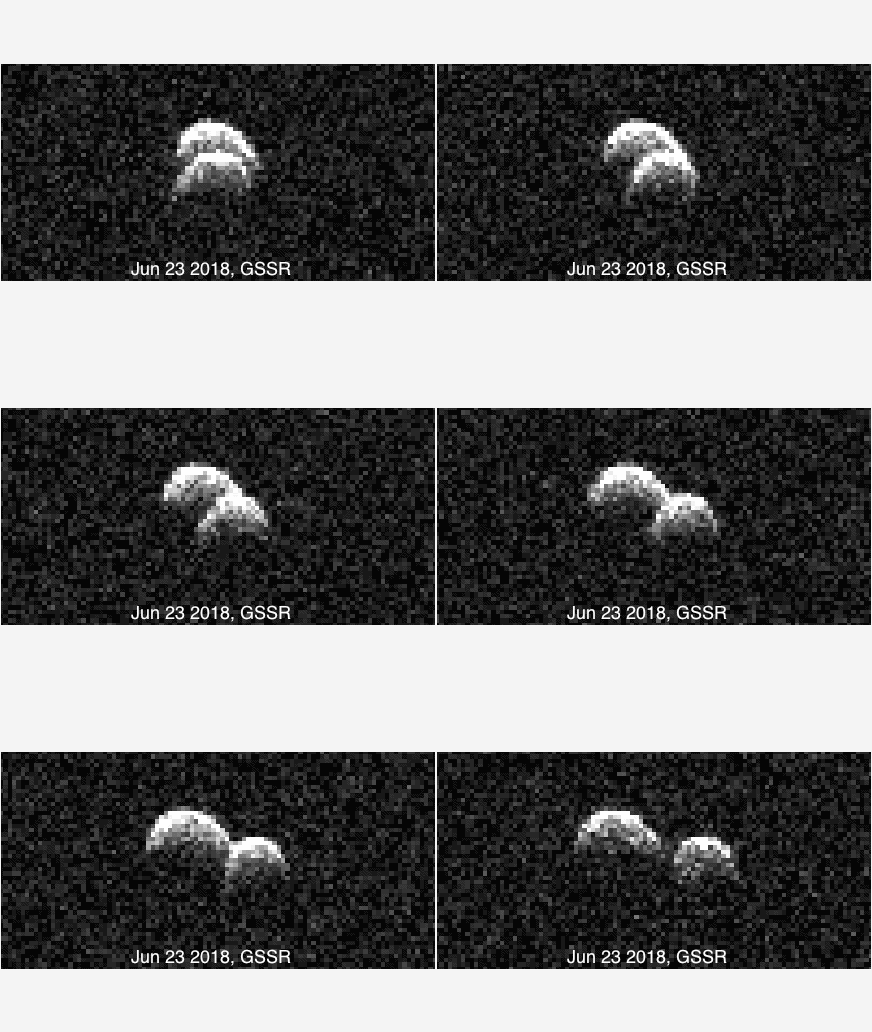
On June 21, the asteroid 2017 YE5 made its closest approach to Earth for at least the next 170 years, coming to within 3.7 million miles (6 million kilometers) of Earth, or about 16 times the distance between Earth and the Moon. On June 21 and 22, observations by NASA’s Goldstone Solar System Radar (GSSR) in California showed the first signs that 2017 YE5 could be a binary system. The observations revealed two distinct lobes, but the asteroid’s orientation was such that scientists could not see if the two bodies were separate or joined. Eventually, the two objects rotated to expose a distinct gap between them.
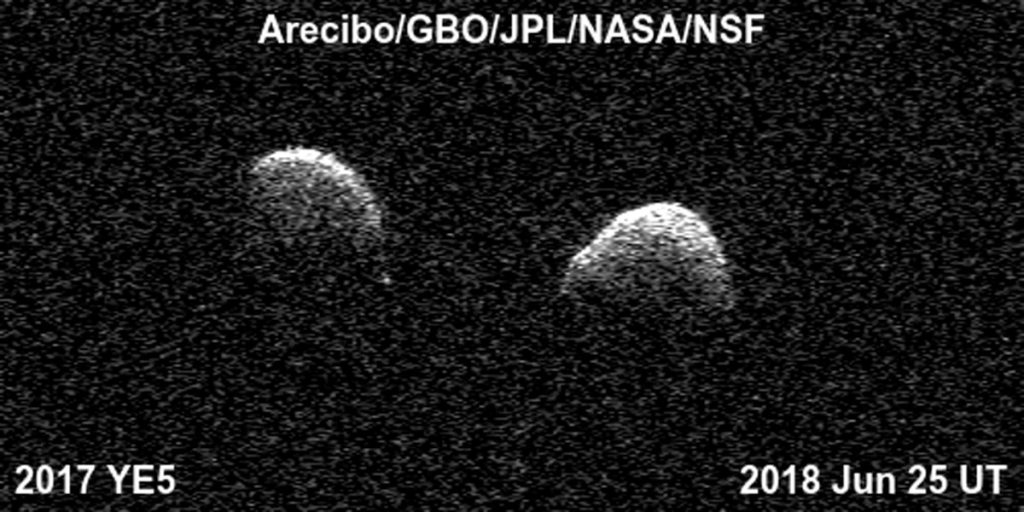
Scientists at the Arecibo Observatory in Puerto Rico had already planned to observe 2017 YE5, and they were alerted by their colleagues at Goldstone of the asteroid’s unique properties. On June 24, the scientists teamed up with researchers at the Green Bank Observatory (GBO) in West Virginia and used the two observatories together in a bi-static radar configuration (in which Arecibo transmits the radar signal and Green Bank receives the return signal). Together, they were able to confirm that 2017 YE5 consists of two separated objects. By June 26, both Goldstone and Arecibo had independently confirmed the asteroid’s binary nature.
The new observations obtained between June 21 and 26 indicate that the two objects revolve around each other once every 20 to 24 hours. This was confirmed with visible-light observations of brightness variations by Brian Warner at the Center for Solar System Studies in Rancho Cucamonga, California.
Radar imaging shows that the two objects are larger than their combined optical brightness originally suggested, indicating that the two rocks do not reflect as much sunlight as a typical rocky asteroid. 2017 YE5 is likely as dark as charcoal. The Goldstone images taken on June 21 also show a striking difference in the radar reflectivity of the two objects, a phenomenon not seen previously among more than 50 other binary asteroid systems studied by radar since 2000. (However, the majority of those binary asteroids consist of one large object and a much smaller satellite.) The reflectivity differences also appear in the Arecibo images and hint that the two objects may have different densities, compositions near their surfaces, or different surface roughnesses.
Scientists estimate that among near-Earth asteroids larger than 650 feet (200 meters) in size, about 15 percent are binaries with one larger object and a much smaller satellite. Equal-mass binaries like 2017 YE5 are much rarer. Contact binaries, in which two similarly sized objects are in contact, are thought to make up another 15 percent of near-Earth asteroids larger than 650 feet (200 meters) in size.
The discovery of the binary nature of 2017 YE5 provides scientists with an important opportunity to improve understanding of different types of binaries and to study the formation mechanisms between binaries and contact binaries, which may be related. Analysis of the combined radar and optical observations may allow scientists to estimate the densities of the 2017 YE5 objects, which will improve understanding of their composition and internal structure, and of how they formed.
Study contributors
The Goldstone observations were led by Marina Brozovi, a radar scientist at NASA’s Jet Propulsion Laboratory in Pasadena, California.
Anne Virkki, Flaviane Venditti and Sean Marshall of the Arecibo Observatory and the University of Central Florida led the observations using the Arecibo Observatory.
Patrick Taylor of the Universities Space Research Association (USRA), scientist at the Lunar and Planetary Institute, led the bi-static radar observations with GBO, home of the Green Bank Telescope (GBT), the world’s largest fully steerable radio telescope.
The Arecibo, Goldstone and USRA planetary radar projects are funded through NASA’s Near-Earth Object Observations Program within the Planetary Defense Coordination Office (PDCO), which manages the Agency’s Planetary Defense Program. The Arecibo Observatory is a facility of the National Science Foundation operated under cooperative agreement by the University of Central Florida, Yang Enterprises, and Universidad Metropolitana. GBO is a facility of the National Science Foundation, operated under a cooperative agreement by Associated Universities, Inc.
In addition to the resources NASA puts into understanding asteroids, the PDCO also partners with other U.S. government agencies, university-based astronomers, and space science institutes across the country, often with grants, interagency transfers and other contracts from NASA. They also collaborate with international space agencies and institutions that are working to track and better understand these smaller objects of the Solar System. In addition, NASA values the work of numerous highly skilled amateur astronomers, whose accurate observational data helps improve asteroid orbits after discovery.
More information about asteroids and near-Earth objects is at these sites:
====
On August 4th, United Launch Alliance (ULA) aims to launch a big Delta IV Heavy rocket from Cape Canaveral to send NASA’s Parker Solar Probe into an orbit that will bring it far closer to our home star than any previous spacecraft has dared go. (Perhaps your name is aboard the probe.) A cutting-edge heat shield enables the probe to fly directly through the corona, which is the extremely hot ionized plasma that surrounds the Sun.
Here is a new NASA video about the mission:
More about the mission at Parker Solar Probe: Humanity’s First Visit to a Star | NASA:
In order to unlock the mysteries of the Sun’s atmosphere, Parker Solar Probe will use Venus’ gravity during seven flybys over nearly seven years to gradually bring its orbit closer to the Sun. The spacecraft will fly through the Sun’s atmosphere as close as 3.8 million miles to our star’s surface, well within the orbit of Mercury and more than seven times closer than any spacecraft has come before. (Earth’s average distance to the Sun is 93 million miles.)
Flying into the outermost part of the Sun’s atmosphere, known as the corona, for the first time, Parker Solar Probe will employ a combination of in situ measurements and imaging to revolutionize our understanding of the corona and expand our knowledge of the origin and evolution of the solar wind. It will also make critical contributions to our ability to forecast changes in Earth’s space environment that affect life and technology on Earth.
A simulation of the orbit that will bring the probe closer and closer to the sub at perigee:
====
A new report from ESO (European Southern Observatory
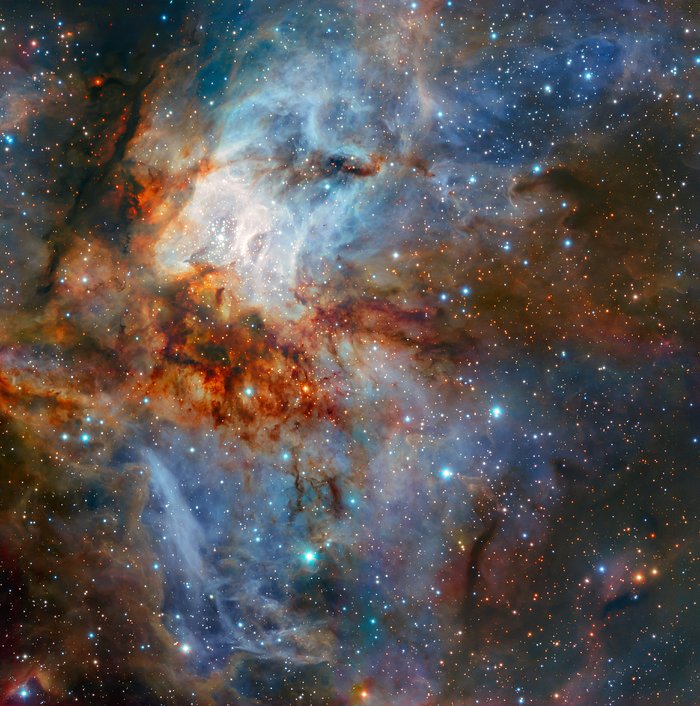
This image shows the star cluster RCW 38, as captured by the HAWK-I infrared imager mounted on ESO’s Very Large Telescope (VLT) in Chile. By gazing into infrared wavelengths, HAWK-I can examine dust-shrouded star clusters like RCW 38, providing an unparalleled view of the stars forming within. This cluster contains hundreds of young, hot, massive stars, and lies some 5500 light-years away in the constellation of Vela (The Sails).
The central area of RCW 38 is visible here as a bright, blue-tinted region, an area inhabited by numerous very young stars and protostars that are still in the process of forming. The intense radiation pouring out from these newly born stars causes the surrounding gas to glow brightly. This is in stark contrast to the streams of cooler cosmic dust winding through the region, which glow gently in dark shades of red and orange. The contrast creates this spectacular scene — a piece of celestial artwork.
HAWK-I is installed on Unit Telescope 4 (Yepun) of the VLT, and operates at near-infrared wavelengths. It has many scientific roles, including obtaining images of nearby galaxies or large nebulae as well as individual stars and exoplanets. GRAAL is an adaptive optics module which helps HAWK-I to produce these spectacular images. It makes use of four laser beams projected into the night sky, which act as artificial reference stars, used to correct for the effects of atmospheric turbulence — providing a sharper image.
This image was captured as part of a series of test observations — a process known as science verification — for HAWK-I and GRAAL. These tests are an integral part of the commissioning of a new instrument on the VLT, and include a set of typical scientific observations that verify and demonstrate the capabilities of the new instrument.
====