Videos: Watch “Moon Shot” series by Orlando von Einsiedel & J.J. Abrams

I posted earlier about the “Moon Shot” documentary project by Orlando von Einsiedel & J.J. Abram, which profiles participants in the Google Lunar XPRIZE competition. The nine short films are now available on YouTube. (The videos are also available for free at Google Play.) You can watch all the films in sequence here starting with the trailer:

The films are very well done and often quite poignant. Below are descriptions of each episode.

Ep. 1 – Astrobotic – Pittsburgh, USA : “Legendary roboticist Red Whittaker is a professor who splits his time between teaching future engineers at Carnegie Mellon and owning/operating a working cattle farm in rural Pennsylvania. With a crack team of former students, he co-founded Astrobotic because he believes robots are the best solution for exploring remote, harsh environments — from nuclear disaster zones to the moon.”

Ep. 2 – Part-Time Scientists – Germany: “Founded by an ad hoc group of part-timers, this Berlin-based GLXP team [PT Scientists] plans to open source its mission data. Team leader Robert Böhme, who was raised in the former East Germany, says the free exchange of information is ultimately more important than money.”

Ep. 3 – Team Indus – India “Deepana Gandhi dreamed of a career in math/science, but she grew up in rural India where women aren’t typically afforded the same opportunities as men. After struggling to find a job, Deepana eventually landed at Indus in Bangalore, where she works on the equations necessary for navigating to the moon.”

Ep. 4 – Team Plan B – Canada: “Alex Dobrianski emigrated from the Ukraine to Vancouver to build a better life for his wife Luda and their three children. Twenty years later, after launching a career in IT, he staked his retirement money on the GLXP and recruited his son Sergei to help him pursue his lifelong passion for aerospace, which Alex had been forced to abandon in post-Soviet Ukraine.” – Team Plan B

Ep. 5 – Hakuto – Japan: “When the 2011 tsunami decimated Japan’s Pacific coast, robotics Professor Kazuya Yoshida and his family were lucky to escape harm’s way. Understanding that it’s only a matter of time before an even greater natural disaster strikes, the professor wants his rovers to explore the lunar caves, which could provide a suitable location for future human settlements that will help preserve our species.” – Hakuto team

Ep. 6 – Moon Express – Cape Canaveral, USA: “When Naveen Jain moved from India to the U.S., he was a poor university student with an uncertain future and a hunch that anything is possible. Decades later, after becoming a successful Internet entrepreneur, he co-founded Moon Express to help find a solution to the world’s energy crisis.” Moon Express

Ep. 7 – SpaceIL – Israel: “One of the last teams to enter the GLXP, SpaceIL was co-founded by Yariv Bash, whose grandfather’s life was tragically altered by the Holocaust. Inspired by his grandfather’s work as an engineer, Bash hopes SpaceIL’s efforts to build cool new technology will encourage others, including his young son, to improve the world for future generations.”

Ep. 8 – Mecaliks – Mexico: “9-year-old Jana González turned to playing videogames after her parent’s divorce. As her love of playing games evolved into programming them, she soon discovered robotics and joined an all-girl team competing in the Moonbots, a worldwide robotics competition for kids.” –Mecaliks Moonbots team

Ep. 9 – Race for the Prize: “For nearly a decade, people around the world have been racing to The Moon as part of the Google Lunar X-PRIZE, a $30 million contest. Developing an array of new technologies for landing and exploring the lunar surface, these private teams are making big strides and sacrifices to chase their dream of reaching the moon!”

Carnival of Space #449 – BrownSpaceMan

The BrownSpaceMan blog hosts the latest Carnival of Space.

8691529496_8dcce5785b_o[1]

Video: ‘The Planetary Post’ – March 2016 with Robert Picardo

Here is the second installment of The Planetary Post with Robert Picardo, a monthly newsletter from the Planetary Society “featuring the most notable space happenings”: The Planetary Post – March 2016 | The Planetary Society

For this issue, we took a trip to the set of the scientist-produced musical called “Boldly Go!” to celebrate the 50th anniversary of Star Trek.

Here was the first episode in case you missed it: The Planetary Post – Feb 2016 – The Planetary Society.

ESO: Observatory sees daily changes in bright spots on Ceres

The latest report from ESO (European Southern Observatory):

Unexpected Changes of Bright Spots on Ceres Discovered

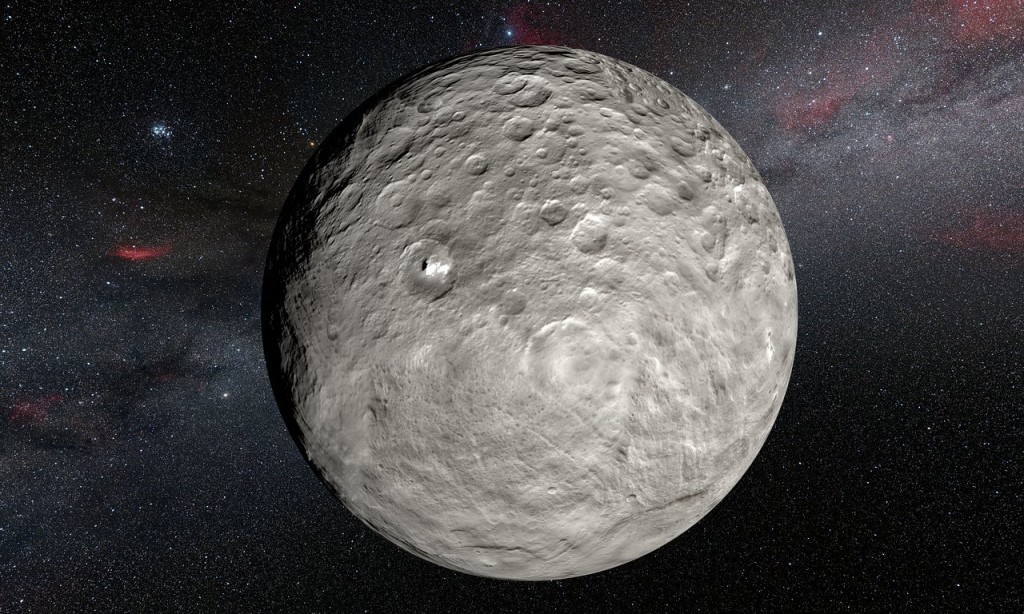
Observations made using the HARPS spectrograph at ESO’s La Silla Observatory in Chile have revealed unexpected changes in the bright spots on the dwarf planet Ceres. Although Ceres appears as little more than a point of light from the Earth, very careful study of its light shows not only the changes expected as Ceres rotates, but also that the spots brighten during the day and also show other variations. These observations suggest that the material of the spots is volatile and evaporates in the warm glow of sunlight.

This artist’s impression is based on a detailed map of the surface compiled from images taken from NASA’s Dawn spacecraft in orbit around the dwarf planet Ceres. It shows the very bright patches of material in the crater Occator and elsewhere. New observations using the HARPS spectrograph on the ESO 3.6-metre telescope at La Silla in Chile have revealed unexpected daily changes on these spots, suggesting that they change under the influence of sunlight as Ceres rotates.  
This artist’s impression is based on a detailed map of the surface compiled from images taken from NASA’s Dawn spacecraft in orbit around the dwarf planet Ceres. It shows the very bright patches of material in the crater Occator and elsewhere. New observations using the HARPS spectrograph on the ESO 3.6-metre telescope at La Silla in Chile have revealed unexpected daily changes on these spots, suggesting that they change under the influence of sunlight as Ceres rotates.

Ceres is the largest body in the asteroid belt between Mars and Jupiter and the only such object classed as a dwarf planet. NASA’s Dawn spacecraft has been in orbit around Ceres for more than a year and has mapped its surface in great detail. One of the biggest surprises has been the discovery of very bright spots, which reflect far more light than their much darker surroundings [1]. The most prominent of these spots lie inside the crater Occator and suggest that Ceres may be a much more active world than most of its asteroid neighbours.

This artist’s impression video [click here for higher resolution versions] is based on a detailed map of the surface compiled from images taken from NASA’s Dawn spacecraft in orbit around the dwarf planet Ceres. It shows the very bright patches of material in the crater Occator and elsewhere. New observations using the HARPS spectrograph on the ESO 3.6-metre telescope at La Silla in Chile have revealed unexpected daily changes on these spots, suggesting that they change under the influence of sunlight as Ceres rotates.

This illustration shows how the features in the spectrum of the light reflected from the bright spots is alternately red and blue shifted slightly compared to the average light of Ceres as it rotates. This very subtle effect has been measured from the ground using the HARPS spectrograph on the ESO 3.6-metre telescope at La Silla in Chile. The effect has been greatly exaggerated to make it visible and excludes the much brighter light coming from the rest of the disc of Ceres. Credit: ESO/L.Calçada/NASA/JPL-Caltech/UCLA/MPS/DLR/IDA/Steve Albers

New and very precise observations using the HARPS spectrograph at the ESO 3.6-metre telescope at La Silla, Chile, have now not only detected the motion of the spots due to the rotation of Ceres about its axis, but also found unexpected additional variations suggesting that the material of the spots is volatile and evaporates in sunlight.

eso1609b[1]
This image taken from NASA’s Dawn spacecraft in orbit around the dwarf planet Ceres shows the very bright patches of material in the crater Occator and elsewhere. New observations using the HARPS spectrograph on the ESO 3.6-metre telescope at La Silla in Chile have revealed unexpected daily changes on these spots, suggesting that they change under the influence of sunlight. Credit: NASA/JPL-Caltech/UCLA/MPS/DLR/IDA
The lead author of the new study, Paolo Molaro, at the INAF–Trieste Astronomical Observatory, takes up the story:

“As soon as the Dawn spacecraft revealed the mysterious bright spots on the surface of Ceres, I immediately thought of the possible measurable effects from Earth. As Ceres rotates the spots approach the Earth and then recede again, which affects the spectrum of the reflected sunlight arriving at Earth.”

Ceres spins every nine hours and calculations showed that the effects due to the motion of the spots towards and away from the Earth caused by this rotation would be very small, of order 20 kilometres per hour. But this motion is big enough to be measurable via the Doppler effect with high-precision instruments such as HARPS.

This artist’s impression video is based on a detailed map of the surface compiled from images taken from NASA’s Dawn spacecraft in orbit around the dwarf planet Ceres. It shows the very bright patches of material in the crater Occator and elsewhere. New observations using the HARPS spectrograph on the ESO 3.6-metre telescope at La Silla in Chile have revealed unexpected daily changes on these spots, suggesting that they change under the influence of sunlight as Ceres rotates. Credit: ESO/L.Calçada/NASA/JPL-Caltech/UCLA/MPS/DLR/IDA/Steve Albers

The team observed Ceres with HARPS for a little over two nights in July and August 2015. “The result was a surprise,”adds Antonino Lanza, at the INAF–Catania Astrophysical Observatory and co-author of the study.

“We did find the expected changes to the spectrum from the rotation of Ceres, but with considerable other variations from night to night.”

The team concluded that the observed changes could be due to the presence of volatile substances that evaporate under the action of solar radiation [2]. When the spots inside the Occator crater are on the side illuminated by the Sun they form plumes that reflect sunlight very effectively. These plumes then evaporate quickly, lose reflectivity and produce the observed changes. This effect, however, changes from night to night, giving rise to additional random patterns, on both short and longer timescales.

If this interpretation is confirmed Ceres would seem to be very different from Vesta and the other main belt asteroids. Despite being relatively isolated, it seems to be internally active [3]. Ceres is known to be rich in water, but it is unclear whether this is related to the bright spots. The energy source that drives this continual leakage of material from the surface is also unknown.

Dawn is continuing to study Ceres and the behaviour of its mysterious spots. Observations from the ground with HARPS and other facilities will be able to continue even after the end of the space mission.

Notes

[1] Bright spots were also seen, with much less clarity, in earlier images of Ceres from the NASA/ESA Hubble Space Telescope taken in 2003 and 2004.

[2] It has been suggested that the highly reflective material in the spots on Ceres might be freshly exposed water ice or hydrated magnesium sulphates.

[3] Many of the most internally active bodies in the Solar System, such as the large satellites of Jupiter and Saturn, are subjected to strong tidal effects due to their proximity to the massive planets.

‘Evolution of Food in Space’ – Infographic

Here’s an infographic sent to me that describes the Evolution of Food in Space:

Infographic - Evolution of Food in Space: From Bland Puree to Almost Like on Earth
labeley.com