Radiation shielding with low field mini-magnetospheres looks promisng

Radiation shielding of space with magnetic fields may be easier than previously assumed by taking advantage of induced fields in plasmas:

From the Medium article:

Bamford and co say that previous studies of magnetic shields have neglected a crucial ingredient— the natural, low-density plasma that already exists in space.

This plasma is so weak that it consists of just a handful of positive and negative ions in each cubic centimetre of space. But a magnetic field moving through space would sweep these ions ahead of it, causing them to bunch up into a denser region of plasma in front of the spacecraft.

Because of the separation of charge within this plasma, it generates its own electric field. And this turns out to be crucial when it comes to deflecting high-energy particles from the Sun and beyond.

The Space Show this week

The guests and topics for The Space Show this week:

1. SPECIAL TIME: Monday, June 16,2014: 7-8:30 PM PDT (10-11:30 PM EDT, 9-10:30 PM CDT): DOUG MESSIER of www.parabolicarc.com returns for Virgin Galactic and space news updates with us.

2. Tuesday, June 17, 2014:, 7-8:30 PM PDT (10-11:30 PM EDT, 9-10:30 PM CDT): We welcome both AARON OSTERLE & SARA JENNINGS to discuss the upcoming NewSpace 2014 Conference with us. Please see https://newspace.spacefrontier.org for more information on the conference event.

3. SPECIAL SHOW AND TIME: Wednesday, June 18, 2014, 2-3:30 PM PDT (5-6:30 PM EDT; 4-5:30 PM CDT): We welcome back DR. PAUL SPUDIS who will discuss his perspectives regarding the NRC Human Spaceflight Study. For more information, visit Paul’s blog at www.spudislunarresources.com/blog. NOTE THAT THIS SHOW WILL ARCHIVE ON FRIDAY DUE TO MY TRAVEL SCHEDULE. WHEN YOU SEE IT ON TSS WEBSITE AND BLOG ON FRIDAY, JUNE 20, IT WILL BE READY FOR PLAY. .

4. Sunday, June 22, 2014, 12-1:30 PM PDT (3-4:30 PM EDT, 2-3:30 PM CDT). There will be no show today due to my travel schedule.

See also:
/– The Space Show on Vimeo – webinar videos
/– The Space Show’s Blog – summaries of interviews.
/– The Space Show Classroom Blog – tutorial programs

The Space Show is a project of the One Giant Leap Foundation.

Video TMRO/Spacevidcast: When do we finally go to Mars?

The latest TMRO/Spacevidcast show looks at the challenges of getting people to Mar: When do we get to finally go to Mars? – TMRO

Zooniverse news: Sunspotters wanted, an oddball in the Radio Galaxy Zoo, and more

A scan of  news and blog posts at Zooniverse citizen science projects:

The Sunspotter project was introduced quietly earlier in the year and the first round of classifications  has been declared a success and a new one is underway:

The goal

 is to determine the complexity of sunspot groups. It is well known (to solar physicists) that more complicated looking sunspot groups produce more solar flares than simple looking ones. But so far, scientists have not found a good way to quantify sunspot group complexity. This is not a task easily accomplished by a computer. Humans, on the other hand, can easily point to the more complex in a pair of objects, ideas, images, and so on.

The task is to judge relative complexity of sunspot groups:
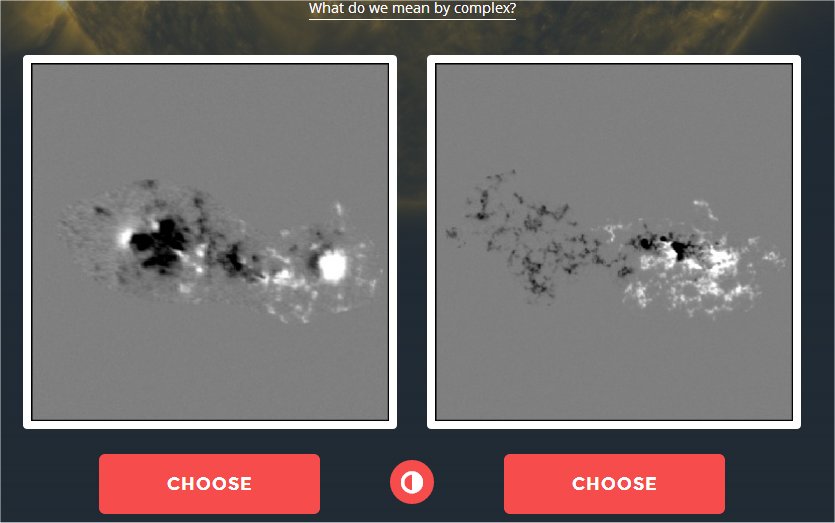
SunspotComplexity

The Sunspotter blog has a several interesting posts about the sun, sun spots, solar weather and more

===
The Radio Galaxy Zoo project has turned up a pair of galaxies that seem to be connected despite measured at vastly different distances and velocities: Remarkable Discoveries Underway – Citizen Scientists fire up Radio Galaxy Zoo – Galaxy Zoo.

arg00025v9_lab[1]

===

Participants in the Planet Hunters project will look for exoplanets in data from the new K2 phase of the Kepler space observatory: Welcome to the Era of K2- Planet Hunters

Milky Way with 9 K2 field locations shown

“This is a photograph of the Milky Way with the approximate locations
of the 9 proposed Kepler K2 campaign target fields. The line shows
the ecliptic (Earth’s orbit plane) along which the Kepler Space
Telescope can maintain precision pointing. That line intersects the
galactic plane in two locations.
Credit: ESO/S. Brunier/NASA Kepler Mission.”
Click for higher resolution version.

===

The Milky Way Project finds “a wonderful synergy that can exist between citizen scientists, professional scientists, and machine learning”  :  New MWP paper outlines the powerful synergy between citizens scientists, professional scientists, and machine learning – The Milky Way Project

A new Milky Way Project paper was published to the arXiv last week. The paper presents Brut, an algorithm trained to identify bubbles in infrared images of the Galaxy.

Brut uses the catalogue of bubbles identified by more 35,000 citizen scientists from the original Milky Way Project. These bubbles are used as a training set to allow Brut to discover the characteristics of bubbles in images from the Spitzer Space Telescope. This training data gives Brut the ability to identify bubbles just as well as expert astronomers!

The paper then shows how Brut can be used to re-assess the bubbles in the Milky Way Project catalog itself, and it finds that more than 10% of the objects in this catalog are really non-bubble interlopers. Furthermore, Brut is able to discover bubbles missed by previous searches too, usually ones that were hard to see because they are near bright sources.

[…]

At first it might seem that Brut removes the need for the Milky Way Project –  but the ruth is exactly the opposite. This new paper demonstrates a wonderful synergy that can exist between citizen scientists, professional scientists, and machine learning. The example outlined with the Milky Way Project is that citizens can identify patterns that machines cannot detect without training, machine learning algorithms can use citizen science projects as input training sets, creating amazing new opportunities to speed-up the pace of discovery. A hybrid model of machine learning combined with crowdsourced training data from citizen scientists can not only classify large quantities of data, but also address the weakness of each approach if deployed alone.

===

A lot more data arrives for participants in the Disk Detective project to look for stars with disks of matter around them where planets could be forming: Good News Everyone! 272,000 More Subjects – Disk Detective.

Sci-Tech: More on Polywell fusion + Focus Fusion crowd-funding update

Alan Boyle gives some additional details about the Navy funded Polywell fusion power project (see post here) that recently published a paper on progress they have made : Low-Cost Fusion Project Steps Out of the Shadows and Looks for Money – NBC News.com.

The Navy funding is running out and they are now looking for private funding. This is not out of the question. General Fusion in Canada has raised a considerable amount of money from Jeff Bezos and others. And secretive Tri-Alpha Energy has raised money from Paul Allen another others as well. (Others is a very rich guy…)

===

Another promising fusion power approach that I’ve mentioned here several times (e.g. see here and here)  is the dense focus fusion concept, which LPP Power in New Jersey is pursuing. Their crowdfunding campaign has raised $120,000 towards a $200,000 goal. They just got a 20 day extension to try to reach the full amount: FOCUS FUSION: emPOWERtheWORLD -Indiegogo.

===

One might have the wacky idea that the Department of Energy would grant some modest funding to these high risk but high pay-off fusion power projects. However, most all of DOE’s fusion funding goes directly or indirectly to the ITER tokamak project, which will, at best, provide a pay-off in 30 or 40 years.

This is typical in science and engineering programs, the biggest project gets bigger and bigger as its influence and industry/political ties multiply with its spending.  See, for example, SLS/Orion in NASA’s HSF program and James Webb Space Telescope in NASA’s science outlays.