Here is the latest episode of NASA’s Space to Ground weekly program, which reports on on activities aboard and related to the International Space Station:
Here is the latest episode of NASA’s Space to Ground weekly program, which reports on on activities aboard and related to the International Space Station:
In a TEDx talk, Shaun Moss lays out his vision of settling Mars in an affordable way. See the site International Mars Research Station for details.
From the caption:
Shaun Moss is a computer scientist with a 15-year passion for Mars. While reading Red Mars by Kim Stanley Robinson in 1999 Shaun realised that people would go to Mars in his lifetime, and he decided he wanted to be part of that. Since then he has been an active member of a variety of space enthusiast groups, mainly the Mars Society and Mars Society Australia (for which he acts as secretary and director) but also the Moon Society, the Mars Foundation and many others. Shaun’s research has included how to make air and steel on Mars, Martian timekeeping systems, terraforming and more, and he has given numerous presentations at conferences in Australia and the United States. For the past year he has been developing a robust and affordable humans-to- Mars mission architecture with the intention of establishing the International Mars Research Station. He publishes regular writing on Mars at his blog and is working on a book; he has already published a book on one of his other passions, Practical Metaphysics.
===
A class of Purdue students have assembled an elaborate plan to put a colony on the Moon: Purdue students pitch Mars colony to NASA – JCOnline. Here is their 1,100-page report.
Unfortunately, they more or less follow a 1960s Apollo model for lunar missions, which results in a hugely expensive multi-hundred billion dollar program. And that’s despite using NASA’s fictitious $500M cost for each SLS flight.
Yet more space policy/politics related links:
Webcast:
* PJTV – Geopolitics In Space: Will Russia Annex the International Space Station? – Glenn Reynolds
The International Space Station is home to Russian and American astronauts. Author and space analyst Rand Simberg breaks down the situation on the ISS. Could the conflict in Ukraine spread to space? The U.S. cannot get to the ISS without hitching a ride from the Russia. Does this mean that Russia could block U.S. access to space, or worse, annex the ISS? Find out.
[ Update: The video is now on Youtube:
]
* Thurs 4/17/14 Hr 2 | John Batchelor Show – Bob Zimmerman ( 3rd guest) in twice-weekly space news and policy report
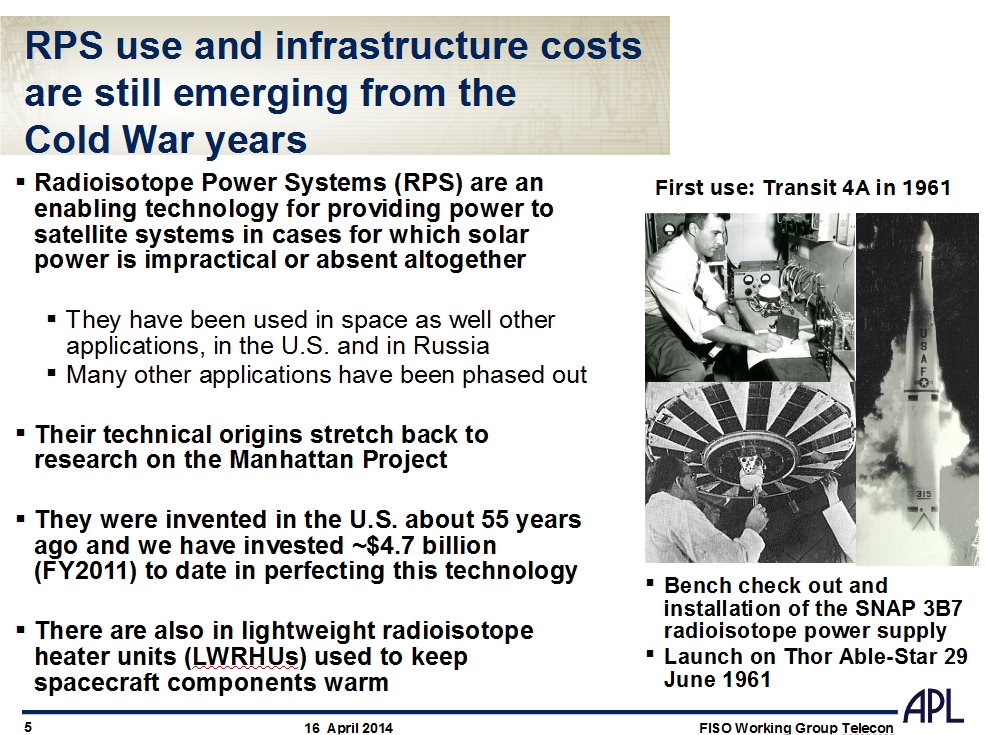
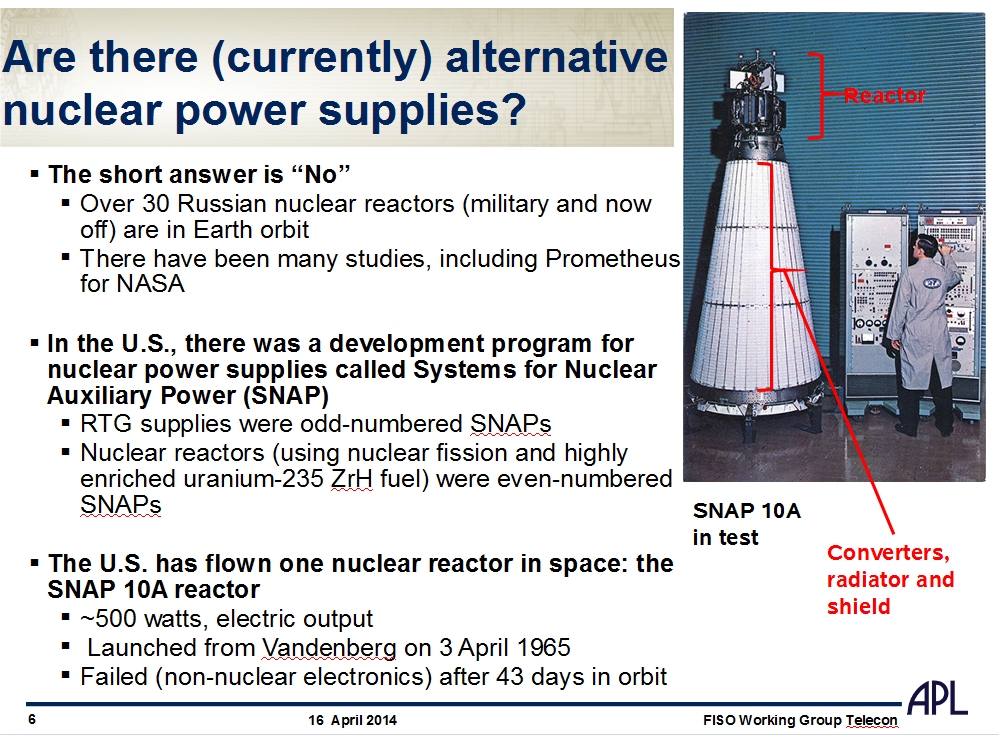
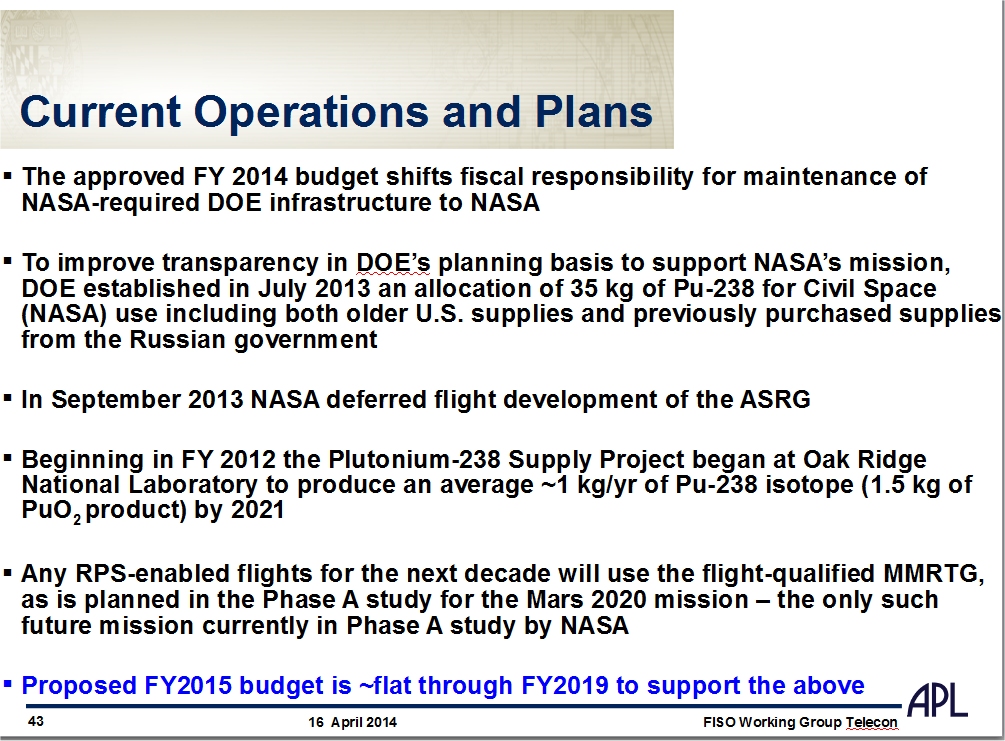
The latest presentation to the Future In-Space Operations (FISO) study group is now posted in the FISO Working Group Presentations Archive. Both slides (ppt) and audio (mp3) are available for the talk, Planetary Exploration and the Plutonium-238 Connection, Ralph McNutt , APL/JHU – April.16.2014.
A sampling of the presentation slides:

Space had a positive effect on one particular cherry tree seed taken to space in 2008 by Japanese astronaut Koichi Wakata to the International Space Station, where they stayed for 8 months till returned to Japan : Space sakura have returned to Earth with cherry blossom superpowers – RocketNews24.
Local botanical groups were only able to successfully breed descendants from the tree through grafting, as none of the seeds taken from it have sprouted after being sewn. Well, all except one, a seed from the Chujohime Seiganzakura that made the trip to space and back. Not only has the space sakura grown to four meters (13 feet, 1 inch) in height, flowers recently bloomed on the tree.
Generally, sakura blooming in the spring don’t shock anyone, given that all of Japan anxiously waits for the arrival of the cherry blossoms every year. The four-year-old Gifu space sakura managed to catch scientists and caretakers off guard, though, as ordinarily cherry trees of this type don’t produce blossoms until they reach a decade or so in age.
And
Scientists aren’t exactly sure why the trees in question are exhibiting such extraordinarily quick development. One researcher was quoted as saying that while it’s yet to be confirmed, they have to at least acknowledge the possibility that the environmental influences of space have somehow altered the plants’ DNA or stimulated their cells in as yet undetected ways, giving them capabilities beyond that of their earthbound brethren.
Credits: karapaia.livedoor.biz
I can’t help but point out that Zero Gravity Solutions Inc is building a business on the effects of microgravity on stem cells (pun intended).