Category Archives: Asteroids & Comets

Space sciences roundup – April.24.2019

A sampling of recent articles, videos, and images from space-related science news items:

** The InSight Mars Lander detects its first Marsquake using the seismometer set on the ground next to the spacecraft:

From NASA:

NASA’s Mars InSight lander has measured and recorded for the first time ever a likely “marsquake.”

The faint seismic signal, detected by the lander’s Seismic Experiment for Interior Structure (SEIS) instrument, was recorded on April 6, the lander’s 128th Martian day, or sol. This is the first recorded trembling that appears to have come from inside the planet, as opposed to being caused by forces above the surface, such as wind. Scientists still are examining the data to determine the exact cause of the signal.
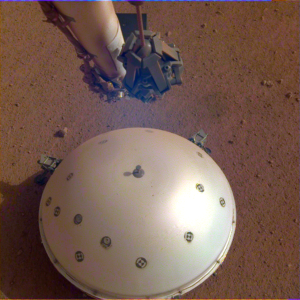
This image, taken March 19, 2019 by a camera on NASA’s Mars InSight lander, shows the rover’s domed Wind and Thermal Shield, which covers its seismometer, the Seismic Experiment for Interior Structure, and the Martian surface in the background. Credits: NASA/JPL-Caltech

The seismometer signals can be converted to audio:

This video and audio illustrates a seismic event detected by NASA’s Mars InSight rover on April 6, 2019, the 128th Martian day, or sol, of the mission. Three distinct kinds of sounds can be heard, all of them detected as ground vibrations by the spacecraft’s seismometer, called the Seismic Experiment for Interior Structure (SEIS): noise from Martian wind, the seismic event itself, and the spacecraft’s robotic arm as it moves to take pictures. Credits: NASA/JPL-Caltech/CNES/IPGP/Imperial College London.

The new seismic event was too small to provide solid data on the Martian interior, which is one of InSight’s main objectives. The Martian surface is extremely quiet, allowing SEIS, InSight’s specially designed seismometer, to pick up faint rumbles. In contrast, Earth’s surface is quivering constantly from seismic noise created by oceans and weather. An event of this size in Southern California would be lost among dozens of tiny crackles that occur every day.

“The Martian Sol 128 event is exciting because its size and longer duration fit the profile of moonquakes detected on the lunar surface during the Apollo missions,” said Lori Glaze, Planetary Science Division director at NASA Headquarters.

Note that the signals’ frequencies “have been sped up by a factor of 60” since otherwise the vibrations would not be audible to the human ear.

** More quakes in the Cosmos are being detected more quickly with newly upgraded gravity wave observatories in the US and Italy. The sensitivities of the detectors have been increased to a level such that signals picked up at the LIGO (Laser Interferometer Gravitational-Wave Observatory) installations in Louisiana, and Washington plus the European Virgo detector in Italy will result in roughly one gravity wave detection per week. A new public alert system will let everyone know when a detection occurs:

From PSU:

Two new probable gravitational waves — ripples in the fabric of spacetime caused by cataclysmic cosmic events and first predicted by Albert Einstein over 100 years ago — have been detected by the Laser Interferometer Gravitational-Wave Observatory (LIGO) and the Virgo observatory in Italy in the first weeks after the detectors were updated. The source of both waves is believed to be the merging of a pair of black holes.

LIGO announced the discovery of the first new gravitational wave in its first-ever open public alert on April 8, and quickly followed up with a second announcement on April 12. LIGO detected the first-ever gravitational wave in September 2015, and announced the discovery in February 2016. Ten more gravitational waves were detected over the following three years, but with updates to LIGO and Virgo, scientists expect to see as many as one per week, which so far has proven true.

Updates to LIGO and Virgo have combined to increase its sensitivity by about 40 percent over its last run. Additionally, with this third observing run, LIGO and Virgo transitioned to a system whereby they alert the astronomy community almost immediately of a potential gravitational wave detection. This allows electromagnetic telescopes (X-ray, UV, optical, radio) to search for and hopefully find an electromagnetic signal from the same source, which can be key to understanding the dynamics of the event.
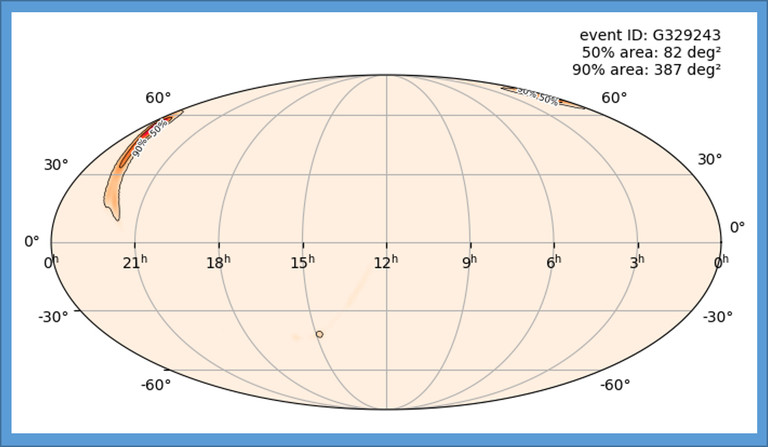
“The region of sky believed to contain the source of the gravitational wave detected on April 8, 2019. The area spans 387 square degrees, equivalent to nearly 2000 full-Moons, roughly meandering through the constellations Cassiopeia, Lacerta, Andromeda, and Cepheus in the northern hemisphere. IMAGE: LIGO/Caltech/MIT”

… The source of both gravitational waves is suspected to be compact binary mergers — the collision of two massive and incredibly dense cosmic objects into one another. Compact binary mergers can occur between two neutron stars, two black holes, or a neutron star and a black hole. Each of these different types of mergers create gravitational waves with strikingly different signals, so the LIGO team can identify the type of event that created the gravitational waves.

** Huge gallery of Rosetta mission images of comet 67P/Churyumov-Gerasimenko is now available on line at the OSIRIS Image Archive:

The ESA release says the image shown below

… was taken on 6 October 2014 from a distance of 18.6 km to the comet. This is just one of almost 70 000 images taken with Rosetta’s high-resolution imaging system OSIRIS that are now available via a new online and mobile-friendly ‘comet viewer’ created in a joint project with the Department of Information and Communication at Flensburg University of Applied Sciences, and the Max Planck Institute for Solar System Research, who lead the OSIRIS team.
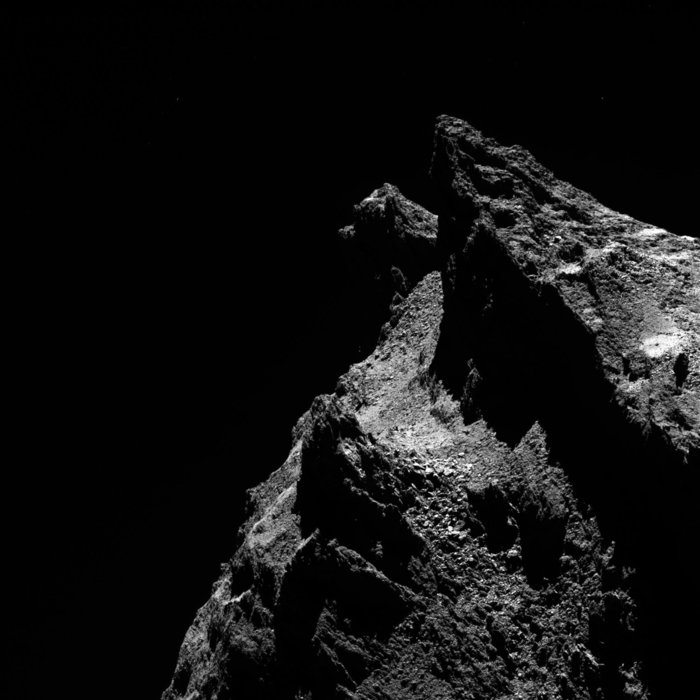
A feature of  Comet 67P/Churyumov-Gerasimenko: “Seen from afar, the comet is usually likened to a duck in shape, but in this enchanting close-up view its profile resembles that of a cat’s face seen side-on. The two ‘ears’ of the cat make up the twin peaks either side of the ‘C. Alexander Gate’ – named for US Rosetta Project Scientist Claudia Alexander who passed away in July 2015. These impressive cliffs lie at the border between the Serqet and Anuket regions on the comet’s head.”

The image viewer hosts the full archive, but also has subsections organising image sets into themes: for example, images showing towering cliffs and bizarre cracks on the comet surface, or those focusing on spectacular dust fountains as the comet launched gas and dust jets into space as its surface ices were warmed as it came closer to the Sun on its orbit.

The collection of OSIRIS images captured the farewell of lander Philae as it dropped towards the surface of the comet, and later, towards the end of the mission, the feverish search for the hidden robot.

Within the new comet viewer, each of the nearly 70 000 images is supplemented with the date on which it was taken, the distance to the comet, and a short accompanying text briefly describing what is seen in the image. The images can be downloaded in full resolution and can also be directly shared to Twitter and Facebook.

** The Southern Crab Nebula shines in a new Hubble image marking 29 years in orbit for the space telescope: Hubble Celebrates its 29th Birthday with Unrivaled View of the Southern Crab Nebula | ESA/Hubble

This incredible image of the hourglass-shaped Southern Crab Nebula was taken to mark the NASA/ESA Hubble Space Telescope’s 29th anniversary in space. The nebula, created by a binary star system, is one of the many objects that Hubble has demystified throughout its productive life. This new image adds to our understanding of the nebula and demonstrates the telescope’s continued capabilities.
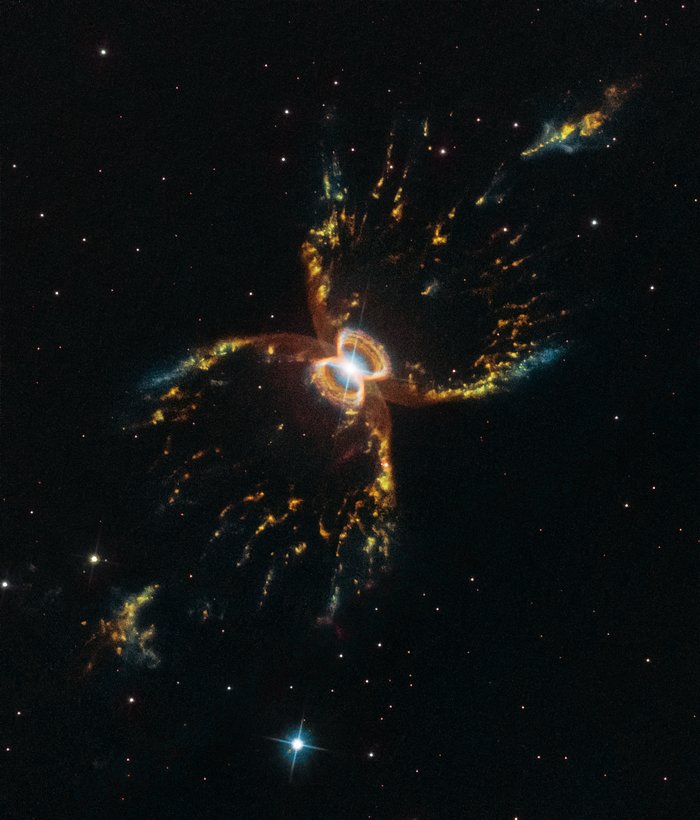
The Southern Crab Nebula — Hubble’s 29th anniversary image.

On 24 April 1990, the NASA/ESA Hubble Space Telescope was launched on the space shuttle Discovery. It has since revolutionised how astronomers and the general public see the Universe. The images it provides are spectacular from both a scientific and a purely aesthetic point of view.

Each year the telescope dedicates a small portion of its precious observing time to take a special anniversary image, focused on capturing particularly beautiful and meaningful objects. This year’s image is the Southern Crab Nebula, and it is no exception [1].

This peculiar nebula, which exhibits nested hourglass-shaped structures, has been created by the interaction between a pair of stars at its centre. The unequal pair consists of a red giant and a white dwarf. The red giant is shedding its outer layers in the last phase of its life before it too lives out its final years as a white dwarf. Some of the red giant’s ejected material is attracted by the gravity of its companion.

More highlights from Hubble’s 29 years in orbit:

** Latest Mars updates from Bob Zimmerman:

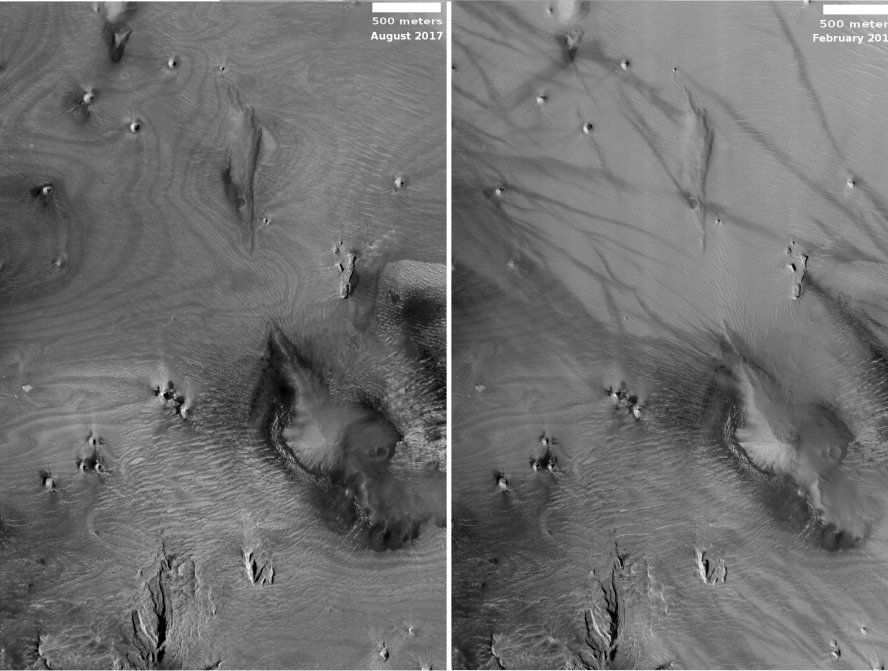
Comparison of an area near Olympus Mars before (left) and after (right) the global dust storm of 2018. Credits: Bob Zimmerman & HiRISE camera on NASA Mars Reconnaissance Orbiter (MRO)
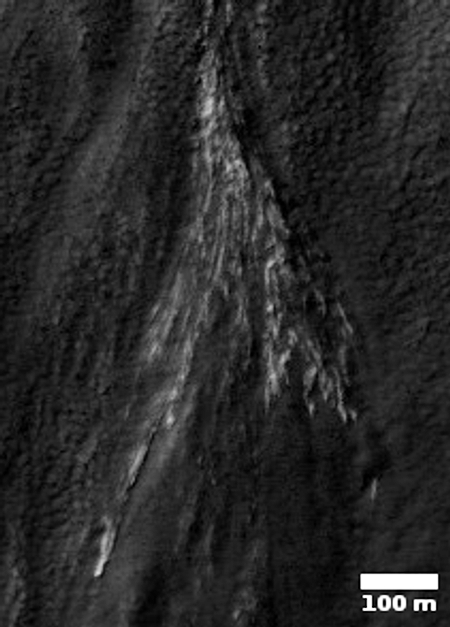
White streaks atop avalanche debris on this Mars slope appear to be water frost. Credits: Bob Zimmerman + HiRISE camera on NASA Mars Reconnaissance Orbiter (MRO)

Check out a new MRO avalanche image released today by NASA: Landslides in Mars’ Cerberus Fossae | NASA.

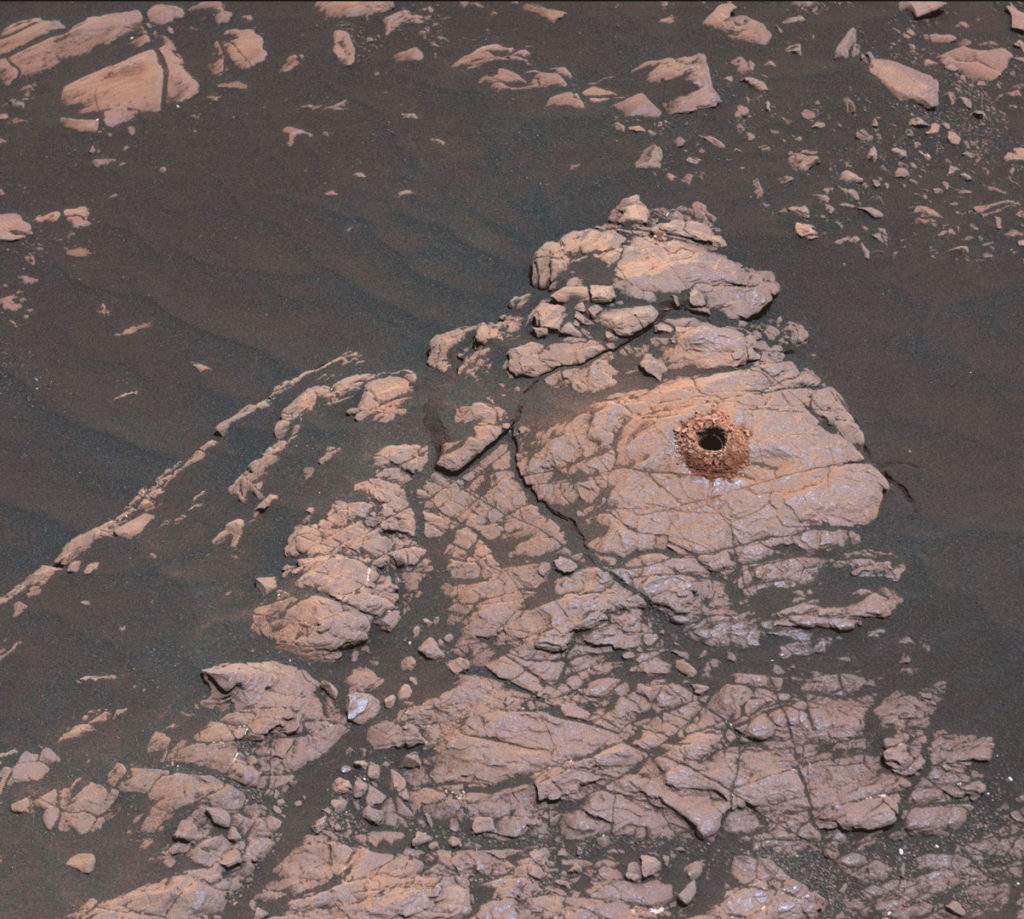
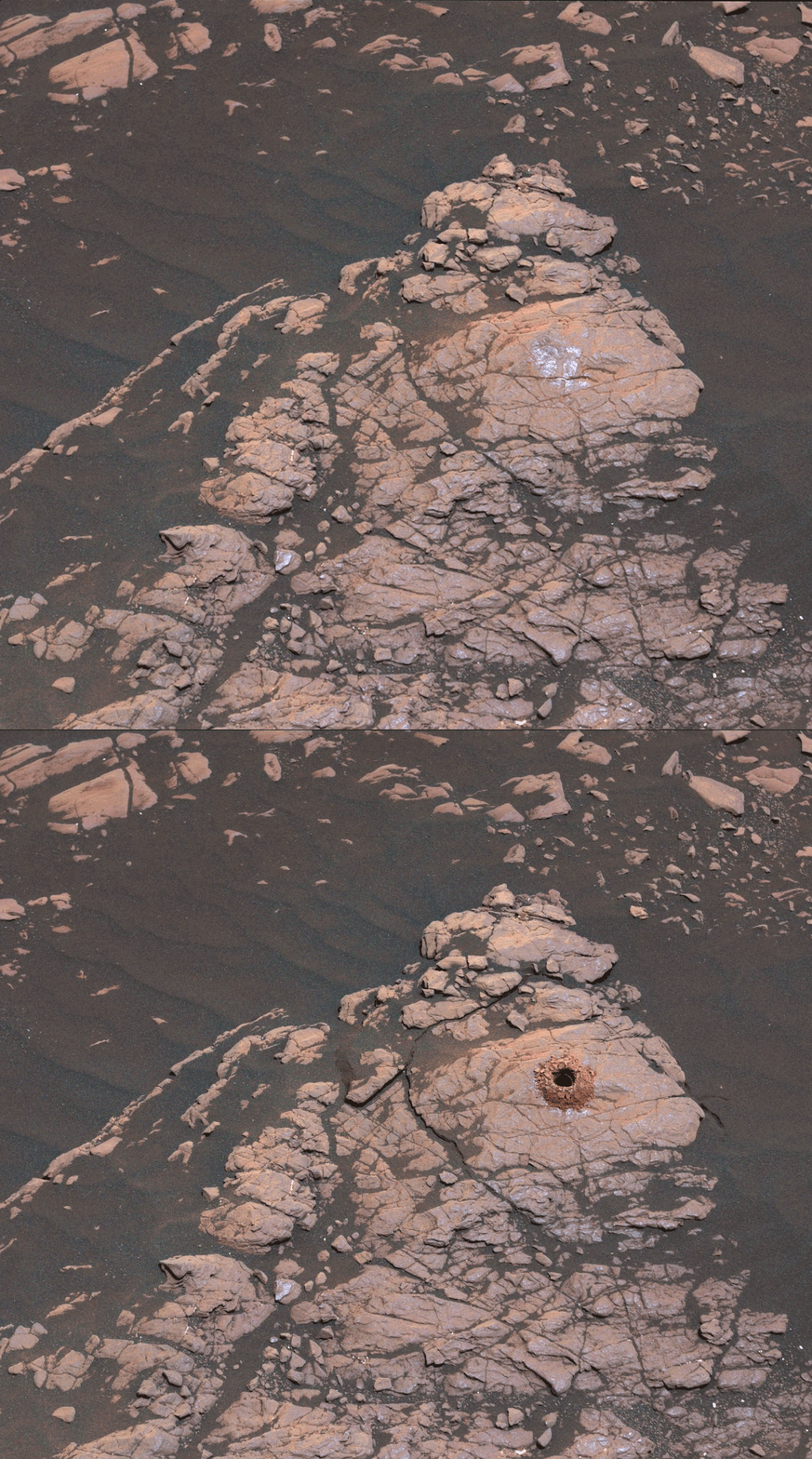
The Mast Camera, or Mastcam, on NASA’s Curiosity Mars rover captured this image after “it drilled a rock nicknamed “Aberlady,” on Saturday, April 6, 2019 (the 2,370th Martian day, or sol, of the mission). The rock and others nearby appear to have moved when the drill was retracted. This was the first time Curiosity has drilled in the long-awaited “clay-bearing unit.” See also a GIF animation showing before and after the drilling. Credits: NASA JPL
  • How fast do things change on Mars? – A comparison of Mars Reconnaissance Orbiter images of a dune-like feature on Mars taken 12 years apart show some differences. “Overall, however, not much is different. Though dunes definitely change on Mars, they do so much more slowly than on Earth. And in some cases what look like dunes are not really dunes at all, but a form of cemented sandstone, exhibiting even fewer changes over long time spans.”

** Some space sciences webcasts:

>> Weekly Space Hangout: Apr 17, 2019 – Dr. Dorothy Oehler Talks “Is there Methane on Mars?”

>> SETI Institute: Tiny Neptune Moon Spotted by Hubble May Have Broken from Larger Moon

>> SETI Institute: Mars Exploration Rovers: Spirit and Opportunity with Nathalie Cabrol

>> SETI Institute: Turkish Meteorite Traced to Impact Crater on Asteroid Vesta

====

Archaeology from Space: How the Future Shapes Our Past

Space sciences roundup – Apr.3.2019

A sampling of recent articles, videos, and images from space related science news:

** SpaceIL’s Beresheet prepares to enter lunar orbit on Thursday, April 4th. The vehicle fired its engine on Monday for 72 seconds to lengthen its long elliptical earth orbit. This will bring the spacecraft close enough to the Moon so that a brief firing of the engine there will put it into lunar orbit. On April 11, a final firing of the engine will send the vehicle down for a landing on the surface.

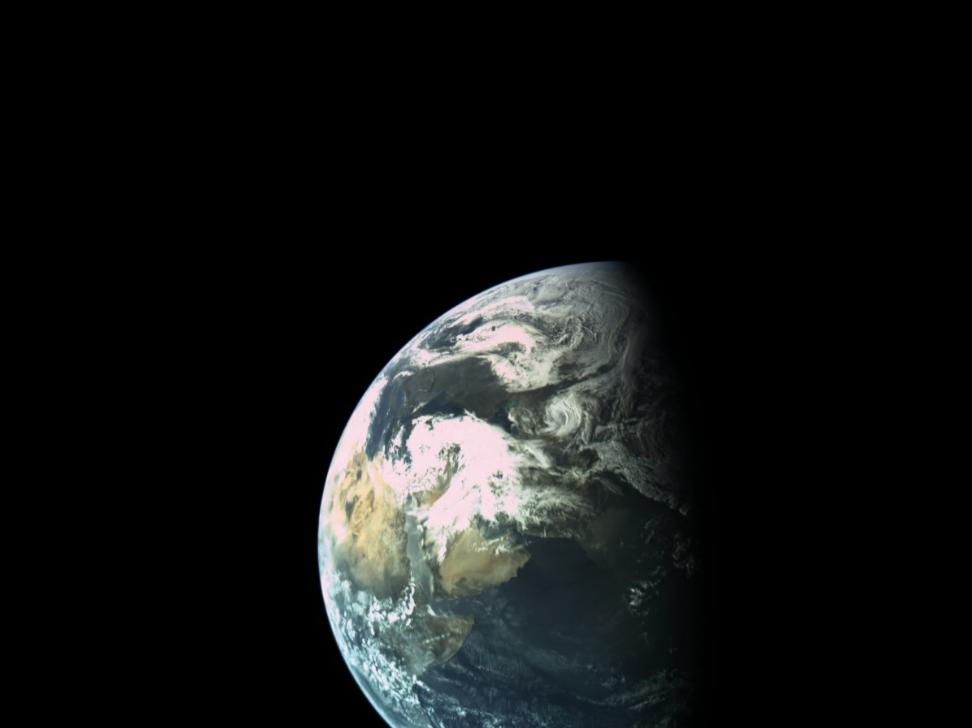
Photo of earth taken by Beresheet on March 1st from about 16,000 kilometers as the spacecraft made its last past by earth. The photo shows the Arab Peninsula and Southeast Africa.

If successful, this will be the first non-governmental spacecraft to go into orbit around another celestial object. And the first such to attempt a landing.

If the landing on Mare Serenitatis, in the northern hemisphere of the Moon, is successful, the craft will operate for about 2 days. The area is known for magnetic anomalies and the magnetometer device on the craft will measure the field strength during its descent and at the landing site.

The spacecraft also holds an array of mirrors provided by NASA for ground tracking and Deep Space Network support to aid in mission communication: NASA, Israel Space Agency Sign Agreement for Commercial Lunar Cooperation – NASA

See also:

** Japan’s Hayabusa2 soon to shoot a projectile into the Ryugu asteroid to learn about the characteristics of the surface material.

From Jason Davis:

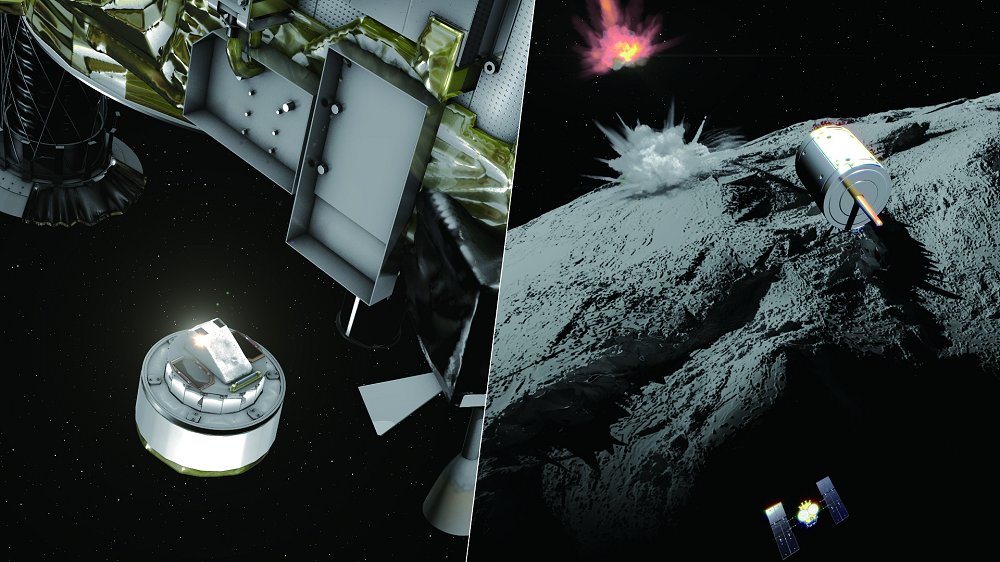
The spacecraft is about to deploy an explosives-filled box that will detonate in space, fire a copper plate into Ryugu, and create a crater up to 10 meters wide. The moment of crater generation is set for 5 April at 02:36 UTC. …

… There’s a lot of uncertainty involved with SCI [Small Carry-on Impactor], which makes it a really interesting experiment. Scientists aren’t quite sure how big the crater will be. They can only aim SCI to a certain degree; the target spot has a margin of error of 200 meters. The width of the crater will depend on the type of material the impactor hits. Most models estimate a crater up to 10 meters wide, but there are a few surface types that could result in either a very small crater (if the impactor hits a particularly porous spot) or a crater even larger than 10 meters (if it hits a bunch of tiny, coarse pebbles). The crater depth is expected to be about a tenth of its diameter, which is actually a rule of thumb for simple, bowl-shaped craters anywhere in the solar system!

The target area is near Ryugu’s equator, about a quarter of the way around the asteroid east of the first sample collection site. That’s roughly 300 meters from MASCOT’s final resting place, so it’s not impossible that SCI could hit quite close to the now-dead lander. Since the Hayabusa2 team might also collect a sample from this artificial crater, they chose a spot geologically similar to the first touchdown site, allowing for an above-and-beneath-the-surface comparison. The location is also relatively free of hazards, which should help for a future touchdown.

Artist’s conception of the SCI experiment. The left panel shows the release of the SCI from the Hayabusa2 spacecraft. The right panel shows the DCAM3 camera  (silver cylinder) observing the explosion while Hayabusa2 is hides behind asteroid Ryugu to avoid the resulting debris.

** China’s station on the far side of the Moon re-awakens after surviving another 2 week long lunar night.

The rover was designed to last for three lunar days, but much like NASA missions that regularly outlive their initial mandates, Yutu 2’s mission may stretch on longer, the Chinese space agency hopes. (The current rover’s predecessor, Yutu, lost its roving ability on its second day on the moon.)

The China Lunar Exploration Program, which heads up the mission, has not provided any details about its scientific plans for the fourth day of Chang’e 4, which is focused on exploring the far side of the moon and how it differs from the near side. 

** Launch of India’s Chandrayaan-2 lunar lander delayed till May – Chandrayaan-2 mission deferred again, scheduled for May launch | India News – Times of India

Unlike the Chandrayaan-1 programme in 2008 that involved only orbiting around the moon, Chandrayaan-2 is a much complicated mission. It involves a soft-landing on the lunar surface and a rover that will move on the moon’s surface for 100 metre and analyse the soil content. Isro is, therefore, not taking any risk and taking time to fix all possible glitches as it wants a perfect landing.

Another reason for the postponement is that space agency wants to make use of the full lunar day (equal to 14 earth days). In January, the Isro chairman told TOI, “We want to land the rover at a time when it can use the full lunar day and do all scientific experiments. For that to happen, there is a launch window. If we miss the window, we have to defer the launch.

** SpaceFab commercial space telescope project awards observing time on the company’s soon-to-be-launched Waypoint space telescope to Dr. David Rubin of Univ. of Hawaii: SpaceFab.US Awards Space Telescope Time for Research – SpaceFab.US

Dr. Rubin’s program will use the Waypoint satellite’s EMCCD (Electron Multiplying Charge Coupled Device) camera to make rapid UV (ultraviolet) observations of newly discovered type Ia supernovae. Almost all UV light is absorbed by the Earth’s atmosphere, so only a telescope in the vacuum of space can make these types of measurements. The Waypoint satellite can be rapidly tasked to take priority observations within 90 minutes.

Dr. Rubin is currently a postdoctoral researcher at the Space Telescope Science Institute, but has accepted a faculty position at the University of Hawaii starting in August 2019.  His primary focus is on supernova cosmology, and is currently co-running a program to dramatically increase the number of distant SNe Ia to get substantially improved cosmological constraints.

The company will make money by leasing observation time on the orbital instrument to scientific and commercial users. The Waypoint Space Telescope is

a 21 centimeter mirror, launching as a co-payload on a SpaceX launch vehicle  in 2020. This commercial telescope will have an image intensified ultraviolet /visible 8 megapixel camera, and a 48MP main camera for visible and near-infrared imaging for astronomical and Earth observation purposes, available for use by customers around the world.  

The Waypoint telescope will also provide 150 band hyper-spectral camera for Earth observation at 3  meter resolution for use in scientific and commercial applications.  These applications include efficient farming, mineral and geological surveys, environmental studies,  climate change, disaster relief, oil spills, animal migrations, monitor urban growth and more.

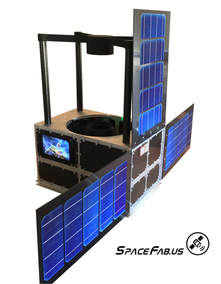
SpaceFab’s Waypoint telescope design provides twice the resolution of other satellite telescopes of equivalent size and weight by using extending optics. The telescope is launched with a standard 12U cubesat form factor, then the secondary optics assembly is extended when in orbit. This doubles the telescope focal length while cutting the size, weight, and launch cost in half compared to conventional satellite telescopes with similar resolution.

Waypoint space telescope design rendering.

An interview from 2017 with Sean League, SpaceFab co-founder and Spacecraft Engineering Director:

** Dunes, Walnut Shells, Alien Impostors and Other Worlds: A Visit with Sarah Hörst | The Planetary Society

A very special, extended conversation with Johns Hopkins University planetary scientist Sarah Hörst is capped by a tour of her fascinating lab. That’s where Sarah and her team simulate decidedly un-Earthlike atmospheres and more. Emily Lakdawalla has returned from this year’s Lunar and Planetary Science Conference with news from around the solar system. Caffeine! It’s on Saturn’s moon Titan AND in the espresso made on the International Space Station! More about the latter in What’s Up.

** Exploring Ultima Thule: humanity’s next frontier – A SETI Institute panel discusses

… the key results of this successful flyby and the future of the mission, we invited Alan Stern, planetary scientist at Southwest Research Institute and the Principal Investigator of NASA’s New Horizons mission who will join us remotely via video-conferencing. Two Senior Research Scientists from our own SETI Institute who are part of the mission will participate in this discussion as well. Mark Showalter is a Fellow of the Institute who led the New Horizons risk assessment team before the flyby, and Ross Beyer, also a member of the New Horizons Geology and Geophysics team, who is helping to understand the 3D shape of MU69.

** A helicopter is ready to go to Mars in 2020 following successful tests in Martian level atmospheric pressure: NASA has been testing the helicopter that will head to Mars next year – MIT Technology Review

** A brief burst of Methane seen by Curiosity rover was also detected by the Mars Express spacecraft as it flew over the same area:  Mars Express matches methane spike measured by Curiosity – ESA

While spacecraft and telescopic observations from Earth have in general reported no or very low detections of methane, or measurements right at the limit of the instruments’ capabilities, a handful of spurious spikes, along with Curiosity’s reported seasonal variation at its location in Gale Crater, raise the exciting question of how it is being generated and destroyed in present times.

Now, for the first time, a strong signal measured by the Curiosity rover on 15 June 2013 is backed up by an independent observation by the Planetary Fourier Spectrometer (PFS) onboard Mars Express the next day, as the spacecraft flew over Gale Crater.

Methane is of particular interest because it is a short lived gas that could be a signature of a biological process. However, there are also geologic processes that could produce it and there are no methods yet for distinguishing the two possible origins of the gas: There Is Definitely Methane on Mars, Scientists Say. But Is It a Sign of Life? – Space.com

** Mars underground water ice on the move:

From Leonard David:

New research suggests deep groundwater on Mars could still be active and creating surface streams in some near-equatorial areas on the planet.

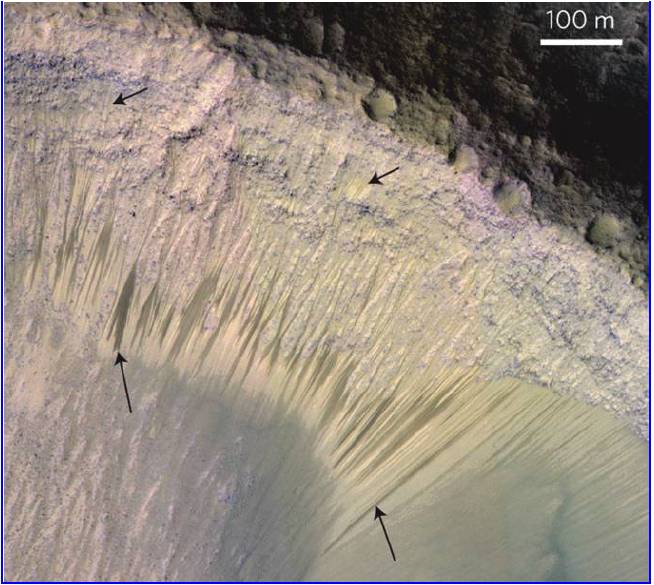
Once again, scientists point to the planet’s recurring slope lineae – RSL for short – that are akin to dried, short streams of water that appear on some crater walls.

Leonard David: “NASA Mars Reconnaissance Orbiter’s HiRISE image of recurring slope lineae in Melas Chasma, Valles Marineris. Arrows point out tops and bottoms of a few lineae.” Credit: NASA/JPL-Caltech/University of Arizona

** Recent analyses of Mars images by Bob Zimmerman:

** Undergrad detects 2 exoplanets in Kepler space telescope data using a deep-learning neural network program:

** The Weekly Space Hangout includes interviews and discussions of topics in the space sciences. Here is a sampling of recent shows:

====

Chasing New Horizons: Inside the Epic First Mission to Pluto

Space sciences roundup – March.7.2019

A sampling of recent articles, videos, and images related to space related sciences:

** Video shows Hayabusa2 landing on asteroid Ryuga and firing a projectile that stired up material from the surface to allow for capturing samples of the asteroid to return to earth: Watch Hayabusa2’s incredible touchdown on asteroid Ryugu | The Planetary Society

The video was shot with Hayabusa2’s small monitoring camera, CAM-H, which points downward from the side of the main spacecraft bus. Incredibly, the camera was funded by donations from the public!

There’s so much to like about the video: The reflection of Ryugu on Hayabusa2’s shiny surface. The white target marker containing names of Planetary Society members, visible in the lower-left corner for the first part of the video. And, of course, the incredible spray of debris when Hayabusa2 hits the surface and fires its tantalum bullet.

With so much material flying around, the team says “the potential for sample collection is high.” That hopefully includes some larger pieces that either floated directly into the sample catcher or were caught on the inner lip of the sample horn, giving them a chance to tumble up into the catcher later. JAXA also confirmed some debris stuck to the lens of one of the optical navigation cameras.

** NASA’s InSight Mars lander’s drill slowed by hard rock. Mars InSight Lander’s ‘Mole’ Pauses Digging – NASA’s InSight Mars Lander

NASA’s Mars InSight lander has a probe designed to dig up to 16 feet (5 meters) below the surface and measure heat coming from inside the planet. After beginning to hammer itself into the soil on Thursday, Feb. 28, the 16-inch-long (40-centimeter-long) probe — part of an instrument called the Heat and Physical Properties Package, or HP3 — got about three-fourths of the way out of its housing structure before stopping. No significant progress was seen after a second bout of hammering on Saturday, March 2. Data suggests the probe, known as a “mole,” is at a 15-degree tilt.

Scientists suspect it hit a rock or some gravel. The team had hoped there would be relatively few rocks below ground, given how few appear on the surface beside the lander. Even so, the mole was designed to push small rocks aside or wend its way around them. The instrument, which was provided for InSight by the German Aerospace Center (DLR), did so repeatedly during testing before InSight launched.

“The team has decided to pause the hammering for now to allow the situation to be analyzed more closely and jointly come up with strategies for overcoming the obstacle,” HP3 Principal Investigator Tilman Spohn of DLR wrote in a blog post. He added that the team wants to hold off from further hammering for about two weeks.

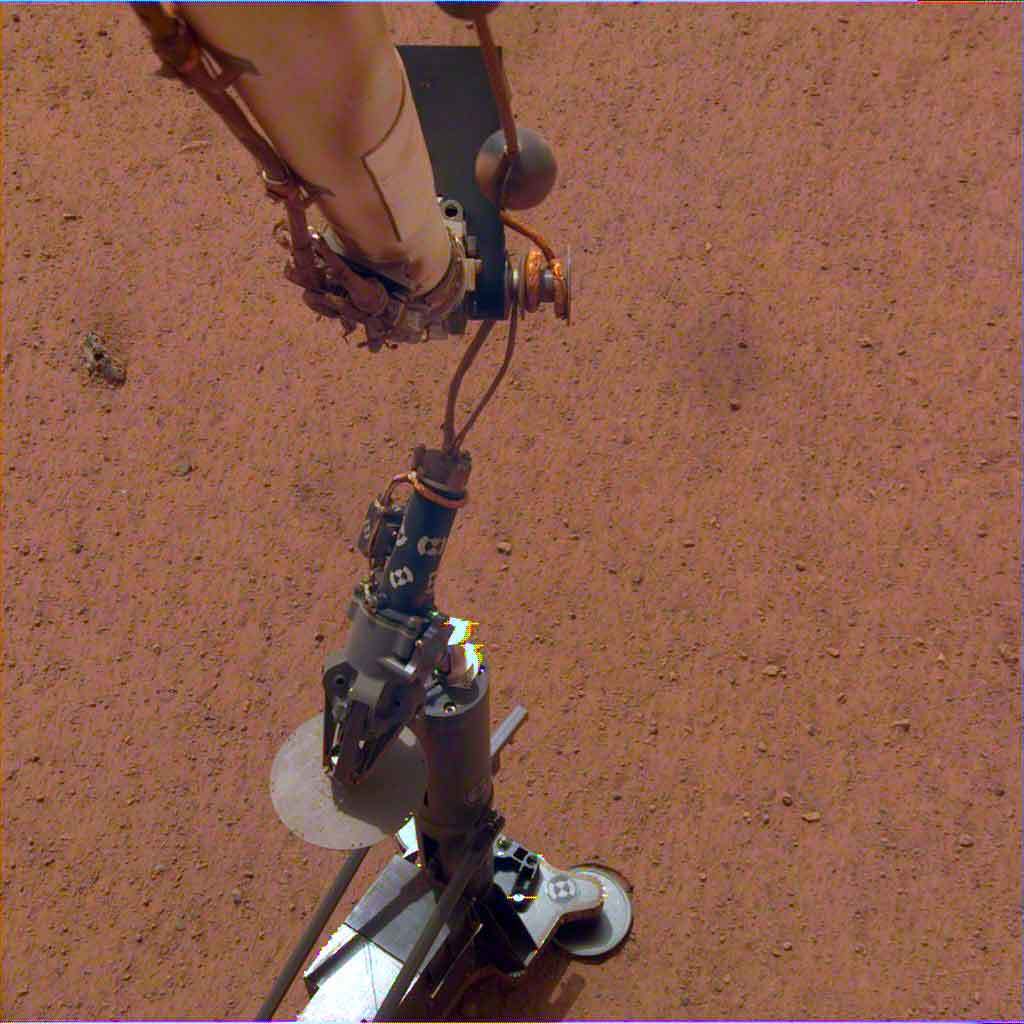
HP3 on the Martian Surface: NASA’s InSight lander set its heat probe, called the Heat and Physical Properties Package (HP3), on the Martian surface on Feb. 12. Image Credit: NASA/JPL-Caltech/DLR. Full image and caption ›

** Israeli Beresheet lunar probe sends selfie as it moves closer to the Moon: Been here, done that: SpaceIL sends its first selfie from space – ISRAEL21c

The SpaceIL Beresheet lunar lander spacecraft takes a picture of itself along with the Earth in the background.

More background info on the selfie:

** View the Moon in the colors of its minerals in this image created by A James Mccarthy (u/ajamesmccarthy) and posted on Reddit


See also:

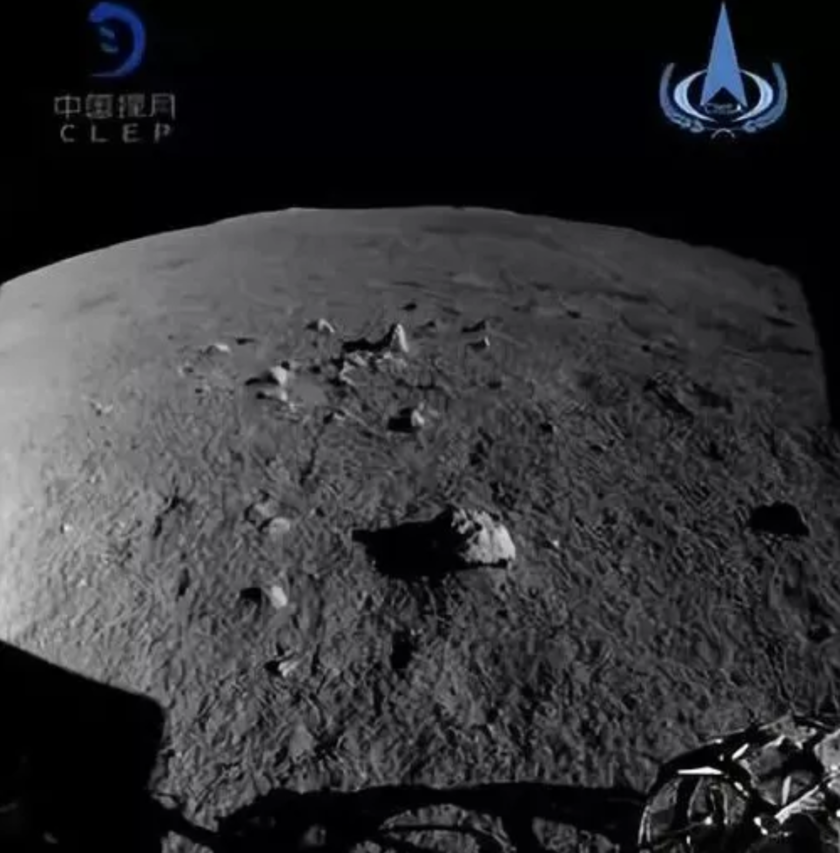
** The Chinese Chang’e 4 lander & rover on the far side of the Moon is busy on its third lunar day (equal to 14 earth days):  Yutu-2 Rocks On into Lunar Day 3 for Chang’e-4 mission | The Planetary Society

Yutu-2 awakened for lunar day 3 of the mission at 02:51 UTC on 28 February, with the lander following later the same day at 23:52. A few days later, the rover stood down for its ‘noon nap’ to avoid heating issues from a high solar incidence angle, at 10:25 UTC on March 3. It will resume its activities early on 10 March, before entering a sleep state around 02:00 UTC on 13 March, when the Sun is low in the sky over Von Kármán crater in preparation for the lunar nighttime.

According to a release by the China Lunar Exploration Program (CLEP) on 4 March, Yutu-2 has so far travelled 127 meters, adding 7 meters to the total of 120 meters driven on lunar days 1 (44.185 m) and 2 (75.815 m).

The apparent relatively low distance is believed to be due to Yutu-2 taking time to image nearby rocks and features in the regolith. Analysis of the images from the Visible and Near-Infrared Imaging Spectrometer (VNIS) and Panoramic camera is expected to provide insight into the origin and composition of the rocks and development of the lunar far side itself.

Yutu-2 observes some Moon rocks during the rover’s third Lunar Day since landing on the far side.

** NASA will pay companies with lunar spacecraft for delivery of scientific instruments and experiments to the Moon as soon as their spacecraft are ready to go: NASA Selects Experiments for Possible Lunar Flights in 2019 – NASA

NASA has selected 12 science and technology demonstration payloads to fly to the Moon as early as the end of this year, dependent upon the availability of commercial landers. These selections represent an early step toward the agency’s long-term scientific study and human exploration of the Moon and, later, Mars.

** NASA MAVEN Mars orbiter to support communications with Mars 2020 rover:

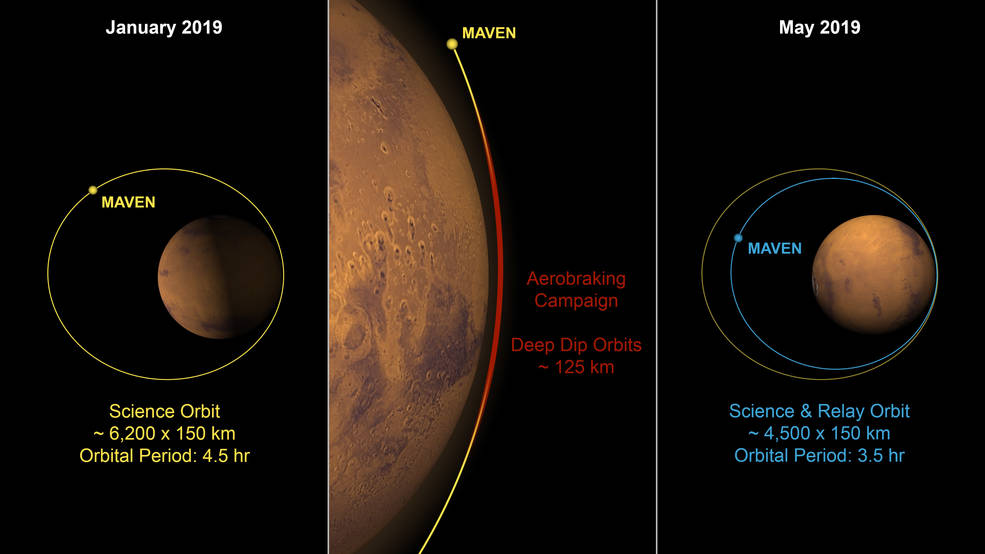
NASA’s 4-year-old atmosphere-sniffing Mars Atmosphere and Volatile Evolution (MAVEN) mission is embarking on a new campaign today to tighten its orbit around Mars. The operation will reduce the highest point of the MAVEN spacecraft’s elliptical orbit from 3,850 to 2,800 miles (6,200 to 4,500 kilometers) above the surface and prepare it to take on additional responsibility as a data-relay satellite for NASA’s Mars 2020 rover, which launches next year.

“The MAVEN spacecraft has done a phenomenal job teaching us how Mars lost its atmosphere and providing other important scientific insights on the evolution of the Martian climate,” said Jim Watzin, director of NASA’s Mars Exploration Program. “Now we’re recruiting it to help NASA communicate with our forthcoming Mars rover and its successors.”

While MAVEN’s new orbit will not be drastically shorter than its present orbit, even this small change will significantly improve its communications capabilities. “It’s like using your cell phone,” said Bruce Jakosky, MAVEN principal investigator from the University of Colorado, Boulder. “The closer you are to a cell tower, the stronger your signal.”

Aerobraking plan for MAVEN. (left) Current MAVEN orbit around Mars: 6,200 kilometers (~3,850 miles) at highest altitude, and an orbit period of about 4.5 hours. (center) Aerobraking process: MAVEN performs a series of “deep dip” orbits approaching to within about 125 kilometers (~78 miles) of Mars at lowest altitude, causing drag from the atmosphere to slow down the spacecraft. Over roughly 360 orbits spanning 2.5 months, this technique reduces the spacecraft’s altitude to about 4,500 kilometers (~2,800 miles) and its orbit period to about 3.5 hours. (right) Post-aerobraking orbit, with reduced altitude and shorter orbit period. Credits: NASA’s Scientific Visualization Studio/Kel Elkins and Dan Gallagher. Download in high resolution from the Scientific Visualization Studio

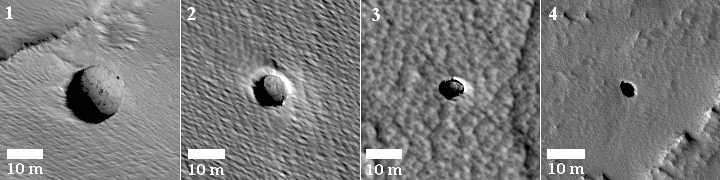
** More Mars caving via images from the Mars Reconnaissance Orbiter (MRO) camera : Another batch of caves/pits found on Mars | Behind The Black

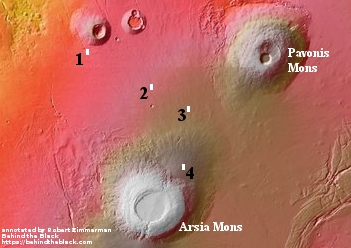
Images from the MRO showing pits, located north and west of Arsia Mons. Credits Bob Zimmerman

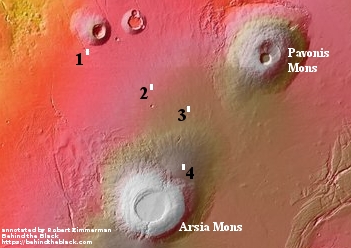
The November release imaged three pits found on the southern flanks of Arsia Mons. The January 2019 release found several north of the volcano, two of which are very close to the two middle new pits highlighted above. The February release, which is the focus of this post, included four more pits, shown above, all located north and west of Arsia Mons, as shown in the overview map [shown below in image from Behind the Black].

MRO images of Arsia Mons with notation by Bob Zimmerman.

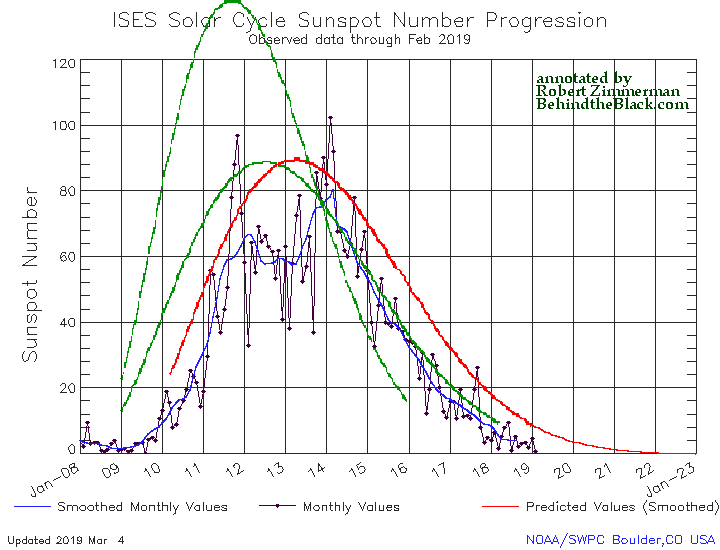
** Our sun is spotless as it reaches a zero minimum in the current phase of the solar cycle. We will have to wait and see how long it remains in that state. Sunspot update February 2019: The Sun flatlines again | Behind The Black

The number of sunspots in the current cycle since 2008. Annotated by Bob Zimmerman.

** And our solar system is very bigAstronomers discover solar system’s most distant object, nicknamed ‘FarFarOut’ – AAAS

For most people, snow days aren’t very productive. Some people, though, use the time to discover the most distant object in the solar system.

That’s what Scott Sheppard, an astronomer at the Carnegie Institution for Science in Washington, D.C., did this week when a snow squall shut down the city. A glitzy public talk he was due to deliver was delayed, so he hunkered down and did what he does best: sifted through telescopic views of the solar system’s fringes that his team had taken last month during their search for a hypothesized ninth giant planet.

That’s when he saw it, a faint object at a distance 140 times farther from the sun than Earth—the farthest solar system object yet known, some 3.5 times more distant than Pluto. The object, if confirmed, would break his team’s own discovery, announced in December 2018, of a dwarf planet 120 times farther out than Earth, which they nicknamed “Farout.” For now, they are jokingly calling the new object “FarFarOut.” “This is hot off the presses,” he said during his rescheduled talk on 21 February.

** Juno’s Jupiter images never get old: Dramatic Jupiter | NASA

Jupiter’s northern hemisphere as seen by Jupiter in an image enhanced by citizen scientist Kevin M. Gill.

====

Chasing New Horizons: Inside the Epic First Mission to Pluto

Japan’s Hayabusa-2 grabs sample of asteroid Ryuga

On Friday, Japan’s Hayabusa 2 spacecraft maneuvered down to the surface of the small asteroid Ryugu and landed just long enough to extract a sample of surface material.

From Spaceflight Now:

The spacecraft dropped a pair of Japanese robots to hop across Ryugu’s surface in September, then released a European mobile scout to land on the asteroid in October. The miniature landers became the first mobile vehicles to explore the surface of an asteroid. All three robots returned imagery and science data.

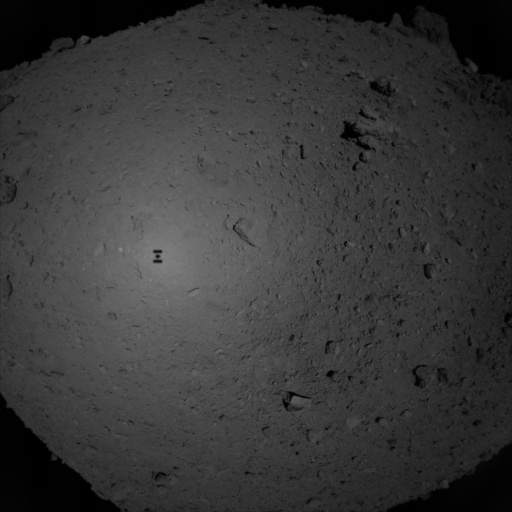
The shadow of Hayabusa 2 on the Ryuga asteroid.

Mission managers hoped to grab the first sample with Hayabusa 2 in late October, but officials postponed the descent to complete additional analysis and surveys after the spacecraft found the asteroid is more rocky and rugged than expected. Managers decided to deploy a target marker at their preferred landing site for Hayabusa 2’s first sampling attempt, helping the spacecraft navigate a narrow corridor to safely reach a location free of boulders, which could have endangered the mission.

“Ryugu turned out to be more difficult than we expected, so we decided to deploy all kinds of technologies that are available,” Tsuda said.

Hayabusa 2 could try to gather two more samples from other locations on Ryugu before departing the asteroid in November or December. The spacecraft must begin its journey back to Earth by the end of the year to return home in December 2020, when Hayabusa 2 will release a sample carrier to re-enter the atmosphere and parachute to a landing in Australia.

Find more about the project at:

====

The Space Barons: Elon Musk, Jeff Bezos, and the Quest to Colonize the Cosmos

Videos: Chang’e-4 on the Moon + OSIRIS REx orbits Bennu + New Horizons passes Ultima Thule

The new year is off to a very impressive start in space science:

** China’s Chang’e 4 spacecraft landed on the far side of the moon. (See posting here.)

** OSIRIS REx successfully orbited Bennu, the smallest body ever orbited by a spacecraft. (See posting here) – NASA’s OSIRIS-REx Spacecraft Enters Close Orbit Around Bennu, Breaking Record – OSIRIS-REx Mission

Now, the spacecraft will circle Bennu about a mile (1.75 kilometers) from its center, closer than any other spacecraft has come to its celestial object of study. (Previously the closest orbit of a planetary body was in May 2016, when the Rosetta spacecraft orbited about four miles (seven kilometers) from the center of the comet 67P/Churyumov-Gerasimenko.) The comfortable distance is necessary to keep the spacecraft locked to Bennu, which has a gravity force only 5-millionths as strong as Earth’s. The spacecraft is scheduled to orbit Bennu through mid-February at a leisurely 62 hours per orbit.

Now that the OSIRIS-REx spacecraft is closer to Bennu, physical details about the asteroid will leap into sharper focus, and the spacecraft’s tour of this rubble pile of primordial debris will become increasingly detailed and focused.

In 2020, OSIRIS-REx will come down onto the surface of Bennu and grab a sample of regolith. The sample will be returned to Earth in 2023.

** New Horizons flew past Ultima Thule, the most distant object ever targeted by a space mission. (See posting here.) New Ultima Thule Discoveries from NASA’s New Horizons – New Horizons. Here is a press briefing held on Thursday:

====

Scott Manley reviews the three heroic missions:

====

Chasing New Horizons: Inside the Epic First Mission to Pluto