Category Archives: Asteroids & Comets

NASA Mars orbiters prepare for comet passing close by

Quite possible that someday a comet will pass near earth. (If it is headed into earth, there will be little we can do about it in time unless we have a sophisticated in-space infrastructure in place.)

NASA’s Mars Spacecraft Maneuvers to Prepare for Close Comet Flyby

NASA is taking steps to protect its Mars orbiters, while preserving opportunities to gather valuable scientific data, as Comet C/2013 A1 Siding Spring heads toward a close flyby of Mars on Oct. 19.

The comet’s nucleus will miss Mars by about 82,000 miles (132,000 kilometers), shedding material hurtling at about 35 miles (56 kilometers) per second, relative to Mars and Mars-orbiting spacecraft. At that velocity, even the smallest particle — estimated to be about one-fiftieth of an inch (half a millimeter) across — could cause significant damage to a spacecraft.

This graphic depicts the orbit of comet C/2013 A1 Siding Spring as it swings around the sun in 2014. On Oct. 19, the comet will have a very close pass at Mars. Its nucleus will miss Mars by about 82,000 miles (132,000 kilometers). The comet's trail of dust particles shed by the nucleus might be wide enough to reach Mars or might also miss it. For more information about this comet, see http://mars.nasa.gov/comets/sidingspring/.
This graphic depicts the orbit of comet C/2013 A1 Siding Spring as it swings
around the sun in 2014. On Oct. 19, the comet will have a very close pass
at Mars. Its nucleus will miss Mars by about 82,000 miles (132,000 kilometers).
Image Credit: NASA/JPL-Caltech
NASA currently operates two Mars orbiters, with a third on its way and expected to arrive in Martian orbit just a month before the comet flyby. Teams operating the orbiters plan to have all spacecraft positioned on the opposite side of the Red Planet when the comet is most likely to pass by.

“Three expert teams have modeled this comet for NASA and provided forecasts for its flyby of Mars,” explained Rich Zurek, chief scientist for the Mars Exploration Program at NASA’s Jet Propulsion Laboratory (JPL) in Pasadena, California. “The hazard is not an impact of the comet nucleus, but the trail of debris coming from it. Using constraints provided by Earth-based observations, the modeling results indicate that the hazard is not as great as first anticipated. Mars will be right at the edge of the debris cloud, so it might encounter some of the particles — or it might not.”

During the day’s events, the smallest distance between Siding Spring’s nucleus and Mars will be less than one-tenth the distance of any known previous Earthly comet flyby. The period of greatest risk to orbiting spacecraft will start about 90 minutes later and last about 20 minutes, when Mars will come closest to the center of the widening dust trail from the nucleus.

NASA’s Mars Reconnaissance Orbiter (MRO) made one orbit-adjustment maneuver on July 2 as part of the process of repositioning the spacecraft for the Oct. 19 event. An additional maneuver is planned for Aug. 27. The team operating NASA’s Mars Odyssey orbiter is planning a similar maneuver on Aug. 5 to put that spacecraft on track to be in the right place at the right time, as well.

NASA’s Mars Atmosphere and Volatile Evolution (MAVEN) spacecraft is on its way to the Red Planet and will enter orbit on Sept. 21. The MAVEN team is planning to conduct a precautionary maneuver on Oct. 9, prior to the start of the mission’s main science phase in early November.

In the days before and after the comet’s flyby, NASA will study the comet by taking advantage of how close it comes to Mars. Researchers plan to use several instruments on the Mars orbiters to study the nucleus, the coma surrounding the nucleus, and the tail of Siding Spring, as well as the possible effects on the Martian atmosphere. This particular comet has never before entered the inner solar system, so it will provide a fresh source of clues to our solar system’s earliest days.

MAVEN will study gases coming off the comet’s nucleus into its coma as it is warmed by the sun. MAVEN also will look for effects the comet flyby may have on the planet’s upper atmosphere and observe the comet as it travels through the solar wind.

Odyssey will study thermal and spectral properties of the comet’s coma and tail. MRO will monitor Mars’ atmosphere for possible temperature increases and cloud formation, as well as changes in electron density at high altitudes. The MRO team also plans to study gases in the comet’s coma. Along with other MRO observations, the team anticipates this event will yield detailed views of the comet’s nucleus and potentially reveal its rotation rate and surface features.

Mars’ atmosphere, though much thinner than Earth’s, is thick enough that NASA does not anticipate any hazard to the Opportunity and Curiosity rovers on the planet’s surface, even if dust particles from the comet hit the atmosphere and form into meteors. Rover cameras may be used to observe the comet before the flyby, and to monitor the atmosphere for meteors while the comet’s dust trail is closest to the planet.

Observations from Earth-based and space telescopes provided data used for modeling to make predictions about Siding Spring’s Mars flyby, which were in turn used for planning protective maneuvers. The three modeling teams were headed by researchers at the University of Maryland in College Park, the Planetary Science Institute in Tucson, Arizona, and JPL.

For more information about the Mars flyby of comet Siding Spring, visit: mars.nasa.gov/comets/sidingspring/

For more information about NASA’s Mars Exploration Program, visit: www.nasa.gov/mars
ESA’s Rosetta probe nears its target comet and finds it weirdly shaped

The European Space Agency’s Rosetta  probe was launched in March 2004 on an Ariane V rocket and on August 6th it will finally

rendezvous with Comet 67P/Churyumov-Gerasimenko and remain in close proximity to the icy nucleus as it plunges towards the warmer inner reaches of the Sun’s domain. At the same time, a small lander will be released onto the surface of this mysterious cosmic iceberg.


Here is a post from the Rosetta blog about how the comet’s structure is starting to come into focus:

The dual personality of comet 67P/C-G 

This week’s images of comet 67P/Churyumov-Gerasimenko reveal an extraordinarily irregular shape. We had hints of that in last week’s images and in the unscheduled previews that were seen a few days ago, and in that short time it has become clear that this is no ordinary comet. Like its name, it seems that comet 67P/C-G is in two parts.

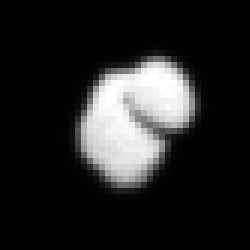
Comet 67P/C-G imaged on 14 July 2014 from a distance of approximately 12 000 km. Credits: ESA/Rosetta/MPS for OSIRIS Team MPS/UPD/LAM/IAA/SSO/INTA/UPM/DASP/IDAComet 67P/C-G imaged on 14 July 2014 from a distance of approximately 12 000 km.
Credits: ESA/Rosetta/MPS for
OSIRIS Team MPS/UPD/LAM/IAA/SSO/INTA/UPM/DASP/IDA

What the spacecraft is actually seeing is the pixelated image shown [above], which was taken by Rosetta’s OSIRIS narrow angle camera on 14 July from a distance of 12 000 km.

A second image and a movie show the comet after the image has been processed. The technique used, called “sub-sampling by interpolation”, only acts to remove the pixelisation and make a smoother image, and it is important to note that the comet’s surface features won’t be as smooth as the processing implies. The surface texture has yet to be resolved simply because we are still too far away; any apparent brighter or darker regions may turn out to be false interpretations at this early stage.

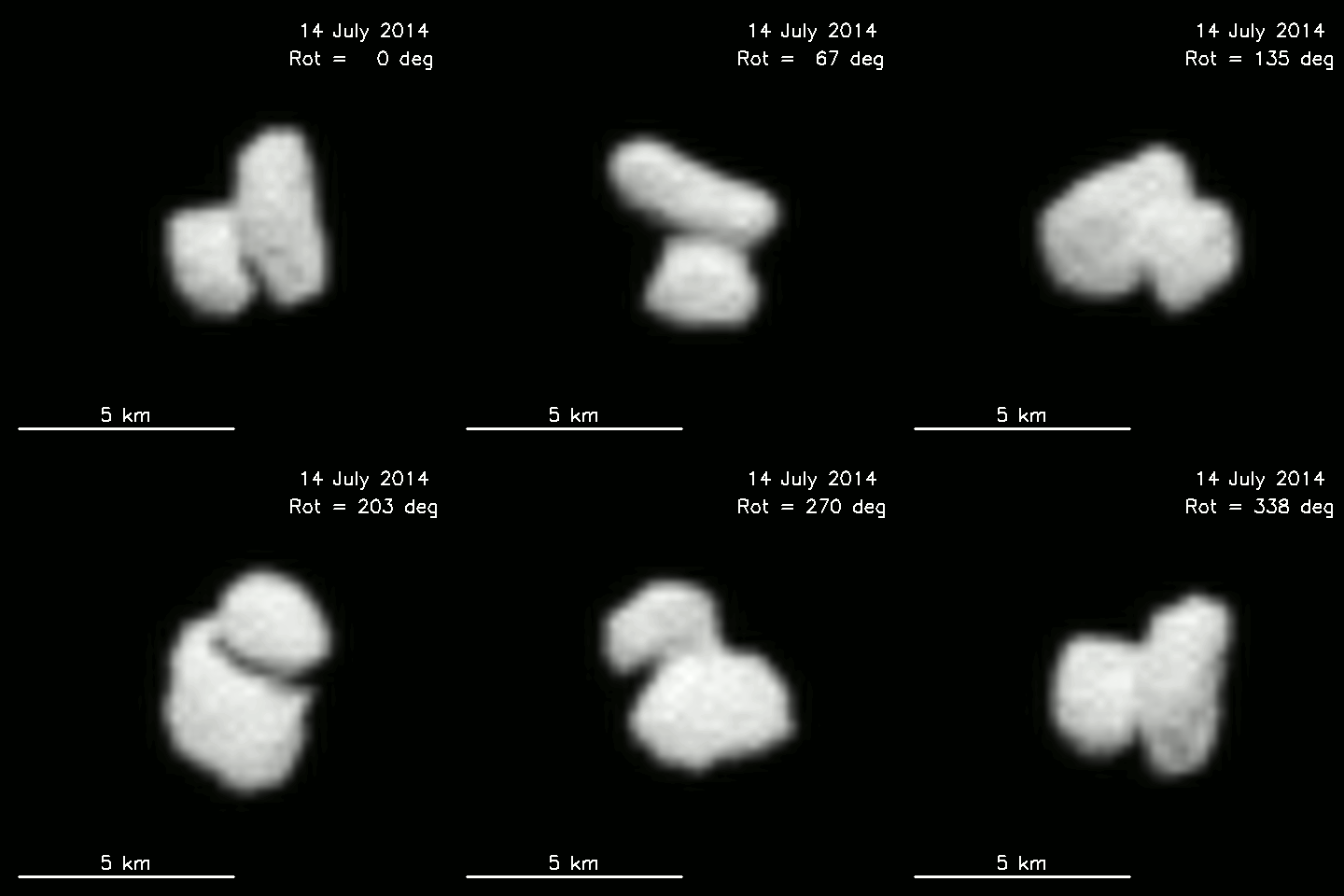
But the movie, which uses a sequence of 36 interpolated images each separated by 20 minutes, certainly provides a truly stunning 360-degree preview of the overall complex shape of the comet. Regardless of surface texture, we can certainly see an irregular shaped world shining through. Indeed, some people have already likened the shape to a duck, with a distinct body and head.

Although less obvious in the ‘real’ image, the movie of interpolated images supports the presence of two definite components. One segment seems to be rather elongated, while the other appears more bulbous.

Rotating view of comet 67P/C-G on 14 July 2014. Credits: ESA/Rosetta/MPS for OSIRIS Team MPS/UPD/LAM/IAA/SSO/INTA/UPM/DASP/IDA
Rotating view of comet 67P/C-G on 14 July 2014.
Credits: ESA/Rosetta/MPS for
OSIRIS Team MPS/UPD/LAM/IAA/SSO/INTA/UPM/DASP/IDA

Dual objects like this – known as ‘contact binaries’ in comet and asteroid terminology – are not uncommon.

Indeed, comet 8P/Tuttle is thought to be such a contact binary; radio imaging by the ground-based Arecibo telescope in Puerto Rico in 2008 suggested that it comprises two sphere-like objects. Meanwhile, the bone-shaped comet 103P/Hartley 2, imaged during NASA’s EPOXI flyby in 2011, revealed a comet with two distinct halves separated by a smooth region. In addition, observations ofasteroid 25143 Itokawa by JAXA’s Hayabusa mission, combined with ground-based data, suggest an asteroid comprising two sections of highly contrasting densities.

Is Rosetta en-route to rendezvous with a similar breed of comet? The scientific rewards of studying such a comet would be high, as a number of possibilities exist as to how they form.

One popular theory is that such an object could arise when two comets – even two compositionally distinct comets – melded together under a low velocity collision during the Solar System’s formation billions of years ago, when small building blocks of rocky and icy debris coalesced to eventually create planets. Perhaps comet 67P/C-G will provide a unique record of the physical processes of accretion.

Or maybe it is the other way around – that is, a single comet could be tugged into a curious shape by the strong gravitational pull of a large object like Jupiter or the Sun; after all, comets are rubble piles with weak internal strength as directly witnessed in the fragmentation of comet Shoemaker-Levy 9 and the subsequent impacts into Jupiter, 20 years ago this week. Perhaps the two parts of comet 67P/C-G will one day separate completely.

On the other hand, perhaps comet 67P/C-G may have once been a much rounder object that became highly asymmetric thanks to ice evaporation. This could have happened when the comet first entered the Solar System from the Kuiper Belt, or on subsequent orbits around the Sun.

Comet 67P/C-G on 14 July 2014 – processed view. Credits: ESA/Rosetta/MPS for OSIRIS Team MPS/UPD/LAM/IAA/SSO/INTA/UPM/DASP/IDA

Comet 67P/C-G on 14 July 2014 – processed view.
Credits: ESA/Rosetta/MPS for
OSIRIS Team MPS/UPD/LAM/IAA/SSO/INTA/UPM/DASP/ID

One could also speculate that the striking dichotomy of the comet’s morphology is the result of a near catastrophic impact event that ripped out one side of the comet. Similarly, it is not unreasonable to think that a large outburst event may have weakened one side of the comet so much that it simply gave away, crumbling into space.

But, while the interpolated images are certainly brilliant, we need to be closer still to see a better three-dimensional view – not to mention to perform a spectroscopic analysis to determine the comet’s composition – in order to draw robust scientific conclusions about this exciting comet.

Rosetta Mission Manager Fred Jansen comments: “We currently see images that suggest a rather complex cometary shape, but there is still a lot that we need to learn before jumping to conclusions. Not only in terms of what this means for comet science in general, but also regarding our planning for science observations, and the operational aspects of the mission such as orbiting and landing.

“We will need to perform detailed analyses and modelling of the shape of the comet to determine how best we can fly around such a uniquely shaped body, taking into account flight control and astrodynamics, the science requirements of the mission, and the landing-related elements like landing site analysis and lander-to-orbiter visibility. But, with fewer than 10 000 km to go before the 6 August rendezvous, our open questions will soon be answered.”

Ceres and Vesta to have historic close encounter

The two largest asteroids – Ceres and Vesta – will appear to have a close approach this weekend: Watch Historic Meeting of Two Monster Asteroids in the Sky This Weekend – News Watch

Not since their discovery more than 200 years ago has anyone observed these two giants of the main asteroid belt pair up so closely in the heavens.

Since spring, keen-eyed sky-watchers using nothing more than binoculars or small telescopes have followed the cosmic duo. The two asteroids have flown in tandem, looping across the Virgo constellation now visible in the southwestern evening skies.

Ceres is actually now referred to as a dwarf  planet since it had enough mass to pull itself into a sphere.

The online observatory Slooh.com will have a special live webcast to watch the event.

See also Small solar system targets take center stage – Astronomy.com.

Asteroid Zoo: A new citizen science project

An announcement from Planetary Resource and Zooniverse:

PLANETARY RESOURCES AND ZOONIVERSE LAUNCH
ASTEROID ZOO,
A CITIZEN SCIENCE ASTEROID CHALLENGE

Asteroid Zoo Engages Public in Search for Near Earth Asteroids that are
Potentially Hazardous, Resource Rich or Possible Human Destinations

Redmond, Washington – June 24, 2014 – Planetary Resources, the asteroid mining company, and Zooniverse today launched Asteroid Zoo (www.asteroidzoo.org), empowering students, citizen scientists and space enthusiasts to aid in the search for previously undiscovered asteroids. The program allows the public to join the search for Near Earth Asteroids (NEAs) of interest to scientists, NASA and asteroid miners, while helping to train computers to better find them in the future.

Asteroid Zoo joins the Zooniverse’s family of more than 25 citizen science projects! It will enable participants to search terabytes of imaging data collected by Catalina Sky Survey (CSS) for undiscovered asteroids in a fun, game-like process from their personal computers or devices. The public’s findings will be used by scientists to develop advanced automated asteroid-searching technology for telescopes on Earth and in space, including Planetary Resources’ ARKYD.

“With Asteroid Zoo, we hope to extend the effort to discover asteroids beyond astronomers and harness the wisdom of crowds to provide a real benefit to Earth,” said Chris Lewicki, President and Chief Engineer, Planetary Resources, Inc. “Furthermore, we’re excited to introduce this program as a way to thank the thousands of people who supported Planetary Resources through Kickstarter. This is the first of many initiatives we’ll introduce as a result of the campaign.”

Planetary Resources’ partnership with Zooniverse was announced in the midst of the company’s successful Kickstarter crowdfunding campaign for ARKYD – the world’s first space telescope for public use. Last year, Planetary Resources exceeded its original US$1M goal and raised over US$1.5M with more than 18,000 people from around the globe pledging their support, ranking Planetary Resources’ effort among the top 25 campaigns in Kickstarter history.  It was then the organizations decided to create Asteroid Zoo, leveraging the public’s interest in space and asteroid detection.  The challenge is made possible, in part, by a grant from Planetary Resources to Adler Planetarium, where the Zooniverse has a large development team. Also contributing to the project is Amazon.com by hosting the CSS imaging data on its servers as a public data set.

Chris Lintott, astronomer at the University of Oxford and Zooniverse Principal Investigator said, “Zooniverse believes in doing projects that make authentic contributions to science. So, in addition to being excited to share the data from this massive asteroid hunt with the whole astronomical community, we’re especially pleased that Asteroid Zoo will also focus on improving machine learning solutions to finding asteroids. In the future, we hope to use the classifications provided by volunteers to improve automated searching and suggest new methods by which machines might take up the strain.”

Of all the asteroids ever discovered, 93 percent were found in only the last 15 years and nearly half of the NEAs were discovered by CSS. Approximately 620,000 objects are currently tracked in our Solar System – representing only one percent of the estimated 60 million asteroids orbiting the Sun. Using Asteroid Zoo, anyone with a computer or mobile device can now join in the search to track unknown asteroids. While over 90 percent of Potentially Hazardous Asteroids are known to scientists right now, less than one percent of asteroids smaller than 100m have been found. These asteroids are still capable of regional disaster, such as massive damage to a metro city.

NASA has also listed planetary defense as a top priority, having signed a Space Act Agreement with Planetary Resources last year to design and implement crowdsourcing algorithm challenges in the effort to detect, track and characterize NEAs. This algorithm challenge, called Asteroid Data Hunters, has completed phase 1 and is approaching the start of the next marathon match. It is anticipated that the data set gathered by Asteroid Zoo will feed into future NASA challenges. Data compiled and used in Asteroid Zoo and Asteroid Data Hunters will both be open-sourced and publicly available.

About Zooniverse

The Zooniverse is home to the Internet’s largest, most popular and most successful citizen science projects, in topics from astronomy to zoology. It began in 2007 with the launch of Galaxy Zoo, and includes projects such as Old Weather, Planet Hunters, Condor Watch, and Sunspotter. The Zooniverse and the suite of projects it contains is produced, maintained and developed by the Citizen Science Alliance. The member institutions of the CSA work with many academic and other partners around the world to produce projects that use the efforts and ability of volunteers to help scientists and researchers deal with the flood of data that confronts them.

Follow the Zooniverse on Twitter @the_zooniverse and for more information, please visit www.zooniverse.org/about.

About Planetary Resources

Planetary Resources, Inc. was founded in 2009 by Eric Anderson and Dr. Peter H. Diamandis. Our vision is to establish a new paradigm for resource utilization that will bring the Solar System within humanity’s economic sphere of influence. The company will conduct low-cost robotic space exploration beginning with the ARKYD Series of space missions that will identify the most commercially viable near-Earth asteroids. These initial missions will assist the company in enabling the retrieval of raw materials from these select asteroids, including water, precious metals and more.

Planetary Resources is financed by industry-launching visionaries, three of whom include Google’s CEO Larry Page & Executive Chairman Eric Schmidt; and Ross Perot, Jr., Chairman of Hillwood and The Perot Group; who are committed to expanding the world’s resource base so humanity can continue to grow and prosper for centuries to come. Some of the company’s partners and advisors include the Bechtel Corporation; film maker and explorer James Cameron; former Chief of Staff, United States Air Force General T. Michael Moseley (Ret.); and Sara Seager, Ph.D., Professor of Planetary Science and Physics at MIT. Members of the company’s technical staff have worked on every recent U.S. Mars lander including Spirit, Opportunity and Curiosity, and include other key non-aerospace and safety-critical disciplines. For more information, please visit www.planetaryresources.com.

Follow us on Twitter, Facebook, Google+ and YouTube for all the latest updates!


Video: NASA asteroid initiative status report

NASA posted two press releases yesterday about the developments in the  agency’s Asteroid Initiative. This includes a program to look for and track near earth asteroids . The current long term goal is to send an unmanned system to rendezvous with, capture, and move a small asteroid into an orbit in the Earth-Moon system where it would be visited by NASA astronauts:

Here is a video of discussion on June 19th by several NASA managers and scientists about the asteroid program :