In this PBS News Hour segment, Miles O’Brien reports on efforts to find and track asteroids and comets that could impact earth:
In this PBS News Hour segment, Miles O’Brien reports on efforts to find and track asteroids and comets that could impact earth:
The comet Siding Spring is just about to reach its closest approach to Mars. Below are links to various sites with info and imagery:

* Latest NASA news and images:
On Sunday, Oct. 19, Comet C/2013 A1, also known as comet Siding Spring, will pass within about 87,000 miles (139,500 kilometers) of the Red Planet — less than half the distance between Earth and our moon and less than one-tenth the distance of any known comet flyby of Earth. Siding Spring’s nucleus will come closest to Mars around 11:27 a.m. PDT (2:27 p.m. EDT), hurtling at about 126,000 mph (56 kilometers per second).

* ESA live webcast: European Space Agency – live streaming video powered by Livestream
* Live webcast from the SLOOH online observatory: live.slooh.com – Comet Siding Spring Swings by on a Close Approach to Mars
* Display of the current position of the comet in the sky: Comet C/2013 A1 (Siding Spring) Live Position and Finder Chart – TheSkyLive
* An animation of NASA’s Mars Odyssey orbiter maneuvering to image Comet Siding Spring:
Path of the comet:
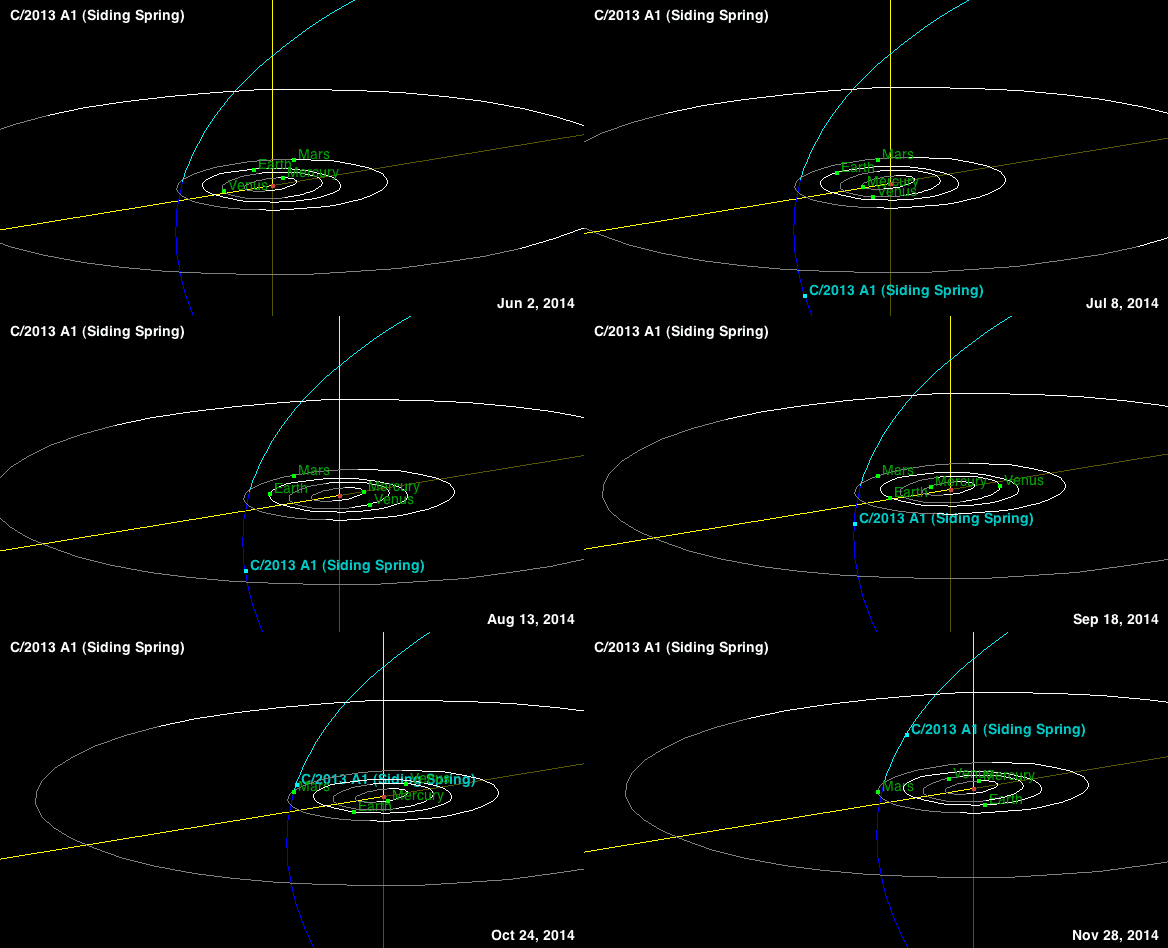 Brought to you by the Near-Earth Object (NEO) office
at NASA’s Jet Propulsion Laboratory.
The latest episode of Xploration Outer Space Online is about asteroids, including how to mine them:
Astronomer Bruce Betts of the Planetary Society lays out all the basics about Comet Siding Spring, which on October 19, 2014 will make a close fly-by of Mars.
Richard Penn points me to his “hard” science fiction book series under the title of the Asteroid Belt Police:
The adventures of a young policewoman begin at a space station at the asteroid Terpsichore in the year 2060, and follow her and her team as they track down a secret colony where women and children are kept as slaves. This is “hard” science fiction, with no magic forces or time-warps, where space travel is hard and takes many months. Colonists invent and build their own equipment from local materials. While truly isolated, they are part of a movement aiming to create thousands of independent communities throughout the Belt.
* Freedom at Feronia – Volume 2
Lisa and her team of asteroid police have captured a nuclear rocket, and rescued a dozen kidnapped children. They aim to return the children to Mars, but first they need to build a ship. The rebel colony of Feronia is on the way, taken over by Christian fundamentalists. Can they return it to civilization, and what kind of government will lead to a long-term peace? This is hard science-fiction, with no laser swords or time-warps, where space travel is difficult and takes many months, and the people who live in space must use engineering innovation to build what they need from local materials.

