Category Archives: Rockets

20th Anniversary of the first DC-X Flight – special event in New Mexico

You may have noticed the new ad here for the DC-X 20 year anniversary symposium, August 16-18, in New Mexico –
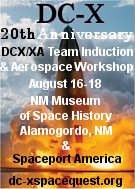
DC-X Anniversary Event

The DC-X (Delta Clipper eXperimental) project was a seminal event in the development of the NewSpace approach to space development. Using a 1950’s X-project organizational style, it accomplished all its goals (e.g. repeated vertical takeoffs and landings, rapid turnaround between flights, lightweight hydrogen tank, flight operation with a very small team, etc.) at 1/10th cost that would have been spent if carried out in the standard NASA/USAF procurement manner. The project aimed to be the start of a systematic step-by-step development program leading to a fully reusable orbital launch vehicle. Unfortunately, while DC-X/XA successfully made the first step, the project got derailed with the over-complicated, over-ambitious X-33. Find lots of resources about the project in the DC-X History section.

Henry Vanderbilt gives his endorsement of the anniversary event here:

We’re coming up fast on the 20th anniversary of DC-X’s first flight later this month, and some of the people involved have organized a conference in New Mexico to mark the occasion.  I’ve volunteered to help out with the conference, and that’s what I’m writing to you about today.

Much of the original DC-X team will be there, to be honored and to talk about how they did it, techniques used and lessons learned.  There will also be a look at some of the many things that came of DC-X’s success, plus a Reusable Spaceplane X-Vehicles workshop looking to what should come next, as well as a tour of the New Mexico Spaceport.

This is a one-of-a-kind event.  It’s very unlikely that all these people will ever be in one place at the same time again.  If you have a deep interest in where “new space” came from, where it is now, and where it should go next, this event is more than worth a trip to New Mexico in August.

Conference agenda and details at http://dc-xspacequest.org/

thanks for your time

Henry Vanderbilt
founder
Space Access Society

The Rocket Company: Chapters 13-16

In the continuing serialization of the updated version of the book The Rocket Company by Patrick J. G. Stiennon and David M. Hoerr, with illustrations by Doug Birkholz.  This week you can obtain the following chapters of the book:

Download these within the next week or so. Only four chapters will be available at any one time.

See also the electronic version of the updated book is available at  The Rocket Company eBook by Patrick Stiennon, David Hoerr, Peter Diamandis, Doug Birkhol: Kindle Store/Amazon.com.

Today on The Space Show – Erik Seedhouse and his book on SpaceX

David Livingston will talk with Erik Seedhouse of Astronauts4Hire will talk about his new book SpaceX: Making Commercial Spaceflight a Reality on today at 12 PM PDT (3 PM EDT). Call in at 1-866-687-7223 .

Video: Morpheus lander tethered test with lateral translation

On Friday the Project Morpheus Vertical Takeoff and Landing rocket vehicle flew another tethered test , this time with a short horizontal translation included:

Caption:

The Morpheus/ALHAT team successfully completed TT27 with ALHAT on board Morpheus’ Bravo vehicle, meeting all test objectives including ALHAT tracking & imaging and Bravo lateral translation and long duration flight. We’ve offloaded propellants and are purging the tanks. Initial indications are that ALHAT and Bravo systems performed nominally, with one exception…

Telemetry data froze on MCC screens during the flight and returned immediately after the flight with no apparent dropouts, presumably buffered onboard the vehicle. The MCC maintained radio contact with the vehicle (and Thrust Termination System (TTS) throughout the flight, suggesting a temporary onboard data buffering issue rather than a comm issue. The MCC also maintained video and direct visual observation of the vehicle throughout the flight, saw no evidence of loss of control or deviation from the planned trajectory, and allowed it to complete its full ~80 second flight profile. (The 1st hover duration was reduced by 10 sec, reducing the overall flight time by the same amount, in order to maintain safety reserves with the actual pre-ignition propellant load.) Though not a flight risk to a fully autonomous vehicle, the telemetry data buffering issue between the vehicle and the MCC will be investigated and fixed by the Morpheus team. The experienced Morpheus/ALHAT ops team maintained steady, steely-eyed focus throughout the loss of telemetry data, enabling successful completion of TT27.

The Morpheus/ALHAT team will spend the next few days de-integrating ALHAT from the Bravo vehicle in B.220 in preparation for shipping ALHAT to KSC for Free Flight testing later this summer and fall. With ALHAT mass simulators instead of laser sensors atop Bravo, the Morpheus team plans to conduct TT28 next week and a couple more JSC tests after that before packing up and shipping Bravo off to KSC in late August. We’re marching inexorably toward flying free at KSC.

Video: NASA Evolutionary Xenon Thruster (NEXT)

This NASA video describes the NASA Evolutionary Xenon Thruster or NEXT, which

is an advanced Ion propulsion system developed at Glenn Research Center. Its unmatched fuel efficiency could give a real boost to future deep space exploration missions — extending the reach of NASA science missions and yielding a higher return on scientific research.