Category Archives: Rockets

Space transport roundup – June.18.2019

A sampling of recent articles, videos, and images dealing with space transport:

** Gyroc tethered hover testAirbourne Engineering in the UK:  Successful Test of VTVL Rocket | Airborne Engineering Limited

…The vehicle, codenamed Gyroc (a shortening of “gyro-stabilised rocket”) is the result of an internal research and development project that has been under way at Airborne for a few years at our Westcott facility in the United Kingdom. VTVL rockets like Gyroc can be used to test technologies required for landing on other planets, such as the Moon or Mars. We believe that this is the first time such a vehicle has been successfully tested in Europe.

… Gyroc uses non-toxic rocket propellants (nitrous oxide and isopropyl alcohol,) weighs about 20kg and can hover for over 30 seconds. After more testing, we plan to scale-up the vehicle so that it can be used to assist other organisations developing autonomous planetary landing technology and who need a way to carry out testing in a realistic way on the Earth. Although the development of Gyroc has been entirely self-funded by Airborne Engineering, we are very grateful to the European Space Agency who have kindly provided some additional funds to support the recent test programme. It is hoped this will lead to future collaboration.

** Stratolaunch is up for sale:

CNBC:

The hefty price tag includes ownership of the airplane as well as the intellectual property and facilities.

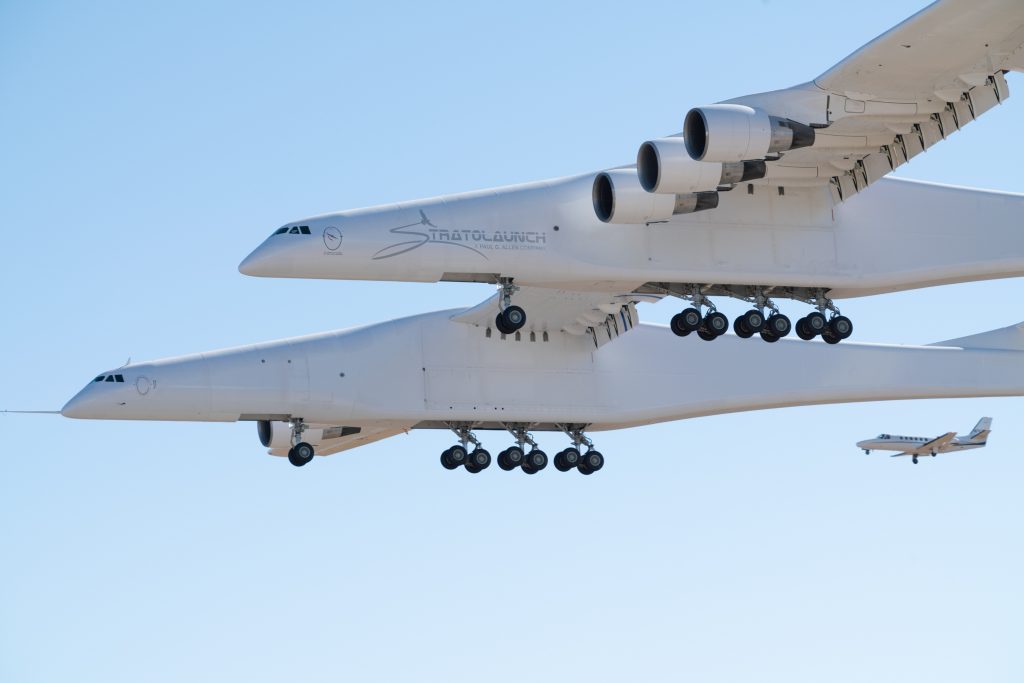
Stratolaunch is the world’s largest airplane by wingspan, which stretches 385 feet — longer than an American football field. The plane is powered by six jet engines salvaged from Boeing 747 aircraft.

Allen’s vision of a massive plane that can launch rockets from the air was at least partially fulfilled in April, when Stratolaunch flew for the first time after about eight years in development. Based at the Mojave Air and Space Port in California, the giant airplane flew for more than two hours before landing after what was deemed a successful first flight.

** Blue Origin has several major projects underway in Florida: Blue Origin investing $1 billion into Space Coast for ‘road to space’ – Florida Today

If all goes according to Blue Origin’s ambitious plan, the Space Coast will become the opening phase of a “road to space” for millions of people taking their livelihoods beyond Earth’s fragile atmosphere.

The Jeff Bezos-led company is investing more than a billion dollars into the region to transform infrastructure — old and new — into gateways for its upcoming New Glenn rocket, a towering vehicle slated to launch from Cape Canaveral Air Force Station no earlier than 2021. It will also be built, launched and refurbished here after landing on a ship in the Atlantic Ocean.

“New Glenn is all about millions of people living and working in space,” Scott Henderson, Blue Origin’s vice president of test and flight operations, said Tuesday during a National Space Club Florida Committee luncheon in Cape Canaveral. “It sets the foundation for building an infrastructure required to get to space.”

** Ariane V rocket set to liftoff from Kourou, French Guiana on June 20th with the AT&T T-16 and Eutelsat 7C communications satellites during the window 2143-2330 GMT (5:43-7:30 p.m. EDT).

VS248 payloads
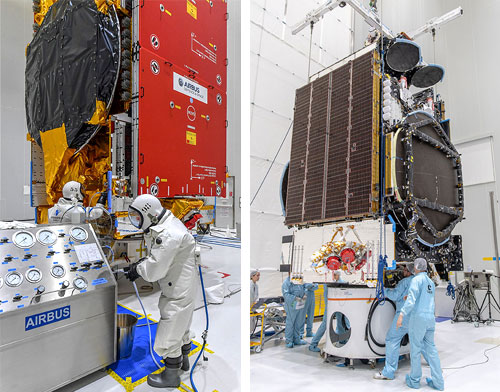
“Flight VA248’s two satellite passengers are readied for launch during parallel activity inside the Spaceport’s S5 building. The photo at left shows AT&T T-16 during its fueling process, while at right EUTELSAT 7C undergoes its fit-check with the payload adapter that will provide the interface with Ariane 5 when integrated on the launcher.” – Arianespace

** Russian Proton rocket set to launch the German and Russian X-ray telescopes on June 21st at 1217 GMT (8:17 am EDT) from the Baikonur Cosmodrome, Kazakhstan: Proton rocket, Russian-German astronomy satellite arrive at launch pad – Spaceflight Now

** ULA Vulcan rocket development update: ULA Preparing Proven Hardware and New Innovations for Vulcan – NASASpaceFlight.com

One of the only components of Vulcan Centaur which will likely not fly prior to Vulcan’s debut is the BE-4 engine, two of which will power Vulcan’s first stage. The BE-4 is a liquid methane and liquid oxygen fueled engine developed by Blue Origin, originally for their New Glenn launch vehicle.

New Glenn is also expected to debut in 2021, so the BE-4 could only fly prior to Vulcan’s debut if New Glenn flies first. The BE-4, as well as BE-3U engines for New Glenn, will be manufactured at a new factory in Huntsville, Alabama, not far from ULA’s Decatur factory. Construction equipment has begun to arrive at the factory site.

Prototype engines have been test fired extensively at Blue Origin’s West Texas facility, also the launch site of their suborbital New Shepard vehicle. Further testing and eventual qualification of the engine will take place in Texas, as well as the 4670 test stand at NASA’s Marshall Space Flight Center in Huntsville. Blue Origin is also preparing an engine test facility at LC-11 at Cape Canaveral Air Force Station in Florida, next to the future launch site of New Glenn, LC-36.

** Firefly seeking payloads for first demo flight of Alpha rocket:

The company

has an (undisclosed) customer for the flight, but the smallsat launcher also has some unused capacity for the mission—the Alpha rocket has about twice as much lift as an existing competitor, Rocket Lab’s Electron vehicle.

So on Monday, Firefly announced that it will accept some academic and educational payloads free of charge on the Alpha flight. “We’ve wanted to do something like this on our first flight from the beginning,” Markusic said. The payloads will fly to a 300km circular orbit, with a 97-degree inclination.

** SpaceX:

*** STP-2 Falcon Heavy launch preparations: Liftoff from Pad-39A at Cape Kennedy Space Center is set for a window that opens on the evening of June 24th at 11:30 pm-3:30 am EDT (0330-0730 GMT)

If the routine test goes as planned, SpaceX’s third completed Falcon Heavy will be ready to lift off as early as 11:30 pm ET (03:30 UTC), June 24th. Atop the massive rocket will be the US Air Force’s Space Test Program-2 (STP-2) mission, a collection of 24 small satellites from a variety of US government agencies and academic institutions. Practically speaking, STP is often more of an engineered excuse to launch, involving satellites and customers that are willing to accept higher risk than more valuable payloads, making it far easier for the US military to certify new technologies and new commercial launch vehicles.

As previously discussed on Teslarati, STP-2 is an extremely ambitious mission that aims to simultaneously certify or pave the way towards certification of critical capabilities. First and foremost, it will (barring serious anomalies) give the US military the data it needs to certify SpaceX’s Falcon Heavy rocket for all national defense launches, giving ULA’s Delta IV Heavy its first real competition in a decade and a half.

Included under the umbrella of that catch-all certification is a sort of torture-test validation of the long-coast capabilities of SpaceX’s Falcon upper stage. To successfully complete STP-2, the upper stage will be subjected to “four separate upper-stage engine burns, three separate deployment orbits, a final propulsive passivation maneuver, and a total mission duration of over six hours.” It will likely be SpaceX’s most technically-challenging launch ever.

*** Planetary Society’s LightSail-2 solar sail on FH flight and the Society is providing lots of information on all aspects of the launch:

*** The Falcon 9 launch of the RadarSat constellation spacecraft looks to be the last SpaceX launch from Vandenberg for several months:

*** Announcement of Korean satellite launch contract may be just one of several launches for 2019 that have not yet been revealed by SpaceX: SpaceX Falcon 9 wins Korean launch contract as 2019 mystery missions persist – Teslarati

As previously discussed in both Teslarati articles and newsletters, comments from SpaceX executives in February and May 2019 reiterate the company’s expectation of 18-21 launches in 2019, excluding Starlink. Hofeller’s “more than 21 launches” admittedly came more than two months before a catastrophic Crew Dragon failure threw the spacecraft’s launch manifest into limbo.

Three months later, SpaceX President and COO Gwynne Shotwell reiterated the idea that SpaceX could beat its 2018 launch record (21 launches) or at least get close. Curiously, she specifically noted that SpaceX’s purported 18-21 launch manifest excluded Starlink missions, of which SpaceX has already launched one. In short, SpaceX has completed 7 launches in 2019 (6 if Starlink v0.9 is excluded). The company’s public manifest – unofficially cobbled together by fans – shows 9 more launches scheduled for a total of 15 non-Starlink launches in 2019.

To meet Shotwell’s expected 18-21 non-Starlink launches, anywhere from 3 to 6 missions are apparently missing from publicly-managed launch manifests. It’s unclear if SpaceX actually has enough launch-ready customers to achieve those ambitious targets. Additionally, SpaceX is currently on track to complete 8 launches total (1 Starlink) in the first half of 2019. In 2017 and 2018 (two years without interruption), SpaceX consistently launched an equivalent number (or more) missions in the first half of the year when compared to the second half, and both years have maxed out at 9 launches in H2.

*** SpaceX aiming Starlink internet services at markets outside of densely populated urban areas: SpaceX CEO Elon Musk hints at Starlink’s global reach at Tesla shareholder event – Teslarati

Elon Musk’s specific comment indicated that Starlink – at least in its current iteration – was never meant to serve more than “3-5%” of Earth (population: ~7.8 billion), with most or all of its users nominally located in areas with low to medium population densities. This generally confirms technical suspicions that Starlink (and other constellations like OneWeb and Telesat) is not really capable of providing internet to everyone per se.

For SpaceX, each Starlink satellite – per official statements that the first 60 satellites represent more than 1 terabit of bandwidth – likely offers bandwidth of roughly 17-20 gigabits per second. In simpler terms, this means that one Starlink satellite overhead could theoretically support as many as 4000 users simultaneously streaming YouTube videos at 1080p/30fps, a figure that sounds impressive but glosses over the sheer number of people that live in cities. Importantly, every single Starlink satellite at ~550 km will likely have a service radius of several thousand – if not tens of thousands of – square kilometers.

Here’s an overview of the Starlink project:

*** Starhopper continues to wait for it’s Raptor engine, which apparently was damaged in tests at the SpaceX facility in McGregor, Texas. Elon Musk said in a tweet that the next test hop of the Starhopper was awaiting repairs to the engine. This also means that his update on the Starship project, which he had hinted would be given on June 20th, will be postponed.

*** The roads near the Starhopper launch pad will be closed during testing times: County preps for SpaceX closures – Brownsville Herald

In a first, Cameron County has announced possible closures of Boca Chica Beach and State Highway 4 for SpaceX testing that could span a week-long window, as opposed to three-day windows.

Cameron County Judge Eddie Treviño Jr. announced in the public notice that closures are possible on June 20 and/or June 21 and/or June 22, as well as June 24 and/or June 25 and/or June 26 from 2 to 8 p.m. for space flight activities.

Testing was initially scheduled for this week, but during the last week of May and each week of June the county has announced the testing has been rescheduled.

*** Views of Starhopper and orbital demo Starship vehicles in Texas and Florida:

SpaceX is leasing Coastal Steel to build its largest spaceship ever. SpaceX CEO Elon Musk said right now, there is simultaneous construction of the interplanetary Starship going on in both Texas and Florida.


====

LEGO Ideas NASA Apollo Saturn V 21309
Outer Space Model Rocket for Kids and Adults, Science Building Kit
(1900 pieces)

Space transport roundup – June.11.2019

A sampling of recent articles, videos, and images dealing with space transport:

[ Update June.12.2019: The launch and deployment of the three RadarSat Constellation spacecraft were successful. Also, the booster landed safely back at Vandenberg AFB, which was fogged in during both the launch and landing.

]

** SpaceX Falcon 9 to launch with 3 RadarSat Constellation spacecraft on Wednesday during the window 7:17-7:30 am PDT (10:17-10:30 am EDT; 1417-1430 GMT) from Vandenberg AFB in California. The SpaceX webcast will start about 15 minutes before liftoff. Info on the mission is provide by the SpaceX RadarSat launch press kit.

More below in the SpaceX section.

** Relativity Space will 3D print and assemble rockets at Mississippi factory:

Via MDA:

Aerospace company Relativity is expanding its rocket component production and rocket engine testing operations at NASA’s Stennis Space Center in Hancock County. The project is a $59-million corporate investment and will create 190 jobs, increasing employment at Relativity’s Stennis Space Center site to 200 workers.

With this expansion, Relativity is increasing infrastructure to more than 350,000 square feet of operations, production, testing and launch facilities. In the past year, the company has increased its employment from 14 to 90 workers. Relativity became the first venture-backed company to secure a launch site Right of Entry at Cape Canaveral Launch Complex-16 from the U.S. Air Force and has a 20-year exclusive-use Commercial Space Launch Act agreement at Stennis Space Center’s E4 test complex, as well as membership on the National Space Council advising the White House.

Relativity will activate its manufacturing equipment in July and plans to complete development of the world’s first 3D-printed rocket, Terran 1, in 2020. The company is on track to conduct its first orbital test launch at the end of 2020 and enter commercial service in 2021. 

** The SpaceShipCompany is building more SpaceShipTwo rocketplanes in Mojave, California for Virgin Galactic:

** An Embry-Riddle student team fires a liquid-fueled rocket engine, which they designed and built:

** The Stanford Student Space Initiative (SSI) also fires a liquid fueled engine that they designed and built:

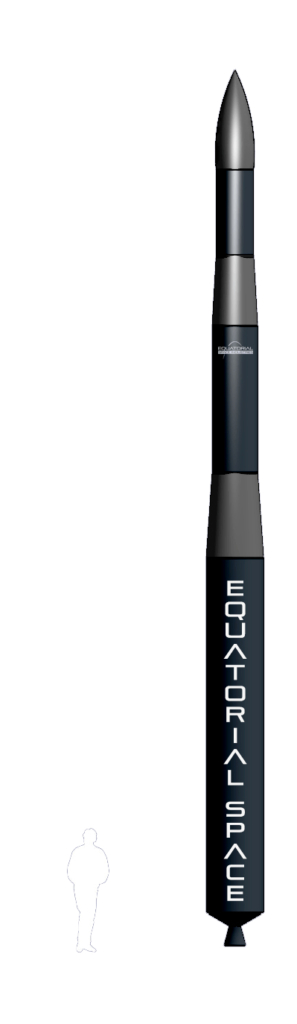
** Equatorial Space Industries is a Singapore-based rocket start-up that’s developing the Volans Block 1 vehicle, powered by a hybrid motor (Paraffin/LOX), for smallsat launch services.

Volans Block 1 Rocket“Named after southern sky’s constellation representing a flying fish, Volans
is a two-stage, hybrid-propelled launch vehicle capable of delivering
20-70kg of payload to a wide range of orbits.”

The company had a successful fund-raising round earlier this year: Equatorial Space Industries Secures Angel Funding – SpaceWatch.Global. The unspecified amount of money will

… support development of ESI’s upcoming suborbital SHARP (Suborbital Hybrid Ascent and Recovery Program) vehicle slated to fly in early 2020. The vehicle’s engine will use liquid Nitrous Oxide as compared Liquid Oxygen used in the previous v.2.2 Engine ground prototype, and will be capable of in-flight restartability.

The location of the test flight, as well as cooperation and arrangements with local suppliers and authorities, will be revealed in the next few months. ESI’s Volans microlauncher is expected to conduct its first test flight in 2021 from a yet-to-be determined location in the APAC region.

** Misc:

** SpaceX:

*** Falcon 9 booster will attempt to land back at Vandenberg after liftoff with the 3 RadarSat Constellation spacecraft:

The booster, which will be on its second flight, was test fired on the VAFB pad last Saturday: SpaceX static fires Falcon 9 for West Coast pad’s second booster landing ever – Teslarati

*** SpaceX Falcon Heavy launch of USAF STP-2 mission now set for the evening of June 24th from Pad 39A at Kennedy Space Center sometime between 11:30 pm-3:30 am EDT (0330-0730 GMT on 25th). This will be the 3rd launch of the FH and will carry 24 different satellites, most of which were funded by the USAF but also includes satellites from NASA, NOAA, and several universities.

The Planetary Society will also be flying the LightSail 2 solar light powered vehicle on the FH: LightSail 2 Has a New Launch Date! – The Planetary Society

*** SpaceX raises funding for new projects: SpaceX worth $33B after raising more than $1B for Starlink and Starship – Teslarati

Since April 2018, SpaceX has successfully raised more than $1.24 billion through the sale of equity, likely sold to investors by extrapolating the company’s current record of success to include the potential of its next two products, Starlink and Starship.

Thanks to SpaceX’s successful streak of fundraising, the company is now valued at $33.3 billion according to sources that spoke with CNBC reporter Michael Sheetz. The same source indicated that demand for SpaceX equity remains strong as the company seeks to continue extremely expensive development and production programs. Most notably, SpaceX is simultaneously building two full-scale orbital Starship prototypes at separate facilities in Texas and Florida, readying an earlier Starhopper testbed for serious test flights, and is in the midst of ramping up its Starlink satellite production to levels unprecedented in the history of spaceflight.

*** Starhopper still waiting for the Raptor engine that will power its low altitude test flights: SpaceX testing rescheduled – Brownsville Herald

According to the notice, State Highway 4 to Boca Chica Beach is scheduled to close from 2 to 8 p.m. on June 17 and/or in the alternative during the same time period on June 18 and/or June 19.

*** Views of Starhopper and Starship Orbital demo vehicle activities recently at the Boca Chica Beach, Texas facilities:

*** And some photos of the second Starship demonstrator under construction in Cocoa Beach, Florida:


====

The Space Barons: Elon Musk, Jeff Bezos, and the Quest to Colonize the Cosmos

Space transport roundup – June.7.2019

A sampling of recent articles, videos, and images dealing with space transport:

** Rocket Lab prepares for an upcoming launch, the seventh for the Electron rocket.

** China launched a Long March 11 rocket this week from a sea platform for the first time. The rocket, which has 4 solid-fueled stages, is essentially a military missile converted to an orbital launcher. The payload consisted of seven smallsats for government, education, and commercial applications.

** ESA promotes Ariane 6, Vega C, and Space Rider projects this week:

** The Space Rider is a reusable lifting body vehicle similar to the X-37B: Space Rider: Europe’s reusable space transport system – ESA

Initially proposed in 2016, ESA’s Space Rider reentry vehicle provides a return to Earth and landing capability that compliments the existing launch options of the Ariane and Vega families.

Having recently completed system and subsystem preliminary design reviews, Space Rider is advancing quickly towards the Critical design review at the end of 2019.

Launched on Vega-C, Space Rider will serve as an uncrewed high-tech space laboratory operating for periods longer than two months in low orbit. It will then re-enter the Earth’s atmosphere and land, returning its valuable payload to eager engineers and scientists at the landing site. After minimal refurbishment it will be ready for its next mission with new payloads and a new mission.

Space Rider combines reusability, in-orbit operations and transportation, and precise descent of a reentry vehicle able to safely traverse and land close to inhabited zones. These are major developments, set to extend European knowhow across a host of applications allowing industry to open up new markets.

More at ESA promotes Vega’s evolution for independent European access to space – NASASpaceFlight.com

** Russia starts development of reusable boosters: Russian hi-tech firm working on technology of space rocket’s reusable stages – TASS

Russia’s Energomash Research and Production Association is working on the technology of carrier rockets’ reusable first stages, Energomash Chief Designer Pyotr Lyovochkin said in an interview published in the June edition of the Popular Mechanics journal.

“We constantly explain to rocket builders that if we had the operational technology of returning first stages, they would have no need to buy quite an expensive engine from us just for one flight. Today both rocket builders and we have started to develop such technologies,” Lyovochkin said.

** Virgin Orbit loses most of the OneWeb launch contracts and isn’t happy about it: Virgin Orbit takes OneWeb to court over canceled launch contract – SpaceNews.com

Virgin Orbit is suing OneWeb for refusing to pay a termination fee for canceling all but four of the 39 launches it ordered from Virgin Orbit in 2015 to fill gaps in its planned constellation of at least 648 broadband satellites.

The first VO flight is coming up soon:

** First Firefly Alpha launch now set for early 2020: Firefly prepares for maiden flight with critical testing, new additions – NASASpaceFlight.com

** Scott Manley profiles the Antares rocket:

** World View Enterprises maintained a Stratollite airship at a high altitude for 16 days: Milestone 16 Day Stratollite Mission  (pdf)

World View, the stratospheric exploration company, today announced it has successfully executed a record-setting16-day Stratollite™ mission, a key step towards the productization of persistent and navigational stratospheric flight for remote sensing and communications applications.

Prior to the completion of this mission, the longest duration Stratollite flight stood at just five days. This mission moves World View one step closer to scaled commercial operations and productization of the Stratollite and the unique data sets it provides. The Stratollite enables persistent, near-real time, very-high resolution remote sensing over large specified areas of interest for commercial and government customers around the world.

** Zero2Infinity high-altitude balloon flights can now be booked via the HOSTmi – Independent-Automated-Global on line service:

** A brief overview of how the FAA regulates commercial launch: Fact Sheet – Commercial Space Transportation Activities

The Federal Aviation Administration (FAA) is responsible for ensuring protection of the public, property, and the national security and foreign policy interests of the United States during commercial launch or reentry activities, and to encourage, facilitate, and promote U.S. commercial space transportation. To date, the FAA Office of Commercial Space Transportation (AST) has licensed or permitted more than 370 launchesand reentries.

** An overview of a nuclear fusion propulsion system, which has gotten NASA and DOE funding: “Direct Fusion Drive for Rapid Deep Space Propulsion”, Stephanie Thomas, Princeton Satellite Systems. The presentation was given to the FISO group on May 29, 2019.

** SpaceX:

*** Cargo Dragon returns safely to splashdown in the Pacific with load of materials from experiments and R&D projects on the ISS:

*** Falcon 9 with the Radarsat Constellation set to lift off on June 12 from Vandenberg AFB: SpaceX Falcon 9 and $1B satellite trio set for first California launch in months – Teslarati

After the better part of both half a year of launch delays and launch pad inactivity, SpaceX and Falcon 9 are ready to return the company’s California-based SLC-4 facilities to action with the launch of the $1 billion Radarsat Constellation Mission (RCM).

Built by Maxar for the Canadian Space Agency (CSA), RCM is a trio of remote-sensing spacecraft designed with large surface-scanning radars as their primary payload. Having suffered years of technical delays during Maxar’s production process, RCM was initially available for launch as early as November 2018. In an unlucky turn of events, issues on the SpaceX side of things took RCM’s assigned Falcon 9 booster out of commission and lead to an additional seven or so months of launch delays. At long last, RCM is just one week away from heading to orbit, scheduled to launch from Vandenberg Air Force Base (VAFB) no earlier than 7:17 am PDT (14:17 UTC), [June 12th].

*** Falcon Heavy STP-2 launch set for June 22nd from Cape Canaveral includes NASA payloads among the 24 total spacecraft: Media Briefing Highlights NASA Tech on Next SpaceX Falcon Heavy Launch | NASA

NASA is sending four technology missions that will help improve future spacecraft design and performance into space on the next SpaceX Falcon Heavy rocket launch. Experts will discuss these technologies, and how they complement NASA’s Moon to Mars exploration plans, during a media teleconference Monday, June 10 at 1 p.m. EDT.

Audio of the teleconference will be streamed live online at:  https://www.nasa.gov/live

*** SpaceX still trying to catch nosecone fairings: SpaceX’s Mr. Steven preparing for first Falcon 9 fairing catch attempt in months – Teslarati

SpaceX recovery vessel Mr. Steven has spent the last several weeks undergoing major refits – including a new net and arms – and testing the upgraded hardware in anticipation of the vessel’s first fairing catch attempt in more than four months.

Required after a mysterious anomaly saw Mr. Steven return to Port in February sans two arms and a net, the appearance of a new net and arms guarantees that SpaceX is still pursuing its current method of fairing recovery. Above all else, successfully closing the loop and catching fairings could help SpaceX dramatically ramp its launch cadence and lower costs, especially critical for the affordable launch of the company’s own Starlink satellite constellation.

*** Speeding up booster turnarounds: SpaceX beats Falcon 9 recovery records after company’s heaviest launch ever  Teslarati

Completed on May 30th, SpaceX’s latest Falcon 9 booster recovery smashed several internal speed records, unofficially cataloged over the years by watchful fans.

In short, as the company’s experienced recovery technicians continue to gain experience and grow familiar with Falcon 9 Block 5, the length of booster recoveries have consistently decreased in the 12 months since Block 5’s launch debut. Already, the efficiency of recovery processing has gotten to the point that – once SpaceX optimizes Block 5’s design for refurbishment-free reuse – there should be no logistical reason the company can’t fly the same booster twice in ~24-48 hours.

*** A Falcon 9 lifting off in high-res slo-mo: Falcon 9 rocket liftoff filmed with ultra-high speed cameras [1,000fps x 1920×1080] : space/reddit.com

*** An item about the status of the investigation into the explosion during a Crew Dragon test:

*** The Raptor engine for the Starhopper flight tests has yet to arrive at the South Texas site. Nevertheless, lots of activity underway with both the Starhopper and the Starship orbital demo vehicle:

*** A report on the Boca Chica Beach activities and the local community: Before Elon Musk reaches Mars, SpaceX may need to survive south Texas – Business Insider

Developing this system at the company’s remote and privately controlled Texas facility comes with several advantages. The area is fairly close to the equator, which adds a natural speed boost to rockets. SpaceX’s autonomy over the site also gives the company more flexibility in scheduling launches, privacy from competitors, and greater freedom in how it uses the land.

But launching a skyscraper-size rocket from this area (engineering challenges notwithstanding) is no trivial undertaking. For one, any future flight path must avoid populated islands. The bay-bottom mud and sand below SpaceX’s site also cause dense structures and tall towers tend to sink and lean. Gulf Coast weather is a challenge, too, as SpaceX recently saw when gale-force winds damaged its Starhopper.

And then there are the 20 or so people, like the Pointers, who live in or near Boca Chica Village. For them, the unparalleled view of the experimental rocket program, while stirring, is also foreboding.

====

Delta-v

Space tourism roundup – June.4.2019

A sampling of recent articles, videos, and images related to commercial human space travel:

** Beth Moses talks about her SpaceShipTwo flight and what she is doing to prepare others for such flights:

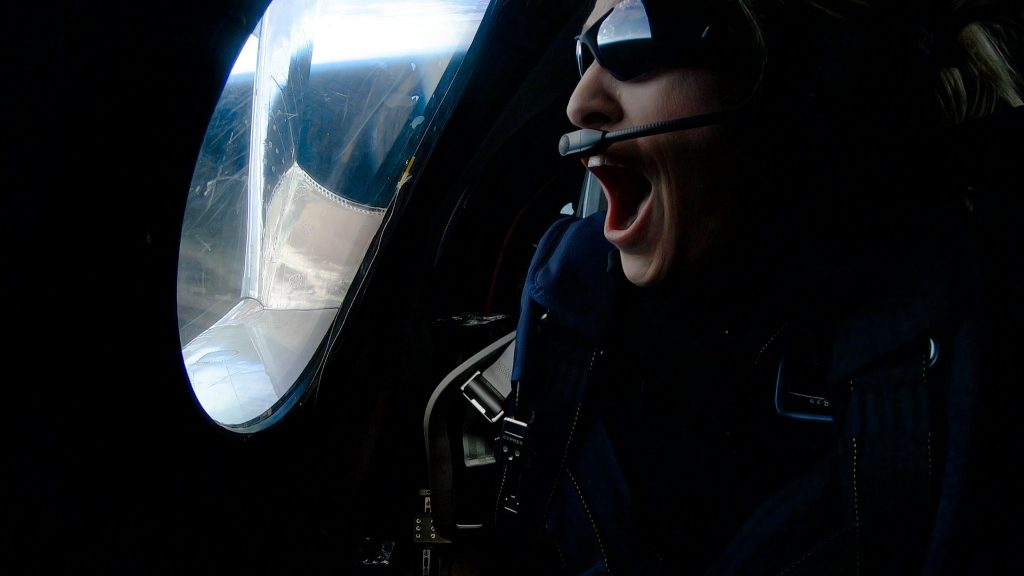
Describe to me the experience of being in space. We all saw that picture of you staring out the window in complete awe.

It was just magic and almost indescribable.

I felt very fortunate to fly where I did and the day I did. I felt like the Earth was so beautiful, but even more so than you can describe or can be imagined. I happened to fly on a day where we had snow on the mountains in the southwestern United States. And I remember vividly that appearance of glistening white mountaintops and blue Pacific Ocean and the green of the Earth. I told someone the other day I felt like Earth was wearing her diamonds for us that day, because it was so, so glistening and sharp.

It just took my breath away. It was amazing

“The face you make when you look back on Earth from space. Our Chief Astronaut Instructor, Beth Moses, is the 571st person to fly to space and the first woman to fly on board a commercial spaceship.” – Virgin Galactic

Clash: Compare the real flight to the simulations.

Moses: The Gz [force through the head] was of a much lower duration. I reached our expected Gz on boost and re-entry, but was pleasantly surprised at how short it was. It just ramps up and then ramps off. You take a breath and realize, ‘Oh this is high G,’ and you take another breath and say, ‘Oh, this is high G.’ By the time you’ve finished your second breath, it’s done, and you’re back to normal G. The Gz felt like the centrifuge, but the Gx [force through the chest] I didn’t perceive as strongly as I did in the centrifuge. I don’t know why. Maybe it was because I was so happy to be going up. So Gz felt like the NASTAR centrifuge, Gx did not. Both maximums were about 3.6.

Clash: Will you fly again?

Moses: I would love to go back up, but I also want to get future astronauts up there as fast as possible. So it depends on what we still have to test, how many test flights we have and for what reasons. We’re actually still mapping that out. But I will not nominate myself. There are lots of other skill-sets and factors that need to be tested, so I will train other folks to do those tests. I’m not trying to blindly hog evaluations. But if there are evaluations that need my particular skill-set, I might fly again. We’re still working that out.

** Richard Branson remains steadfastly upbeat about Virgin Galactic’s prospects: Richard Branson: We’re at the dawn of new era of space exploration (Opinion) – Richard Branson/CNN

I said after the flight on December 13, as I stood with our pilots, Frederick “CJ” Sturckow and Mark “Forger” Stucky, that when you set off on important adventures, exceptional people come forward to join the journey — people who are consistently by your side and on your side, people who share your dreams and people who help make them reality. Reaching space has been the ultimate team effort.

It is evident that we are finally at the dawn of a new age of space exploration, which will see reusable space vehicles built and operated by commercially successful private companies, transforming our business and personal lives in ways that we have yet to comprehend fully.

Standing on the flight line, I could hear my dad in the back of my mind saying, as he often did, “Isn’t life wonderful?”

** Land Rover designed the Astronaut Edition Range Rover just for “Virgin Galactic’s Future Astronaut customers”:

** Suborbital space tourism will be a lot safer than climbing Mt. Everest, thankfully: Everest deaths: Four reasons why this climbing season went wrong – BBC News

Over the past two decades, the average annual death rate of climbers on Mount Everest has remained at about six.

But this spring, at least 10 people have already been reported dead or missing on the world’s highest peak.

This is also the season that saw a record 381 climbing permits issued by the Nepalese government.

In reality, this means about 600 people were preparing to embark on the climb, with permit holders accompanied by support staff up the mountain.

** Virgin Galactic & Blue Origin near space tourism operations. VG is currently installing the interior seating in a SpaceShipTwo rocketplane and plans to begin flying customers this year. Blue Origin expects to fly people on the New Shepard for the first time in 2019, though ticket sales have yet to begun. So suborbital space tourism may finally get off the ground this year:  Suborbital space tourism nears its make-or-break moment – The Space Review

After the Ansari X Prize was won in October of 2004, I was sure that there would be regular space tourism services available by 2008. (I lost a bet, in fact, that there would be services by then.) Here it is 15 years later and I’m still waiting to see routine flights of public citizens to the edge of space.

This is disappointing for sure but it is hardly unusual that a technology takes a lot longer than expected to reach the market.

I enjoy listening to Jonathan Strickland on the TechStuff Podcast tell captivating stories behind the development and commercialization of technologies. He explains the science and engineering in a clear and straight-forward manner while also drawing fine verbal portraits of the fascinating characters involved and vividly depicting the often bitter and complex battles among them.

Many of the technologies we take for granted today saw decades pass between the initial key invention(s) and commercial success. I just listened, for example, to a podcast about compact audio cassette tapes and another on video cassettes. (These are in a series from Strickland on the development of media starting with records and films.) While not nearly as challenging as high altitude rocket transportation, there was still a considerable gap between the initial invention of flexible audio tape in Germany in the 1930s and high-fidelity audio cassettes in the 1970s.  The first video tape recorders appeared in the 1950s but the first successful home video recorders didn’t appear until the mid-1970s.

Technological devices typically involve multiple sub-technologies that must work well together as a system. Finding the optimum combination of technologies that synergize into an affordable, practical product seldom happens on the first try. Instead an evolutionary competition occurs with the fittest combo eventually winning after a long struggle that leaves behind a trail of failed designs and bankrupted companies.

In the mid-2000s, there was at least a half-dozen companies making serious efforts at a suborbital vehicle for space tourism. There was no grand overarching roadblock that a few keen outsiders saw that the companies didn’t. Rather, each encountered particular individualized hurdles that tripped them up.

For example, Virgin Galactic could have developed a SpaceShip 1.5 vehicle that involved modest improvements to the 3-seat SpaceShipOne and starting flying within a couple of years after the XPRIZE. Burt Rutan has said he had customers requesting flights on the SpaceShipOne. Instead, VG decided to jump straight to an elaborate 8-person vehicle. Unfortunately, the company ran into tremendous difficulties in scaling up the hybrid rocket motor used on the SS1 and even today does not have a motor that can send the SS2 above 100 km, which was the altitude boundary for the XPRIZE.

XCOR made good progress on low-cost, reliable liquid-fueled rocket engines but could not raise sufficient funding to bring the Lynx spaceplane to fruition. Rocketplane Ltd.‘s design based on a converted Learjet turned out not to be viable and by the time they changed the design they were out of money. Similarly, TGV Rockets fell short of funding to build the Michelle-B, a vertical takeoff and landing rocket vehicle similar to Blue’s New Shepard.

Blue Origin had plenty of funding but, after flying a couple of prototype vehicles, the company decided to focus on developing a new liquid hydrogen propulsion system that could be used for the booster of a suborbital vehicle and also for the upper stage of an orbital launcher. A highly reusable LOX/LH2 engine is no trivial technology so there’s little surprise it took them a few years to develop.

The suborbital space tourism story is just another confirmation that a new technology needs multiple entrants, all trying their hardest to make their designs work.

So, if the SpaceShipTwo and New Shepard vehicles do start flying regularly, does that guarantee a successful space tourism business? No, of course, not. No untried business is a guaranteed success. However, there are many positive signs.

For example, several hundred people have signed up for SS2 flights and most have waited patiently for many years. Only a few percent canceled after the 2014 accident and many of these dropped out not because of safety concerns but because they were discouraged by the additional years of waiting to fly.

If 600 people each year attempt to scale Mt. Everest, despite an annual average of 6 deaths, just to brag about the ordeal they overcame, we can be sure there will be no shortage of customers willing to pay for the totally unique thrill of riding a rocket straight up to the edge of space and encountering the awesome view of a glittering cosmos above and a glistening Earth below.

** A UBS Global Research view of commercial space travel:

** Russia’s KosmoKurs (КосмоКурс) is developing a suborbital vertical takeoff and landing rocket vehicle similar to Blue Origin’s New Shepard and also intended for tourism services. Like the New Shepard, up to six passengers would ride in a capsule that detaches from a booster and returns via parachutes. The goal is to build the vehicle by 2023.

** A customer for a Circumlunar Mission offered by Space Adventures wanted his deposit back as delays grew ever longer: Space Adventures reaches settlement with would-be lunar tourist – SpaceNews.com

[Harald] McPike, an Austrian businessman and adventurer who lives in the Bahamas, filed the original suit in May 2017, seeking the return of a $7 million deposit he paid to Space Adventures for a $150 million seat on a Soyuz mission that would go around the moon, and additional damages. The defendants in the suit included Space Adventures; Tom Shelley, the company’s president; and Eric Anderson, the company’s chairman and chief executive.

According to McPike’s suit, he contacted Space Adventures in July 2012 about the possibility of flying on a mission around the moon that the company had been promoting for several years. In March 2013, he signed an agreement committing to participate in such a mission, and paid an initial deposit of $7 million towards the $150 million total price with the expectation that the mission would take place within six years.

====

Space 2.0: How Private Spaceflight, a Resurgent NASA,
and International Partners are Creating a New Space Age

Space transport roundup – June.3.2019

A sampling of recent articles, videos, and images dealing with space transport:

** Lightning strikes Soyuz 2-1B rocket during ascent but launch on May 27th successful anyway:

** Russian Proton rocket launches Yamal-601 geostationary communications satellite on May 30th:

** Stratolaunch appears to be shutting down: Exclusive: Space firm founded by billionaire Paul Allen closing operations – sources – Reuters

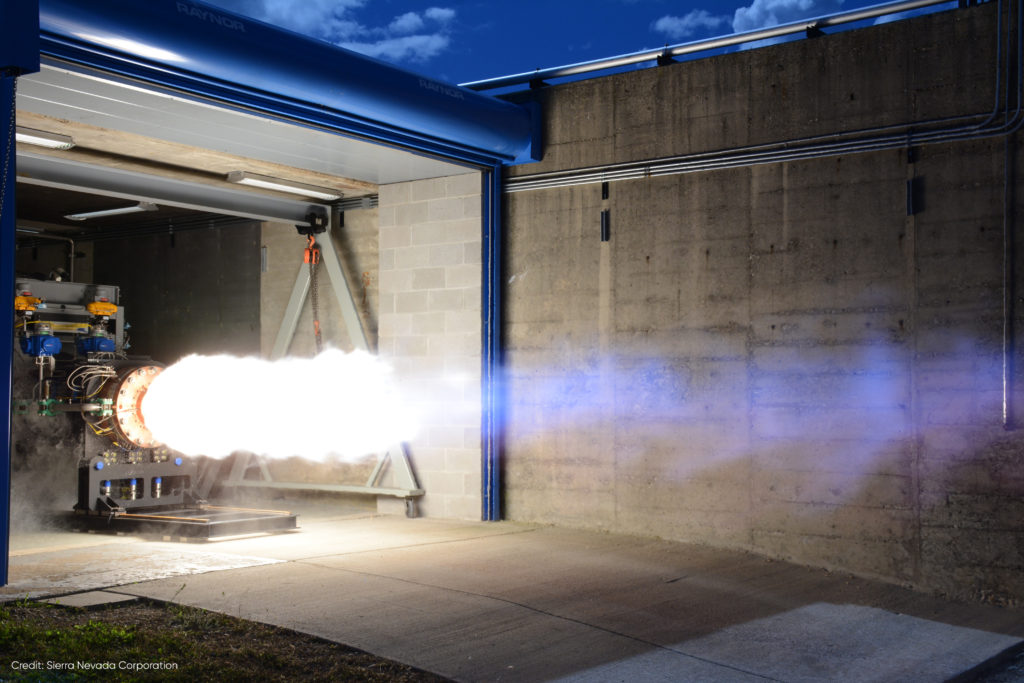
** Sierra Nevada Corp’s patented VORTEX® rocket engine was test fired in a public demo: Ozmens’ SNC Test-fires Next-Gen Rocket Engine in Prep for U.S. Launches – SNC

SNC Vortex Engine Test
SNC Vortex engine test firing. Credits: SNC

** SNC will support upgrades to the Japanese next-gen ISS cargo vehicle: Ozmens’ Sierra Nevada Corporation to Provide Hardware for Japanese HTV-X International Space Station Missions – SNC

HTV-X is the advanced version of H-II Transfer Vehicle (HTV). The spacecraft will provide supplies to the Kibō Japanese Experiment Module and the International Space Station for future servicing missions.

The HTV-X spacecraft is developed and operated by the Japanese Aerospace Exploration Agency (JAXA), with primary sections of the vehicle being manufactured by Mitsubishi Heavy Industries (MHI) and Mitsubishi Electric Corporation (MELCO).

** Nozzle blows off during test firing of Northrop-Grumman solid fuel booster:

N-G management is downplaying the incident but I’m sure the USAF will want the problem found and fixed before the OmegA can be considered for defense payloads.

[ Update: Scott Manley analyzes the incident:

]

** An update on Gilmour Space Technologies, an Australian/Singapore company developing a SmallSat launcher with a hybrid motor propulsion system: Building a rocket in a garage to take on SpaceX and Blue Origin – CNET

GIlmour’s suborbital One Vision rocket “is slated to launch in late June”. If that goes well they will proceed with development of the orbital

… three-stage rocket dubbed “Eris,” it will blast off to low Earth orbit, dropping off small satellites 100 miles (160 kilometers) above the surface.

“Eris is a three-stage vehicle, so it has three separate stages that fire individual sections,” Gilmour explains. “We have designed it to be able to take all of the known small satellites that are being built and designed right now, into space.”

The company has started work on Eris, and completion is tentatively scheduled in for 2020.

** Rocket Crafters tests 2.5 kN Cyclone hybrid motor:

This test is the most recent demonstration of Rocket Crafters new 2.5 kN (550 lbf) Cyclone Labscale testing engine. The Cyclone Engine uses a combination of the patent pending STAR-3D (Safe, Throttleable, Affordable, Reliable, 3D-Printed) Fuel Grain and VIFFI (Vortex Flow-Field Injector) technologies. The engine was fired for five seconds at 50% throttle and performed even better than expected with a maximum thrust of 1.5 kN (340 lbf)! Notice how smooth the plume from the engine is, it is much steadier and smoother than that what would be observed from a traditional Hybrid Rocket Engine. In addition, the top view is taken from a GoPro mounted to the Oxidizer Tank for the Engine, because it is attached to the test stand any vibrations from the Engine would be seen from this view.

** Firefly Aerospace releases payload users guide for the Orbital Transfer Vehicle (OTV), which uses solar electric propulsion to move payloads to a desired orbit:

** A Chinese rocket company tests a thruster system:

** More about university student rocket teams:

[ Update: The team fell short of 100 km but still reached a high altitude: College Rocket-Builders Are Flying High, Even as Launch Falls a Bit Short – WSJ

But in the middle of their flights, the rockets ran into an issue and fell short of hitting the Karman Line, an international standard for the boundary between earth’s atmosphere and space at 62 miles up.

“The bottom line is, from the start, it wasn’t really about the small technical details,” said Saad Mirza, a 19-year-old Princeton University student who was the team’s technical lead. “The real fact is we beat pretty much every odd.”

After spending innumerable hours working toward getting to space and falling short, the team members weren’t upset. Oddly enough, they were giddy.

There were technical triumphs to celebrate. The second-stage ignition, they felt, was a major accomplishment. Both rockets took off “straight as an arrow,” Mr. Mirza said. And even without getting to space, the rockets still got quite high. (They are still going through data to determine the exact height.)

]

** Misc.

** SpaceX:

*** SpaceX CRS-17 Dragon leaving the ISS this morning for a splashdown in the Pacific: NASA TV Set to Air US Cargo Ship Departure from Space Station | NASA

Filled with more than 4,200 pounds of valuable scientific experiments and other cargo, a SpaceX Dragon cargo spacecraft is set to return to Earth from the International Space Station Monday, June 3. NASA Television and the agency’s website will provide live coverage of the craft’s release beginning at 11:45 a.m. EDT.

Around noon, flight controllers at mission control in Houston will deliver remote commands to the station’s Canadarm2 robotic arm to detached Dragon from the Earth-facing port of the Harmony module. Expedition 59 Flight Engineer David Saint-Jacques of the Canadian Space Agency will back up the operation and monitor Dragon’s systems as it departs the orbital laboratory.

After firing its thrusters to move a safe distance away from the station, Dragon will execute a deorbit burn around 4:56 p.m. to leave orbit, as it heads for a parachute-assisted splashdown in the Pacific Ocean, 202 miles southwest of Long Beach, California, at 2:55 p.m. PDT. There will be no live coverage of deorbit burn or splashdown.

A view of the splashdown target area:

The Dragon is currently the only vehicle that can return substantial amounts of cargo from the ISS: Science Results Packed for Return to Earth Aboard Dragon Monday – Space Station

*** Two launches set for June. The following dates are still “no earlier than” and the specific launch window times are not yet posted.

  • June 11: Vandenberg AFB, Pad SLC-4E – Falcon 9 with three spacecraft for the Canadian Radarsat Constellation.
  • June 22: Kennedy Space Center, Pad 39-A – Falcon Heavy with USAF STP-2 Mission with 24 military and scientific research satellites.

[ Update: A time has been released for the FH launch:

]

*** Falcon Heavy STP-2 launch system components are on site and in assembly: SpaceX’s next Falcon Heavy hits milestone as final rocket parts arrive in Florida – Teslarati

*** Planetary Society’s LightSail-2 arrives at Cape for launch on the SpaceX Falcon Heavy. LightSail 2 Arrives in Florida | The Planetary Society

*** The Falcon 9 booster for the launch for the 60 Starlink satellites returned to Port Canaveral last week (videos via www.USLaunchReport.com):

*** Update on the Starlink satellites: SpaceX says all 60 Starlink satellites functioning so far – SpaceNews.com

All 60 satellites — the first in a constellation that could one day number 12,000 — have deployed solar arrays, a SpaceX spokesperson said in a May 31 statement, and most are in the process of climbing from their 440-kilometer drop-off point to their 550-kilometer target orbit.  

“SpaceX continues to monitor the constellation for any satellites that may need to be safely deorbited,” the spokesperson said. “All the satellites have maneuvering capability and are programmed to avoid each other and other objects in orbit by a wide margin.”

*** Starhopper & Starship orbiter demonstrators:

**** Raptor engine being installed on the Starhopper test vehicle this weekend but just for fit checks:

From SNF:

For instance, up until recently, the company was planning to utilize Raptor SN4 for the untethered hops. However, the company has now decided to utilize this engine only for fit checks, and will instead perform the hops with SN5 – the latest Raptor to come out of SpaceX’s factory in Hawthorne, California.

SN4 arrived in Boca Chica for the fit checks on Friday afternoon. Meanwhile, SN5 is already at SpaceX’s test facility in McGregor Texas for verification testing before being shipped south.

While the precise reason for the engine change is unknown, by still shipping SN4 to Boca Chica first, SpaceX will be able to ensure that the Starhopper is ready for hopping ahead of SN5’s arrival. This should help to reduce the delays caused by waiting for SN5.

Some pictures:

***** Starships may become single-stage point-to-point transports:

**** An examination of the latest iteration of the design of the Super Heavy Booster/Starship combo:  Initial BFR (Starship) is not much more powerful than Falcon Heavy | Selenian Boondocks

BFR is now no longer absurdly over-sized at all. That talking point is over. It’s easily within their demonstrated capability. Fewer staging events also helps. And landing the Super Heavy booster may be easier than landing 3 separate cores simultaneously (no one knows right now). They switched from carbon fiber to stainless steel for fabrication, but that’s probably a step in the right direction if you want the vehicle to fly realsoonnow. Hypothetically (with almost balloon tanks), stainless has the same mass fraction as a carbon fiber (which needs design knock-downs for cryogenics and oxygen, particularly with out-of-autoclave processes) and similar to SpaceX’s current aluminum-lithium alloy. In practice, it seems SpaceX is still literally hammering out the manufacturing process. They have a method that seems to work with Starhopper, but the mass fraction is terrible (built literally by a water tower company). It seems almost like Sea Dragon.

But they don’t HAVE to have extremely good mass ratio. The upper stage doesn’t HAVE to have SSTO-like capability, not at first. It just needs enough to get to orbit with significant payload, say 50 tons. Perhaps it just needs 6.5km/s. That’s also about the delta-v needed to go from the Gateway to LLO then to the lunar surface and back (well, that’s about 6.2km/s total… 5.2km/s if you’re aggressive with your burns).

*** A talk by Paul Wooster of SpaceX at the recent Humans to Mars Summit in Washington, D.C. (starts at around 00:23:00) – Getting to the Moon and Mars:

Wooster also participated in the afternoon panel session titled, Session 1b: Surface Operations on Mars (starts at around 7:05:00 into the video).

====

Space 2.0: How Private Spaceflight, a Resurgent NASA,
and International Partners are Creating a New Space Age