Category Archives: Rockets

Space transport roundup – July.2.2019

A sampling of recent articles, videos, and images dealing with space transport:

** Rocket Lab‘s seventh Electron rocket launch successfully carried seven payloads into orbit last Saturday:

The liftoff is at about 18:55 into this webcast video:

** EXOS Aerospace‘s SARGE reusable sounding rocket suffers guidance anomaly shortly after liftoff but successfully returns via parasail for a soft landing. Exos suffers setback in reusable suborbital launch attempt – SpaceNews.com

Liftoff is at about the 2:57:30 point in this webcast video. The miscue in the trajectory is visible just before the rocket goes out of view of the camera.

A problem with the engine gimbal is mentioned in the video. Haven’t seen any update since then from the company giving more details about the problem. The vehicle appears to be undamaged so the next launch could happen relatively soon. You can follow EXOS at EXOS (@exosaerosystech) | Twitter.

** A SpaceShipTwo hybrid moter is tested in Mojave by The SpaceShip Company, the Virgin Galactic subsidiary in charge of manufacturing the SS2/WhiteKnightTwo vehicles.

** bluShift Aerospace of Main wins NASA SBIR funding for development of the MAREVL (Modular Adaptable Rocket Engine for Vehicle Launch): Maine rocket company wins NASA grant | Journal Tribune.

Modern orbital rockets are made up of two or more stages. Different stages use different engine types, each optimized for a specific part of the ascent. With MAREVL, each stage will have different numbers of the same engine type and it uses a hybrid rocket, in which liquid oxidizer combines with a solid fuel, to reduce the complexity, weight, and cost of the engine.

“We are developing a modular hybrid rocket engine that will use a bio-derived solid fuel to launch cubesats into low-Earth orbit,” Lockman said.

The goal is development of a smallsat launcher. Here is a recent presentation by Seth Lockman of bluShift: 5 Minute Genius: Seth Lockman – From Maine to the Stars. Maine Science Festival 2019

And another intro video about the company:

Find updates at bluShift Aerospace (@bluShiftAero) | Twitter.

** Another article about Spinlaunch and its catapult launch system: This Startup Wants To Use A Hypersonic Catapult To Throw Satellites Directly Into Space By 2022 – Forbes

The company was founded back in 2014 but only emerged into the public eye in 2018 after spending four years in stealth mode. The company raised $40 million in Series A funding in April last year from Airbus Ventures, Google Ventures, and Kleiner Perkins. They are touting launch costs of $250,000, and up to five launches per day. It’s unclear what the weight limit is per launch.

** Blue Origin is preparing the ship on which New Glenn boosters will land:

** Chinese commercial launch companies:

*** Polar Space Exploration Technology Ltd. developing  vertical takeoff and landing launch system: “Tianmeng” rocket project – Weibo

Booster landing from animation of Tianmeng launch system.

*** OneSpace tests two thrusters:


** SpaceX:

*** The first Starship operational orbital launch set for 2021 according to SpaceX VP: SpaceX targets 2021 commercial Starship launch – SpaceNews.com

The first commercial mission for SpaceX’s Starship and Super Heavy launch system will likely take place in 2021, a company executive said June 26. 

Jonathan Hofeller, SpaceX’s vice president of commercial sales, said the company is in talks with prospective customers for the first commercial launch of that system roughly two years from now. 

“We are in discussions with three different customers as we speak right now to be that first mission,” Hofeller said at the APSAT conference here. “Those are all telecom companies.”

*** Falcon 9 standard launch price is now $50M according to Hofeller in the same presentation.

Hofeller said the discounted pricing SpaceX gave to early customers of Falcon 9 missions with pre-flown first-stage boosters is now the company’s normal pricing. SpaceX Founder Elon Musk said last year that previously flown booster missions were priced “around $50 million,” down from $62 million. Musk said SpaceX’s prices would continue to decline, too. 

Hofeller reiterated that prices would keep dropping through the introduction of Super Heavy and Starship. The fully reusable nature of the launch system enables those lower prices, he said. 

According to the official SpaceX Falcon 9 specs, the $50M price makes for $2193/kg ($995/lb) to LEO, $6024/kg ($2732/lb) to GEO, and $12440/kg ($5643/lb) to Mars.

*** We may see a Falcon booster fly for its 6th time this year: SpaceX sets new Falcon 9 Block 5 reusability milestones for second half of 2019 – Teslarati

Speaking at 2019’s Asia-Pacific Satellite (APSAT) Conference, SpaceX Vice President of Commercial Sales Jonathan Hofeller – squeezed into a sea of breaking-news updates – announced that the company plans to launch the same Falcon 9 Block 5 booster for the fifth (or sixth) time by the end of 2019.

Just an add-on at the end of a number of updates focused on SpaceX’s next-generation Starship/Super Heavy rocket, the phrasing reported by SpaceNews.com technically means that there are plans for a Falcon 9 booster to launch for the sixth time in the second half of 2019. The demonstration of such an extreme level of operational reusability barely 18 months after Falcon 9 Block 5’s debut would make it clear that SpaceX’s latest Falcon upgrade has been a resounding success. In line with those positive signs, Hofeller also noted that SpaceX is already starting to transfer the fruits of those labors to its customers by permanently lowering the base price of Falcon 9 launch contracts.

*** Great views of the most recent Falcon Heavy launch: More photos from SpaceX’s first Falcon Heavy night launch – Spaceflight Now.

The the Air Force Research Laboratory had two spacecraft on the flight: AFRL puts new technologies into space aboard world’s most powerful launch vehicle – U.S. Air Force.

…the Green Propellant Infusion Mission spacecraft, which enables the first ever on-orbit demonstration of the AFRL developed Advanced Spacecraft Energetic Non-toxic Propellant.

Space demonstration of this new propellant, ASCENT, formerly known as AF-M315E, marks a major milestone in a national effort to develop new energetic propellants to replace hydrazine, the current established chemical propellant of choice for nearly all current satellite propulsion. Not only is ASCENT 50% higher performing than hydrazine, it is also a vastly safer alternative, allowing for streamlined ground operations relative to legacy propellants. While hydrazine is flammable, toxic and requires the use of Self Contained Atmospheric Protective Ensemble suits for handling operations, ASCENT propellant requires minimal Personal Protective Equipment such as a lab coat and a splash guard for the face.

Also part of the STP-2 mission was AFRL’s Demonstration and Science Experiments (DSX) spacecraft. The first of its kind globally, the DSX flight experiment will conduct new research to advance DOD’s understanding of the processes governing the Van Allen radiation belts and the effect they have on spacecraft components. DSX’s elliptical path in medium Earth orbit will increase understanding of this orbital regime, and advance understanding of the interplay between waves and particles that underlie radiation belt dynamics, enabling better specification, forecasting and mitigation. This will ultimately enhance the nation’s capability to field resilient space systems, AFRL officials say.

DSX’s mission is different from most other Air Force flight experiments as it is a purely scientific mission. The spacecraft is equipped with a unique suite of technologies such as space weather sensors and graphite antenna booms used to conduct experiments with very-low frequency radio waves. DSX has two sets of immense deployable booms due to the large antenna requirements of these experiments. One set extends 80 meters tip-to-tip and the other extends 16 meters tip-to-tip, making the DSX spacecraft one of the largest deployable structures in orbit.

Despite the third launch success, there are no FH missions listed on the public manifest till the end of 2020:

*** Turning the return and capture of a Falcon fairing into a physics lesson: SpaceX Recovered Its First Rocket Fairing. Let’s Crunch the Numbers! | WIRED

A SpaceX fairing is falling from an altitude of 50 km and falls with a constant terminal velocity of 20 m/s. You are the captain of the fast boat Ms. Tree. Mission control has just determined that the fairing will land a distance of 12.3 km from your location. Since you are trying to impress everyone, you decide to wait until the last possible moment to travel to the rendezvous site. How long should you wait?

*** A Falcon  9 booster may join the Rocket Garden at Kennedy Space Center at Cape Canaveral: Kennedy Space Center wants a SpaceX Falcon 9 core for its Rocket Garden – Teslarati

*** 57 Starlink satellites have reached operational orbit while 3 are not in contact with the controllers.  These first-generation spacecraft were inserted into orbit at 440 km in May and then used on-board ion thrusters to reach 550 kilometers. Since they are in the lower orbit, the three failed satellites will reenter the atmosphere within a year or two.

** Some info about NASA’s commercial crew program from Eric Berger including an item about the investigation into the explosion during the test of the abort system on a Dragon spacecraft on April 20th:

*

====

Space 2.0: How Private Spaceflight, a Resurgent NASA,
and International Partners are Creating a New Space Age

Space transport roundup – June.28.2019

A sampling of recent articles, videos, and images dealing with space transport:

[ Update: SpaceX accelerates Super Heavy/Starship development : SpaceX targets 2021 commercial Starship launch – SpaceNews.com.

More SpaceX items below.

]

** Rocket Lab aims to launch an Electron rocket on June 29th following two postponements.

Live streaming webcast will begin 20 minutes before the targeted lift-off time. Here is some background on the “Make it Rain” mission:

The Make It Rain mission will launch multiple spacecraft as part of a rideshare flight procured by Spaceflight. The launch will take place from Rocket Lab Launch Complex 1 on New Zealand’s Māhia Peninsula.

The mission is named ‘Make it Rain’ in a nod to the high volume of rainfall in Seattle, where Spaceflight is headquartered, as well in New Zealand where Launch Complex 1 is located. Among the payloads on the mission for Spaceflight are BlackSky’s Global-3 satellite and Melbourne Space Program’s ACRUX-1 CubeSat.

More about the mission:

** Space is the theme of the July/August 2019 issue of MIT Technology Review magazine and several of the articles deal with space transport related topics, e.g.

** An interesting interview with Tom Markusic, founder and CEO of Firefly Aerospace, who talks about his experiences in working at NASA, SpaceX, Blue Origin, and Virgin Galactic: Talking With a Leader of the Next Generation of Rocketry Companies – Texas Monthly

TM: I recently saw a stat that said SpaceX built its Falcon 9 rocket with almost $400 million, whereas there was a NASA estimate that it would cost $1.6 billion to build a similar kind of vehicle. Why is it so much cheaper for a private company to do that? 

MARKUSIC: When you’re doing something in that heritage space way, you’re inheriting a lot of requirements that can drive cost up. It’s a very risk-averse framework. Many things in the government are like, “You just add money and a person. Here are the instructions—do this thing.” That type of approach is usually pretty reliable in getting the result you want, but it’s really expensive. And it’s usually undergirded by contractors who are disincentivized to make things at the lowest cost. With New Space, you’re spending people’s money; you’re not spending this amorphous blob of taxpayer money. That just pervades the whole culture. 

** China’s Kyushu Yunjian rocket company fires up the gas generator for the “Longyun” Liquid Methane/Liquid Oxygen engine: “Longyun” 80t high thrust engine gas generator passed the assessment – Google Translate

In the second half of the year, Kyushu Yunjian […] will conduct a test of the whole machine test for the “Lingyun” engine. After the whole machine is tested, the “Lingyun” engine will enter the reliability test and assessment stage. The 80-ton “Longyun” liquid oxygen methane engine with greater thrust will also be tested and tested by other components in the second half of the year. Reusable and recycling technology verification rocket platform “Ling Wei” has completed the program demonstration, and is currently undergoing detailed engineering design and optimization.

** EU backed project pursues development of vertical landing reusable rockets.

Five European Companies and the German Aerospace Center (DLR) have teamed up to tackle the shortcoming of
know-how in reusable rockets in Europe, which start upright and land upright after a successful mission. For that,
they commonly decided to investigate and develop key technologies to land rockets backwards. What is state-of-the-
art in the USA is only in its beginnings in Europe, and the consortium is determined to accept the challenge and
to become important players in this game changing technology.

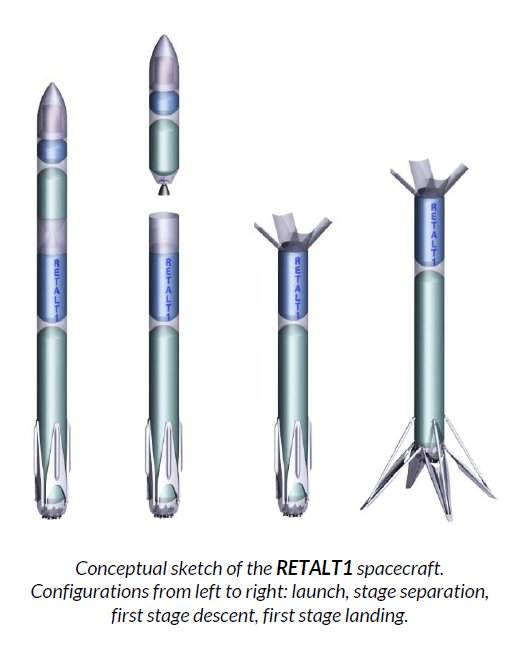
RETALT1 Artwork

RETALT (RETro propulsion Assisted Landing Technologies) is a European project which got funded with 3 Mio. €
by the European Commission in the frame of Horizon 2020. The partnering organizations are the DLR (Germany),
CFS Engineering (Switzerland), Elecnor Deimos (Spain), MT Aerospace (Germany), Almatech (Switzerland) and
Amorim Cork Composites (Portugal).

During the three years of the project lifetime the consortium will investigate the areas of aerodynamics, aerothermodynamics (i.e. the temperatures that evolve at the surface of the vehicle during flight), flight dynamics, guidance, navigation and control, and advanced structural parts, materials and mechanisms. For this purpose, two types of rocket launchers will be investigated which both start and land in an upright position. One of them will have two stages and will be similar to conventional rockets like the Falcon 9 or the Ariane 5 launcher. For this launcher only the first stage will be landed again. The second launcher has only a single stage. It will be designed for the use of smaller payloads and when returning it will break not only with retro propulsion but also with the aid of a large aerodynamic base surface at the bottom.

See also Europe says SpaceX “dominating” launch, vows to develop Falcon 9-like rocket | Ars Technica

** Boeing’s Starliner crew spacecraft passes major milestone with the qualification of the parachute system: Starliner Space Capsule Completes Parachute Testing – Boeing

** The 3rd Annual Spaceport America Cup attracted 120 teams and the UW team was the overall winner: University of Washington Wins Third Annual Spaceport America Cup

Spaceport America, the world’s first purpose-built commercial spaceport and the Experimental Sounding Rocket Association (ESRA), congratulate the University of Washington Society for Advanced Rocket Propulsion as the Champion of the Third Annual Spaceport America Cup. Champions were selected in each category, and the University of Washington team was chosen by judges from the group of category champions as the overall winner.  

From June 18–22, thousands of students and spectators flocked to southern New Mexico from all over the globe, creating an economic and tourism boost for surrounding communities as part of their attendance at the 2019 Spaceport America Cup. This year’s competition was the largest to date, with over 120 teams registered including a large international presence from 14 different countries.

** SpaceX:

**** SpaceX raises more funding for Starlink and Starship development:

“SpaceX is the world’s leading private space launch provider, and we are excited to work with the company in the next phase of its growth as it rolls out its Starlink satellite network,” said Olivia Steedman, Senior Managing Director, TIP.

SpaceX was identified as a compelling investment opportunity for TIP due to its proven track record of technology disruption in the launch space and significant future growth potential in the satellite broadband market. TIP focuses on late-stage venture capital and growth equity investments in companies that use technology to disrupt incumbents and create new sectors.

“Our investment in SpaceX fits well within the TIP investment strategy of capitalizing on significant global opportunities in new businesses and sectors that are emerging as a result of unprecedented technological change,” added Ms. Steedman.

**** Next Dragon Cargo mission to the ISS set for July 21: SpaceX Targeting Sunday, July 21, at 7:35 p.m. for CRS-18 Launch – SpaceX

**** The 24 satellites launched on the latest Falcon Heavy mission are operating:

**** Center-core landing failure due to heat from the high re-entry velocity: SpaceX CEO Elon Musk explains why Falcon Heavy’s center core missed the drone ship – Teslarati

**** The first successful fairing catch took place in the dark in the Atlantic ocean:

**** Satellite image shows post landing activities of the two side boosters:

**** Watching the construction of the Starhopper and StarShip demonstrators is a popular on-line and on-site spectator pastime.


**** Elon visits the Starship orbital demonstrator under construction in Florida: SpaceX CEO Elon Musk & Raptor engine make surprise visit to Florida Starship – Teslarati

In what seems to be a coincidence, Musk’s message – either recorded or streamed – was filmed on SpaceX’s Florida Starship development campus, a surprisingly large facility uncovered less than two months ago. The CEO was standing in the sun directly in front of two large segments of the second orbital-class Starship prototype, part of a parallel development process featuring a second Starship prototype (and separate Starhopper) in Texas. Musk’s appearance at Starship Florida is not particularly surprising; if he flew all the way to Florida for Falcon Heavy, might as well tour SpaceX’s newest Florida facilities on the same trip.

**** The Super Heavy Booster/StarShip combo will be quite a sight to see:

====

Safe Is Not an Option

Space transport roundup – June.25.2019

Following up on  yesterday’s roundup, the SpaceX Falcon Heavy successfully reached orbit and deployed a big batch of satellites on board. Three ISS crew members also made it back to Earth safely via their Soyuz spacecraft.

** SpaceX Falcon Heavy completes the company’s “most difficult launch ever”, as described by Elon Musk. While the center core rocket failed to make a successful landing, everything else went quite well, including the first-time capture of a nosecone fairing in a net. The biggest challenge – multiple firings of the upper stage engine after long coasting periods – went well. In total, 24 satellites were deployed.

The launch:

The landings of the two side boosters and the miss of the central core:

The fairing on the net of the SpaceX ship Ms. Tree (formerly Mr. Steven):

More at:

** The Planetary Society’s LightSail-2 finally makes it to orbit via the FH but the mission still has two hurdles ahead before the sail begins to accelerate from the push of sunlight. On July 2nd, the CubeSat is to be ejected from the Prox-1 carrier spacecraft and then about a week later the sail will be deployed: LightSail 2 Has Launched! | The Planetary Society

** Soyuz lands safely in Kazakstan with three ISS crew members:

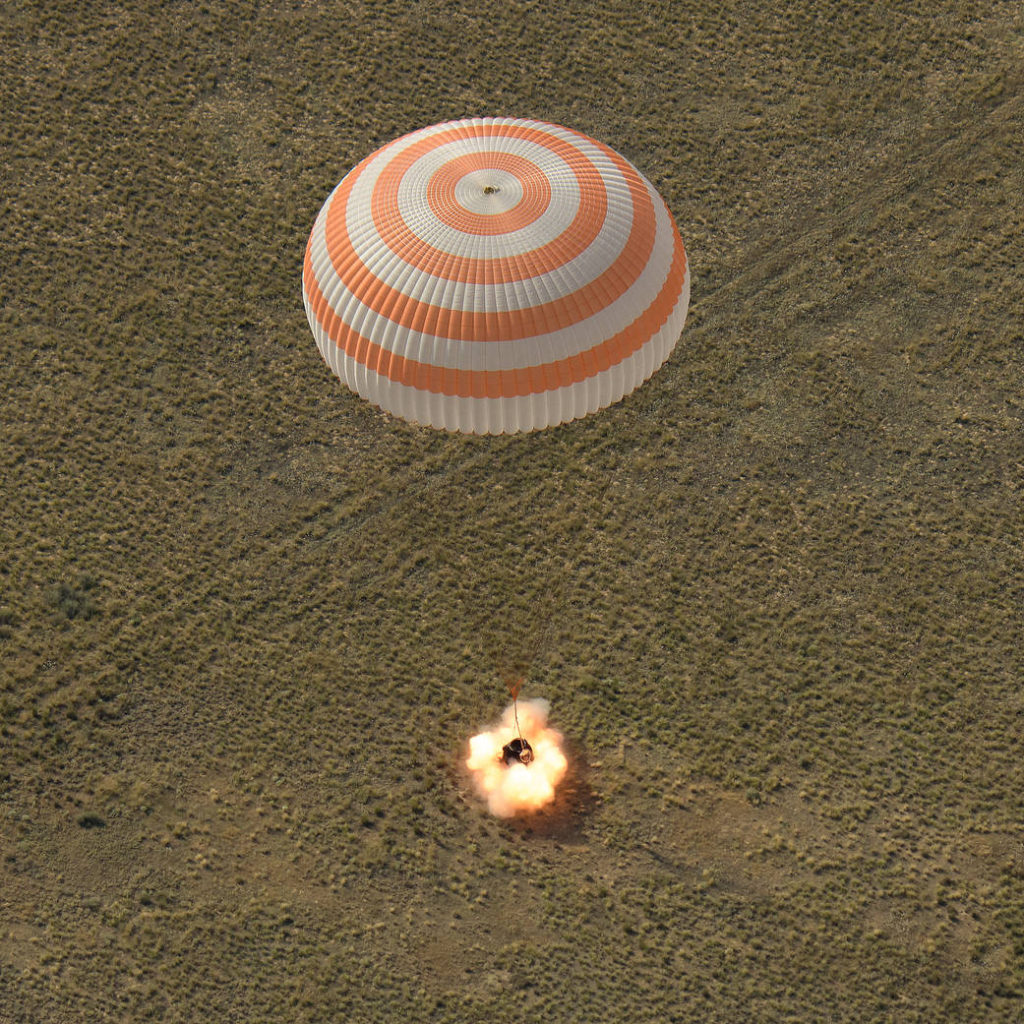
“The Soyuz MS-11 spacecraft is seen as it lands with Expedition 59 crew members Anne McClain of NASA, David Saint-Jacques of the Canadian Space Agency, and Oleg Kononenko of Roscosmos, Tuesday, June 25, 2019 Kazakh time (June 24 Eastern time). McClain, Saint-Jacques, and Kononenko are returning after 204 days in space where they served as members of the Expedition 58 and 59 crews onboard the International Space Station. Photo Credit: (NASA/Bill Ingalls)” – NASA

Highlights of the departure from the station and the landing:

** Chinese Long March 3B rocket launches navigation satellite: China launches new BeiDou satellite – CGTN

China sent a new satellite of the BeiDou Navigation Satellite System (BDS) into space from the Xichang Satellite Launch Center in its southwestern province of Sichuan on Tuesday. Launched on board a Long March-3B carrier rocket, the satellite was sent to a inclined geosynchronous earth orbit.

More at Chinese Long March 3B lofts Beidou-3I2 – NASASpaceFlight.com.

** India-based Bellatrix Aerospace raises $3M for development of smallsat rocket launchers and satellite propulsion systems.

“This funding will help Bellatrix to space qualify our products soon. During the coming months, we will be subjecting our thrusters to rigorous ground qualification tests and also work on key innovations that will make our products stand out. We will also be expanding to key global locations,” Rohan Ganapathy, co-founder at Bellatrix said.

** Misc. space transport items:

  • Next Atlas 5 launch delayed by battery failure – Spaceflight Now – “The next launch of United Launch Alliance’s Atlas 5 rocket with the U.S. Air Force’s fifth Advanced Extremely High Frequency communications satellite, previously scheduled for Thursday, has been delayed to no earlier than July 12 to replace a failed battery on the vehicle.”
  • STS-121 The Hardest Launch Part 4: Damage to the Heatshield | Wayne Hale’s Blog – The former Space Shuttle Program Manager recounts a case that illustrates the challenges in assessing risks for Shuttle launches in the aftermath of the Columbia loss.
  • SpaceRyde wants to make access to space more available and more affordable | TechCrunch – Canada’s SpaceRyde startup is developing a smallsat launch system using a high-altitude balloon platform. “Earlier this year, SpaceRyde launched a stratospheric balloon carrying a scaled down version of their launch platform and rocket in Northern Ontario, Canada. The test wasn’t a complete success – a modification to the off-the-shelf rocket engine they used didn’t work exactly as expected – but it did demonstrate that their in-flight launch platform orientation tech worked as intended, and Safari says the malfunction that did occur is relatively easy to fix.Next up for SpaceRyde is to work towards a full-scale demonstration of their platform, which Safari says should happen sometime next year….
  • Univ. of Washington rocketeers take the prize at Spaceport America Cup – GeekWire – Washington’s Society for Advanced Rocket Propulsion won the top prize at this year’s Spaceport America Cup competition held at the NM spaceport. “The SARP team took the Judge’s Choice and Overall Winner Award at the world’s largest collegiate rocket engineering contest, which is run by the Experimental Sounding Rocket Association and drew 120 teams from 14 countries. Each team is required to design, build and fly a rocket that can reach 10,000 feet or 30,000 feet, depending on the contest category.

** Raptor engine spotted at site of the Starship orbital demonstrator under construction in Florida.

Another Starship test vehicle is in construction at Boca Chica Beach facility and Elon says flights will take place at both places:

A comparison of the Starships in Florida and Texas:

Elon wants to speed up the Raptor and Starship program: SpaceX: Elon Musk Teases Rapid, Cheap Raptor Production to Get to Mars Fast | Inverse

SpaceX is planning to give its Mars-bound Raptor engine design a big production boost, CEO Elon Musk teased in a series of Twitter posts Monday. By the end of this year, Musk declared, the company is aiming to produce a new engine every 12 hours.

Musk suggested on Twitter that SpaceX is set to ramp up production for the engine “exponentially” soon. The sixth engine is almost done, and the firm is “aiming for an engine every 12 hours by end of year.” This should equate to around 500 engines per year, as Musk explained that a full year of production is around 70 percent of the peak daily rate.

====

Safe Is Not an Option

Space transport roundup – June.24.2019

The Falcon Heavy mission and the Soyuz return are the focus points of today’s roundup:

** SpaceX:

*** The countdown is proceeding for the Falcon Heavy liftoff tonight for the complex STP-2 mission. The four hour launch window opens at 11:30 pm EDT (0330 GMT on 25th). The weather forecast shows an 80% chance of acceptable conditions for launch during the window.

The SpaceX webcast will begin about 20 minutes before the liftoff time. NASA TV coverage will start at 11:00 pm EDT.

Updates to check as the window approaches:

The mission events time line is given in the SpaceX Press Kit (pdf). SpaceX will attempt to recover all 3 boosters:

Falcon Heavy’s side boosters for the STP-2 mission previously supported the Arabsat-6A mission in April 2019. Following booster separation, Falcon Heavy’s two side boosters will attempt to land at SpaceX’s Landing Zones 1 and 2 (LZ-1 and LZ-2) at Cape Canaveral Air Force Station in Florida. Falcon Heavy’s center core will attempt to land on the “Of Course I Still Love You” droneship, which will be stationed in the Atlantic Ocean.

There is also a ship sent to capture in a net and/or drag from the sea the two fairing halves of the nosecone.

Liftoff through final deployment will span over 3.5 hours and include 3 in-orbit firings of the second stage engine.

The STP-2 mission will use a SpaceX Falcon Heavy launch vehicle to perform 20 commanded deployment actions and place 24 separate spacecraft in three different orbits. The spacecraft include the Air Force Research Laboratory Demonstration and Science Experiments (DSX) satellite; the NOAA-sponsored Constellation Observing System for Meteorology, Ionosphere, and Climate (COSMIC-2) constellation; four NASA experiments; and many other missions.

After about 7 hours, the second stage will be “passivated”, which includes dumping any remaining fuel to avoid any chance the stage would explode and increase debris in low earth orbit. Eventually the stage will de-orbit into the atmosphere.

Some photos of the FH on the pad:

More about the mission:

The Planetary Society is closely following the launch since it includes the deployment of the LightSail-2 mission inside  Georgia Tech’s Prox-1 smallsat:

Here’s a video update from the Cape by Chris Gebhardt of NASASpaceflight.com:

** A Soyuz capsule is set to return with three ISS Expedition 59 crew members today: Departing Trio Aboard Soyuz Crew Ship Awaiting Undocking – Space Station

At 4:15 p.m. EDT, the hatch closed between the Soyuz spacecraft and the International Space Station in preparation for undocking. NASA Flight Engineer Anne McClain, Expedition 59/Soyuz Commander Oleg Konenenko of the Russian space agency Roscosmos, and David Saint-Jacques of the Canadian Space Agency are scheduled to undock their Soyuz at 7:25 p.m.

The landing is set for just over 40 minutes before the FH liftoff window opens:

Their landing in Kazakhstan is targeted for approximately 10:48 p.m. and will conclude a more than six month mission conducting science and maintenance aboard the space station, in which they circled the globe 3,264 times, covering 86.4 million miles.

The latest on the undocking and return:

====

The Space Barons: Elon Musk, Jeff Bezos,
and the Quest to Colonize the Cosmos

Space transport roundup – June.22.2019

A sampling of recent articles, videos, and images dealing with space transport:

** Blue Origin’s BE7 lunar lander engine was fired successfully this week:

** Jeff Bezos described his goals for Blue Origin during an on-stage interview held at the recent JFK Space Summit in the JFK Library in Massachusetts.

** Spinlaunch awarded a Dept. of Defense contract for delivery of payloads to low earth orbit with the company’s catapult style launch system, which is currently in development at the New Mexico spaceport.

From the PR:

LONG BEACH, Calif.–Jonathan Yaney, founder and CEO of SpinLaunch, has announced that the company has been awarded a responsive launch prototype contract from the Department of Defense (DOD), facilitated by the Defense Innovation Unit (DIU).

SpinLaunch is developing a kinetic energy-based launch system that will provide the world’s lowest-cost orbital launch services for the rapidly growing small satellite industry. In 2018, the company received $40 million in a Series A financing round from Airbus Ventures, Google Ventures and Kleiner Perkins.

The recently published State of the Space Industrial Base states that the future and growth of the U.S. space economy is “critically dependent on continuing reductions in the costs and risks associated with launch. There is a bifurcation of launch providers between lower-cost, ‘bulk’ carriers…and higher-cost, ‘niche’ providers offering lower lift-mass, but launch to a specific orbit.”

“SpinLaunch fills this gap by providing dedicated orbital launch with high frequency at a magnitude lower cost than any current ‘niche’ launch system,” stated Yaney. “This will truly be a disruptive enabler for the emerging commercial space industry. There is a promising market surge in the demand for LEO constellations of inexpensive small satellites for disaster monitoring, weather, reconnaissance, communications and other services.”

In January 2019, SpinLaunch moved from Silicon Valley to its new 140,000 square foot headquarters in Long Beach, California and last month broke ground on a new $7 million test facility on 10 acres at New Mexico’s Spaceport America. First kinetic energy flight tests are expected to occur early 2020 and the company has announced its plans for first launch by 2022.

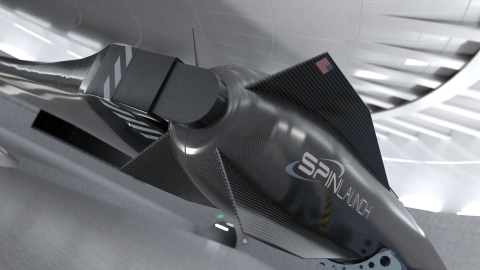
Few technical details are known publicly about the Spinlaunch system. This image was released with the PR but it’s difficult to decipher. It appears to show the launch projectile attached to the rotating mechanism that will bring the projectile up to a significant fraction of orbital velocity.

Spinlaunch PR image
“Illustration depicting SpinLaunch orbital vehicle inside the electric kinetic launcher.” (Photo: Business Wire)

See also the Spinlaunch Fact Sheet (pdf)

Due to its unique technology, SpinLaunch is able to offer readily-available, low cost, dedicated launches at high frequencies. SpinLaunch is working to provide up to five launches per day at a price of $250,000 / launch.

** Orbit Fab‘s satellite water propulsion initiative begins with water sent to the ISS: Orbit Fab Becomes the First Private Company to Supply the International Space Station with Water – Orbit Fab

Within a year of securing venture funding, Orbit Fab has launched their hardware twice to the International Space Station (ISS) and supplied the station with water. Following the success of the multi-day microgravity refueling demonstration, Kenneth Shields, COO of the ISS U.S. National Laboratory, said in a statement, “With their recent successful completion of in-orbit water transfer operations aboard the space station, Orbit Fab became the first private company to supply the ISS with water using its own proprietary refueling equipment and processes. This concept of operations was not previously conceived of in the original design of the ISS, thus demonstrating NASA’s flexibility and desire to accommodate private sector clients who are utilizing the ISS U.S. National Laboratory as a steppingstone to an industrialized Low Earth Orbit.”

Using water as an in-space propellant has the advantage of being a very safe substance, which is important on the station where NASA is extremely cautious about such things.

Water was used for this propellant transfer demonstration as it is one of the most inert and easy to handle propellants available. Several companies offer satellite thrusters that use water as a propellant, among them is OrbitFab co-founder Daniel Faber’s former company, Deep Space Industries, which was recently acquired by Bradford Space. Orbit Fab plans on offering a variety of storable propellants on orbit, including water, xenon, green monopropellants, hydrazine, NTO, and hydrogen peroxide.

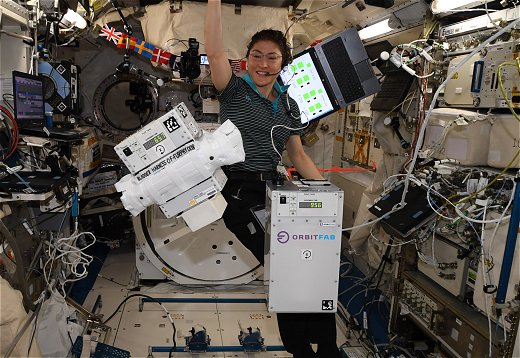
Orbit Fab water containers on the ISS
Two of the Orbit Fab water containers on the ISS.

Details on the hardware used to transfer water to a spacecraft are available at:

** The window for the next Rocket Lab Electron launch opens on June 27th.

The Make It Rain mission will launch multiple spacecraft as part of a rideshare flight procured by Spaceflight. The launch window will open in late June, with launch taking place from Rocket Lab Launch Complex 1 on New Zealand’s Māhia Peninsula.

The mission is named ‘Make it Rain’ in a nod to the high volume of rainfall in Seattle, where Spaceflight is headquartered, as well in New Zealand where Launch Complex 1 is located. Among the payloads on the mission for Spaceflight are BlackSky’s Global-4 satellite and Melbourne Space Program’s ACRUX-1 CubeSat.

** Ariane V successfully launches two satellites to GEO:

** Commercial launch industry must deal with the double challenges of the introduction of lower priced reusable rocket flight services and a drop in the number of orders for big GEO communications satellites:

It’s been a little more than three years since Space X launched the Falcon 9 reusable rocket booster B1021 on a mission to the International Space Station (ISS) in April 2016. When the rocket came back to Earth, it became the first to land vertically on a ship at sea, and then the first to be flown again, on a March 2017 SES-10 mission. Shortly before then, in November 2015, Blue Origin launched its suborbital New Shepard booster, and successfully achieved a powered vertical soft landing.

Such demonstrations have proven that it is possible to bring big payloads into Low Earth Orbit (LEO) — and potentially do so at a fraction of the cost of expendable launches.

“The big factor here is time,” notes Marco Caceres, an analyst with Reston, Va.-based consultancy Teal Group. “When you have an expendable launch vehicle, everything is brand new and you have to test everything. And typically, you don’t launch more than once a month. With reusability your check out time is less, because everything tends to work. As long as there are no cracks, you’re going to launch again within a couple of weeks.”

** Student rocket teams battle it out at the Spaceport America Cup competition in New Mexico:

** EXOS Aerospace sets June 30th for next SARGE launch from Spaceport America. This will be the third flight of the reusable sounding rocker.

** Sweden’s arctic Esrange spaceport will support reusable rocket operations:

SSC is currently developing Esrange Space Center in northern Sweden with new capabilities and services. A testbed for reusable rockets is currently being established, and SSC aims at launching small satellites in a couple of years. In addition, SSC is now introducing a new flight ticket service for suborbital space flights, accessible and affordable for both current and new types of customers. The new concept introduces both the opportunity to fly fractional payloads, ranging from only a few kg up to 800 kg, and a substantially more frequent flight schedule. The flight ticket service is carried out jointly between SSC and DLR MORABA within the EuroLaunch partnership.

Swedish Space Corporation SSC has been launching more than 560 suborbital rockets from Esrange Space Center since the 1966. At Esrange, SSC also operates one of the world largest ground stations for satellite control and data reception. This legacy gives SSC a unique position in the European space community.

For scientists and researchers using microgravity as a tool, the new flight ticket concept SubOrbital Express covers a complete set of services ranging from a flight ticket including launch, quick and safe land recovery to customized services such as design and development of experiment payload modules.

The Spaceport Sweden project is a separate initiative aimed towards suborbital space tourism. The goal is to enable spaceflight participants one day to view the aurora from a Virgin Galactic SpaceShipTwo or other high altitude vehicle.

** Boeing aims to start Spaceliner crew spacecraft missions to the ISS this fall, starting with an uncrewed flight in September. An item today about a recent test:

** SpaceX:

*** Falcon Heavy set for launch on Monday evening from Pad 39A at Cape Kennedy Space Center during a 4 hour window that opens at 11:30 pm EDT (0330 GMT on 25th). A successful static firing of the engines took place last Wednesday:

The mission will be unusually demanding: SpaceX fires Falcon Heavy’s 27 booster engines ahead of “most difficult launch ever” – Teslarati.

SpaceX has a webpage dedicated to the STP-2 Mission:

…this mission will deliver 24 satellites to space on the DoD’s first ever SpaceX Falcon Heavy launch vehicle. The STP-2 mission will be among the most challenging launches in SpaceX history with four separate upper-stage engine burns, three separate deployment orbits, a final propulsive passivation maneuver and a total mission duration of over six hours. In addition, the U.S. Air Force plans to reuse side boosters from the Arabsat-6A Falcon Heavy launch, recovered after a return to launch site landing, making it the first reused Falcon Heavy ever flown for the U.S. Air Force.

Weather conditions look promising: Falcon Heavy L-2 Weather Forecast: 70% Chance Favorable – SpaceX/NASA.

The SpaceX webcast will presumably start at least 15 minutes before liftoff.

The 24 payloads include four NASA sponsored spacecraft. So NASA TV is providing coverage of the launch: Coverage Set for NASA Tech Missions Launching on SpaceX Falcon Heavy | NASA.

This includes a “prelaunch NASA technology show […] scheduled for Sunday, June 23 at noon from Kennedy. NASA will stream the briefing live at https://www.nasa.gov/live“.

The platform for the center core to land on will be placed at “more than 1240 km (770 mi) off the coast of Florida”: A SpaceX surprise: Falcon Heavy booster landing to smash distance record – Teslarati

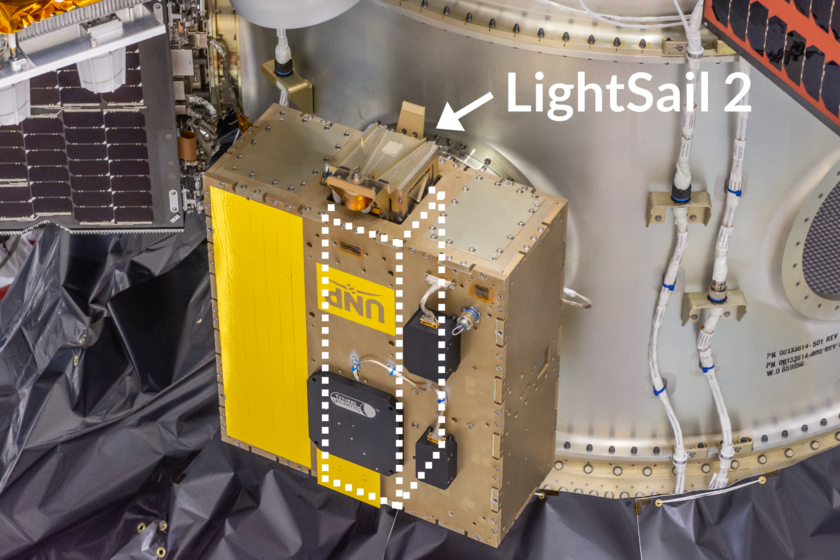
The payloads include university and private spacecraft such as the Planetary Society’s LightSail-2 solar sailing demonstrator: Here’s Our First Look at LightSail 2 Installed on SpaceX’s Falcon Heavy Rocket | The Planetary Society

LightSail-2 inside Prox-1
An image of  Prox-1, a satellite built by a team at Georgia Tech, with a dotted lines marking the location of The Planetary Society’s LightSail 2 spacecraft inside it. A week after the Falcon Heavy upper stage deploys Prox-1 into orbit, the deployer door will open and eject LightSail 2.

*** First Crew Dragon flight to the ISS no earlier than November 15th according to the latest schedule.

*** SpaceX has a third GPS launch set for December: SpaceX on track for US Air Force Falcon 9 mission later this year – Teslarati

Reading between the lines, the US Air Force has effectively confirmed that GPS III Space Vehicle 03 (SV03) – the third GPS III satellite built by Lockheed Martin – is ready for launch aboard a SpaceX Falcon 9 rocket, scheduled no earlier than December 2019.

*** Starhopper still awaits the Raptor engine needed to do low altitude test flights. Preparation of the engines at the McGregor test site is taking longer than expected. It appears that first hops may not take place till July.

*** Starhopper preps and construction of the Starship orbital demostrators can often be viewed via these sources:

A recent Starhopper tank test:

A new structure is in construction at the Boca Chica facility:

====

Delta-v