Category Archives: Rockets

Space transport roundup – Aug.2.2019

A sampling of recent articles, videos, and images dealing with space transport:

** LightSail-2 successfully propelled in low earth orbit by solar light: LightSail 2 Spacecraft Successfully Demonstrates Flight by Light | The Planetary Society

Years of computer simulations. Countless ground tests. They’ve all led up to now. The Planetary Society’s crowdfunded LightSail 2 spacecraft is successfully raising its orbit solely on the power of sunlight. 

Since unfurling the spacecraft’s silver solar sail last week, mission managers have been optimizing the way the spacecraft orients itself during solar sailing. After a few tweaks, LightSail 2 began raising its orbit around the Earth. In the past 4 days, the spacecraft has raised its orbital high point, or apogee, by about 2 kilometers. The perigee, or low point of its orbit, has dropped by a similar amount, which is consistent with pre-flight expectations for the effects of atmospheric drag on the spacecraft. The mission team has confirmed the apogee increase can only be attributed to solar sailing, meaning LightSail 2 has successfully completed its primary goal of demonstrating flight by light for CubeSats.

“We’re thrilled to announce mission success for LightSail 2,” said LightSail program manager and Planetary Society chief scientist Bruce Betts. “Our criteria was to demonstrate controlled solar sailing in a CubeSat by changing the spacecraft’s orbit using only the light pressure of the Sun, something that’s never been done before. I’m enormously proud of this team. It’s been a long road and we did it.”

Some follow-up, including some controversy on the orbital data: ‘Mission success’ declared after LightSail 2 solar sail raises orbit – GeekWire.

For LightSail related resources, see the LightSail Press Kit | The Planetary Society

** Russian rockets send cargo freighter to ISS and communications satellite to MEO.

*** Progress cargo vehicle launches on Soyuz and docks with ISS just 3 hours and 19 minutes later.

A Soyuz-2.1a launch vehicle launched the Progress MS-12 spacecraft to resupply the International Space Station (ISS Progress 73 mission) on 31 July 2019, at 12:10 UTC (18:10 local time, 08:10 EDT) from the Baikonur Cosmodrome in Kazakhstan.

Stories about the mission:

*** Soyuz 2.1a rocket launches from far east Pletsetsk spaceport to send communications satellite to medium altitude Molynia earth orbit:

** First test flight of the Gilmour suborbital rocket falls short of target altitude when engien shuts down shortly after liftoff: One Vision statement

On Monday July 29, Gilmour Space Technologies attempted to launch our ‘One Vision’ suborbital rocket to flight test the company’s proprietary orbital-class hybrid rocket engine and demonstrate our mobile launch capability.

At T-7 seconds to launch, the test rocket suffered an anomaly that resulted in the premature end of this mission. Initial investigations show that a pressure regulator in the oxidiser tank had failed to maintain required pressure, and this anomaly resulted in some damage to the tank and rocket. There was no explosion due to the safe nature of hybrid rocket engines, and no observable damage to the engine. (We will share footage of the launch attempt when available.)

Despite failing to launch, our team successfully tested the mobile launch platform and mission control centre, which had journeyed over 1,800 km to the test site. The automatic ‘load-and-launch’ ground support system performed nominally through countdown, and switched to safe mode to dilute the oxidiser when the tank was compromised. With this mobile launch system, we believe we have the capability to launch a light orbital vehicle from anywhere in Australia.

** Interstellar Technologies MOMO suborbital rocket fails to reach its planned orbit as well:

The

onboard computer issued an emergency stop command. MOMO-F4 reached an apogee of around 13 km and splashed down of 9 km offshore in Launch Hazard Area.

The company has raised more funds to keep development going: Interstellar Technologies Inc. Raises ¥1.22 Billion [US$12.2M] in Series B – Interstellar Technologies  –  July.29.2019 (pdf)

** Update on the next SpaceShipTwo in construction at The Spaceship Company:

Virgin Galactic expects, according to a recent investor presentation, to have five SS2 vehicles in operation by 2023 to support around 270 flights per year.

** China:

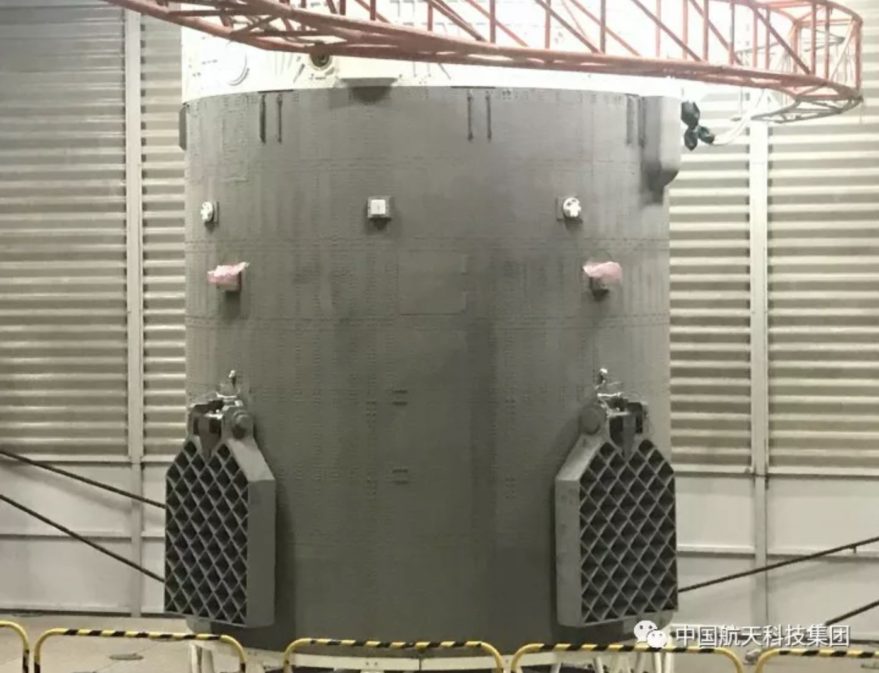
*** First stage of Chinese Long March 2C rocket used grid fins similar to those on the SpaceX Falcon boosters. They were used to guide the first stage to an unpopulated area after the launch from an inland spaceport:

Grid Fins on Long March 2C.
Grid Fins on Long March 2C. Credits: China Aerospace Science and Technology Corporation (CASC)

*** iSpace Hyperbola-1 first launch mimics SpaceX Falcon Heavy‘s launch of a Tesla Roadster:

iSpace Hyperbola-1 launch – weibo.com

** The 2019 International Space Elevator Conference will be held August 16-18 at the Museum of Flight in Seattle, WA. The annual meeting is organized by the International Space Elevator Consortium (ISEC). Check out their latest update: ISEC Space Elevator Newsletter August 2019

** SpaceX:

*** Falcon 9 launch of AMOS-17 communications is delayed after a problem found during a static firing test on Wednesday:

The first stage booster has flown twice but will be expended on this launch.

Here is a video of the static test courtesy of www.USLaunchReport.com

*** Synchronized views of the Falcon 9 booster returning to the Cape after the CRS-18 Dragon launch: SpaceX CEO Elon Musk posts uncut Falcon 9 landing video: reentry burn to touchdown – Teslarati

*** Legs of the recovered booster folded up rather than removed: SpaceX retracts Falcon 9 booster’s landing legs a second time after speedy reuse – Teslarati.

Following the Falcon 9 booster’s second successful NASA launch in less than three months, SpaceX recovery technicians have once again rapidly retracted B1056’s four landing legs, also reused from the booster’s May 2019 launch debut.

On the heels of Falcon 9 B1056’s first speedy, leg-retracting recovery, a repeat of the booster’s impressive landing leg retraction debut – using the same legs, no less – serves as an excellent sign that whatever hardware changes were implemented are on the right track. As part of SpaceX and CEO Elon Musk’s interim goal of launching the same Falcon 9 booster twice in 1-2 days, a speedy recovery is an absolute necessity, and landing leg retraction is just one of the dozens of ways the company will need to optimize recovery and reuse to lower average turnaround times from weeks to days.

*** Environmental impact of Starship/Super Heavy launches from Pad 39A outlined in Draft Environmental Assessment for the SpaceX Starship and Super Heavy  Launch Vehicle at Kennedy Space Center (KSC) – NASA  (pdf)

Pursuant to the Commercial Space Launch Act (CSLA), SpaceX currently operates its Falcon family of launch vehicles on KSC at Launch Complex 39A (LC-39A). SpaceX proposes to expand operations to include launch of Starship/Super Heavy vehicle from this complex. The fully reusable rocket system is being developed by SpaceX to take humans and cargo to Earth orbit and beyond, including to the Moon and Mars.

The launch vehicle is comprised of two stages; the Super Heavy booster is the first stage, and the Starship is the second stage. The booster would be powered by 31 Raptor engines and Starship spacecraft would be powered by seven Raptor engines. The propellant is composed of liquid oxygen (LOX) and liquid methane (LCH4). SpaceX intends to eventually launch the Starship/Super Heavy approximately 24 times per year. The Starship/Super Heavy would include Lunar and Mars missions, satellite payload missions, and human spaceflight.

SpaceX would construct an additional launch mount for Starship/Super Heavy at LC-39A, adjacent to the existing mount used for the Falcon 9 and Falcon Heavy. A LCH4 farm would be built near the existing Falcon Rocket Propellant-1 (RP-1) farm similar in structure to the existing LOX farm. Site improvements would also include an interior transport road leading from the pad entrance gate up to the launch mount as well as several new high pressure gaseous commodity lines. A deluge water system and water cooled flame diverter would be installed and comprised of new water tanks capable of delivering the necessary water pressure.

The Landing Zone 1 (LZ-1) facility, at Cape Canaveral Air Force Station (CCAFS), would be used as a landing location for Starship, similar to its current use for Falcon booster landings. The Starship spacecraft is the second stage of the vehicle. Super Heavy is the first stage booster and would be landed downrange on a droneship (converted barge), similar to the downrange landings of Falcon boosters. SpaceX’s proposed action includes the construction of a landing pad for Starship land landings within the LC-39A boundary. The potential for land landings of Starship at LC-39A will require additional analysis to fully assess the potential impacts to NASA programs, facilities, personnel and operations.

The file includes also the report: Starship Noise and Sonic Boom Assessment for Flight and Static Test Operations at Kennedy Space Center – KBRwyle Technical Note TN 19-02.

*** The Starhopper moved back to its starting point after its first un-tethered flight:

The window for the next flight, which will go up to 200 meters, opens on August 12th.

*** Scott Manley analyzes the Starhopper’s hop:

*** A view from the sky of SpaceX facilities and activities at Boca Chica Beach:

*** Shots of the Starhopper and Starship demo vehicle under assembly at Boca Chica:

*** Misc. SpaceX items:

====

The Space Barons: Elon Musk, Jeff Bezos,
and the Quest to Colonize the Cosmos

Space transport roundup – July.26.2019

A sampling of recent articles, videos, and images dealing with space transport:

** SpaceX:

Starhopper on first flight as seen by drone
The Starhopper begins moving sideways during its first untethered flight as seen by a drone.

*** Starhopper makes first successful hop within a fiery storm of flame, smoke, and steam. Late Thursday evening, SpaceX’s Starhopper, a Raptor methane engine powered prototype Starship, lifted off the ground untethered for the first time and moved sideways a short distance on the flat pad. The high swirl of smoke and steam hid most of the vehicle during its brief flight. Elon Musk this morning, however, released a video showing a view of the engine from an onboard camera during the hop. Plus he provided a video from a drone where one can see much more of the vehicle during the flight than from the ground videos.

This view from the ground shows an overlay for the location of the vehicle within the cloud:

A grass fire was set off by the exhaust and was still burning this morning. However, local firefighters seem to have it under control.

Elon also said, there will be “200m hop in a week or two”.

Now that the Starhopper has made its first flight, he will soon give a presentation on the latest design and development plans for the Super Heavy Booster/Starship system.

*** A previous hop attempt on Wednesday was quickly aborted after the engine fired: SpaceX’s Starhopper aborts first free flight after igniting Raptor engine, catching fire [updated] – Teslarati

*** Falcon 9 launches Cargo Dragon and booster lands back at the Cape. The Dragon is on its third flight and the first stage booster was on its second. The Dragon is scheduled to berth to the ISS on Saturday morning.

The SpaceX webcast:

A nice view of the booster from separation to landing (via www.USLaunchReport.com):

** The Dragon is wearing some ceramic tiles to test them for use as heat shields on the Starship. Tiles appear to be the latest approach to protecting the Starship during reentry. Previously, the plan was to pressure feed water or liquid methane through tiny holes in the steel body panels to soak up the heat to protect the vehicle. The passive tile approach seems more robust to flaws than an active transpiration system.  SpaceX testing ceramic Starship heat shield tiles on flight-proven CRS-18 Cargo Dragon – Teslarati

SpaceX announced during its CRS-18 Cargo Dragon webcast that the twice-flown orbital spacecraft will feature a handful of ceramic Starship heat shield tiles, meant to flight-test a critical component of the next-generation SpaceX spacecraft.

If Cargo Dragon capsule C108 continues its successful record of orbital missions and recoveries, SpaceX will be able to recover Starship’s prototype ceramic heat shield tiles perfectly intact and thus have access to orbit- and reentry-tested hardware that should provide invaluable data for Starship. It’s unclear where exactly ceramic heat shielding would be used on Starship or if this means that the spacecraft’s transpirationally-cooled steel tiles did not pass muster, but CEO Elon Musk will hopefully provide additional details in a presentation later this month or early next.

** Planetary Society’s LightSail 2 cubesat deployed the sail and began the sunlight propulsion test: LightSail 2 Successfully Deploys Solar Sail | The Planetary Society

The Planetary Society’s LightSail 2 spacecraft has successfully deployed the large, aluminized Mylar sail it will use to raise its orbit solely with sunlight.

Flight controllers at Cal Poly San Luis Obispo in California commanded the spacecraft to deploy its solar sails [on July 23rd] at about 11:47 PDT (18:47 UTC). Images captured during the deployment sequence and downloaded today show the 32-square-meter sail, which is about the size of a boxing ring, deploying as the spacecraft flew south of the continental United States.

More about the project:

** iSpace becomes first commercial Chinese company to put satellites into orbit. The company Beijing Interstellar Glory Space Technology Ltd., which also goes by the shorter name iSpace, put 2 satellites into low earth orbit with the four-stage Hyperbola 1 rocket on Thursday. The lower three stages uses solid-fueled motors while the final stage has a liquid fueled engine..

CGTN:

Beijing-based startup iSpace successfully sent two satellites into the designated orbits with their own rocket on Thursday. It is the first company to complete such a mission in the commercial space industry at a domestic level. The SQX-1 Y1 is the 20.8-meter-tall four-stage solid-propellant carrier rocket carrying two satellites. The rocket blasted off at 1:00 p.m. BJT from a supporting pad in the large desert at the Jiuquan Satellite Launch Center, northwest China. With a liftoff weight of 31 metric tonnes and a diameter of 1.4 meters, the rocket can carry a payload of 260kg into a sun-synchronous orbit 500 km above the Earth. Established in 2015, the startup iSpace is China’s first private company to get a license to develop carrier rockets.

** China launches three remote sensing satellites.

** Chinese companies developing methane rocket engines:

    • LandSpace
      • China’s liquid oxygen-methane rocket engine completes key test – ecns.cn :
        80-tonne thrust liquid oxygen-methane engine has completed a full-thrust run test with a duration of 100 seconds, the developer said Tuesday.The engine, named TQ-12, was independently developed by the private rocket company LandSpace and has the third-highest thrust level among liquid oxygen-methane engines globally.
    • Kyushu Yunjian (Beijing) Space Technology Co.
      • Kyushu Yunjian “Lingyun” liquid oxygen methane engine completed the hot test – (Google Translate) – Original: 九州云箭.
        As the first liquid oxygen methane engine in China that truly realizes reusable, multiple start and deep variable thrust capability, the “Lingyun” engine has low-cost rapid maintenance and multiple start-up capability, large-scale change of engine during the development process. A series of bold and difficult explorations and attempts have been made in the adjustment technology of thrust, control technology and the adaptability technology of key assemblies. The successful completion of this round of hot test marks that the Kyushu Yunjian “Lingyun” engine has achieved the pumping type in China. Several effective breakthroughs in the bottleneck technology of cryogenic liquid rocket engines.

Another day, another methalox engine test for Chinese NewSpace. Jiuzhou Yunjian (九州云箭, est. 2017) testing deep throttling and multiple starts with its ‘Lingyun’ 10-tonne variable thrust liquid oxygen-methane engine. https://t.co/IKEsDK6zJp pic.twitter.com/7dQf9896g5
— Andrew Jones (@AJ_FI) July 23, 2019

For frequent updates on Chinese space developments, see Andrew Jones (@AJ_FI) / Twitter.

**

====

Space 2.0: How Private Spaceflight, a Resurgent NASA,
and International Partners are Creating a New Space Age

Space transport roundup – July.23.2019

A sampling of recent articles, videos, and images dealing with space transport:

** LightSail-2 unfurled today: Live Coverage: LightSail 2 Sail Deployment | The Planetary Society

** India launches the Chandrayaan-2 lunar mission, which includes an orbiter, lander, and rover. The spacecraft’s elliptical orbit of Earth will gradually extend farther and farther out until on August 14 the engines will fire to put the spacecraft on course for the Moon. It will go into lunar orbit on August 20th. The goal is to separate the lander/rover combo from the orbiter on September 1st and settle down on the lunar surface on September 6th. If successful, the landing will be the first time a spacecraft has reached the southern polar region, where water ice is believed to be embedded in the floors of permanently dark craters.

An animation of the mission:

More about the mission:

** Russian Soyuz launches 3 new ISS crew members and docks with the station just 6 hours after liftoff. The July 20th flight took place on the 50th anniversary of the Apollo 11 landing on the Moon. Currently, the US has no operational system for putting people into orbit (though, in a pinch, the SpaceX Cargo Dragon could certainly be configured to take someone to orbit).

The new members of the ISS crew include cosmonaut Alexander Skvortsov, ESA astronaut Luca Parmitano and NASA physician-astronaut Andrew Morgan. More at:

** Rocket Lab’s next launch set for August and will carry four satellites: Rocket Lab’s Next Mission Focused On Building Constellations And Enabling R&D | Rocket Lab.

Rocket Lab

announced its next launch is a mission carrying satellites destined to begin a new constellation for UNSEENLABS, as well as more rideshare payloads for Spaceflight, consisting of a spacecraft for BlackSky and the United States Air Force Space Command.

The mission – named ‘Look Ma, No Hands’ – will lift-off in August from Launch Complex 1 in New Zealand, carrying a total of four satellites aboard an Electron launch vehicle.

See also:

** Gilmour Space Technologies prepares for a suborbital launch of the company’s OneVision rocket. The 8.6 meter high, 1600 kilogram vehicle

will flight test the company’s first-stage 80kN orbital engine, and demonstrate their mobile launch capability.

The company plans to launch smallsats into orbit in the 2021 time frame. More about Gilmour Space:

** Blue Origin is making progress with its BE-7 rocket engine that will power the Blue Moon lander vehicle: Blue Origin fires BE-7 lunar lander engine for full 6 minutes – GeekWire

** SpaceX:

*** Falcon 9 set to launch Cargo Dragon on CRS-18 mission on Wednesday at 6:24 pm EDT (2224 GMT) from Cape Canaveral. The weather forecast (pdf), however, gives only a 30% chance of acceptable conditions for liftoff within the instantaneous launch window.

A view of the Falcon 9 static fire test last Friday (via www.USLaunchReport.com):

*** A fuel leak fire following the Starhopper static engine test last week resulted in a scary fireball but caused no significant damage to the vehicle. The first brief flight of the vehicle is planned for this week.

Some recent views of the Starhopper and the orbital Starship demonstrator at Boca Chica Beach, Texas:

*** Elon gives more clues about Super Heavy Booster/Starship system design: SpaceX’s Elon Musk says Starship, Super Heavy will have more than 40 Raptor engines – Teslarati

If the above Starhopper test flight is successful, Elon promises to provide a more extensive update soon after on the latest design details.

*** Elon Musk discusses SpaceX projects in two interviews. Highlights include his belief that the first crewed Dragon mission to the ISS will happen within 6 months, an uncrewed Starship could land on the Moon within 2 years, and with a crew in 3-4 years:

*** More about the Crew Dragon test explosion. Last week, SpaceX released an Update on the In-Flight Abort Static Fire Test Anomaly Investigation that occurred in April. Scott Manley gives a lucid description of the investigation’s findings:

See also:

*** Crew Dragon parachute development and testing appear to have reached a successful conclusion:

====

Space 2.0: How Private Spaceflight, a Resurgent NASA,
and International Partners are Creating a New Space Age

Space transport roundup – July.14.2019

A sampling of recent articles, videos, and images dealing with space transport:

** SpaceX Starhopper demo vehicle prepared for first un-tethered low altitude flights at the SpaceX South Texas Launch Site. More in SpaceX section below.

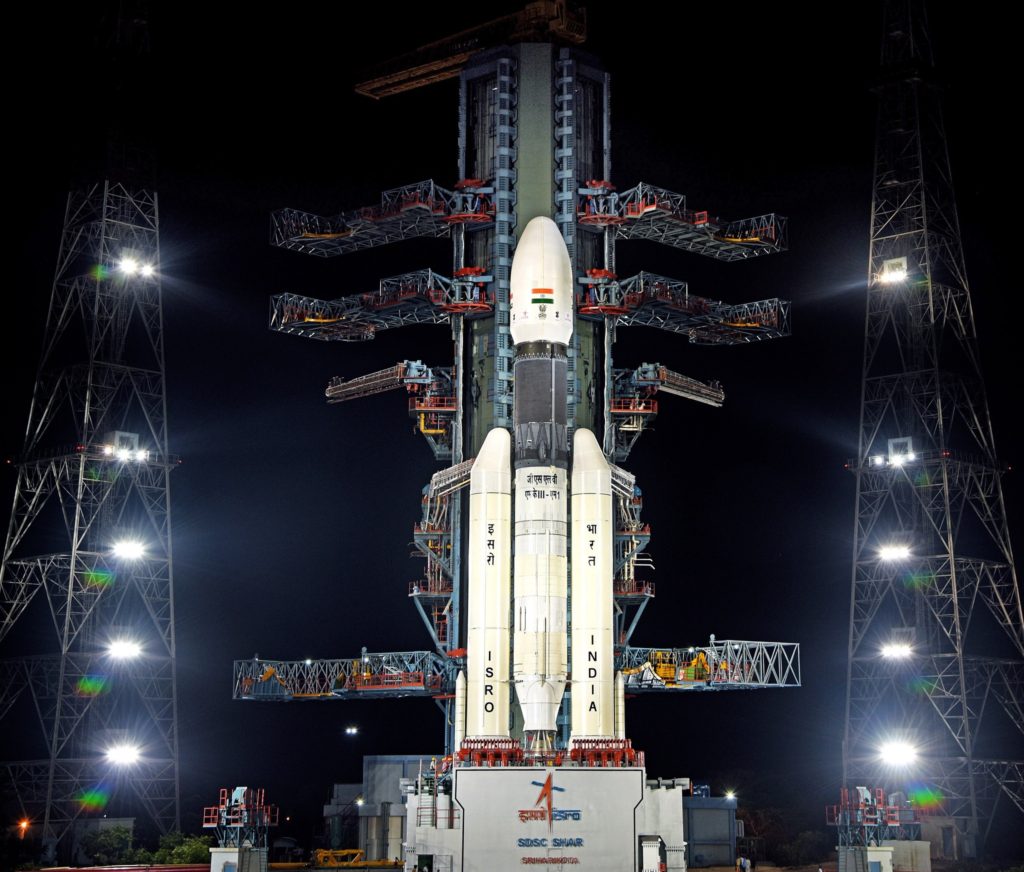
** India scrubs today’s launch of the Chandrayaan-2 lunar lander on a Geosynchronous Satellite Launch Vehicle (GSLV Mk.3).

More about the mission:

GSLV MkIII-M1 / Chandryaan 2 vehicle
The GSLV MkIII-M1 / Chandryaan 2 vehicle on the launch pad.

From SFN:

If everything goes according to plan, the three-in-one spacecraft will arrive in orbit around the moon around Aug. 5, then detach the landing craft around Sept. 2 or 3 to begin lowering its altitude in preparation for a final descent to the lunar surface as soon as Sept. 6.

“We are landing at a place where nobody else has gone,” said K. Sivan, chairman of the Indian Space Research Organization.

Indian scientists are targeting landing of the Chandrayaan 2 lander at an unexplored site located on the near side of the moon at 70.9 degrees south latitude, closer to the moon’s south pole than any previous mission. The landing module is named Vikram for Vikram Sarabhai, the father of India’s space program, and will deploy the Pragyan rover, named for the Sanskrit word for “wisdom.”

** Russian Proton-M rocket launched the Spektr-RG astrophysical x-ray observatory from the Baikonur Cosmodrome in Kazakhstan: Russian Proton-M launches Spektr-RG observatory – NASASpaceFlight.com

** An Arianespace Vega rocket failed during the launch of UAE’s Falcon Eye-1 earth observation satellite:

The $400M payout for the failure will be a real blow to the space insurance industry.

** A Russian Soyuz 2-1v launched four military satellites with little prior public notification: Soyuz 2-1v conduts surprise military launch – NASASpaceFlight.com

** Virgin Orbit executes successful drop test of LauncherOne rocket from the “Cosmic Girl” 747 carrier aircraft:

** EXOS Aerospace posts videos from recent launch in which the SARGE reusable rocket suffered a guidance glitch shortly after liftoff but still manages to return for a landing via paraglider:

** China’s Galactic Energy Aerospace Technology, Ltd wants to challenge SpaceX in reusable rocketry: Chinese rocket start-up aims at ‘SpaceX dominance’ – ecns.cn

Beijing-based private rocket start-up Galactic Energy Aerospace Technology Co has made a breakthrough in its “Pallas” medium liquid-propellant rocket, a step closer to the firm’s goal of forging a Chinese version of the Falcon 9 rocket manufactured by U.S. spaceflight company SpaceX.

The gas generator, which helps provide thrust to the rocket’s 40-ton engine that is powered by reusable liquid oxygen and kerosene, has completed seven ignition tests over the weekend, with an accumulated operation time of 380 seconds, according to Galactic Energy. The maximum single operation time lasted 100 seconds.

The company started developing the main rocket engine for the Pallas in December 2018, and it is the first Chinese rocket with engines that run on reusable liquid oxygen and kerosene.

Galactic Energy’s products include the Pallas family of medium-sized liquid rockets, named Pallas, and small solid rockets named Ceres.

The Ceres-1 is aimed at the low-orbit commercial small satellite market and is expected to fly in March 2020. The Pallas-1 is expected to launch in December 2022.

** Spaceflight takes advantage of two cargo spacecraft and the ISS to put six smallsats into their designated orbits : SEOPS Mission Preview – Spaceflight
Continue reading Space transport roundup – July.14.2019

Space transport roundup – July.9.2019

A sampling of recent articles, videos, and images dealing with space transport:

** Russian Soyuz launches 33 satellites last wee including the primary Meteor-M No.2-2 weather satellite and 32 smallsats from a host of countries and organizations:

A busy month planned for Russian rockets: Russia plans seven space launches in July – TASS

** PLD Space releases video of a high altitude drop in April of a demo booster for the MIURA 5 orbital rocket, which will have a reusable first stage booster: Successful drop test of the demonstrator of the first stage of MIURA 5 – PLD Space

Drop Test of the demonstrator of the first stage of MIURA 5 orbital microlauncher. This project was part of ESA’s FLPP-LPSR programme. PLD Space successfully completed in April the first drop test with a full-scale demonstrator of the first stage of the MIURA 5 orbital rocket. As a result, we have documented assessment of all the recovery and reusable technologies that will help PLD Space to develop its recovery and reusability technology roadmap. One step closer to reusability in Europe!

With this, we have validated many operational procedures, including all recovery and reusability steps, as well as the telemetry down-links, among others. This project is part of the FLPP-LPSR program, promoted by the European Space Agency (ESA), supported by CDTI, INTA, Ejército de Tierra #FAMET #BHELTRAV and with the participation of Tecnalia.

** Amateur spacecraft observers capture images of the X-37B spaceplane: Mysterious X-37B Military Space Plane Caught on Camera (Photo) – Space.com

** Rocket Crafters thruster demos suffer various glitches: Cocoa-based Rocket Crafters working through issues ahead of 2021 debut – Florida Today

** System for long duration in-space storage for cryogenic propellants has been developed by a Chinese team: Scientists make breakthrough that enables rockets to orbit longer – Xinhua

Scientists from the China Academy of Launch Vehicle Technology have developed two insulating materials that can reduce propellant evaporation loss and keep rockets in flight for longer than before.

According to Zhang Shaohua, a member of the research team, a cryogenic rocket will face a severe thermal environment when it flies in orbit, which will cause lots of propellant evaporation, accelerate propellant loss and reduce the time in orbit.

Long term cryogenic propellant storage is important for space tugs and fuel depots.

** Canadian SpaceRyde developing a high-altitude balloon rocket launch system for orbiting smallsats:

** The latest on space elevators: ISEC Space Elevator Newsletter July 2019

According to Pete Swan, president of the ISEC (Int. Space Elevator Consortium), the development of space elevators is “Closer than you Think”:

There are two factors that lead to this conclusion:

The first is that the material for space elevator tethers has been discovered and is in the laboratory now. Single Crystal Graphene has been developed towards a continuous growth production concept (grow a single molecule very long – hundreds of meters) (currently at 0.5 x 0.1 meter single molecule one atom thick in laboratories). Adrian Nixon projected that future of very long molecules during his talk at our recent ISEC Webinar. The material is going to be available in the required strength and length for space elevators.

The second is that we (ISEC with the other organizations such as IAA, Obayashi Corporation, and JSEA) have conducted engineering studies and testing showing great progress across the engineering design segments of a space elevator. The following year long (IAAs and Obayashi were multi-year) studies have lead to the conclusion that the space elevator is ready to start testing the technologies needed inside each of its major segments and regions.

The 2018 ISEC Space Elevator Conference will be held at the Museum of Flight in Seattle, Washington over August 16-18.

** SpaceX:

*** Launch contracts:

*** Practicing for Crew Dragon docking to the ISS: NASA, SpaceX Simulate Astronauts Docking to Station on Crew Dragon Spacecraft – Commercial Crew Program

NASA and SpaceX practiced Crew Dragon rendezvous and docking to the International Space Station during a virtual dress rehearsal on June 26 for the company’s first crew flight test, known as Demo-2, to the microgravity laboratory

The activity is part of a series of integrated simulations bringing together NASA and SpaceX flight control teams to complete multiple practice runs for each dynamic phase of a mission from launch to splashdown. These simulations provide the teams plenty of practice to ensure they safely and successfully perform the planned operations of the actual spaceflight, with opportunities to fine-tune their procedures and gain experience on how to solve problems should they arise.

*** Views of a recovered Falcon fairing: SpaceX’s Falcon Heavy fairing tries to enter hyperspace, lands in net in new videos – Teslarati. Here Scott Manley discusses the fairing return videos:

*** Raptor engine debugging nearly done: SpaceX CEO Elon Musk says major Starship engine bug is fixed as Raptor testing continues – Teslarati

SpaceX CEO Elon Musk has revealed the latest official photo of the company’s Raptor engine in action and indicated that a major technical issue with vibration appears to have been solved, hopefully paving the way for Starhopper’s first untethered flights.

Partly due to Musk’s own involvement in the program, SpaceX’s propulsion development team have struggled to get any single Raptor engine to survive more than 50-100 seconds of cumulative test fires. According to information from sources familiar with the program, Musk has enforced an exceptionally hardware-rich development program for the first full-scale Raptor engines to such an extent that several have been destroyed so completely that they could barely be used to inform design optimization work. Although likely more strenuous and inefficient than it needed to be, the exceptionally hardware-rich test program appears to have begun to show fruit, with the sixth engine built (SN06) passing its first tests without exhibiting signs of a problem that has plagued most of the five Raptors that came before it.

A Tweet from Elon on the rocket engine development process:

*** Starship launch facility development underway: SpaceX’s Starship/Super Heavy rocket needs a launch pad and work is already starting – Teslarati

*** An update presentation from Elon on Starship program tentatively set for late July:

*** Assembly of the Starhopper and two orbital Starship demonstrators appear to be moving along:

*** A fire at the Cocoa Beach facility wasn’t too serious apparently:

====

Space 2.0: How Private Spaceflight, a Resurgent NASA,
and International Partners are Creating a New Space Age