Category Archives: Rockets

Space transport roundup – Sept.30.2019

A sampling of recent articles, videos, and images dealing with space transport (find previous roundups here):

** SpaceX:

*** Elon Musk presents plans for rapid development of Starship/Super Heavy Booster space transport system while standing in front of first assembled Starship demonstrator on Saturday evening.

Some of the highlights from his remarks:

  • Starships Mk.1 and Mk.2 (Cocoa Beach, Florida) are just the first vehicles off the assembly lines.
    • Expect to complete a new vehicle every few months
    • Each will incorporate lessons learned from the previous vehicles.
  • Switching from composite to stainless steel brought multiple advantages:
    • Enables fast prototyping
    • Excellent strength and thermal properties
    • Much cheaper than composites
  • Mk.1 to fly to 20 kilometers in 1 to 2 months from now.
  • Doesn’t expect big regulatory problems with test flights and landings.
  • Before assembling first Super Heavy Booster (SH), need to ramp-up Raptor engine production.
  • Need about 30 engines for first SH.
  • SS Mk 4 or Mk.5 with first SH could launch to orbit by next year
  • Full reusability with rapid turnaround will enable multiple test flights in a short period.
  • Will fly crews within a year or so.
  • Will fly SS/SH from both Boca Chica and Kennedy Space Center launch sites.

*** Sampling of articles and responses to the presentation:

*** Time lapse of stacking of the Starship Mk.1 – LabPadre:

*** Scott Manley’s view of the presentation:

Reports leading up to the presentation:

*** A drone view of the Cocoa Beach facility where the Starship Mk.2 demonstrator is under construction:

*** Elon believes the Starships will enable large space settlements on the Moon and Mars. Some of the artwork shown:


*** SpaceX Crew Dragon developments:

Musk estimated that Crew Dragon capsule 03 (C203) and its expendable trunk would be sent from SpaceX’s Hawthorne, CA factory to Cape Canaveral, FL as early as October. Crew Dragon capsule C204 is then expected to follow around one month later, arriving in Florida for preflight preparation as early as November

SpaceX has applied for an FCC Special Temporary Authority license to authorize rocket communications during what is likely Crew Dragon’s In-Flight Abort (IFA) test, now scheduled to occur no earlier than November 23rd.

In line with recent comments from SpaceX executives, a November or December In-Flight Abort test would almost certainly preclude Crew Dragon from launching with astronauts in 2019, pushing the Demo-2 mission into the Q1 2020. Nevertheless, it would serve as a good sign that Crew Dragon remains on track if SpaceX can complete the critical abort test – meant to prove that Dragon can whisk astronauts away from a failing rocket at any point during launch – before the year is out.

NASA and SpaceX conducted a formal verification of the company’s emergency escape, or egress, system at Kennedy Space Center’s Launch Complex 39A in Florida on Sept. 18, 2019. NASA astronauts Bob Behnken and Shannon Walker participated in the exercise to verify the crew can safely and swiftly evacuate from the launch pad in the unlikely event of an emergency before liftoff of SpaceX’s first crewed flight test, called Demo-2.

NASA astronauts Shannon Walker, in front, and Bob Behnken participated in the exercise to verify the crew can safely and quickly evacuate from the launch pad in the unlikely event of an emergency before liftoff of SpaceX’s first crewed flight test, called Demo-2. During the escape verification, Walker and Behnken pass through the water deluge system on the 265-foot level of the crew access tower. Photo credit: SpaceX
NASA: “NASA astronauts Shannon Walker, in front, and Bob Behnken participated in the exercise to verify the crew can safely and quickly evacuate from the launch pad in the unlikely event of an emergency before liftoff of SpaceX’s first crewed flight test, called Demo-2. During the escape verification, Walker and Behnken pass through the water deluge system on the 265-foot level of the crew access tower.”Photo credit: SpaceX

**  Japanese HTV-8 launched last week docked with the ISS on Saturday:

** Latest Ariane 6 news: Ariane 6’s core engine completes qualification tests – ESA

Ariane 6, Europe’s next-generation launch vehicle, has passed another key development milestone. Its Vulcain 2.1 liquid-fuelled engine has now completed its qualification testing, which means combined tests can now begin.

The main stage Vulcain 2.1 engine will deliver 135 t of thrust to propel Ariane 6 in the first eight minutes of flight up to an altitude of 200 km.

** Russia launches 2nd Soyuz in two days. Puts missile warning satellite into low earth orbit: Soyuz 2-1B launches latest Tundra satellite – NASASpaceFlight.com

Russia’s Soyuz rocket has made its second launch in less than twenty-four hours, delivering a missile detection satellite to orbit Thursday in a military launch from the Plesetsk Cosmodrome. Soyuz lifted off at 10:46 Moscow Time (07:46 UTC), placing the Tundra satellite into its planned orbit with the aid of a Fregat upper stage.

Tundra plays a significant part in Russia’s national security arrangements, monitoring the Earth for potentially hostile missile launches so the Russian Government can react as necessary. It forms part of the Edinaya Kosmicheskaya Sistema (EKS) or Unified Space System which is being introduced to replace the earlier Oko system that Russia inherited from the Soviet Union. Thursday’s launch deployed the third such satellite.

** Reports of the death of Stratolaunch appear to have been exaggerated: Stratolaunch rebuilds team for world’s biggest plane – GeekWire

Representatives of the Allen family’s Vulcan holding company have insisted that Stratolaunch remains operational. LinkedIn listings indicate that Jean Floyd is still president and CEO, although three company vice presidents left in July.

Now Stratolaunch is posting 11 job openings, including listings for two test pilots. “As a test pilot on the history-making Stratolaunch Carrier Aircraft, the world’s largest-wingspan aircraft, you will have the opportunity to accomplish new milestones in aviation,” the company says.

** Rocket Lab prepares launch facility at Wallops Island, Virginia: Rocket Lab Readies Launch Complex 2 for Electron Launches From U.S. Soil | Rocket Lab

Rocket Lab, the global leader in dedicated small satellite launch, and Virginia Space at the Mid-Atlantic Regional Spaceport (MARS), have completed a major construction milestone ahead of the first Electron launch from U.S. soil. The recent installation of the launch platform at Rocket Lab’s second launch site, Launch Complex 2, marks one of the final steps in the construction of the new pad being built by the Rocket Lab and Virginia Space teams.

Construction on Launch Complex 2, located at the Mid-Atlantic Regional Spaceport (MARS) on Wallops Island, Virginia, began in February 2019. In the few months since then, more than 1,400 cubic yards of concrete have been poured to create the pad on which Electron’s launch platform is mounted. The 66 ton launch platform was installed into its final position this month, ready for the 44 foot, 7.6 ton strongback to be mounted to the platform in coming weeks. Both the launch platform and strongback were built by Steel America in Norfolk, Virginia. The launch site largely mirrors Rocket Lab’s first launch location, Launch Complex 1 in New Zealand, where the Electron launch vehicle transports horizontally down the launch ramp, and then is lifted vertically by the strongback to be ready for launch.

In the coming weeks, work will focus on final build and integration of various launch pad systems that will process, load propellant into, and launch Electron. The final step in the completion of the site is integration and test activities, which is expected to be complete by December 2019. Once the site is complete, work begins on testing, commissioning, and integration at the launch site in preparation for the first Electron launch from U.S. soil in early 2020.

** Blue Origin plans to start  flying New Shepard with people on board after two more uncrewed test flights. However, the test flights won’t happen before November.

From CNBC:

The company is developing the New Shepard rocket system for its space tourism business. Blue Origin is still hoping to fly people on New Shepard this year, although the company noted in a meeting with reporters on Tuesday that 2019 is quickly coming to an end, so those plans may move to 2020.

Blue Origin also filed an application for its next test flight with the Federal Communications Commission (FCC) on Tuesday. The filing is “for Flight #12 of the New Shepard space launch booster and capsule” and has an operational window beginning in November. To be clear, that’s not necessarily when Blue Origin will next launch New Shepard, but rather the earliest time they could with federal approvals.

====

Delta-v

Space transport roundup – Sept.25.2019

A sampling of recent articles, videos, and images dealing with space transport (find previous roundups here):

[ Update: Great views of the Starship Mk.1 coming to together at Boca Chica Beach:

]

** Today a Russian Soyuz launched 3 new ISS crew members including the first astronaut from the UAE. This was the final flight for the Soyuz-FG version of the rocket. The modernized Soyuz-2 will now become the standard crew launch version of the Soyuz family of rockets. The Expedition 61 crew includes Russian cosmonaut Oleg Skripochka, NASA astronaut Jessica Meir, United Arab Emirates guest cosmonaut Hazzaa Ali Almansoori. The launch was timed for a fast rendezvous with the station and the spacecraft is set to dock today at 3:45 p.m. EDT (1945 GMT).

** A Japanese H-IIB rocket launched a HTV cargo module to the ISS on Tuesday. Following a scrub on Sept. 10 due to a launch pad fire, the H-IIB successfully lifted off yesterday from the Tanegashima Space Center with the eighth HTV (H-II Cargo Vehicle) to go to the ISS. The spacecraft will take 4 days to reach the station with its load of over 4 tons of supplies and equipment, including several new lithium-ion batteries  to replace aging nickel-hydrogen batteries for part of the station’s power system.

** Three rocket launches took place in China in the past week including a Long March 2D today carrying a Yunhai remote sensing satellite:  China launches environmental monitoring satellite – Spaceflight Now

*** Long March 3B rocket on with two Beidou navigation satellites launched on Sept. 22th:

*** A Long March 11 launched on Sept.19th with five satellites for the private company Zhuhai Orbita Aerospace Science and Technology Co., Ltd. The group of satellites included four with hyperspectral imaging systems and one with video imaging.

** Virgin Orbit shipped out the first operational LauncherOne rocket for tests in prep for launch by end of the year: LauncherOne: Shaping Up and Shipping Out | Virgin Orbit

This week, after a very hard drive by our teammates in our Long Beach factory, we waved good-bye to our latest test rocket. Our previous LauncherOne served valiantly through a battery of tests highlighted by several captive carry flights and especially by our flawless drop test. Our latest rocket — which has already been fully integrated, tested, checked, re-checked, analyzed, and triple-checked — is destined for a rigorous crucible of engineering demonstrations and tests of its own. The final demonstration for this rocket will also be the biggest test we’ve attempted as a team: during that test, we’ll fire up LauncherOne’s engine in flight and head for space for the first time.

Virgin Orbit LauncherOne
This will be the first Virgin Orbit LauncherOne rocket to attempt to put a payload into orbit.

** Firefly Aerospace is posting updates on preps for the first launch of an Alpha rocket next year.

** The small company LAUNCHER pushes 3D printing technology to make its  rocket engines more efficient:

** Blue Origin targets November for next New Shepard flight:

** An update on research on bleeding-edge propulsion concepts: Marc Millis: Testing Possible Spacedrives – Centauri Dreams

Marc Millis, former head of NASA’s Breakthrough Propulsion Physics project, recently returned from another trip to Germany, where he worked with Martin Tajmar’s SpaceDrive project at Germany’s Technische Universität Dresden. Recent coverage of the ongoing experimental work into spacedrives in both the popular and scientific press has raised public interest, leading Millis to explain in today’s essay why and how the techniques for studying these matters are improving, and how far we have to go before we have something definitive. Millis is in the midst of developing an interstellar propulsion study from a NASA grant even as he continues to examine advanced propulsion concepts and the methodologies with which to approach them.

See also Just How Feasible is a Warp Drive? – Universe Today.

** SpaceX

*** Assembly of the Starship Mk.1 orbital demonstrator accelerated at even a faster pace in the past week at Boca Chica Beach. It appears that some staff from the Mk.2 project in Cocoa Beach, Florida came to help out in Texas so that a complete Starship can provide a dramatic backdrop to Elon Musk’s update presentation on the project this Saturday, Sept. 28th.

*** Elon gives some pre-presentation hints on the latest Starship design and operation concepts:

*** Tim Dodd, the Everyday Astronaut, gives an overview of the new design for the fins:

*** Scott Manley also gives his thoughts on the design changes: Scott Manley: New Details Revealed About SpaceX’s Stainless Steel Starship as Prototype Nears Completion : spacex/reddit.com

*** Some synergy at last between SpaceX and Tesla: SpaceX’s Starship Mk1 rocket shares a surprising connection with Tesla EVs – Teslarati

These battery packs were spotted by an eagle-eyed forum user who was first to recognize the hardware for what it likely was. Per the above photo, SpaceX appears to have joined two self-contained Tesla battery packs into single units that were then installed on a header tank. Knowing that the highest capacity Tesla offers is ~100 kWh, the 2×2 packs could store up to 400 kWh and offer instantaneous power output (ignoring thermal limitations) well into the megawatt (MW) range.

The Tesla batteries are needed to run the motors that move the fins:

*** Yusaku Maezawa raises a few billion dollars from selling stock in his clothing company. This will provide him additional money to fund his Starship flight around the Moon with artist friends. He may also take a preliminary flight to space on a Crew Dragon.

Forbes:

While acknowledging his mistakes at a two-hour press conference, he said there were two personal reasons for his resignation: Preparing for the 2023 lunar mission, including going into space once before that, and wanting to feel the “rush” of building a company from the ground up again.

“Training to go into space will to take up much of my time,” he said, flanked by his successor at Zozo, Kotaro Sawada, and the president of Yahoo Japan.

*** Falcon 9 launch rate to accelerate in coming year as SpaceX ramps up deployment of the Starlink broadband Internet constellation: Starlink to fill lion’s share of SpaceX near-term launch manifest – Spaceflight Now

SpaceX plans as many as 24 launches next year to build out the company’s Starlink network to provide broadband Internet service from space, following up to four more Starlink missions before the end of this year, according to SpaceX’s chief operating officer.

The rapid-fire launch cadence for SpaceX’s Starlink fleet will take up the majority of the company’s launch manifest next year with a series of missions taking off from Florida’s Space Coast, adding new nodes to a network that could eventually contain nearly 12,000 small satellites.

** After a two month break, the next Falcon 9 launch looks to happen in mid-October but not clear yet if it will be a Starlink payload or a customer satellite  SpaceX’s next Falcon 9 launches get a bit closer as hardware arrives in Florida – Teslarati

SpaceX completed its last orbital launch on August 7th, placing the AMOS-17 communications satellite into a geostationary transfer orbit (GTO) on an exceedingly rare expendable Falcon 9. As of then, SpaceX’s next launch – an internal Starlink mission – was already expected no earlier than October and has since settled towards the end of the month. First reported by NASASpaceflight.com, the first Starlink v1.0 mission (AKA Starlink-1) is tentatively scheduled to launch no earlier than (NET) October 17th, followed by Starlink-2 NET November 4th and Starlink-3 NET late-November.

Of note, there have been whispers in the last few days that SpaceX’s next launch is not, in fact, a Starlink mission. Reading between the lines, only two possible spacecraft – JCSAT-18/Kacific-1 or South Korea’s ANASIS – are next on SpaceX’s manifest, the former of which is scheduled to launch no earlier than November 11th and the latter of which does not yet have a firm date.

*** Crew Dragon program continues to move along with progress on parachutes, finalizing the April explosion investigation, and targeting late this year for the in-flight abort test:

====

Delta-v

Space transport roundup – Sept.18.2019

A sampling of recent articles, videos, and images dealing with space transport (find previous roundups here):

** Blue Origin still planning for crewed New Shepard flights this year.

The last flight of the New Shepard took place on May 2nd. Jeff Bezos and other Blue management have been indicating that the first flights with people on board would take place this year after a few more uncrewed test flights. So it would seem that they must soon begin flying again and at a much higher rate.

** Virgin Galactic marks a milestone in the assembly of a new SpaceShipTwo: Virgin Galactic Announces Major Milestone in Manufacture of Next Spaceship – Virgin Galactic

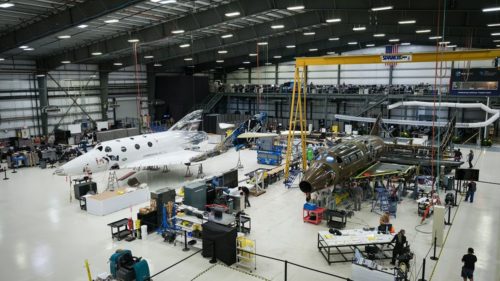
Virgin Galactic announced today that it has mated the fuselage and cabin of its next spaceship to the completed wing assembly. In addition, the two tail booms have been mated to the spaceship’s rear feather flap assembly. The completion of these two milestones brings assembly of the next SpaceShipTwo, planned to enter service after VSS Unity, a major step forward.

The next spaceship being manufactured
The next spaceship (right) being manufactured next to the VSS Unity on the left.

Meanwhile, Virgin Orbit plans to air launch the first LauncherOne rocket this year as well (a military payload, however, won’t be flown till next year): Branson: Virgin Launch Of USAF Sat By End Of Year – Breaking Defense

** A Chinese Long March 4B rocket launched last week with two remote sensing satellites and a CubeSat that will test a drag-sail for accelerated de-orbiting:

** Lunar space elevator possible with current technology according to a recent study:

Perhaps the biggest hurdle to mankind’s expansion throughout the Solar System is the prohibitive cost of escaping Earth’s gravitational pull. In its many forms, the space-elevator provides a way to circumvent this cost, allowing payloads to traverse along a cable extending from Earth to orbit. However, modern materials are not strong enough to build a cable capable of supporting its own weight. In this work we present an alternative to the classic space elevator, within reach of modern technology: The Spaceline. By extending a line, anchored on the moon, to deep within Earth’s gravity well, we can construct a stable, traversable cable allowing free movement from the vicinity of Earth to the Moon’s surface. With current materials, it is feasible to build a cable extending to close to the height of geostationary orbit, allowing easy traversal and construction between the Earth and the Moon.

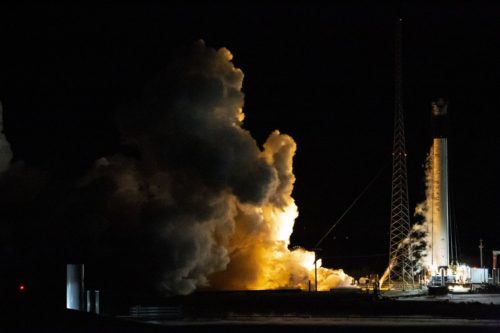
** Firefly begins firing tests  of dual Reaver engines. The Alpha rocket will use 4 Reavers on the first stage.

You have to beware when walking around Texas at night – you might run into fire breathing Reavers! Big milestone for the whole Firefly team yesterday with the first Dual Reaver engine test. This slow motion video shows the two engine startup sequence. Getting the engines to start simultaneously is critical. Quad Reaver coming soon!

Images of the engines on the test stand:

** The Space Show – Fri, 09/13/2019 –  Lars Osborne and Daudi Barnes discussed their company, Agile Space Propulsion, and “explained their propulsion systems, hypergolic fuel uses and why they stand out from other companies”.

** SpaceX:

*** Brief update on tests of the Crew Dragon abort system:   SpaceX highlights Crew Dragon SuperDraco thrusters as explosion investigation nears end – Teslarati

*** Next Falcon 9 launch from Vandenberg no earlier than Feb. 2020: SpaceX’s first West Coast Falcon 9 launch in eight months now set for early 2020 – Teslarati

Speaking at 2019’s World Satellite Business Week, Raúl Kulichevsky – a director at the Comisión Nacional de Actividades Espaciales (CONAE), Argentina’s national space agency – confirmed that the country’s SAOCOM-1B Earth observation satellite making great progress towards that launch target.

*** Progress on the Starship orbital demonstrators appears to be accelerating at the Boca Chica Beach, Texas and Cocoa Beach, Florida facilities. Elon  Musk is expected to give a presentation on the Starship program on Sept. 28th at Boca Chica. He has said in tweets that the first suborbital test flight could happen as early as October for the Texas vehicle. Here are some items highlighting  activities at the two sites.

Texas – Starship Mk.1:

Views of the Starship construction and launch site activities:

What the final stack could look like:

SpaceX is attempting to buy the homes of the small village near the launch site: SpaceX wants to buy a Texas hamlet to make way for its Mars rockets – Business Insider

It takes a small village to raise a Mars rocket — or at least it does in South Texas, where SpaceX has built an experimental spaceport around a community of residents.

Now, according to interviews with residents and a proprietary offer letter obtained by Business Insider, SpaceX is trying to buy as much of Boca Chica Village as it can and move people out. But many of those who live in the hamlet, also known as Kopernik Shores, say they may not accept the company’s offer.

Florida – Starship Mk.2:

Preparations are underway for moving the Mk.2 vehicle from the assembly site to Pad 39A. Presumably, the three main structures  (the tanks/propulsion section, the nosecone, and the tip of the nosecone) visible in the photos and videos below will be moved separately. SpaceX wants to move Starship Mk2 to one of its Florida launch pads later this month – Teslarati

According to documents filed with local city and transportation authorities in recent months and cataloged by a few local news outlets and spaceflight fans, SpaceX is preparing to transport its East Coast Starship prototype – known as “Mk2” – as early as later this month.

Throughout August 2019, local resident, spaceflight fan, photographer, and cookie-baker Julia Bergeron did a significant amount of groundwork to flesh out an estimated route for Starship Mk2. Delivering the massive rocket prototype from Cocoa, Florida to SpaceX’s Kennedy Space Center Launch Complex 39A facilities would involve a 30+ mile trip by road, cost-prohibitive due to the amount of work required. Confirmed by documents unearthed by local ClickOrlando journalists, SpaceX will instead transport the rocket a few miles by road before loading it onto a barge and shipping the vehicle the rest of the way to KSC.

Construction is underway on a section of Pad 39A that will support launches of the Starship : SpaceX breaks ground on Starship, Super Heavy launch facilities at Pad 39A

As of September 14th, SpaceX has officially broken ground on what will likely be the first orbital-class Starship and Super Heavy launch facilities, coming in the form of an addition to the company’s NASA-leased LC-39A pad at Kennedy Space Center.

Based on environmental assessment documents published in August 2019, the modifications SpaceX plans to make to Pad 39A are surprisingly minor and could arguably take just a handful of months from start to finish. Once complete, SpaceX will possess dedicated Starship launch facilities in both Florida and Texas, although there is a strong chance that Pad 39A will be ready to support orbital launch attempts well before SpaceX’s Boca Chica launch site is certified.

A look at recent work on the propulsion section via www.USLaunchReport.com. Also includes views of the path along which the Starship will be moved.

Aerial view below. Note the rings on the ground that will be used to build either another Starship or a Super Heavy Booster:

====

Delta-v

Space transport roundup – Sept.11.2019

A sampling of recent articles, videos, and images dealing with space transport (find previous roundups here):

[ Update: Masten Space Systems flies the Xodiac rocket vehicle to test terrain relative navigation systems developed by Draper Lab that could one day be used for landers on the Moon, Mars and elsewhere:  One Giant Leap for Lunar Landing Navigation – NASA

But what is terrain relative navigation? And why is it so important to NASA’s Artemis program to return American astronauts to the Moon by 2024, and future human missions to Mars?

Without capabilities like GPS, which is designed to help us navigate on Earth, determining a lander vehicle’s location is much like comparing visual cues (e.g., road signs, important buildings, notable landmarks) while driving a car with those cues identified on road maps.

“We have onboard satellite maps loaded onto the flight computer and a camera acts as our sensor,” explained [Draper’s Matthew Fritz]. “The camera captures images as the lander flies along a trajectory and those images are overlaid onto the preloaded satellite maps that include unique terrain features. Then by mapping the features in the live images, we’re able to know where the vehicle is relative to the features on the map.”

]

** Launchpad fire ends countdown for Japanese rocket with ISS cargo vehicle:

From SFN:

Japanese officials called off the launch of an H-2B rocket and HTV space station cargo ship Tuesday after a fire broke out on the launch pad at the Tanegashima Space Center.

The fire occurred at around 1805 GMT (2:05 p.m. EDT) Tuesday, or 3:05 a.m. local time Wednesday, around three-and-a-half hours before the H-2B launcher was scheduled to lift off with an automated supply ship bound for the International Space Station.

The cause of the fire was still under investigation when officials briefed reporters on the fire four hours after cameras first observed the blaze near the base of the 186-foot-tall (56.6-meter) rocket. The launch pad was evacuated at the time of the fire, and the rocket’s manufacturer, Mitsubishi Heavy Industries, reported no injuries.

** Test mission of new Soyuz spacecraft to the ISS ends with successful landing in Kazakhstan. Humanoid robot Skybot F-850 returns as well. Soyuz spacecraft, humanoid robot return to Earth after 16-day test flight – Spaceflight Now

An unpiloted Russian Soyuz spacecraft, carrying a humanoid robot instead of cosmonauts, parachuted to a rare nighttime landing on the steppe of Kazakhstan Friday (U.S. time) to wrap up a test flight to the International Space Station that paved the way for crewed launches using upgraded Soyuz boosters next year.

The 16-day test flight, which launched Aug. 22, also demonstrated technology Russia aims to use on a future automated payload return vehicle to bring cargo and experiments back to Earth.

The Soyuz MS-14 spacecraft’s descent module landed in a rural zone of south-central Kazakhstan at 2132 GMT (5:32 p.m. EDT) Friday, or 3:32 a.m. local time Saturday at the landing site, according to Roscosmos, the Russian space agency.

** Update on Virgin Orbit via TMRO.tv

Virgin Orbit VP of Special Projects William Pomerantz joins us on station to talk about everything they are working on. Sounds like Virgin Orbit isn’t just near flying, but ready to come out of the gate strong with a series of vehicles already being built! In this hour long interview Jared and Will talk about the small satellite market and Virgin Orbit’s place in it, rocket reusability and the Brooke Owens Fellowship. Will is an amazing force within the NewSpace community and this is an interview you don’t want to miss!

** Virgin Galactic has ambitious plans for  the SpaceShipTwo flight rate: Virgin Galactic wants to send people to space every 32 hours by 2023 – Business Insider

According to the document, the company plans to start with 16 flights a year in 2020, then to increase this to 270 flights a year by 2023, when it will have its entire fleet of five vessels — which works out to around one flight every 32 hours.

Within four years, it will eventually have the capacity to transport 1,565 people on a year-round basis.

No word, though, on when VG will resume flight tests of the SpaceShipTwo. The last flight to high altitude took place on Feb, 22, 2019.

** Aevum wins USAF payload contract given up by Vector following suspension of work at Vector after funding shortfall:

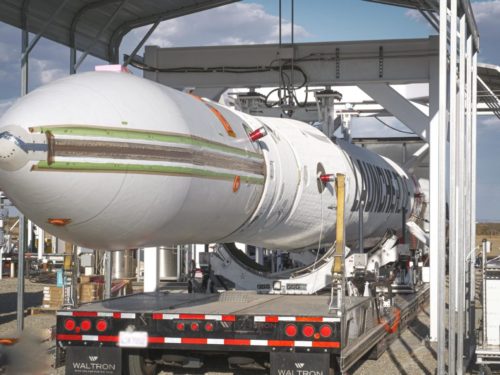
Aevum is developing an unusual smallsat air-launch system design based on  an unmanned high-speed carrier vehicle called the Ravn: Aevum’s New Rocket-Drone Airplane Duo Could Launch Satellites Every 3 Hours | Space.com

Ravn Releases Rocket - Aevum
Ravn Releases Rocket – Aevum

The first stage of Ravn consists of a reusable, fully autonomous unmanned aircraft system designed for atmospheric flight. “The overall aerodynamic design of the vehicle has been optimized for the rocket separation,” Skylus said. “The maximum speed of the Ravn first stage is Mach 2.85 [2,186 mph, or 3,519 km/h].” 

This aircraft carries an expendable two-stage rocket engineered for spaceflight. The first stage of this rocket uses a proprietary fuel approved by the U.S. Department of Transportation, while the second stage relies on liquid oxygen. “The rocket engines have already been hot-fire demonstrated,” Skylus said.

Launch of the USAF ASLON-45 mission is expected in the third quarter of 2021.

** Northrop-Grumman Pegasus launch of ICON mission is scheduled following a long delay due to technical issues with the rocket.

From SFN:

The launch of a NASA ionospheric research satellite off Florida’s east coast is targeted for Oct. 9 after persistent technical problems with its air-dropped Pegasus rocket stymied two launch opportunities last year.

The launch campaign for the Ionospheric Connection Explorer, or ICON, mission resumed this week.

**

** Relativity Space signs up Momentus space tug services for those payloads on the Terran 1 rocket that need to go to geostationary orbit: Relativity signs launch agreement with Momentus – SpaceNews.com

The launch agreement, announced during Euroconsult’s World Satellite Business Week here, covers one launch of Relativity’s Terran 1 rocket in 2021 with an option for up to five additional launches. The companies did not disclose the terms of the agreement, but Relativity offers the Terran 1 for a list price of $10 million.

The 2021 launch will fly Momentus’ Vigoride Extended tug, capable of carrying up to 350 kilograms of satellites. The tug will transport the satellites from an initial low Earth orbit to geostationary orbit using its water plasma thruster technology.

** Momentus says the water plasma thruster is working well on the company’s first prototype to reach space:

** Firefly‘s launch of the first Alpha rocket slips into next year: Firefly Aerospace pushes back first launch to 2020 – UPI.com

Firefly Aerospace, one of several new rocket companies working on orbital launch services, has pushed back its first launch to early 2020 due to supplier delays.

“We were trying for this year, but won’t get there,” Eric Salwan, Firefly’s director of commercial business development told UPI. “Primarily, we are having issues with a few externally sourced components, such as the flight termination system.”

A couple of tweets showing some of the Alpha work underway:

** Update on Blue Origin facilities for New Glenn rocket production and launch:  Blue Origin continuing work on New Glenn launch complex, support facilities – NASASpaceFlight.com

Work on Blue Origin’s New Glenn launch complex – LC-36 – is well underway. Recent aerial imagery of Cape Canaveral from NOAA shows how far Blue has come on the launch complex. Meanwhile, the company is also working on an engine factory in Alabama, and a first stage refurbishment facility near Kennedy Space Center.

**  Vikram lander spotted by Chandrayaan-2 orbiter but still no official information on why the landing failed:

Scott Manley gives his take on What We Know About India’s Failed Lunar Landing:

** Some short items:

** SpaceX

*** SpaceX has caught up with its launch manifest after groundings from accidents in 2015 and in 2016 caused long delays and a payload traffic jam: SpaceX executive says Falcon 9 is waiting for customer satellites for the first time ever

This trend is partially visible in the status of SpaceX’s Falcon 9 booster fleet over the course of 2019. In the first eight months of 2019, SpaceX has completed 10 launches (two Falcon Heavies and eight Falcon 9s), compared to 15 in 2018 and 12 in 2017. However, Falcon 9 Block 5 has proven itself to be extremely reliable and reusable since its May 2018 debut, truly coming into its own around the start of 2019. By May 2019, SpaceX’s fleet of flight-proven boosters had grown to eight, at least half of which were at or approaching flight-readiness.

*** In 2020 we may see Falcon launches every week or two with both customer payloads and the company’s Starlink satellites going to orbit: SpaceX plans 24 Starlink launches next year – SpaceNews.com

SpaceX hopes to launch 24 Starlink missions in 2020 as the company builds out a broadband megaconstellation that could ultimately number close to 12,000 satellites, a company executive said Sept. 10. 

SpaceX’s Starlink launch cadence will likely average “two a month,” in addition to customer launches, Gwynne Shotwell, SpaceX’s president and chief operating officer, said at the World Satellite Business Week conference here. 

“Next year, I hope we launch 24 Starlinks,” Shotwell said. 

*** SpaceX working through the permits process for the first test flight of the Starship Mk. 1 demonstrator, which will attempt to reach about 22 kilometers (74000 feet or 14 miles) in altitude.

From Teslarati:

On September 9th, the first signs of SpaceX planning for Starship Mk1’s South Texas launch debut appeared in the form of FCC applications, requesting permission to communicate with the rocket prototype during its first flight.

*** FAA re-evaluates environmental impact of SpaceX activities at Boca Chica Beach, Texas with the change from Falcon 9 operations to Starship development and test flights:

From BI:

By May 2018, Musk said that SpaceX was dropping its commercial-spaceport plan and instead dedicating the site to building and flying Mars rocket-ship prototypes. The company is now using different launch vehicles (Starship prototypes), different fuel (methane instead of RP-1, a rocket-grade kerosene), and a new rate of launches, as well as switching up construction projects and other details.

This shift in plans prompted the FAA to step in, reevaluate, and square these new details with the original EIS [Environmental Impact Statement] to see whether there’d be any unaddressed public-safety threats or environmental damage.

So far the FAA doesn’t see a need for a new impact statement.

*** Recent views of the Boca Chica facilities:

*** A Starship full of people might one day need to pull quickly away from an Super Heavy Booster exploding on the pad: SpaceX CEO Elon Musk says Starship pad abort capabilities could come sooner than later – Teslarati

Despite a number of technical hurdles, SpaceX CEO Elon Musk believes that the company’s next-generation Starship spacecraft could eventually be capable of pad aborts in the event of a Super Heavy booster failure before liftoff.

For a vehicle as large and heavy as Starship, this would necessitate a number of compromises, but would undoubtedly serve as a major confidence-booster for prospective passengers in lieu of an established record of reliability. If Starship were capable of pad aborts like the company’s Crew Dragon spacecraft, high-profile and high-value customers like NASA and other space agencies could be far more willing to place astronauts and payloads on what they perceive to be a bizarre but high-performance launch vehicle.

*** Update on Starship heat shield tile tests: SpaceX tests ceramic Starship heat shield tiles on Starhopper’s final flight test- Teslarati

Although it flew under the radar in the heat of the moment, SpaceX’s final Starhopper test flight – completed on August 27th – happened to include an unusual bit of test hardware – eight (give or take) ceramic Starship heat shield tiles.

On the same day that Starhopper lifted off for the last time and completed a 150m (500 ft) hop test in South Texas, SpaceX Cargo Dragon capsule C108 wrapped up its third successful orbital mission, reentering Earth’s atmosphere with a complement of several ceramic Starship heat shield tiles. This marked the first known orbital test of Starship hardware on the same exact day that Starhopper was putting nearly identical tiles through an entirely different kind of flight test.

*** Florida Starship construction site not damaged by hurricane Dorian: SpaceX’s Starship, Florida Space Coast make it through Hurricane Dorian unscathed – Teslarati

*** Another Florida site for Starship construction spotted:

====

Delta-v

Space transport roundup – Sept.4.2019

A sampling of recent articles, videos, and images dealing with space transport t (find previous roundups here):

** Russia launches Rokot rocket launches satellite to measure earth’s gravitation field: Russia’s Rokot vehicle successfully launches Geo-IK-2 satellite – NASASpaceFlight.com

… The Geo-IK-2 No.13L satellite lifted off from the Plesetsk Cosmodrome at 17:00:14 Moscow Time (14:00 UTC) Friday, separating from its carrier rocket less than two hours later.

Geodesy – the study of Earth’s shape and gravitational field – is one of many sciences that underpin humanity’s use of space for both peaceful and military purposes. Accurate models of the planet’s physical parameters and surrounding gravitational forces are vital to determining accurate positions on the surface and planning trajectories for orbital and suborbital spaceflight. For a nation’s military, such a model can serve a multitude of applications, including improved targeting of weapons and predicting the flight paths of missiles.

** A Chinese KX-1A rocket launches two technology test satellites into orbit:

The Kuaizhou-1A is a high reliability, high precision and low-cost solid launch vehicle developed by China Aerospace Science and Technology Corporation (CASIC) and commercialized by the China Space Sanjiang Group Corporation (EXPACE).

** The Chinese launch venture LandSpace is developing rockets powered by methane fueled engines, which are now being test fired: China’s first medium-scale launcher with LOX/LCH4 propellants ZQ-2 soliciting payloads worldwide – SpaceWatch.Global

Chinese commercial launcher developer and launch service provider LandSpace announced during the MAKS 2019 show, that the company is seeking and accepting payloads from around the world for the maiden launch of its proprietary ZhuQue-2 (ZQ-2) launcher powered by a LOX/LCH4 liquid-propellant rocket engine (LRE).

LandSpace President Zhang Long stated, “As China’s first medium-scale launcher with LOX/LCH4 propellants, ZQ-2 is widely recognized as a reusable eco-friendly and affordable solution designed for providing launch and orbital deployment services for small and medium satellites.” LCH4 helps improve the reusability of the engine as it is widely available and low-cost and helps prevent carbon deposits when the fuel is burning in the engine.

A more detailed report on LandSpace, including a visit to the company’s HQ: Will LandSpace be China’s SpaceX? – The Space Review.

… LandSpace has created many “firsts” in China: the first private company to develop space launchers, the first privately funded orbital launch attempt, the first private company to sign a launch agreement with international customers. And on May 17, LandSpace announced that the company’s 80-tonne-class methane and liquid oxygen (methalox) engine, TQ-12, has completed successful full-system hot-fire tests. In the week leading up to that announcement, the engine made four successful test firings, with the longest one lasting 20 seconds. The company released photos and videos showing the engine and the impressive firing at a test stand located in a mountainous area.

LandSpace claimed that their new methalox engine ranks number three in the world after SpaceX’s Raptor and Blue Origin’s BE-4. According to LandSpace, the TQ-12 engine has a sea-level thrust of 67 tonnes and a vacuum thrust of 76 tonnes. A future vacuum model will increase the thrust to 80 tonnes. LandSpace’s methalox engine project was kicked off in 2017 with a 10-tonne-class gas generator and thrust chamber test firing at the end of that year and again in March 2018. After that, LandSpace’s focus shifted to the 80-tonne engine, and in September 2018 and January 2019 it successfully tested the larger engine’s thrust chamber and the gas generator. The fast development led to a semi-system test firing in March 2019, paving the way for the May test firing.

** Latest update from Virgin OrbitExpect the Unaspected – Virgin Orbit Newsletter – August 2019.

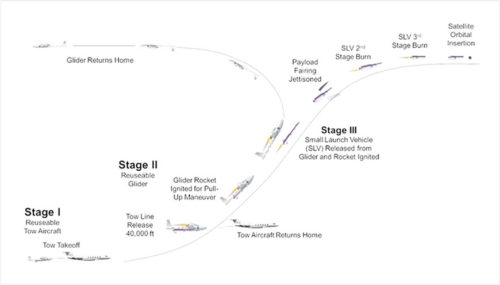
** EXOS Aerospace will provide an engine for Fenix Space’s orbital launcher, that will be air launched via towing to high altitude: EXOS Aerospace Receives Rocket Engine Contract from Fenix Space – Satnew

EXOS Aerospace Systems & Technologies, Inc. has announced that Fenix Space, Inc. has awarded the firm a glider rocket engine contract, with the key deliverable (full-up demonstration testing) due in the next 45 days.

The engine development component of a $1.5 million proposal calls for Exos Aerospace to provide a ~4800# thrust Lox Ethanol engine and conduct a customer demonstration of the same at full thrust and throttled to about 2500# thrust before the end of August.

Fenix Space, Inc. is an offshoot of Kelly Space & Technology, Inc, a privately-held aerospace, defense, technology and testing services company. Fenix is co-located with Kelly Space at its Aerospace Research and Development Center at the former Norton Air Force Base in San Bernardino, California. Fenix Space’s vision is to create and commercialize technologies that will open space to large-scale commercial development and apply these space technologies to beneficial use on Earth, which harmonizes with EXOS Aerospace’s vision to make space access more affordable.

Fenis Space towed air launch scheme
Fenix Space towed air launch scheme. Credits Fenix Space

** Launch ventures proliferate far faster than payloads: Foust Forward | Worldwide, there are 131 small launch vehicles in the works. Most of these will fizzle out. – SpaceNews.com

There’s almost universal agreement in the industry that there are far many more small launchers under development than can be supported by even the most optimistic forecasts of smallsat development. That inevitable shakeout of the market will give an advantage to companies that are already launching, like Rocket Lab, or those that soon plan to enter service, like Virgin Orbit.

** A report on the latest space elevator conference, which is sponsored by the International Space Elevator Consortium (ISEC) and held annually in Seattle: ISEC Newsletter – August 2019

The 2019 ISEC Space Elevator conference was held last month August 16th through the 18th at the Museum of Flight in Seattle, Washington, USA. This was our 8th year hosting the conference at this site. We had a great series of productive workshops on ISEC outreach, interplanetary Mission Support, and the environmental benefits of Earth space elevators. Michael Fitzgerald presented the keynote presentation on the Space Elevator Pathway to Technology Maturity … and Beyond, From Fountains to Tech Ready showing how close the space elevator is to becoming a reality. The weekend as full of other wonderful talks on graphene, carbon nanotubes, climber design considerations, multi-stage elevators, summary reports from this year’s ISEC interns, and more. Presentations and papers from the 2019 conference will be available at https://isec.org/conference-proceedings-2/.

** SpaceX

*** Four Falcon 9 launches of Starlink satellites planned for this fall:  SpaceX planning four more Falcon 9-launched Starlink missions this year, permits show – Teslarati

According to a suite of eight FCC Special Temporary Authority licenses SpaceX filed for on August 30th, the company has plans for as many as four additional Starlink satellite launches in 2019, on top of Starlink’s May 23rd launch debut.

Additionally, SpaceX simultaneously requested that the FCC modify its current Starlink application to permit a slight change in orbital characteristics that would drastically improve the broadband satellite constellation’s coverage in its early stages. Combined, SpaceX appears to be extremely confident about the status and near-future progress to be made by its prospective Starlink constellation, confidence presumably inspired by the performance of the first 60 “v0.9” satellites launched three months ago.

*** The Falcon 9 booster for the first Crew Dragon launch has been tested in McGregor: SpaceX fires up Falcon 9 booster destined for Crew Dragon’s astronaut launch debut – Teslarati

SpaceX announced that it has successfully completed a routine static fire acceptance test of the Falcon 9 booster that will eventually support Crew Dragon’s inaugural astronaut launch, expected no earlier than early 2020.

The booster in question – believed to be Falcon 9 B1058 – is very likely the first new Falcon 9 booster SpaceX has shipped to McGregor, Texas and test-fired in more than four months, an unusual lull for the typically busy launch company. If all goes according to plan, B1058 will become SpaceX’s first truly human-rated commercial rocket and will support its first human spaceflight attempt ever, a huge milestone along the company’s path to the sustainable colonization of Mars.

Testing Booster for First Crew Mission - Aug.2019

*** SpaceX offers low cost launch services for smallsats. SpaceX posted updated prices and schedule for the smallsat rideshare program unveiled recently: SpaceX revamps smallsat rideshare program – SpaceNews.com

Less than a month after announcing a new effort to provide low-cost launch services for small satellites, SpaceX says it will increase the number of flight opportunities and reduce the prices it offers.

The revamped smallsat rideshare program, the company announced late Aug. 28, will provide launch opportunities at least once per month starting in March 2020, at a cost of $1 million for a 200-kilogram smallsat.

“Earlier this month, SpaceX announced the Smallsat Rideshare Program and received a lot of interest and great feedback from customers,” the company said in a statement. “As such, we have updated the terms of the program and have made the service even more compelling with reduced pricing and increased flight opportunities.”

The  $5k/kg price is considerably less than what Rocket Lab and other smallsat launch ventures are offering. A dedicated smallsat launcher, however, can often place a smallsat directly into the optimum orbit for its particular application. Scheduling may also be more advantageous with a small launcher.

The SpaceX rideshare program does provide the option of deployment into either polar or mid-inclination orbits. Momentus Space tugs  are offered as a means to move from the initial orbit to the optimum one.

SpaceX also offers scheduling reliability with

… launch opportunities to mid-inclination on a monthly basis, as well as missions to sun synchronous and/or polar orbits at approximately four month intervals. Dedicated rideshare missions will not be delayed by co-passenger readiness–if you are ready to fly during the scheduled launch period, you will fly.

BTW, when I interviewed Elon Musk back in 2003, I asked him about offering “a fixed date schedule arrangement” for smallsat launches on the Falcon 1. He responded,

Certainly a possibility, although it can be very difficult coordinating multiple customers, particularly if some want to go to different places than others. At this point, our preference is to sell the whole ride. If another company wants to buy a flight and then assume the risk and complexity of reselling slots, that would be fine with us.

*** Speaking of Momentus, the company is growingHyperspeed at Momentus Headquarters – Momentus

… heading into September, the team has grown from 14 to 30 persons in the last 3 months (don’t worry, we are still hiring!) and the office/lab has grown from 4000 sq.ft to 10,000 sq.ft. Plenty of room for vacuum chambers and other cool space gear!

*** The FAA required SpaceX to boost its insurance coverage for the recent Starhopper test flight: Why SpaceX increased its rocket-launch liability insurance in Texas – Business Insider

SpaceX built its launchpad about 1.5 miles (2.4 kilometers) from the eastern edge of Boca Chica Village, a hamlet that’s home to about 20 part- and full-time residents.

*** Construction of a second demo Starship in Florida interrupted by hurricane Dorian but it appears the site escaped serious damage.

*** Construction of the other Starship demo vehicle continues in Boca Chica:

*** A birds eye view of the Boca Chica facilities from earlier this week:

*** An aerial view of the Starship demo site in Florida before shutting up shop for the hurricane evacuation:

*** First flight of a Starship demo could happen soon:   The SpaceX CEO Elon Musk teases Starship flight debut details, reveals presentation date – Teslarati

Speaking on August 28th, CEO Elon Musk says that SpaceX’s first Starship flight test(s) could occur as early as October 2019, in line with a late-July estimate that pegged the milestone at 2-3 months out.

Under construction in Cocoa, Florida and Boca Chica, Texas, SpaceX’s duo of orbital-class Starship prototypes have made immense progress in the last two or so months, part of a (hopefully friendly) internal competition to be first to flight and first to orbit. Elon Musk has been planning to present an updated overview on the next-generation SpaceX launch vehicle, originally expected in August before a variety of factors pushed it into September. Musk says that presentation is now scheduled no earlier than (NET) September 28th.

*** 2nd-gen Starship to be a monster: SpaceX CEO Elon Musk says Starship could be followed by a dramatically larger rocket – Teslarati

Hinted at in a brief tweet on August 28th, SpaceX CEO Elon Musk says that SpaceX’s massive Starship and Super Heavy launch vehicle – set to be the most powerful rocket ever built upon completion – could eventually be followed by a rocket multiple times larger.

SpaceX is currently in the process of assembling the first full-fidelity prototypes of Starship, a 9m (30 ft) diameter, 55m (180 ft) tall reusable spacecraft and upper stage. Two prototypes – Mk1 and Mk2 – are simultaneously being built in Texas and Florida, respectively, while the beginnings of the first Super Heavy prototype has visibly begun to take shape at SpaceX’s Florida campus.

*** Check out a Detailed diagram of the Raptor engine (ER26, gimbal) : spacex

====

Fire in the Sky:
Cosmic Collisions, Killer Asteroids, and
the Race to Defend Earth