Category Archives: Rockets

Space transport roundup – Oct.30.2019

A sampling of recent articles, videos, and images dealing with space transport (find previous roundups here):

** Northrop Grumman Antares on pad for launch of Cygnus cargo module to the ISS. Liftoff currently set for 9:59 am EDT on Saturday Nov. 2nd from Wallops Island, Virginia.
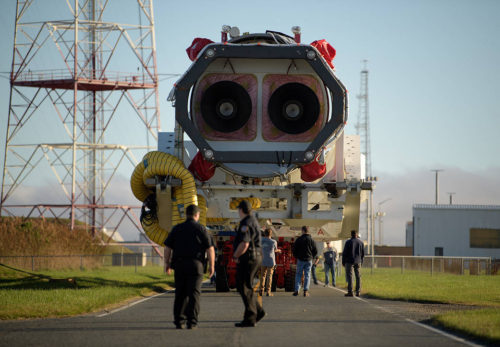
Northrop Grumman Antares CRS-12 Rollout
A Northrop Grumman Antares rocket is seen as it rolls out to Pad-0A, Tuesday, Oct. 29, 2019, at NASA’s Wallops Flight Facility in Virginia. Northrop Grumman’s 12th contracted cargo resupply mission with NASA to the International Space Station will deliver about 8,200 pounds of science and research, crew supplies and vehicle hardware to the orbital laboratory and its crew. Launch is scheduled for 9:59 a.m. EDT Saturday, Nov. 2. Photo Credit: (NASA/Bill Ingalls) – NASA IOTD

The Cygnus module is named the “SS Alan Bean” in recognition of the late Apollo 12 astronaut. The module will cary over 3719 kilograms (8200 lbs) of supplies and equipment for the station. More info about the mission:

** Reusable X-38 spaceplane returns to Cape Canaveral more than two years after launching on a SpaceX Falcon 9:

From the USAF:

The Air Force’s X-37B Orbital Test Vehicle Mission 5 successfully landed at NASA’s Kennedy Space Center Shuttle Landing Facility Oct. 27, 2019 at 3:51 a.m.

The spaceplane conducted on-orbit experiments for 780 days during its mission, recently breaking its own record by being in orbit for more than two years. As of today, the total number of days spent on-orbit for the entire test vehicle program is 2,865 days.

“The X-37B continues to demonstrate the importance of a reusable spaceplane,” said Secretary of the Air Force Barbara Barrett. “Each successive mission advances our nation’s space capabilities.”

This is the Air Force’s premier reusable and unmanned spacecraft, providing the performance and flexibility to improve technologies in a way that allows scientists and engineers to recover experiments tested in a long-duration space environment.
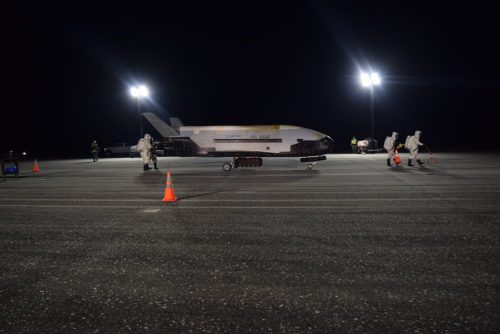
X-37B after landing at Cape Kennedy
X-37B after landing at Cape Kennedy on Oct.27, 2019 after 780 days in orbit. Credits: USAF

[ Update 3: Scott Manley discusses the X-37B history, features, and missions:

]

** Relativity Space prints big rockets: The Worlds Largest 3d Metal Printer Is Churning Out Rockets – IEEE Spectrum

The room contained Stargate, the largest metal 3D printer in the world. Relativity invented the Stargate printer for the audacious purpose of 3D printing an entire rocket that’s intended to fly to low Earth orbit. We hope our rockets will eventually fly even farther. Perhaps one day we’ll ship our 3D printers to Mars, so rockets can be constructed on the Red Planet. From there, who knows where they’ll go.

Does this sound crazy? Crazy ambitious, maybe. But plenty of people are taking our idea seriously. Four commercial customers have signed up for launches to Earth orbit beginning in early 2021. The U.S. Air Force has approved our request to build a launch site at Cape Canaveral, the famed Florida facility that launched many historic human spaceflight missions. And NASA has leased us a building at its Stennis Space Center, in Bay St. Louis, Miss., where Relativity will build a factory capable of turning out 24 rockets per year. Such mass production will represent a revolution in rocketry. By embracing additive manufacturing—that is, 3D printing—we believe we can pull it off.

** A couple of recent updates from Copenhagen Suborbitals, the all-volunteer effort to design, build, and launch a single person capsule on a suborbital space trip:

** Scott Manley comments on the history behind EXOS Aerospace, which made an unsuccessful suborbital rocket launch attempt last weekend:

** Landspace in China fires engine for reusable 1st stage booster for full flight duration:

China’s 80-ton thrust liquid oxygen-methane engine for a proposed new rocket launcher completed a variable 200-second test on Saturday. The duration is longer than the whole flying period of a rocket. The engine, named TQ-12, was independently developed by the commercial rocket company LandSpace. It has the third highest thrust level among liquid oxygen-methane engines glob

** LAROS is a Russian company developing a reusable suborbital rocket. The LAROS RN-1 will fly to 120-130 kilometers and return for a vertical landing.

The TASS article claims the first flight will be in 2020 but the LAROS item says 2022. Other info from LAROS:

Currently, work is underway on rocket engines. Experimental samples printed on a 3D — printer with a thrust of 20 kgf are successfully tested on mobile stands in the technical laboratory of the Aircraft Bureau «LAROS». «After achieving stable performance on these samples, the engine will be scaled to a capacity of 500 kg. For a new engine, we will need a testing ground», — said Larionov.

After testing the suborbital rocket, the company will begin to create an orbital reusable light rocket-LAROS-RN2, which will display a payload weighing up to 200 kg at a height of up to 400-500 km.
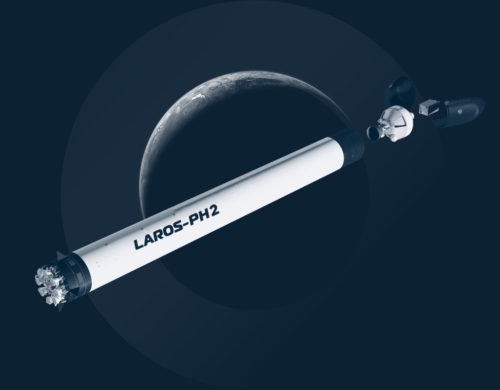
LAROS-RC2 orbital carrier
LAROS reusable orbital  launch system.

** Rocket Lab’s Electron rocket and Photon satellite tug to use Kongsberg ground station servicesRocket Lab partners with Kongsberg Satellite Services for Electron and Photon ground station support | Rocket Lab

Rocket Lab, the global leader in dedicated small satellite launch, has partnered with Kongsberg Satellite Services (KSAT), the world’s largest provider of ground station services, to be the sole provider of ground station services for the Electron launch vehicle and Photon satellite bus customers. The agreement sees Rocket Lab deliver a complete solution for small satellite operators, including satellite design and build, launch, and ground segment support leveraging an existing global network of ground stations.

..

The closely integrated partnership with KSAT now provides launch to operations ground segment support for Photon customers – the final piece for small satellite operators seeking an end-to-end mission partner. This enables small satellite operators to focus on what really matters—their applications and their customers—freeing engineering time and capital from having to develop a spacecraft platform, secure a launch, and coordinate access to ground stations from different providers.

** The DC-X was the rocket that accelerated the emergence of New Space: DC-X: The NASA Rocket That Inspired SpaceX and Blue Origin – The Crux

** SpaceX

***The base section of Starship Mk1 moved to launch pad site from the construction facility today.

[ Update 2: More about the move: Starship Mk1 arrives at launch site ahead of flight test – NASASpaceFlight.com.

Update: Another view of the move:

]

*** Landing Starships wherever – Lars Blackmore made key contributions in the effort to return and land Falcon 9 boosters and now he is working on landing Starships:

What’s next for Lars?

Sending people to the Moon and Mars! I’m now leading entry and landing for Starship, a fully reusable rocket that will one day be able to land up to 100 people on the surface of Mars. Because it lands vertically, like Falcon 9, it should be able to land almost anywhere in the solar system. The Starship’s engines run on methane, this means we can refuel it using propellant generated on Mars and then fly back to Earth or fly further to more distant planets. The near-term goal is just to get Starship into Earth orbit and back with a 100% reusable vehicle, but even that is exciting, because the payload capacity will be far beyond that of any rocket that has ever existed – and with full reusability, the cost should be tiny compared to existing rockets.

For me personally, this is a great opportunity to continue learning, especially outside of my main field of expertise. Designing the rocket hardware from the ground up to be capable of landing, will require a much broader understanding of engineering, combined with all the lessons learned from landing Falcon 9. “Experience comes immediately after you need it,” and many times I realised late in the game that our lives would have been much easier if we could have made simple changes at the start. This time around, I’m hoping to use that experience early in the design cycle, and perhaps save myself some grey hairs in the process! 

Landing Starship will be much harder than landing Falcon 9, but if we can do it, it will be revolutionary. Let’s see what happens!

*** Another look at the Mk.1 video shown by Gwynne Shotwell at IAC 2019:

*** Views of the Starship Mk.1 assembly work earlier this week at Boca Chica Beach:

Over in Boca Chica, SpaceX’s Starship Mk1’s landing legs have been installed, as work continues on the vehicle and (per the flashes) inside the fairing section. With the Roll-Lifts arriving, the two halves will be moved close to each other for re-mating in the coming days. Several clips, with numerous photos edited in. Some of the video has been sped up, some plays at normal speed so you can hear the noise of the worksite. All filmed and photographed by Mary (@bocachicagal).

** The work continues late into the night:

*** Preparations are underway for the next Crew Dragon tests. The the test include:

  • Static firing of all the SuperDraco engines on the Crew Dragon that will do the in-flight abort test. Appears to be set for Nov. 6th.
  • In-flight abort test will see an uncrewed Dragon fly off a Falcon 9 upper stage during the max-Q moment of a launch. The test is currently expected in early December.
  • First crewed flight of a Dragon to the ISS. This could happen by the end of the first quarter of 2020.

More at SpaceX’s Crew Dragon astronaut launch debut a step closer after SuperDraco milestone – Teslarati.

*** Practicing Falcon 9 fairing catches: SpaceX’s new Falcon 9 fairing recovery ship kicks off sea trials ahead of next launch – Teslarati

After a brief installation period, SpaceX’s second Falcon 9 fairing-catching ship departed Port Canaveral to begin sea trials with its new net and arms, a critical step before it can be declared ready to attempt its first fairing recovery.

Known as GO Ms. Chief, the ship’s first opportunity could come as early as a few weeks from now, potentially marking a major milestone for SpaceX’s fairing recovery and reuse program.

*** More about Gwynne Shotwell’s comments on launching lots of Starlink satellites:  SpaceX president teases Starship’s game-changing Starlink launch capabilities – Teslarati

Beyond Shotwell’s clear confidence that Starlink’s satellite technology is far beyond OneWeb and years ahead of Amazon’s Project Kuiper clone, she also touched on yet another strength: SpaceX’s very own vertically-integrated launch systems. OneWeb plans to launch the vast majority of its Phase 1 constellation on Arianespace’s commercial Soyuz rockets, with the launch contract alone expected to cost more than $1B for ~700 satellites.

SpaceX, on the other hand, owns, builds, and operates its own rocket factory and high-performance orbital launch vehicles and is the only company on Earth to have successfully fielded reusable rockets. In short, although Starlink’s voracious need for launch capacity will undoubtedly require some major direct investments, a large portion of SpaceX’s Starlink launch costs can be perceived as little more than the cost of propellant, work-hours, and recovery fleet operations. Boosters (and hopefully fairings) can be reused ad nauseum and so long as SpaceX sticks to its promise to put customer missions first, the practical opportunity cost of each Starlink launch should be close to zero.

== Amazon Ad ==

LEGO Ideas NASA Apollo Saturn V 21309
Outer Space Model Rocket for Kids and Adults, Science Building Kit
(1900 pieces)

Space transport roundup – Oct.22.2019

A sampling of recent articles, videos, and images dealing with space transport (find previous roundups here):

[ Update: Blue Origin and partners to build lunar transport system: Blue Origin Announces National Team for NASA’s Human Landing System Artemis – Blue Origin

Today, Blue Origin is proud to announce a national team to offer a Human Landing System for NASA’s Artemis program to return Americans to the lunar surface by 2024. 

Blue Origin has signed teaming agreements with Lockheed Martin, Northrop Grumman and Draper. These partners have decades of experience supporting NASA with human space flight systems, launch vehicles, orbital logistics, deep-space missions, interplanetary navigation and planetary landings.

Our combined experience is uniquely positioned to meet NASA’s needs for the Artemis program. Each partner will bring their industry leading solutions to the following roles:

    • Blue Origin, as prime contractor, leads program management, systems engineering, safety and mission assurance, and mission engineering while providing the Descent Element that is based on the multi-year development of the Blue Moon lunar lander and its BE-7 engine.
    • Lockheed Martin develops the reusable Ascent Element vehicle and leads crewed flight operations and training.
    • Northrop Grumman provides the Transfer Element vehicle that brings the landing system down towards the Moon.
    • Draper leads descent guidance and provides flight avionics.

See also Blue Origin announces a blue-chip team to return humans to the Moon | Ars Technica.

]

** Rocket Lab’s Photon expendable space tug can take payloads  beyond Earth orbit : Rocket Lab to deliver payloads to the Moon and beyond with Photon | Rocket Lab

The Photon is an advanced version of Rocket Lab’s Kick Stage, which can carry a payload to an orbit  beyond the maximum altitude achievable with the two-stage Electron rocket alone. These propulsion modules essentially serve as expendable space tugs that can transport a payload, within given mass and volume limits, to a particular orbit or trajectory.  From the announcement:

Less than two years after opening access to low Earth orbit (LEO) for small satellites with the Electron launch vehicle, Rocket Lab is now bringing medium, geostationary, and lunar orbits within reach for small satellites. Rocket Lab will combine its Electron launch vehicle, Photon small spacecraft platform, and a dedicated bulk maneuver stage to accomplish extended-range missions and deliver small spacecraft to lunar flyby, Near Rectilinear Halo Orbit (NRHO), L1/L2 points, or Lunar orbit. These capabilities can then be expanded to deliver even larger payloads throughout cis-lunar space, including as high as geostationary orbit (GEO).

Rocket Lab Founder and Chief Executive, Peter Beck, says there is increasing international interest in lunar and beyond LEO exploration from government and private sectors.

“Small satellites will play a crucial role in science and exploration, as well as providing communications and navigation infrastructure to support returning humans to the Moon – they play a vital role as pathfinders to retire risk and lay down infrastructure for future missions,” he says. “Just like LEO small spacecraft, many potential exploration instruments and full satellites are on shelves waiting for launch to deeper space. In the same way we opened access to LEO for smallsats, Rocket Lab is poised to become the dedicated ride to the Moon and beyond for small satellites.”

Kick Stage with Astro Digital CubeSat
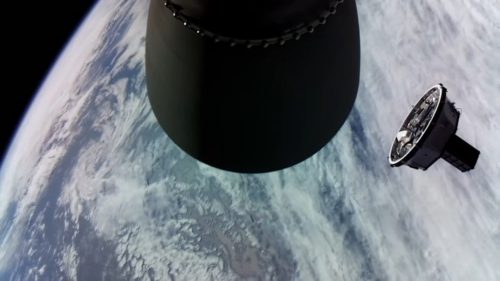
After an Electron rocket reached LEO (the nozzle belongs to the 2nd stage) for the ‘As The Crow Flies’ mission on Oct.17,2019, it released the Kick Stage (disk shaped module) with an Astro Digital CubeSat (the rectangular box on the disk) at an altitude of about 500 km. The Kick Stage then fired its own propulsion system to deliver the satellite to an orbit of 1000 km. Credits: Rocket Lab

** Firefly working with Aerojet on propulsion systems for rockets and space tug:

The first flight of Firefly’s small-satellite rocket, Alpha, is scheduled for launch in the first quarter of 2020 from Vandenberg AFB. At a dedicated mission price of $15 million, Alpha is currently capable of delivering one metric ton to LEO and 630 kg to sun-synchronous orbit (SSO). Aerojet Rocketdyne is contributing to the first flight of Alpha by providing additive manufacturing expertise for key Reaver first stage engine components. They will have increased influence on Alpha block two upgrades, on both the first and second stage engines, which will work toward an increase Alpha SSO payload performance to greater than 800 kg. These contributions will include expanded implementation of additively manufactured elements to reduce cost and increase reliability, as well as technical input to increase engine performance.

Aerojet Rocketdyne’s unique additive manufacturing, chemical and electric in-space propulsion technologies also have direct applicability to Firefly’s Orbital Transfer Vehicle (OTV), which transfers small payloads between orbits. The OTV provides mission flexibility by deploying payloads into unique orbits and reaching altitudes and inclinations that are out of reach for many small launch vehicles.

Dr. Markusic added, “Firefly is committed to flying Beta, our medium class launch vehicle. Aerojet Rocketdyne’s AR1 engine, which incorporates the latest advances in propulsion technology, materials science and manufacturing techniques, is incredibly well suited to power Beta given its cost-effective, high performance capabilities. By cooperating on this development, we are accelerating our time to market and providing our customers with high confidence in Beta’s schedule, performance and reliability.”

The Space News article quotes Mark Watt of Firefly as saying that the Beta rocket will feature “a reusable first stage”.

** Boeing set for two key tests in preparation for crew transport to the ISS: Boeing’s Starliner set for two pivotal test flights before the year’s end – NASASpaceFlight.com

Boeing’s Starliner spacecraft is preparing for two major flight tests before the end of the year, which will pave the way for the spacecraft’s first crewed flight in 2020. The capsule is being developed under NASA’s Commercial Crew Program to provide transportation services to and from the International Space Station.

NASA provided an official update on Boeing’s flight test dates last Friday. Starliner’s pad abort test is currently scheduled for no earlier than November 2nd, with the Orbital Flight Test (OFT) occurring no earlier than December 17th.

The pad abort test will see a Starliner capsule perform the abort sequence that would be necessary if there were to be a problem with the launch vehicle on the pad.

November’s abort test will occur from a test stand at the White Sands Missile Range in New Mexico.

** Reaction Engines demonstrates fast inlet air cooling for SABRE engine: British hypersonic jet engine technology passes crucial heat test | Financial Times

The Oxfordshire-based company, which is developing a new class of hybrid engine known as Sabre combining traditional jet and rocket technologies, said it had proven the viability of its precooling system in conditions equivalent to a speed of Mach 5.

At this speed, the air entering a jet engine would hit 1,000 degrees centigrade, enough to severely damage components. Reaction’s precooler takes the air down to minus 150 degrees centigrade in less than a 20th of a second.

[ Update: The press release for this: Reaction Engines Test Programme Fully Validates Precooler At Hypersonic Heat Conditions – Reaction Engines

Reaction Engines has successfully tested its innovative precooler at airflow temperature conditions representing Mach 5, or five times the speed of sound, marking a significant milestone in the development of its SABRE™ engine and paving the way for a revolution in hypersonic flight and space access.

The precooler heat exchanger is a vital component of Reaction Engines’ revolutionary SABRE air-breathing rocket engine and is an enabling technology for other precooled propulsion systems and a range of commercial applications.

This ground-based test achieved the highest temperature objective of the Company’s HTX testing programme and took place at its specially constructed unique facility at the Colorado Air and Space Port, United States.

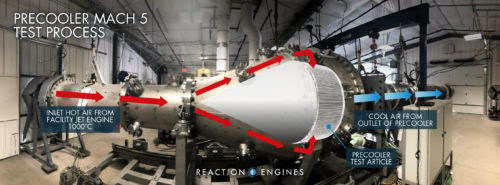
During the latest series of tests, Reaction Engines’ unique precooler successfully quenched airflow temperatures in excess of 1,000°C (~1,800°F) in less than 1/20th of a second. The tests demonstrated the precooler’s ability to successfully cool airflow at speeds significantly in excess of the operational limit of any jet-engine powered aircraft in history. Mach 5 is more than twice as fast as the cruising speed of Concorde and over 50% faster than the SR-71 Blackbird aircraft – the world’s fastest jet-engine powered aircraft.

HTX airlow - Reaction Engines
The pre-cooler test setup. Credits: Reaction Engines

]

** i-Space of China debuts design of the Hyperbola-2 rocket with a reusable first stage:

In July 2019, i-Space launched the all-solid fuel motor four-stage Hyperbola-1 rocket and successfully placed two small satellites into orbit. It thus became the first private Chinese rocket startup company, not directly spun off from the military space program, to put a payload into orbit.

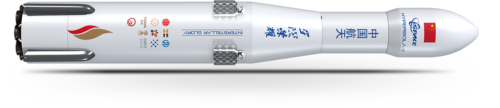
The Hyperbola-2 will be a much bigger rocket and use liquid fueled engines to power its two stages. It will put up to 1.9 tons into low earth orbit. The first stage will be flown back and reused. The goal is to start flights in 2021. Recovering the first stage will not happen on the initial flights.

i-Space Hyperbola-2 Rocket

** Exos Aerospace hover tests the SARGE rocket and is counting down to another launch at Spaceport America on Saturday, Oct. 26th.

Webcast for the launch:

** A great overview of aerospike engines from Time Dodd, the Everyday Astronaut:  Are Aerospike Engines Better Than Traditional Rocket Engines? – Everyday Astronaut

Today we’re going to look at the history of aerospike engines, go over how nozzles work including things like overexpansion, underexpansion and even expansion ratios, we’ll look at the pros and cons of the aerospike, the physical limitations and problems, then we’ll compare the aerospike to some other traditional rocket engines. But that’s not all, I obtained never seen before photos and videos of some aerospikes, we’ll get opinions from some people who have actually worked with aerospike engines, look at some promising prospects and compelling concepts and by the end of the video we’ll hopefully know whether or not the holy grail of rocket engines is just waiting to be utilized or if aerospikes just simply aren’t worth it.

** SpaceX

***  SpaceX Principal Mars Development Engineer Paul Wooster gave an update on the Starship and Super Heavy (BFR) at the Mars Society Convention 2019 over the weekend:

** A stormy Monday at Boca Chica Beach:

A storm and tornado impacted the Boca Chica region overnight but mostly avoided the SpaceX site, although it received a downpour. While power was knocked out due to a larger impact in South Padre Island, SpaceX, typically, had Tesla Power to allow the workers to get back to operations as planned in the morning.

Several views of the launch site and Hopper, filmed by Mary (@bocachicagal).

And watching the work on the Mk.1 Starship on Saturday:

Find the latest on Boca Chica activities  at SpaceX Starship : Texas Prototype(s) Thread 2 : Photos and Updates.

*** Launch hiatus to continue into November: SpaceX’s next Falcon 9 launch delayed until November as lull drags on – Teslarati

For unknown reasons, SpaceX’s next Falcon 9 rocket launch has slipped from October to November, extending an already record-breaking lull in commercial US launch activity.

Depending on when SpaceX finally returns to flight, the company could have easily spent more than a quarter of 2019 between launches.

*** SpaceX drastically lowered big sat launch costs and now doing same for smallsat launch: How SpaceX Just Turbocharged The Space Race (Again) – Charles Beames/Forbes

With regular departure dates and minimal rebooking fees, the competition for launch service is now reaching a fever pitch in the smallsat market. At $1 million per launch [of a CubeSat on a rideshare flight], SpaceX is today offering an 80% cost reduction in dollars per kilo compared to its nearest competitor. And it’s not an offer to ride on some notional future rocket, but instead on a rocket with plenty of flight heritage and at much lower insurance rates.

As ever, real competition like this rewards innovation and ultimately delivers better value to its customers, satellite and space data companies and their investors. Companies will soon be able to deliver space data at dramatically lower prices than today, ensuring even greater penetration of the space sector to add further value and efficiencies to the global economy.

Make no mistake, SpaceX returning to address the old Falcon 1 market is no accident. When Musk designed and launched his first Falcon on the way to Mars, he likely didn’t anticipate this growth—but he certainly sees it now. In response to this and other competitors, Rocket Lab has recently announced its pursuit of a reusable Electron rocket and we should expect the nearly 100 other new space launch companies to reimagine or retool their businesses to adjust to this new reality.

== Amazon Ad ==

Space 2.0: How Private Spaceflight, a Resurgent NASA,
and International Partners are Creating a New Space Age

Space transport roundup – Oct.17.2019

A sampling of recent articles, videos, and images dealing with space transport (find previous roundups here):

** Rocket Lab launches ninth Electron rocket with Astro Digital satellite: Rocket Lab successfully launches ninth Electron mission, deploys payload to highest orbit yet | Rocket Lab

The mission, named ‘As The Crow Flies,’ lifted off from Rocket Lab Launch Complex 1 on New Zealand’s Māhia Peninsula at 01:22 UTC, 17 October 2019 (14:22 NZDT). Approximately 71 minutes after lift-off, Electron’s Kick Stage deployed the payload to a circular orbit of more than 1,000 km – more than twice the altitude of any Electron mission to date. The mission successfully demonstrated recent upgrades to the Kick Stage’s 3D-printed Curie engine, including the move to a bi-propellant design for improved performance. Curie also serves as the propulsion system on Rocket Lab’s Photon satellite bus, and the flight-proven engine upgrades support enduring missions in LEO, as well as higher orbits.

This mission takes the total number of satellites deployed by Rocket Lab to 40 and continues the company’s track record of 100% mission success for customers.

The spacecraft on board was a Palisade technology demonstration satellite – a 16U CubeSat with on-board propulsion and next generation communications systems developed by Astro Digital, and software developed by Advanced Solutions Inc. including an advanced version of ASI’s MAX Flight Software.

This video of the webcast shows the liftoff at the 15:05 point. There are also interesting background stories about the company’s rocket making process, plans for reusing the first stage, the launch site, etc.

** Composite vehicle frame for Sierra Nevada Dream Chaser ready for full assembly and preparation for first flight in 2021:

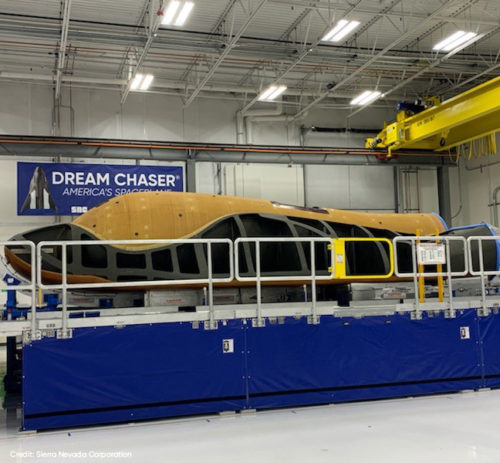
…The structure is the largest piece of technology to make up Dream Chaser and the most advanced high-temperature composite spaceframe ever built.

The primary structure is a pressurized composite structure that will contain pressurized payloads heading to the International Space Station. The structure was manufactured by subcontractor Lockheed Martin and recently shipped from their Fort Worth, Texas facility to Louisville, Colorado, where Dream Chaser is being built and integrated by SNC.

Design highlights:

    • Uses advanced composite 3D woven assembly methods and represents the most advanced high-temperature composite spaceframe ever built.
    • Structure is about 30 feet long by 15 feet wide and approximately 6 feet high and weighs roughly 2,200 pounds.
    • Materials include carbon fiber reinforced polymers (CFRPs), more traditionally referred to as “composites.”
    • The use of CFRP materials instead of aluminum and titanium alloys, lowers manufacturing costs for creating a unique, aerodynamically complex spaceframe design.  
    • Composites decrease the amount of thermal protection required compared to an aluminum primary structure. 
    • Advanced 3D woven construction minimize penetrations to the hot lower aeroshell.
Dream Chaser Primary Structure
The primary structure for the Dream Chaser arrives at the Sierra Nevada Corp. Colorado facility. Credits: SNC

** South Korea’s Perigee Aerospace to launch from the Whalers Way Orbital Launch Complex on the southern Coast of Australia. The Whalers Way facility is a project of the Australian company, Southern Launch. 

** Launcher company Skyrora of Scotland opens a new facility and begins firing tests of a  30kN rocket engine: Scottish space explorer completes crucial first phase of tests – Business Insider

**Report  released on flight safety of the proposed Georgia spaceport. While waiting for FAA licensing process to be completed, Spaceport Camden management says that they have been working

… to determine a way to increase transparency about the project’s licensing information without complicating the agency’s ongoing review or releasing sensitive or export-controlled information that cannot lawfully be shared with the public. Pursuant to those goals, the County initiated the development of a publicly releasable report, prepared by The Aerospace Corporation, that describes the project’s flight safety analysis.

The report can be viewed at Flight Safety Analysis for Spaceport Camden County – CamdenCountyBOC – issuu

** Today China launched a Long March 3B with the TJSW-4 military satellite, whose capability and mission have not been publicized: Long March 3B launches TJSW -4 – NASASpaceFlight.com

** China developing a second super heavy rocket in addition to Long March 9: Initial research on rocket ends successfully – ecns.cn

According to the report, the new rocket is being designed at the China Academy of Launch Vehicle Technology in Beijing. Its main body will be 87 meters tall, which means it will be almost twice as tall as the Long March 5, currently the biggest of China’s rockets.

The gigantic craft will boast liftoff weight of about 2,200 metric tons, nearly triple that of the Long March 5. This will enable the rocket to place a 25-ton spacecraft in a lunar transfer trajectory, the newspaper said.

The Long March 9 is expected to fly in 2030.

“But it is necessary for China to develop a new rocket for manned missions because such a rocket will offer us a new option, besides the Long March 9, for future explorations to the moon or other deep-space destinations,” he said.

“And compared with the Long March 9, it will have lower costs and can enter service earlier.”

According to the designers’ plan, a Long March 9 will be capable of lifting 140 tons of payload into a low-Earth orbit or a 50-ton spacecraft to a lunar transfer trajectory. The 100-meter colossal machine will also be able to ferry 44 tons of payload to a Mars transfer orbit.

** Indian RLV program to do a drop test of a prototype reusable spaceplane: Isro readies its Swadeshi space shuttle – DeccanChronicle.com

The Reusable Launch Vehicle (RLV), for the first time, will be tested on land — the 2.2 km runway at ATR to be precise — with its under carriage in position after a freefall from a helicopter flying at an altitude of three km. The onboard computer will help the RLV to glide for some distance before touching down like an aircraft, scientists at Isro told Deccan Chronicle.

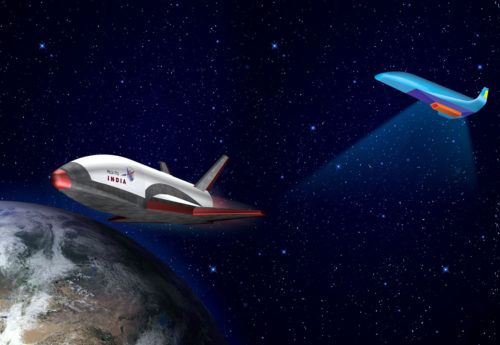
Indian spaceplanes in orbit
Artist’s view of reusable space planes in orbit, which is the goal of the Reusable Launch Vehicle Technology Demonstration program (RLV-TD) aims to develop.

** SpaceX:

*** NASA funding to assist development of in-orbit refueling of Starships: NASA shows interest in SpaceX’s Starship orbital refueling ambitions – Florida Today

The technology to dock spacecraft and transfer propellants or other necessities has a history in spaceflight, but doing so autonomously and in more modern ways has long been sought after by NASA, commercial satellite operators, and even the Department of Defense.

Having that ability could mean spacecraft such as Starship go on longer voyages; or it could help existing satellites in orbit around Earth stay in their positions longer without having to shut down due to fuel depletion. And it doesn’t have to just be fuel – such docking maneuvers could help pave the way for in-orbit repairs and servicing, too.

*** A new Starship/Super Heavy animation was posted by SpaceX this week. The in-orbit refueling starts at about the 1:15 point.

** More details on development of the vacuum version of the Raptor engine released by Elon Musk: SpaceX’s Starship Raptor Vacuum engine plans laid out by CEO Elon Musk

Elon Musk says that SpaceX Starship engine upgrades are on track to begin static fire tests of a Raptor Vacuum variant as few as a “couple months” from now.

Designed to enable more efficient performance in thin atmosphere or vacuum, Musk admitted that the first version(s) of Raptor Vacuum (RVac) will likely be a compromise between efficiency and speed of development. Nevertheless, the faster SpaceX can prepare Raptor Vacuum for flight, the easier it will be for Starship to begin serious (sub)orbital flight tests.

** Raptor vertical test stand under construction at McGregor, Texas facility:

According to CEO Elon Musk, SpaceX’s Starship and Super Heavy rockets are about to get a new test stand that will enable additional and more useful static fire tests of their Raptor engines.

These modifications could reportedly lead to a simplified engine design and will generally expand SpaceX’s ability to rapidly acceptance-test a huge number of Raptors – a necessity given that each Starship/Super Heavy pair will need up to 43 engines.

*** Latest on SpaceX efforts to buy out Boca Chica home owners:

*** Recent views of Boca Chica Beach facilities:

*** And of the Cocoa Beach Starship site:

Update: More about the start of construction of a third demo starship: SpaceX starts construction of another Starship rocket in Florida – CNBC

SpaceX now has three of its next-generation Starship rockets under construction, as aerial video shows the latest developments at the company’s facility in Florida.

The first bands of stainless steel for another Starship rocket were put on a stand Thursday, and were captured in a video taken from a flying drone. Former commercial pilot John Winkopp took the video and gave CNBC permission to use his footage.

*** SpaceX sea fleet grows to assist reusability.

— Two ships will now be deployed for satellite missions so that both nosecone fairings can be caught: SpaceX preparing to catch two Falcon 9 fairings at once with twin net-carrying ships – Teslarati.

— And another sea-going platform is being prepared so that both side boosters of a Falcon Heavy can land at sea: Elon Musk says SpaceX is still building a third drone ship – but is it for Falcon or Starship? – Teslarati

*** Lots of launches for Falcon 9 and Starship rockets: SpaceX could upgrade Starlink constellation with tens of thousands of satellites

====

Delta-v

Space transport roundup – Oct.12.2019

A sampling of recent articles, videos, and images dealing with space transport (find previous roundups here):

** Northrop Grumman Pegasus XL launched with ICON spacecraft. After nearly a year of delay due to various technical issues, the rocket was air launched from a L-1011 aircraft on Thursday off the coast of Florida. NASA’s Ionospheric Connection Explorer (ICON) will “study the dynamic zone in our atmosphere where terrestrial weather from below meets space weather from above”.

** Northrop Grumman buys back two Pegasus rockets from Stratolaunch, which had puirchased them for air launch from the giant Roc aircraft. Stratolaunch now has other plans:  Rockets purchased by Stratolaunch back under Northrop Grumman control – Spaceflight Now

Phil Joyce, vice president of space launch programs at Northrop Grumman, said this week that the company is trying to sell the launches using the two remaining Pegasus XL rockets, and officials plan to keep the Pegasus rocket’s L-1011 carrier jet flying for at least five or 10 more years.

The airborne launch of NASA’s Ionospheric Connection Explorer, or ICON, scientific satellite Thursday night off Florida’s east coast is the final scheduled flight of a Pegasus XL rocket. Variants of the solid-fueled Pegasus rocket have flown on 43 satellite delivery missions since 1990.

“We actually purchased those back (from Stratolaunch),” Joyce said in an interview with Spaceflight Now. “So they’re in a very advanced state of integration, which means they’re available for a very rapid response launch. We could launch one of those in six months, the second one probably in eight (months).

** Stratolaunch has new ownership and a new business plan:

See also Stratolaunch says it’s been sold by Paul Allen’s Vulcan to a new owner – GeekWire.

** Northrop Grumman’s satellite servicing spacecraft launched on Proton rocket along with a Eutelsat comm-sat. The MEV-1 (Mission Extension Vehicle 1) will reach the Intelsat IS-901 satellite in geostationary orbit in about 3 months. The IS-901 is running out of propellant to maintain its position and orientation. MEV-1 will attach to the apogee rocket nozzle on the satellite and use its own electric propulsion system to do the station-keeping duties for IS-901. In about five years, MEV-1 will park IS-901 in a higher, graveyard orbit and move on to another comm-sat nearing the end of its fuel and repeat the service.

** Rocket Lab gets FAA license that covers multiple launches over five years:

** Virgin Orbit working with Polish universities to send a CubeSat mission to Mars: SatRevolution, Virgin Orbit and Polish Universities Establish Mars Consortium | Virgin Orbit

Scientists and engineers from nearly a dozen Polish universities have teamed up with Poland-based satellite company SatRevolution and Sir Richard Branson’s small satellite launch company Virgin Orbit to establish a new consortium to design and carry out the world’s first dedicated commercial small satellite mission to Mars. The parties established the consortium at a formal signing ceremony during the Impact Mobility’19 rEVolution conference in Katowice, Poland.

The consortium will jointly develop the first in a series of up to three Mars missions, with the initial launch expected as early as three years from now.

** Masten partners with AI experts: Masten partners with MSBAI for AI-Augmented Space Flight – Masten Space

Masten Space Systems announced a new partnership with MSBAI to integrate cognitive artificial intelligence capabilities for autonomous space flight applications.

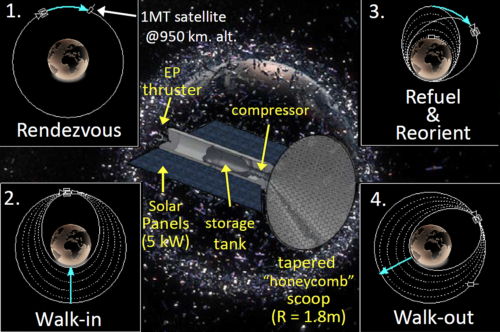
** Using Earth’s upper atmosphere to replenish propellants for a debris removal spacecraft will be studied by John Slough, MSNW LLC, with a NIAC Phase I grant: Crosscutting High Apogee Refueling Orbital Navigator (CHARON) | NASA

An orbital vehicle that could utilize in-situ upper atmospheric resources would enable a host of missions, and in particular ADR [Active Debris Removal], that require extremely high delta-V in a fast, responsive, and repeatable manner. The concept proposed here, the Crosscutting, High Apogee, Refueling Orbital Navigator (CHARON) will provide such capability.

CHARON accomplishes this in the following manner: first it obtains fuel by scooping up and storing the low density N2 and O encountered during the low altitude perigee periods of the highly elliptical orbits. Incorporation of the ultra-lightweight, high thrust-to-power Electrodeless Lorentz Force thruster developed at MSNW enables CHARON to operate efficiently on stored gas in a variety of configurations depending upon mission requirements. As CHARON can thrust at apogee, it can achieve the extensive orbit lowering needed for ADR.

Additionally, CHARON can thrust at perigee to provide drag compensation for very low perigee refueling, stable non-Keplerian orbits, or rapid phase changes. CHARON requires only 5 kW of on-board solar power as energy collected during the higher altitude portions of its elliptical orbit can be stored for higher power operation later. Functioning in this manner CHARON can generate 1.2 N of thrust at 2500 sec of Isp for ADR. During a 10 year mission life, CHARON will process 5500 kg of propellant to ferry 80 spacecraft, perform 850 degrees of plane change, with over 100km/s of delta-V, all with a single spacecraft launch, and requiring no additional onboard propellant.

Crosscutting High Apogee Refueling Orbital Navigator (CHARON)
A diagram showing the steps taken by the Crosscutting High Apogee Refueling Orbital Navigator (CHARON) to carry out Active Debris Removal. John Slough won funding from NIAC for a Phase I study of the CHARON  concept. Credits: John Slough, MSNW LLC.

** Boeing sets dates for Starliner crew spacecraft tests: Boeing reveals target dates for initial Starliner test flights – Spaceflight Now

Boeing officials said Wednesday that the company is targeting Dec. 17 for the launch of the first unpiloted orbital test flight of the new Starliner crew capsule from Cape Canaveral on a week-long demonstration mission to the International Space Station, a precursor to a mission with astronauts next year.

Meanwhile, engineers in the New Mexico desert are readying a Starliner test vehicle for a pad abort test scheduled for the morning of Nov. 4, local time, during which the crew capsule will demonstrate its ability to escape an emergency on the launch pad, according to industry sources.

But officials did not say when the Starliner could be ready to launch with astronauts. The Starliner’s first crewed test flight will use a different spacecraft than the one set for launch in December.

** SpaceX

*** Commercial Crew program in the spotlight this week. NASA Administrator Jim Bridenstine visited SpaceX HQ in Hawthorne, California to check out the status of development of the Crew Dragon. An in-flight abort test is coming up

Some of the highlights of the event:

*** Tim Dodd, the Everyday Astronaut, interviewed Bridenstine after the news conference:

*** Tour the Hawthorne CCP facilities in this 360 degree VR video from NASA: NASA’s Commercial Crew Program VR 360 Tour: SpaceX Crew Dragon – YouTube

In Part 2 of NASA’s Commercial Crew Program VR 360 Tour, NASA Communications Specialist Joshua Santora takes you on a tour of SpaceX Headquarters in Hawthorne, California. This immersive, Virtual Reality experience exhibits the design and manufacturing of the SpaceX Crew Dragon. Visit nasa.gov/stem/ccp for more STEM educational resources featuring NASA’s Commercial Crew Program.

Find more Commercial Crew Program VR 360 Tour videos at the Cape Kennedy Youtube  channel.

*** A Falcon 9 booster will be flown a fourth time for the first time when the next set of Starliner satellites are launched either late this month or in early November. SpaceX’s next launch to mark another incremental step in rocket reusability – Spaceflight Now

SpaceX next mission, slated to carry the company’s second set of Starlink broadband satellites into orbit, will be the first to fly with a reused Falcon 9 booster making its fourth launch when it takes off in the coming weeks.

Hans Koenigsmann, SpaceX’s vice president of build and flight reliability, confirmed earlier this week the plan to use a thrice-flown booster on the next Falcon 9 launch.

“Currently we use our boosters 10 times, they’re designed for 10 times,” Koenigsmann said Monday during a panel discussion at the annual meeting of the National Academy of Engineering. “We’re going to start with a fourth time with the next launch, actually. Dragon has been used three times, Crew Dragon will be used up to five times (initially only for cargo missions). So all these things help because you don’t have to build something again. You have to inspect it, refurbish it where you need to refurbish it, but ideally you need to keep that really, really low.”

*** A Falcon 9 to head  due south from Cape Canaveral to put remote sensing satellite into a polar orbit: SpaceX to shift Falcon 9’s next West Coast launch to Florida, the first of its kind in decades – Teslarati

According to NASASpaceflight spaceflight reporter Michael Baylor and an Argentinian government website, SpaceX appears to have decided to move its next West Coast launch from California to Florida, signifying the first East Coast polar launch in half a century could be just four months away.

Initially expected to launch out of SpaceX’s Vandenberg Air Force Base (VAFB) SLC-4E pad on a Falcon 9 rocket, the Argentinian space agency’s (CONAE) SAOCOM-1B Earth observation satellite was scheduled to lift off no earlier than February 2020. That launch window remains the same but Florida’s Cape Canaveral Air Force Station (CCAFS) has somehow arranged approval to reopen the United States’ Eastern polar launch corridor. The story behind the corridor’s closure is a bizarre one.

====

Manned Lunar Landing and Return

Space transport roundup – Oct.8.2019

A sampling of recent articles, videos, and images dealing with space transport (find previous roundups here):

** Boeing buys into Virgin Galactic: Boeing To Invest In Human Spaceflight Pioneer Virgin Galactic

Boeing will invest $20 million in Virgin Galactic, a vertically integrated human spaceflight company. The companies will work together to broaden commercial space access and transform global travel technologies.

“Boeing’s strategic investment facilitates our effort to drive the commercialization of space and broaden consumer access to safe, efficient, and environmentally responsible new forms of transportation,” said Brian Schettler, senior managing director of Boeing HorizonX Ventures. “Our work with Virgin Galactic and others will help unlock the future of space travel and high-speed mobility.”

To date, Virgin Galactic has invested more than $1 billion of capital to build reusable, human spaceflight systems designed to enable significantly more people to experience and utilize space. In July, the company announced its intent to become a publicly-listed entity via a business combination with Social Capital Hedosophia Holdings Corp. The Boeing investment will be in return for new shares in Virgin Galactic and is therefore contingent on the closing of that transaction, which is expected to close in the fourth quarter of 2019, and any such investment will be in the post-business combination company.

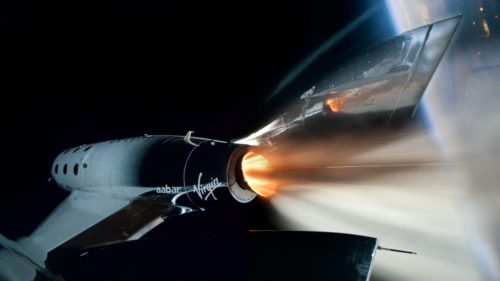
“VSS Unity Rockets to Space on Historic First Spaceflight.” Credits Virgin Galactic

** Italian Air Force buys a Virgin Galactic SpaceShipTwo flight for microgravity research: Virgin Galactic and Italian Air Force Announce World First Government Contract for Human Tended Research Flight

Virgin Galactic has announced a new contract with the Italian Air Force for a research flight on the company’s SpaceShipTwo system during which Italian researchers will actively conduct experiments while they are in space.

The contract marks the first time a government department has funded a human-tended research flight on a commercial space vehicle. The mission, set to take place as early as 2020, will fly three Italian payload specialists and a rack of research payloads. The Italian Air Force payload specialists and Virgin Galactic’s payload team are working with the Italian National Research Centre (CNR) on the design of the experimental payloads.

Human-tended research onboard SpaceShipTwo allows a dynamic approach to space-based science with researchers able to engage actively with their experiments, responding to developments in real time, optimizing the effectiveness of the research. Experimentation with humans-in-the-loop may also improve reliability by removing the unneeded complexity of building automation in. Virgin Galactic will be able to provide these benefits to the research community at levels of repeatability, affordability and quality of microgravity which have been historically unavailable in human spaceflight.

** Virgin Galactic ticket prices will rise above $250k and Blue Origin’s will start at a few hundred thousand until flight rates rise significantly:  Blue Origin’s CEO says first space trips on New Shepard will cost ‘hundreds of thousands of dollars’ – GeekWire

This week, the Australian Financial Review quoted Virgin Galactic’s commercial director, Stephen Attenborough, as saying that customer flights would begin in 2020, and that the price tag would rise once the company starts flying the more than 600 people currently on its reservation list.

Attenborough said he hoped the price would eventually come down, as the frequency of flights goes from once or twice a month to a few times a week.

Blue Origin CEO Bob Smith wouldn’t give the exact ticket price but just gave a range:

“Any new technology is never cheap, whether you’re talking about the first IBM computers or what we actually see today,” Smith said. “But it’ll be actually in the hundreds of thousands of dollars for people to go, initially.”

Smith added that over time, “we’re going to get this down to the point where middle-class people” can afford a ticket to space.

** China maintains a high mission rate with the launch of a Long March 4C with a remote sensing satellite:

**Rocket Lab prepares for ninth Electron rocket launch. The two week launch window opens on October 15th.

The payload customer is Astro Digital:

The mission is named ‘As The Crow Flies’ in a nod to Astro Digital’s Corvus Platform, which provides flexible and cost-effective solutions across a wide range of applications and mission profiles on bus variants ranging from 6U and 16U CubeSats to ESPA Class. Corvus is also a widely-distributed genus of birds which includes crows.

** Relativity Space raises big money for building small rockets with big 3D printers:

Relativity Space, the company building the world’s first autonomous rocket factory and launch services for satellites, today announced that it has closed a $140 million Series C funding round led by Bond and Tribe Capital.

 With this $140 million funding round, Relativity is fully funded to become the first company in the world to launch an entirely 3D printed rocket to orbit and enter commercial service in early 2021. The Series C round includes participation by new investors Lee Fixel, Michael Ovitz, Spencer Rascoff, Republic Labs, and Jared Leto, with participation from current investors Playground Global, Y Combinator, Social Capital, and Mark Cuban.

 “Relativity was founded with the long term vision of 3D printing the first rocket made on Mars and expanding the possibilities for human experience in our lifetime. With the close of our Series C funding, we are now one step closer to that vision by being fully funded to launch Terran 1 to orbit as the world’s first entirely 3D printed rocket,” said Tim Ellis, Cofounder and CEO of Relativity Space. “Bond and Tribe are unrivaled partners in leading this funding round, and we are excited to build this important future together with our entire team.”

** LAUNCHER is progressing on 3D printing of their engine designs:

** Ursa Major designs and builds advanced rocket engines for small rockets. Here is a brief update and a clip of a recent test:


View this post on Instagram


Look at us now! Hadley Block 1 completed a baseline qualification campaign, meeting all life and functional objectives. We set performance requirements for items such as temperatures, pressures, run time, and starts and met all of these desired goals. Congrats to the team! ⁠⠀ ⁠⠀ 📷: @barefootkait⁠⠀ ⁠⠀ .⁠⠀ .⁠⠀ .⁠⠀ ⁠⠀ #hadley #ripley #ursamajortech #rocketengine #rocketscience #additivemanufacturing #startup #aerospace #engineering #engines #3Dprinting #3dprint #exploreouterspace #coloradolife #aerospaceindustry #themoreyouknow #qualification #block1qualification #enginequalification #nextsteps #congrats #success #meetinggoals #okrs #winning #objectives

A post shared by Ursa Major Technologies (@ursamajortech) on

** Firefly test fires four Reaver engines altogether in the configuration used on the Alpha rocket  first stage:

** Space Access: Transport and Logistics panel discussion at the recent Space Studies Institute conference in Seattle.

  • Henry Vanderbilt starts with a beginner’s guide to the Rocket Equation (00:17:56)
  • John Schilling of Aerospace Corporation
    • Near-Term Partially Reusable Launch Vehicles (00:38:20)
    • A Possible Cislunar Transportation Architecture Compatible with Near-Term NASA Requirements (00:54:00)
  • Dallas Bienhoff of Cislunar Development Corp – Evolving Reusable Cislunar Transportation Architecture (01:17:50)
  • Audience Q&A ( 01:35:50).

** Human Spaceflight  panel at the 2019 National Academy of Engineering Annual Meeting. Panelists included former NASA astronaut Robert Crippen, former NASA Administrator and astronaut Charles Bolden, former NASA astronauts Lt. Gen. Tom Stafford (USAF, Ret.) , SpaceX VP Hans Koenigsmann,  and Boeing (and former NASA) astronaut Chris Ferguson.


** Latest on space elevators: October 2019 Edition of the ISEC Newsletter

The tether will likely be constructed of either carbon nanotubes (CNT) or sheets of single-crystal graphene (SCG). Production of these materials has advanced in recent years, with both CNTs and SCGs reaching lengths of 50 cm in the laboratory. The specific strength (tensile strength divided by density) of either material is already sufficient for space elevator needs. Concepts are now being developed for mass production of both of these materials. The mass of the tether will vary depending on its taper (cross sectional area as a function of length), the tether material and construction. Current estimates are around 1000 MT for the tether and 400 MT for the Apex Anchor.

** SpaceX

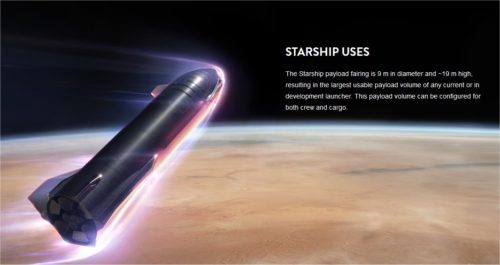
*** Dedicated SpaceX Starship web page includes lots of interesting info and cool imagery.

“The Starship payload fairing is 9 m in diameter and ~19 m high, resulting in the largest usable payload volume of any current or in development launcher. This payload volume can be configured for both crew and cargo.”

*** Construction underway of Starship launch/landing facilities at Kennedy Space Center:

NSF:

The construction of the new Starship launch and landing facility at Pad 39A is in full swing as heavy equipment lays the foundations at the iconic Kennedy Space Center pad complex. Built alongside the 39A ramp, a new launch mount will be installed for what will be the maiden launch of SpaceX’s Starship Mk2 prototype rocket. The facility also includes a landing pad that will be eventually used for returning vehicles.

*** Hardware detail work makes Starship & Super Heavy seem real rather than just research projects:

For the first several years of Falcon 9 and Falcon Heavy booster recovery operations, SpaceX built grid fins – used for maneuvering the rockets at high speeds – out of aluminum. With Falcon 9 Block 5, aluminum grid fins were phased out entirely in favor of larger titanium fins, necessitated by exceptionally high-speed reentries that nearly melted through the aluminum fins on several occasions. Now, SpaceX wants to move from titanium to steel fins for its next-generation Starship launch vehicle.

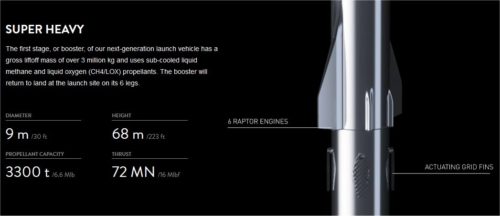
Super Heavy grid fins are shown in this model of the space transport system shown on the SpaceX Starship site.

Noted multiple times over the years (and in recent days) by both SpaceX and CEO Elon Musk, an extremely robust and reliable method of orbital refueling is essential to the success of Starship’s current designed – perhaps more so than any other single aspect of the next-generation launch vehicle. Although Starship-Super Heavy will likely offer respectable performance in single-launch mode, the implicit need to recover and reuse both booster and spacecraft takes a big chunk out of the rocket’s potential capabilities.

*** Time Dodd, the Everyday Astronaut, talked with Elon Musk after his Starship presentation in Boca Chica Beach on Sept. 28th:

*** Some other items about the presentation:

*** Latest drone view of Cocoa Beach Starship facility:

*** Crew Dragon news:

Despite all of the technical work ahead, Musk said he expected both the rocket and Crew Dragon spacecraft for the first crewed mission to arrive in Florida at the company’s launch facilities within about 10 weeks. Within that time frame, he said testing on hardware should also be completed.

If this is the case, the ball would move to NASA’s court to review all of the company’s paperwork and procedures and sign off on a crewed mission. One source said it was possible this could be done in time to support a flight early in the spring of 2020—but no one is offering launch guarantees at this point.

A decision to extend the duration of the Crew Dragon test flight with Behnken and Hurley, designated Demo-2, is one of several options under consideration to ensure the space station remains staffed with U.S. astronauts after NASA’s agreement to procure seats on Russia’s Soyuz spacecraft expires next year.

In an interview with CNN last week, NASA Administrator Jim Bridenstine said the agency is also looking at purchasing more Soyuz seats from Roscosmos, the Russian space agency.

The final round-trip Soyuz seat procured by NASA will launch in March 2020 on the Soyuz MS-16 spacecraft, a mission also designated Soyuz 62S in the space station’s sequence of visiting vehicles. The crew member flying in that seat has not been announced, but a U.S. astronaut and a Japanese astronaut have been training to potentially fly on a Soyuz mission in early 2020.

As part of continued preparations ahead of SpaceX’s Demonstration-2 mission (DM-2) that will debut Crew Dragon’s ability to support astronaut flight, SpaceX and NASA have successfully tested crew emergency egress (escape) systems at SpaceX’s primary crew launch facilities located at Launch Complex 39-A (LC-39A) at Kennedy Space Center in Florida. The successful verification tests have proven that SpaceX is ready to support crewed launches and preserve human life with effective escape methods, including a zipline mounted basket system that will whisk astronauts away from Crew Dragon and Falcon 9 in the event of a launch pad anomaly.

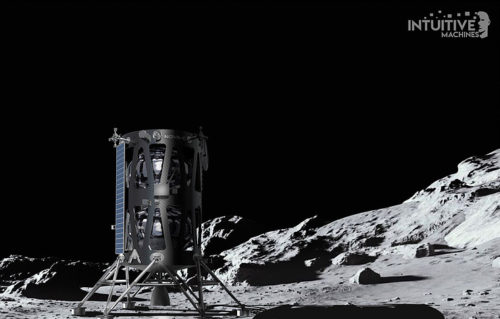
*** Intuitive Machines to launch  Nova-C lunar lander on Falcon 9:

Houston-based Intuitive Machines selected SpaceX to launch its lunar lander, Nova-C, to the Moon in 2021 on a Falcon 9 rocket.

“Intuitive Machines is thrilled to sign with SpaceX to take Nova-C on its first mission to the moon,” said Intuitive Machines President and CEO, Steve Altemus. “SpaceX’s ability to make low-cost quality lunar transport is paramount to completing NASA’s Commercial Lunar Payload Services (CLPS) contract and Intuitive Machines becoming the first commercial company to land on the Moon.”

Powered by the liquid methane main engine, Nova-C can deliver at least 220 pounds of space technology and instrumentation cargo to anywhere on the lunar surface. On its maiden mission in 2021, Nova-C will carry 5 NASA CLPS payloads to the lunar surface and transmit scientific data back to Earth during 13.5 days of activity on the moon. Intuitive Machines is in the process of adding additional payloads from other customers to the 2021 mission to fill out the available cargo manifest. Credits: Intuitive Machines

====

Space 2.0: How Private Spaceflight, a Resurgent NASA,
and International Partners are Creating a New Space Age