Category Archives: Rockets

Space transport roundup – Nov.20.2019

A sampling of recent articles, videos, and images dealing with space transport (find previous roundups here):

[ Update 4: A statement from SpaceX indicates that they were pushing the pressure extremely high as a test of the tank design since they had decided it would never fly.

Sounds like the Mk.2 in Florida may also not fly. Perhaps it will also be used for ground tests like this one.

See also

Update 3: Elon says they will learn from this and move on to Mk.3, which will be much closer to the actual flight design:

Update 2: During a pressure test of the Starship Mk.1 propulsion module today in Boca Chica, the top bulkhead blew off:

Will be interesting to see if they repair it or build a whole new propulsion module. Regardless, no Mk.1 test flight this year for sure. A flight of the Mk.2 in Florida may now happen before a demo Starship flight in Texas.

Update: NASA posted a video of the recent SpaceX Crew Dragon static abort firing test:

]

** China launched a two Kuaizhou-1A rockets in less than a week. The latest  one carried

two multimedia satellites into space on Sunday after the successful launch of a remote sensing satellite on Wednesday, according to China Aerospace Science and Technology Corporation (CASC). The two satellites have already entered the pre-set orbit by the time of release. The rocket, carrying the satellites named KL-α-A, KL-α-B, blasted off from northwestern China’s Jiuquan Satellite Launch Center at 18:00 p.m. BJT. The two satellites atop were developed by the Innovation Academy for Microsatellites of Chinese Academy of Sciences to conduct Ka-band communication technology test for German customers.

More at:

** Japan’s Space One commercial rocket venture begins construction of a new launch facility: Japan’s 1st private-sector rocket launch site – NHK WORLD/JAPAN News

Space One is building the launch site in Kushimoto town, Wakayama Prefecture.

Space One is a joint venture funded by four companies — Canon Electronics, IHI Aerospace, Shimizu Corporation and Development Bank of Japan.

** Aerojet Rocketdyne demos a big electric propulsion system that will be used to move NASA’s Gateway lunar space station: Advanced Electric Propulsion Thruster for NASA’s Gateway Achieves Full Power Demonstration | Aerojet Rocketdyne

Aerojet Rocketdyne and NASA recently demonstrated an Advanced Electric Propulsion System (AEPS) thruster at full power for the first time, achieving an important program milestone.

Aerojet Rocketdyne-developed AEPS thrusters are slated to be used on the Power and Propulsion Element of NASA’s Gateway, the agency’s orbiting lunar outpost for robotic and human exploration operations in deep space.

The state-of-the-art AEPS Hall thruster operated at 12.5 kilowatts (kW) as part of its final conditioning sequence during testing at the Jet Propulsion Laboratory in Pasadena, California. The thruster demonstrated stable operation at power levels ranging from 4.2 kW to 12.5 kW. Full electric propulsion thruster string integration will take place early next year.
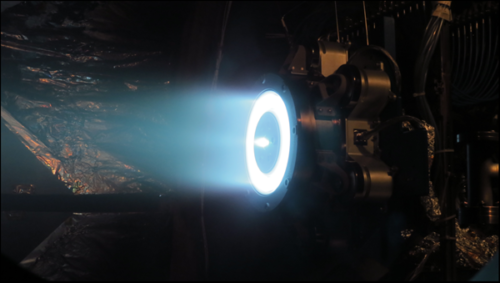
‘Aerojet Rocketdyne’s Advanced Electric Propulsion System thruster demonstrates full power operation at the Jet Propulsion Laboratory in Pasadena, California.”

** Relativity Space promotes the Terran-1 rocket, which the company plans to start launching in 2021.

** Orbex shows off the company’s factory where the Prime rockets will be made:

Orbex, a U.K.-based company that hopes to start launching rockets from Scotland in the coming years, has revealed images of the facility where it will build its upcoming Prime launch vehicle.

Located in the town of Forres near Inverness in Scotland, the company’s facility will be used to construct each 17-meter long Prime rocket, designed to loft small satellites into polar orbit from the early 2020s.

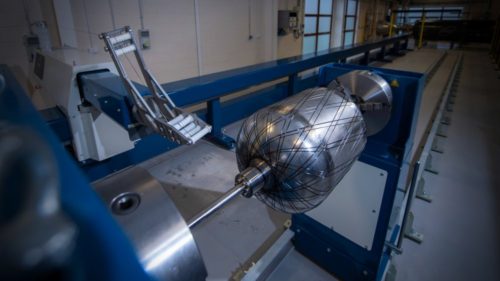
Inside, the company says it has included a number of features to produce a lighter and more environmentally-friendly rocket. This includes, with regards to the former, a large carbon-fiber winding machine to build the exterior structure of the two-stage rocket, which the company says is among the largest in Europe.

See also

“Orbex has installed one of the largest high-speed automated carbon fibre winding machines in Europe in its Scottish factory, as well as a full size ‘autoclave’. This equipment allows engineers to have complete control over the design and pace of manufacture of all carbon fibre tanks, including the main stage tanks, which can be wound in a matter of hours. Orbex fuel tanks use specialized materials, including graphene, and specially developed processing techniques to ensure linerless compatibility with liquid oxygen.” – Orbex

** An update on Sierra Nevada’s Dream Chaser cargo vehicle development:

At the Kennedy Space Center’s Space Station Processing Facility, Sierra Nevada Corporation unveiled the name for Dream Chaser’s cargo module element as well as provided an update on the status of the cargo craft as it prepares for its first flight in 2021.

Also discussed at the event were potential other applications for Dream Chaser, including but not limited to a Gateway logistics cargo vehicle, a standalone space station, and a crew transportation vehicle.

Today’s update came as Sierra Nevada continues to prepare its cargo version of Dream Chaser for its first voyage to the International Space Station in “Fall 2021,” according to Steve Lindsey – Vice President, Space Exploration Systems Space Systems for Sierra Nevada Corporation.
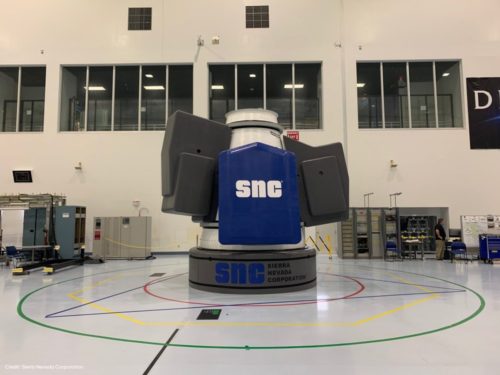
A test version of Dream Chaser’s “Shooting Star” cargo module on display at KSC this week. The blue panel is where a solar panel can be located. The gray structures on the sides represent where cargo modules can be attached.

Here is a video of a Sierra Nevada briefing held back in October 15th on the occasion of the arrival of the primary structure of the first Dream Chaser at a SNC facility in Colorado where they will  assemble the vehicle: Dream Chaser Primary Structure Arrives in Colorado – SNC

** The Space Show – Mon, 11/18/2019Joe Carroll discussed “tethers, artificial gravity, humans and long duration spaceflight, living in space, on the Moon and Mars plus much more”.

See also Carroll’s slides shown at IAC 2019: Do Humans Have a Future in Moon or Mars Gravity 2019 IAC rev Nov14 no video.pptx.

** How SpinLaunch will swing payloads into space: Flinging Small Satellites Into Orbit on the Cheap – Wired/Spaceport America

Jonathan Yaney and his colleagues at SpinLaunch, a startup based in Long Beach, California, believe they’ve found the answer. Their nearly fuel-free system, known as a mass accelerator, will use a giant vacuum-sealed centrifuge to spin a payload to more than 4,000 mph. Once released, the payload will go screaming through the atmosphere, coasting nearly 30 vertical miles before propelling itself the rest of the way to orbit by means of a small rocket. The company already has a working prototype; Yaney calls it “science fiction stuff.”

Eventually, Yaney claims, SpinLaunch will be able to fling several 200-pound payloads into space every day, at a cost of less than half a million dollars each— five or 10 times cheaper than the competition. Human passengers are out of the question; the accelerator would turn their bodies to mush. Even satellites must be specially hardened to survive the ride. But that’s a small concession, Yaney argues, when you’re talking about putting together, say, a constellation of internet satellites in a matter of days rather than months.

** OHB of Germany recently  joined the crowded ranks of smallsat launcher developers: OHB defends self-funded launcher effort – SpaceNews.com

OHB is best known for building Europe’s Galileo navigation satellites, but the company also supplies many of the structures and tanks for the Ariane 5 and upcoming Ariane 6 rockets. 

This year OHB revealed plans to develop its own rocket, targeting the small satellite market around the range Rocket Lab’s Electron addresses today. 

OHB hopes to have a small launcher capable of sending 200 kilograms to low Earth orbit conduct a first flight by the end of 2021, Fuchs said in an interview at Space Tech Expo Europe here. The German prime contractor established an entity called Rocket Factory Augsburg to spearhead the small launcher program.

** SpaceX:

*** Falcon 9 booster used for the recent Starlink launch returns from the sea: SpaceX Falcon 9 booster returns to port on a drone ship for the first time in six months – Teslarati

*** The legs were soon removed and the booster laid on its transporter:

[ Update: The guys at www.USLaunchReport.com capture a video of the booster on its way to the hangar:

]

*** Starship program:

**** Testing of the Starship Mk1 began this week in preparation for its first flight from Boca Chica Beach, Texas: SpaceX’s Starship comes to life for the first time in lead-up to launch debut – Teslarati

An anthropomorphization sometimes used to describe the venting launch vehicles often exhibit while during and after fueling, Starship Mk1’s so-called ‘breaths’ occurred around 5:59 pm CST (23:59 UTC). Those first vents came after roughly an hour or two spent performing several different pressurization cycles, observable due to the fact that Starship’s stainless steel tanks visibly smoothed out as pressure increased.

Due to the typical distances Starship is viewed from and the nature of the mirror-finished stainless steel SpaceX has chosen to build the next-generation launch vehicle out of, the exterior of Starship prototypes can produce a reflection that looks bumpy and disjointed. This has lead many a layperson to incorrectly assume that SpaceX’s Starship prototypes are thus shoddily built. In reality, viewed from afar, the tiniest hint of surface heterogeneity on a mirror can dramatically change what is reflected on its surface.

Even at the thinness of Starship Mk1’s liquid oxygen and methane tanks, stainless steel is still extremely strong, but pressurizing the vehicle’s tanks can clearly counteract a significant portion of the slight imperfections in their curvature.

**** Additional views of Starship Mk1 activities at Boca Chica from the past few days

Following Monday’s initial testing, engineers entered Starship Mk1 for checks ahead of the cryoproofing test objectives potentially later this week. Long video (down to 12 mins thanks to timelapse, lots of viewpoints, with special guests: Starship Internal Ladder and Concrete Smoother guy. Learn about Starship Mk1: UPDATES: https://forum.nasaspaceflight.com/ind… ARTICLES: https://www.nasaspaceflight.com/?s=St… Video and photos from Mary (@bocachicagal) for NSF.

Starship Mk1’s first cryo loading tests are just around the corner as workers prepare the test vehicle by flushing out the lines and pressurizing the commodity tanks. Venting IS normal (or “norminal” as SpaceX would say. 🙂 Learn about Starship Mk1: UPDATES: https://forum.nasaspaceflight.com/ind… ARTICLES: https://www.nasaspaceflight.com/?s=St… Lots of videos (some time-lapse) and Photos by Mary (@bocachicagal) for NASASpaceFlight.com.

**** And view of the Starship Mk2 in Cocoa Beach, Florida

Some delicate adjustments to the propellant bulkhead:

**** Yusaku Maezawa gets a souvenir from the Starhopper.  The cost of development of the Starships has been helped by a down payment from Yusaku Maezawa for a trip on a Starship flight around the Moon with a group of artist friends. Elon Musk gifts SpaceX Starship angel investor a piece of Starhopper history – Teslarati

**** NASA will accept bids from SpaceX to use a Starship for lunar missions:

A SpaceX Starship on the Moon. Credits: SpaceX via NASA PR

== Amazon Ad ==

The Case for Space:
How the Revolution in Spaceflight Opens Up
a Future of Limitless Possibility

Space transport roundup – Nov.16.2019

A sampling of recent articles, videos, and images dealing with space transport (find previous roundups here):

** SpaceX executes successful static firing of Crew Dragon launch escape system.  A similar firing last April led to an explosion caused by leaks and other problems in the propellant plumbing. Assuming the data looks OK in closer examination, this firing allows for SpaceX to proceed to the in-flight abort test flight, presumably in December, in which a Crew Dragon will detach from a Falcon 9 upper stage not long after launch to simulate the escape from a failing booster.

See also

More SpaceX entries below.

** China launches two rockets on same day – Sept.13th: China carries out 2 orbital launches inside 3 hours – SpaceNews.com.

Firstly, a Kuaizhou-1A (Y11) launcher sent a remote sensing satellite into low earth orbit from the Jiuquan Satellite Launch Center, Gansu Province in northwest China, on 13 November 2019:

The Jilin-1 satellite constellation was developed on China’s Jilin Province and is the country’s first self-developed remote sensing satellite for commercial use. Data will be provided to commercial clients to help them forecast and mitigate geological disasters, as well as shorten the time scale for the exploration of natural resources.

The satellites were developed by the Chang Guang Satellite Technology Co., Ltd under the Changchun Institute of Optics, Fine Mechanics and Physics, Chinese Academy of Sciences.

And then a Long March-6 sent five  small remote-sensing satellites into orbit from Taiyuan Satellite Launch Center in north China’s Shanxi Province:

The new satellites – also designated Zhongzi, were developed by the DFH Satellite Co., Ltd. and the Shanghai Academy of Spaceflight Technology (SAST) – are part of a commercial satellite project financed by the Ningxia Jingui Information Technology Co., Ltd. and will be mainly used for remote sensing detection.

This mission was the first low-inclination orbital launch for the Long March-6 launch vehicles, in response to the mission needs. The rocket was submitted to a series of technical upgrades, including take-off roll, horizontal guidance, new composite material double-walled mount barrel and others.

** UK govt. aims to develop plan for flight-testing Reaction Engines‘ SABRE engine:

The purpose of this call is to produce a roadmap for the next phase in the SABRE development. It is focused on flight-testing the core SABRE air-breathing engine and assessing the potential competitive positioning of future SABRE-powered applications in the future space transportation segment.

** US rocket company Launcher gets $1.5 million for rocket engine development:

From launcher:

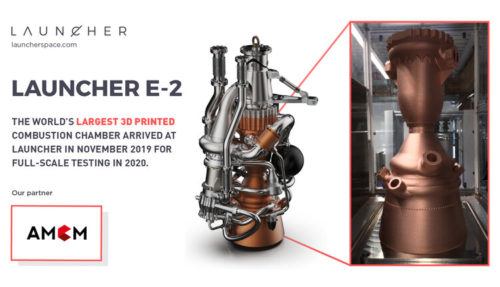
Launcher Inc. has scheduled the first full-scale test of its E-2 rocket engine for mid-2020 after securing a $1.5M award from the U.S. Air Force and taking delivery of the world’s largest 3D printed combustion chamber. 

3D printed by AMCM (An EOS Group Company) in Copper Alloy on AMCM’s M4K machine, it is the world’s largest liquid rocket engine combustion chamber 3D printed in a single part. The combustion chamber is 34in (86cm) tall with an exit nozzle diameter of 16in (41cm).

Launcher E-2 engine employs a large 3-D printed combustion chamber.

** EXOS Aerospace says structural failure led to the in-flight abort and loss of the SARGE vehicle  on the recent launch at Spaceport America in October : Exos blames suborbital launch accident on structural failure – SpaceNews.com

In a statement released by the Texas-based company Nov. 14, Exos said its Suborbital Autonomous Rocket with GuidancE, or SARGE, rocket was lost 48 seconds after its Oct. 26 liftoff from Spaceport America in New Mexico.

“We are still in the process of evaluating video and telemetry data; however, it appears a structural failure resulted in an abort and deployment of the recovery system at speeds far beyond its design capability,” the company stated.

** Airbus team flies TEXUS suborbital rocket from Esrange launch facility near Kiruna in northern Sweden:

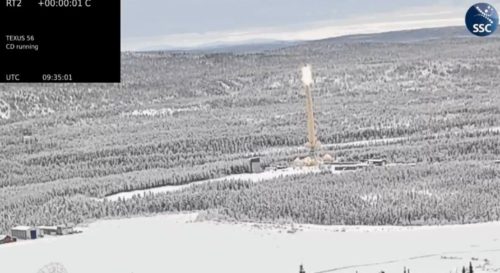
Airbus has completed another successful space mission. On 15 November, the TEXUS-56 rocket completed a scientific research flight.

The research rocket took off at 10:35 CET from Kiruna, north Sweden, and gave the scientists involved six minutes of research in microgravity.  After the parachute landing of the rocket, the experiments were recovered by a helicopter team. The research teams will now evaluate the results.

“Mission accomplished! Our TEXUS team from Bremen has once again done a great job for our customers, ESA and DLR,” enthuses project manager Detlef Wilde. “With TEXUS, we offer very short preparation times, integrate the payloads and take care of the complete mission execution, including procurement of the rockets – a service that our customers love to use”.

Launch of the Airbus suborbital TEXUS-56 mission from Esrange Space Center in northern Sweden.

** SpaceX:

*** Falcon 9 first stage returns to port following landing at sea for the Starlink launch:

Incredible how well the first-ever four-time flown booster looks. Was sort of bad weather, the B1048.4 traveled thru 15ft seas.

*** Update on the first group of fully operational Starlink satellites to reach orbit: SpaceX says upgraded Starlink satellites have better bandwidth, beams, and more – Teslarati

Aside from a general improvement to the overall visual fit-and-finish of the v1.0 spacecraft, SpaceX’s official comments on the matter indicated that the most substantial changes between v0.9 and v1.0 were more related to each spacecraft’s advanced electronics and payloads. In the case of Starlink, each satellite’s primary payload is a high-performance suite of electronically-steered phased array antennas. Initially developed to improve the flexibility of tracking and scanning radars used by military fighter aircraft, phased array antennas (and radar) allow multiple beams to be aimed without physically moving the antenna.

SpaceX says that Starlink v1.0 satellites added a number of Ka-band antennas alongside upgraded Ku-band hardware similar to what was installed on Starlink v0.9. Ka and Ku refer to similar but different communications frequencies, with Ku-band generally offering greater reliability and cloud/rain tolerance, while Ka-band is a bit more sensitive to environmental factors but offers a substantially higher theoretical bandwidth.

*** SpaceX aims to launch the Kacific-1 comm-sat to orbit in DecemberSpaceX’s next Falcon 9 satellite launch a step closer as spacecraft heads to Florida – Teslarati

Known as Kacific-1 or JCSat-18 the massive spacecraft is scheduled to launch no earlier than mid-December and is current set to be SpaceX’s second to last or final launch of 2019. According to tweets published by operator Kacific and satellite manufacturer Boeing, the satellite departed Boeing’s El Segundo, California factory on November 4th and has probably already arrived in Cape Canaveral, Florida.

After arrival, Boeing technicians will inspect the satellite to ensure its road trip caused no damaged and fuel the spacecraft’s bipropellant and xenon propellant tanks. SpaceX technicians will then take over, encapsulating Kacific-1 inside a Falcon 9 payload fairing, transporting the assembly to its Launch Complex 40 pad, and attaching the fairing to an integrated Falcon 9 rocket.

*** Views of Starship Mk.1 construction activity at Boca Chica Beach, Texas:

Starship Mk1 is now preparing for cryo loading tests in the coming days, which will mark fuel tests ahead of the testing with her three Raptor engines.

*** Latest fly-around the Florida orbital Starship demo construction facility:

Aerial view of Cocoa Facility. Attachment points in the top of the engine section are close to completion so that the top dome can be installed. Three very large containers have arrived at the site who’s purpose is unknown. They are located in various locations. One out front of main facility, one on the side of the facility and one in the small tent on the side of the facility.

== Amazon Ad ==

See You In Orbit?: Our Dream Of Spaceflight

Space transport roundup – Nov.10.2019

A sampling of recent articles, videos, and images dealing with space transport (find previous roundups here):

** SpaceX Falcon 9 set to launch 60 Starlink satellites on Monday at 9:56 am EST, 14:56 UTC.

[ Update: The launch was a success. The booster landed right on target and the satellites were deployed as planned. Apparently the sea was quite rough, though, and so the ships returned without any attempt to capture the fairings.

]

This will be the first  booster to fly four times. It will also be the first time that a recovered fairing will be re-flown. SpaceX will attempt to catch both fairings from this flight with two ships outfitted with large nets.

More about the mission:

More SpaceX items below.

** Updates on the recent Boeing Starliner pad abort test. (See previous roundup.)

A second video from Boeing:

Boeing said Nov. 7 that a misplaced pin prevented a parachute from deploying during a pad abort test of its CST-100 Starliner vehicle three days earlier, the only flaw in a key test of that commercial crew vehicle.

In a call with reporters, John Mulholland, vice president and program manager for commercial crew at Boeing, said an investigation after the Nov. 4 test at White Sands Missile Range in New Mexico led the company to conclude that a “lack of secure connection” between a pilot parachute and the main parachute prevented that main parachute, one of three, from deploying.

See also

** Update on Boeing’s uncrewed Starliner test mission to the ISS currently set for Dec. 17th: OFT Mission Taking Shape at Space Launch Complex 41 – Commercial Crew Program/NASA

The United Launch Alliance (ULA) Atlas V rocket set to launch Boeing’s CST-100 Starliner on its maiden voyage to the International Space Station for NASA’s Commercial Crew Program is ready for the mating of Starliner to the top of the launch vehicle.

On Monday, Nov. 4, the Atlas V’s first stage was lifted to the vertical position inside the Vertical Integration Facility at Space Launch Complex 41 at Cape Canaveral Air Force Station in Florida, followed by the mating of two solid rocket boosters to the booster. ULA teams then attached the Centaur upper stage and launch vehicle adapter atop the Atlas V first stage.

** The history of Japan’s reusable suborbital rocket projects are described in this set of tweets:

See also a related item in an earlier roundup.

** Video tour of Rocket Lab‘s New Zealand launch facility:

Join Amanda Stiles, Director of Mission Management and Integration, as we take you on a tour of Rocket Lab’s Launch Complex 1. Located on the Mahia Peninsula on New Zealand’s East Coast, LC-1 is the best spot in the world to launch more frequently than anywhere else on the planet.

** “What are Hypergolic Rocket Fuels? (Other than Explosive, Corrosive, Toxic, Carcinogenic and Orange)” – Scott Manley answers the question, ”

Hypergolic fuels are a core technology in rocket science, propellents that will spontaneously combust when mixed together. This makes them attractive for rocket designers, who generally aren’t the people who have to get in a the protective gear to load the stuff. So, what are they made of, and why do designers pick one option over another?

** Govt launch cost estimates as seen by former Shuttle mission director, Wayne Hale. See the response from Eric Berger on Twitter. Hale was probably responding to Berger’s article on SLS mission launch estimates in which Berger concluded the following:

Adding all of this up, the true cost of a Space Launch System mission with Orion on top in the 2020s, including the rocket’s development but excluding ground systems and Orion development costs, appears to be in the ballpark of $5 billion per flight. Let’s hope the astronauts are served more than just pretzels after takeoff.

I’ve always been amazed and angered that NASA for decades has gotten away with using theoretical marginal cost numbers (i.e. count only the cost of fuel, metals, operators salaries, etc. to do one additional flight)  when asked for the cost of a Saturn V, Shuttle or SLS mission. This is clearly a grossly misleading way to answer the question of how much taxpayer money it took for a flight to take place. I’m quite disappointed that Hale defends the practice and I posted a comment on his post but he hasn’t approve it. So [Now approved.] here is what I said (with some typos fixed):

So the cost of the James Webb ST is not $10B, like those knuckle-headed bloggers claim, but is actually ~$500M because that’s about how much it would cost to build a second one?

Marginal (i.e. incremental) cost is an interesting number after making a million widgets and you want to know how much the next widget costs. The fixed cost contribution vanishes. Marginal cost is an irrelevant number when only making, or launching, a 100 or so widgets. The fixed cost contribution doesn’t vanish – and no magical accounting or browbeating by a highly respected Flight Director can make it do so.

It’s definitely relevant to know who is doing the calculation but it’s also good to know if the calculation answers the question being asked. In this case, the question from taxpayers is simply how much did it cost to make those [135] Shuttle flights happen? If only $105B instead of $210B (in 2010 dollars) had been allocated, would [135] launches still have taken place? No, of course not. It is irrelevant if NASA used a substantial portion of the money for items like roofs and non-essential civil servant salaries. That’s what govt organizations do with their budgets. If half the total Shuttle expenditure had instead been allocated to NASA, half [i.e. 67] or fewer flights would have happened.

Yes, who calculates what number is a factor. We can be sure NASA in the next few years will calculate $500M as the cost of a SLS flight. And the $3B+ that it will cost to make each flight happen will be [accurately] calculated by knuckle-headed bloggers.

** SpaceX:

*** Video: Elon Musk discusses SpaceX and the importance of fully reusable rockets at a US Air Force event last week:

Opening day of Air Force Space Pitch Day. The two-day event was hosted by the U.S. Air Force to demonstrate the Air Force’s willingness and ability to work with non-traditional startups. The “Fireside Chat” features Lt. Gen. John F. Thompson, Space and Missile Systems Center Commander, and Elon Musk, Space X Chief Engineer. The chat covers the future of space, space industry, how to find talent, and various other topics.

See also SpaceX Starship: Elon Musk outlines an ultra-low price tag for launches | Inverse

*** USAF also testing Starlink for global broadband communications capabilities SpaceX’s Starlink satellite internet was tested by the US Air Force and the results are in – Teslararti

The technical viability and utility of beaming high speed, low-latency broadband internet directly into the cockpits of military aircraft is being tested under a program called Global Lightning. SpaceX has engaged the initiative and was awarded $29M to pursue development and testing, far more than any other contract recipient. In October 2019, SpaceX and the USAF began publicly discussing the latest results of that effort to test Starlink’s capabilities in the realm of in-flight connectivity. As reported by SpaceNews, SpaceX COO Gwynne Shotwell revealed that Starlink had successfully demonstrated a data link to the cockpit of a military aircraft with a bandwidth of 610 megabits per second (Mbps), equivalent to a gigabyte ever ~13 seconds.

*** Views of recent Starship construction activity at Boca Chica Beach:

[ Update: A video from Sunday:

]

*** And a fly-around of the Mk2 Starship construction activity in Florida:

Aerial Flyby, Quiet Sunday. Working on new ring on top of the engine section. Hints of 6 Raptor engines to be included on MK2. Lot of sheets of steel getting stored in the “On Deck” area. These sheets can be used to construct domes and nosecones.

*** Speaking of Florida, launch facilities for Starships are under construction at KSC: SpaceX begins Starship launch mount installation at historic Pad 39A in Florida – Teslarati

At the same time as SpaceX’s Boca Chica, Texas team is working around the clock to prepare Starship Mk1 for several major tests, the company is building a second dedicated Starship launch complex at Pad 39A and as of November 4th, that construction effort has reached a symbolic milestone.

== Amazon Ad ==

Delta-v

Space transport roundup – Nov.5.2019

A sampling of recent articles, videos, and images dealing with space transport (find previous roundups here):

** SpaceX Falcon 9 set for static firing test on the pad at Cape Canaveral. This is in preparation for a launch of Starlink satellites on Nov. 11th.

[ Update: The static firing test took place successfully. The Falcon 9 nosecone will include the first fairing to be reused.

See also: SpaceX finally fires up Falcon 9 ahead of Starlink mission – NASASpaceFlight.com.

A video of the firing:

]

See also: SpaceX’s first Falcon 9 launch in months gets a launch date- Teslarati.

More SpaceX items below.

** Boeing Starliner blasted off on Monday in a pad abort test and made a soft landing though only 2 of the 3 parachutes deployed properly:

NASA:

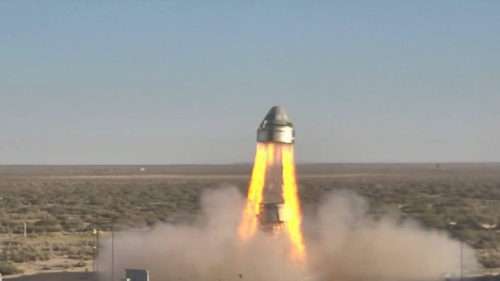
During the test, Starliner’s four launch abort engines, and several orbital maneuvering and attitude control thrusters simultaneously ignited to rapidly push the spacecraft away from the test stand. Five seconds into flight, the abort engines shut off as planned, transferring steering to the control thrusters for the next five seconds.

A pitcharound maneuver rotated the spacecraft into position for landing as it neared its peak altitude of approximately 4,500 feet. Two of three Starliner’s main parachutes deployed just under half a minute into the test, and the service module separated from the crew module a few seconds later. Although designed with three parachutes, two opening successfully is acceptable for the test parameters and crew safety. After one minute, the heat shield was released and airbags inflated, and the Starliner eased to the ground beneath its parachutes.

The demonstration took only about 95 seconds from the moment the simulated abort was initiated until the Starliner crew module touched down on the desert ground.

“Boeing’s CST-100 Starliner’s four launch abort engines and several orbital maneuvering and attitude control thrusters ignite in the company’s Pad Abort Test, pushing the spacecraft away from the test stand with a combined 160,000 pounds of thrust, from Launch Complex 32 on White Sands Missile Range in New Mexico. The test, conducted Nov. 4, 2019, was designed to verify that each of Starliner’s systems will function not only separately, but in concert, to protect astronauts by carrying them safely away from the launch pad in the unlikely event of an emergency prior to liftoff. The Pad Abort Test is Boeing’s first test flight for NASA’s Commercial Crew Program, which is working to launch astronauts on American rockets and spacecraft from American soil for the first time since 2011.” – NASA

Here is the webcast of the test. Liftoff happens at around 24:55 into the video.

Scott Manley comments on the test:

** Northrop Grumman Cygnus arrives at the ISS after traveling in space for two days since its launch on an Antares rocket on Saturday.

** Chinese Long March 4B launches remote sensing satellite on Sunday:

** And a Long March 3B launched a Beidou navigation satellite on Monday:

** Report on EXOS Aerospace suborbital launch: Unsuccessful Attempt in the Desert … EXOS Aerospace Systems & Technologies Fourth Launch of a Reusable Vehicle- Satnews

Unfortunately a reusable suborbital sounding rocket launched by EXOS Aerospace malfunctioned shortly after liftoff causing the vehicle to crash back to Earth minutes later. Even though today’s attempt was unsuccessful this EXOS flight was the third time a suborbital-class rocket stage has been reused for a fourth time.

The launch took place at the Spaceport America. Spaceport America which is an FAA-licensed spaceport located on 18,000 acres of State Trust Land in the Jornada del Muerto desert basin in New Mexico, directly west and adjacent to U.S. Army’s White Sands Missile Range. It lies 89 miles north of El Paso, 45 miles north of Las Cruces, and 20 miles southeast of Truth or Consequences.

** Video: Review of reusable rocket engines with Matt Richardson of Univ. of TokyoTMRO.tv

We’re joined by Dr Matt Richardson of U Tokyo/JAXA to talk reusable rocket engines. Matt recently graduated with a PhD in aerospace engineering where he tested ways to extend the lifetime and reduce refurbishment costs of liquid-fueled rocket engines.

** SpaceX;

*** Starlink early deployment: What to expect from SpaceX Starlink broadband service next year and beyond – CIS 471

… it sounds like SpaceX is serious about pursuing the consumer market from the start. When asked about price recently, Shotwell said millions of people in the U. S. pay $80 per month to get “crappy service.” She did not commit to a price, but homes, schools, community centers, etc. with crappy service would pay that for good service, not to mention those with no service. Some customers may pay around $80 per month, but the price at a given location will be a function of SpaceX capacity, the price/demand curve for Intenet service and competition from terrestrial and other satellite service providers, so prices will vary within the U. S. and globally. In nations where Starlink service is sold by partner Internet service providers, they will share in pricing decisions.

Since the marginal cost of serving a customer is near zero as long as there is sufficient capacity, we can expect lower prices in a poor, sparsely-populated region than in an affluent, densely-populated region. Dynamic pricing is also a possibility since SpaceX will have real-time demand data for every location. “Dynamic pricing of a zero marginal cost, variable-demand service” sounds like a good thesis topic. It will be interesting to see their pricing policy.

National governments will also have a say on pricing and service. While the U. S. will allow SpaceX to serve customers directly, other nations may require that they sell through Internet service providers and some — maybe Russia — may ban Starlink service altogether.

*** SpaceX ramps up rate of Crew Dragon parachute tests: SpaceX says Crew Dragon parachute upgrade nailed more than a dozen tests in a row – Teslarati. These included single parachute tests. Elon notes that they need to do 9 more multi-chute tests of the Mk3 design:

*** Demo Starship Mk.1 coming back together. For Elon Musk’s presentation back in September, the top nosecone and lower propulsion module were stacked atop each other and each had their respective “wings” (to provide drag during reentry, not for flying) attached.  After the presentation, the two parts were de-stacked and the wing sections removed. Outfitting of the Starship modules with fuel line, wiring, misc. sub-systems, etc. then proceeded. Last week the propulsion module was moved to the launch site, presumably to prepare for static engine tests. The wing sections, or canards, are now being added back to the nosecone. SpaceX installs Starship Mk1 rocket’s flaps for the second time in build-up to flight debut – Teslarati

*** SpaceX and the Brownsville community: SpaceX connects Brownsville to a new world of space enthusiasts – HoustonChronicle.com

*** Starship launch pad at KSC under construction:

*** Starships will eventually operate from offshore launch facilities.

== Amazon Ad ==

Delta-v

Space transport roundup – Nov.2.2019

A sampling of recent articles, videos, and images dealing with space transport (find previous roundups here).

** Northrop Grumman Antares successfully launches Cygnus cargo spacecraft. This is the 12th Cygnus mission to the the ISS. The craft is to dock with the ISS at 4:10 am EST on Monday, Nov. 4th.

Lift off is at the 30:32 point in the webcast video:

The pre-launch briefing given on Friday:

** Japan’s HTV-8 “Kounotori” cargo vehicle left the ISS on Friday: HTV-8 departs ISS ahead of destructive re-entry – NASASpaceFlight.com

** Interview with Rocket Lab CEO Peter Beck: Episode T+138: Peter Beck, Founder of Rocket Lab – Main Engine Cut Off

Peter Beck, Founder, CEO, and CTO of Rocket Lab, joins me to talk about what they’ve been up to with Electron and Photon, as well as some of their new offerings like ground station support through KSAT and Photon missions to the Moon.

** Aevum gains a USAF contract for its drone-launched rocket: Vector’s lost contract gives wings to new startup Aevum – SpaceNews.com

Aevum, an Alabama startup designing a drone-launched rocket in a former textile mill, went from winning a $50,000 study grant to landing a $4.9 million U.S. Air Force launch contract in the span of three weeks.

About a month later, on Oct. 10, Aevum then became one of eight launch service providers qualified by the Air Force to compete for $986 million worth of small- and medium-sized launch missions over nine years.

Ravn Releases Rocket - Aevum
Ravn Releases Rocket – Aevum

** Virgin Orbit promotes LauncherOne for beyond earth orbit missions:

With the addition of a third stage housed within the rocket’s fairing, LauncherOne can send cutting-edge satellites on a ride past LEO into deep space. We’ve run the numbers, and we think we’ve got a solid engineering plan for ways to use a third stage to launch payloads not only into LEO, MEO, and GEO, but even towards the Moon, any of the Earth-Moon LaGrange points, various main-belt asteroids, Venus, or Mars. With this simple adaptation, LauncherOne unlocks the ability to deliver enough mass to interplanetary destinations to conduct some really valuable smallsat missions, whether that’s studying the potential for extraterrestrial life or learning more about the chemical composition of far-flung worlds.

** bluShift Aerospace hopes to launch bio-fueled rockets from Maine: Billion-dollar ‘Space Port’ business could be headed to Maine if state legislator has her way | newscentermaine.com

“For long enough people have thought of Mainers as, ‘We do great lobster, we do, heck, we do great beer,'” Sascha Deri, founder of bluShift, said. “It’s time for us to show the world that, ‘No, we do a lot of really cool things too like, rockets.'”

** China prepares for launch of Long March 5 heavy lift rocket: China on pace to resume Long March 5 launches by end of year – Spaceflight Now

Components for China’s third Long March 5 rocket arrived at the country’s southern launch base this week as teams prepare for the first flight of the heavy-lift launcher since a 2017 mission ended in failure.

The return-to-flight mission, expected in the second half of December, is a major test of the heavy-lift rocket before China commits to launching a Mars rover and a lunar sample return mission on Long March 5 vehicles next year.

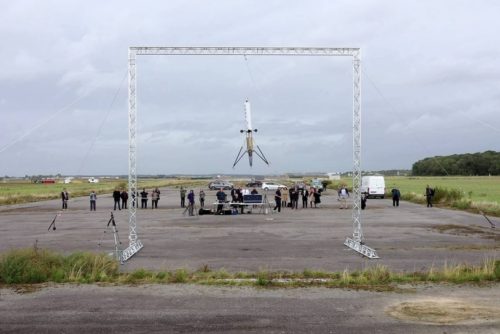
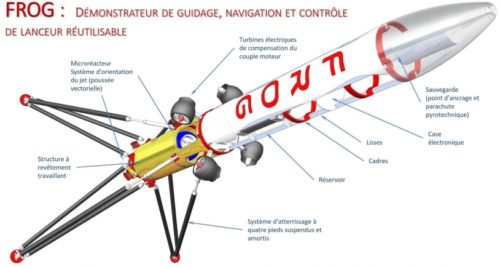
** French space agency tests Frog, a prototype vertical takeoff & landing vehicle: Successful captive flights for FROG – CNES. It is jet powered but serves to teach the VTOL techniques needed for rocket landings.

Both demonstrations in captive flight take-off and landing were a success. FROG is a small scale flight demonstrator designed to test vertical landing algorithms for future reusable launchers.

The project team is currently preparing the Free Flight Fitness Review (RAV) which will take place in October and will allow free flight tests, without gantry or safety cable.

FROG VTOL Prototype
FROG jet powered VTOL prototype in tethered tests.
FROG Schematic
Schematic diagram of the FROG VTOL demonstrator.

** Japan preparing the RV-X vertical takeoff and landing rocket vehicle for test flights. The RV-X is essentially a re-start of the RVT (Reusable Vehicle Test) program of the late 1990s, early 2000s. See my interview with Yoshifumi Inatani, who led the RVT program.

Here is a set of program overview slides in Japanese (pdf). Note that CALLISTO mentioned on the slides refers to a VTOL suborbital rocket vehicle under development by the French and German space agencies. See CALLISTO – Reusable VTVL launcher first stage demonstrator, E. Dumont et al, 2018 (pdf).

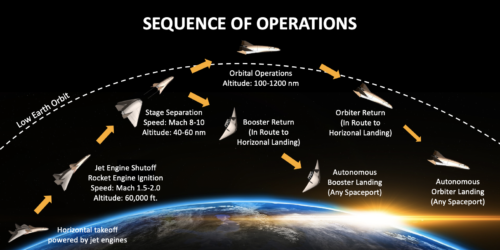
** Exodus Space pursues two-stage space plane RLV design. Here is an overview by Fraser Cain:

Exodus CEO Miguel Ayala recently gave a presentation to the FISO (Future In-Space Operations Working Group): Fully Reusable, Two-Stage-To-Orbit (TSTO), Horizontal Takeoff & Landing Spaceplanes – Here are the slides (pdf) and the audio:

AstroClipper - Exodus Space
The flight sequence for the Exodus Space AstroClipper reusable launch system.

** Latest update on space elevators from ISEC (Int. Space Elevator Consortium): ISEC Newsletter – November 2019

The ISEC has had an impact. In the last 6 years the technical maturity and engineering substance of the Space Elevator has solidified and become organized; most notably as the Galactic Harbour.   ISEC’s Technology Development and Maturation approach has melded a better definition of the Space Elevator Engineering solution(s). 

The Elevator is no longer a mystery. Engineering approaches for the Tether Climber, the Earth Port, the GEO Region, and the Apex Anchor have been expressed in terms everyone understands; a harbor. The last technology hurdle – strong material for the tether – was conquered.

*** NASA Commercial Crew update:

The current dates for the tests:

  • Boeing:
    • Nov.4: Pad abort test at the White Sands Missile Range (WSMR) in New Mexico. The event will be webcast.
    • Dec.17: Orbital Flight Test (OFT) will send an uncrewed Starliner to the ISS via a ULA Atlas V launch.
  • SpaceX:
    • Nov. 6: Static firing of all the SuperDraco engines on the Crew Dragon.
    • Early Dec.: In-flight abort test in which a Crew Dragon will fire its abort engines to depart from a Falcon 9 during the max-Q portion of the flight.

** SpaceX:

** Attaching a canard to the Spaceship Mk.1:

** Next Falcon 9 launch of Starlink satellites set for Nov. 11. Presumably these Starlinks will be operational spacecraft rather than the demo prototypes on the first launch.  Over the coming year, SpaceX hopes to get into a routine of Starlink launches about every two weeks. 2nd Starlink Mission Launch Campaign Thread : spacex/reddit.com.

== Amazon Ad ==

Safe Is Not an Option