Category Archives: Rockets

Space transport roundup – Mar.20.2020

A sampling of recent articles, videos, and images dealing with space transport (find previous roundups here):

** Falcon 9 launches 60 more Starlink satellites. A first stage engine shut down prematurely (just before staging) but had no effect on the mission as the other 8 engines made up the difference. The booster also failed to make a successful landing on a sea platform. This was the fifth flight of this booster.

The nosecone also used fairings recovered from a previously flight. The halves were recovered again today but after landing onto the water rather than into ship nets:

Scott Manley discusses the booster problems:

More about the launch:

Find more SpaceX items below

** This week a Chinese Long March 7A failed during its first launch. The rocket’s boosters uses kerosene/liquid oxygen propulsion rather than the highly toxic hydrazine-based propulsion systems used on most other Chinese liquid propellant rockets like the Long March 2F. The expectation is that the LM-7A will eventually become the workhorse launch system for China’s space program.

Little else has been disclosed about the incident including either the cause or nature of the failure, but footage of the launch published on China’s Twitter-like Weibo platform by distant spectators, showed what appeared to be a sudden flaring within a few minutes after take-off, suggesting an explosion during, or soon after, second-stage separation.

Here is the Wiebo video mentioned in the Room article.

** Russia sent a Glonass-M navigation satellite to orbit this week on a Soyuz-2-1b rocket launched from the Plesetsk Cosmodrome.

** OneWeb plans to send third batch of Internet satellites to orbit on a Soyuz rocket this Saturday, March 21st, at 17:06 (GMT) / 1:06 PM (EDT) / 22:06 (local time) :

** United Launch Alliance (ULA) is preparing an Atlas V to launch the US Air Force’s  AEHF-6 satellite for the Advanced Extremely High Frequency military communications constellation. The launch window on Wednesday March 26th at the Cape Canaveral Air Force Station launch pad is between 2:57-4:57 pm EDT (1857-2057 GMT).

The coronavirus pandemic isn’t stopping the first national security space mission for the U.S. Space Force, slated to launch March 26th aboard a United Launch Alliance rocket from Cape Canaveral Air Force Station.

“We are full steam ahead for the launch,” ULA spokesperson Julie Arnold told FLORIDA TODAY in a message Wednesday afternoon. 
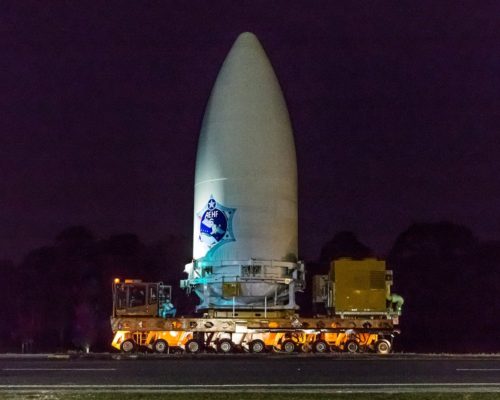
AEHF-6 encapsulated in nosecone on way to integration with the Atlas V. Credits: ULA

** Blue Origin making progress on multiple projects despite the coronavirus disruptions: Blue Origin pressing on with rocket and engine development as industry copes with coronavirus – SpaceNews.com

Even tough travel is highly restricted and most employees are teleworking, Smith said Blue Origin plans to continue to conduct test flights of its New Shepard suborbital vehicle that last flew in December. The company has said the goal is to start flying people to the edge of space as early as 2020.

“We continue to make progress with the test program, going through the vehicle verification process,” Smith said. “We hope to be able to fly people by the end of the year.”

** Momentus offers space tug modules to expand orbit options for smallsats launched from Falcon 9 Rideshare missions: Momentus to Provide Unmatched Flexibility for SpaceX Rideshare Missions – Momentus

[SpaceX] has proven that the world’s first orbital-class reusable rocket can bring down costs for smallsat operators through regularly scheduled, dedicated Falcon 9 rideshare missions.

Still, many CubeSat and smallsat operators would prefer to be in custom orbits at different inclinations, in different orbit planes, or at different altitudes.

Today, we are announcing Momentus has purchased rides on six SpaceX SmallSat Rideshare Program missions, including five launches to Sun-Synchronous orbit (SSO) and one to mid-inclined low Earth orbit, which Momentus will use to allow its customers access to custom drop-off altitudes and orbits in space.

Customers already signed up for the 2020 and 2021 Vigoride flights include U.K. startup Steamjet Space Systems, NuSpace of Singapore and Aurora Propulsion Technologies of Finland. Additional customers have signed up for Momentus rides from the Falcon 9 drop-off to other destinations.
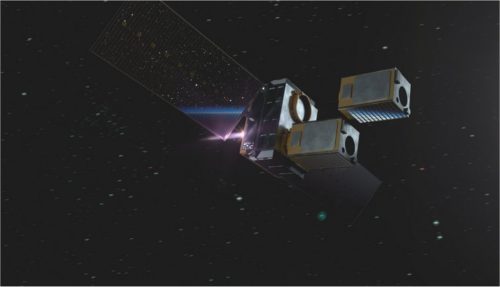
Artist’s rendering shows a Vigoride deploying a smallsat. Credits: Momentus

Check out the Vigoride Users Guide.

** Rocket Lab continues march towards Electron launch at the end of March: Rocket Lab launch preparations continue despite coronavirus travel restrictions – SpaceNews.com

Rocket Lab is continuing with preparations for a launch later this month despite the coronavirus pandemic, although another small launch company’s plans for a launch this month remain unclear.

Rocket Lab spokesperson Morgan Bailey said March 19 that the company was still planning to launch an Electron rocket from New Zealand later this month. The launch is currently scheduled for no earlier than March 30, a few days later originally announced.

That mission, called “Don’t Stop Me Now” by the company, will carry three payloads for the National Reconnaissance Office. It will also place into orbit ANDESITE, a cubesat built by students at Boston University and whose launch is being provided by NASA, as well as a cubesat from the University of New South Wales in Australia.

** Virgin Orbit, though, may delay till May: Virgin Orbit working toward first launch, schedule reassessed amid pandemic – SpaceNews.com

Virgin Orbit is reassessing the schedule for the first orbital flight demonstration of its LauncherOne vehicle, which had been scheduled for April.

“We’re mindful that COVID-19 is putting added burdens and stresses on our teams and leaders, so we are assessing things daily and keeping momentum up as best we can while doing everything we can to protect the health of our people,” Virgin Orbit spokesman Kendall Russell told SpaceNews March 19 in a statement.

LauncherOne rockets, made in Long Beach, California, will be air-launched from a modified 747-400 “Cosmic Girl” carrier aircraft. The vehicle is being offered to government and commercial customers as a flexible launch service that can operate from locations around the world.

The company earlier this month performed a taxi test at the Mojave Air and Space Port in California. It was a taxi test of the aircraft with a liquid-fueled LauncherOne vehicle attached to it, said Mandy Vaughn, president of Virgin Orbit’s sister company VOX Space. The next step before the orbital launch will be a captive carry test flight with the rocket attached to the plane.

** Briefs:

** SpaceX:

** The May time frame for first Crew Dragon flight with astronauts is firming up: NASA, SpaceX Invite Media to Crew Launch to Station from America | NASA

Media accreditation is open for NASA’s SpaceX Demo-2 flight test, which will send two astronauts to the International Space Station as part of the agency’s Commercial Crew Program. This mission will be the return of human spaceflight launch capabilities to the United States and the first launch of American astronauts aboard an American rocket and spacecraft since the final space shuttle mission on July 8, 2011.

SpaceX’s Falcon 9 rocket will launch Crew Dragon, with NASA astronauts Bob Behnken and Doug Hurley aboard the spacecraft, from Launch Complex 39A at NASA’s Kennedy Space Center in Florida. NASA and SpaceX are currently targeting no earlier than mid-to-late May for launch.

** Some nice video of the recent Falcon 9 launch of CRS-20 Cargo Dragon to the ISS:

**** Starship

****** The Starlink 6 launch webcast included a segment about Starship development:

****** Starship SN-3 is coming together at Boca Chica as seen in the videos of activities there. The SN-1 vehicle should be the first of the full scale prototypes to do test flights, starting with low altitude hops.


****** SpaceX Boca Chica – Stage Set for Starship SN3 Stacking – May 14 – NASASpaceflight – YouTube

SpaceXers worked through the night and day to move SN3 sections and stands ahead of the expected stacking of the next Starship – while yet another new tent started to rise out of the Boca Chica ground. Videos and Photos from Mary (@bocachicagal). Edited By Jack Beyer (@thejackbeyer)

****** SpaceX Boca Chica – Final Preps for Starship SN3 Stacking – May.16.2020 – NASASpaceflight – YouTube

All the chess pieces for the Starship SN3 are on the board and stacking operations are imminent at SpaceX’s Boca Chica production site. Video includes shots of the new thrust puck. Videos and Photos from Mary (@bocachicagal). Edited By Jack Beyer (@thejackbeyer)

****** SpaceX Boca Chica – Starship SN3 Stacking: Nose cone and VAB work – May.17.2020

In SpaceX Boca Chica, Starship SN3 is now taking shape, with the nose cone stacking and several sections waiting to be mated – including two sections in the new VAB/Windbreak, which is also sporting its own internal elevator. Videos and Photos from Mary (@bocachicagal). Edited By Jack Beyer (@thejackbeyer)

****** SpaceX Boca Chica – Starship SN3 begins Stacking Operations – May.18.2020

SpaceX’s Starship SN3 has entered stacking operations in Boca Chica! Segments were rolled and prepped, including stacking operations in the new VAB/Windbreak. Videos and Photos from Mary (@bocachicagal). Edited By Jack Beyer (@thejackbeyer)

****** Starship SN3 Construction Update at SpaceX Boca Chica – May.19.2020 – SPadre – YouTube

****** SpaceX Boca Chica – Starship SN3 Stacks Another Section – May.19.2020

SpaceX Starship SN3 continues stacking operations with another segment added on Thursday inside the VAB/Windbreak, as work continues around the Boca Chica facility. Videos and Photos from Mary (@bocachicagal). Edited By Jack Beyer (@thejackbeyer)

****** SpaceX Starship assembly 24h timelapse 2020-03-19Rocket Frames – YouTube

A timelapse created from LabPadre’s live stream of the SpaceX Boca Chica Facility. Special thanks to Maria Pointer for mounting the camera on her property. This video was created in consent with LabPadre. All copyrights are owned explicitly by LabPadre.

****** SpaceX is gradually buying out the last of the private residencies near the Boca Chica facilities: Boca Chica residents take Elon Musk’s money, make way for SpaceX launches from Texas – HoustonChronicle.com

Maria Pointer held one final party at her home overlooking the SpaceX facility outside of Brownsville, with guests visiting from early morning until the stars twinkled goodnight and said farewell to the woman who shared her front-row seat of Elon Musk’s rocket activities in Texas.

“I cried three times, and then I laughed three times,” Maria Pointer said, “and then I opened up another bottle of wine and hugged a few more people.”

Her husband Rayford, however, couldn’t bring himself to attend the party, devastated by the way things played out. The Pointers purchased the property for its isolation and birdwatching. They spent years building their perfect retirement home.

== Amazon Ad ==

See You In Orbit?:
Our Dream Of Spaceflight

Space transport roundup – Mar.11.2020

A sampling of recent articles, videos, and images dealing with space transport (find previous roundups here):

** SpaceX planning for May launch of astronauts on Crew Dragon to the ISS: SpaceX aiming for May astronaut launch, will reuse Crew Dragon – CNBC

    • SpaceX is “gunning for May” to launch NASA astronauts on its first spaceflight with crew, president and COO Gwynne Shotwell said Tuesday.
    • She noted that the length of the mission is still under consideration, saying its “kind of TBD right now.”
    • Shotwell also noted that SpaceX is planning to reuse its Crew Dragon capsules, a decision that was in doubt previously.

Find more SpaceX items below

** Update from Boeing and NASA on Starliner problems during the uncrewed test flight: NASA Update on Orbital Flight Test Independent Review Team – Commercial Crew Program/NASA

The joint NASA and Boeing Independent Review Team formed following the anomalies during the company’s uncrewed Orbital Flight Test as a part of the agency’s Commercial Crew Program has completed its initial investigation. The team was tasked with reviewing three primary anomalies experienced during the mission: two software coding errors and unanticipated loss of space-to-ground communication capability. During the investigation, the team identified several technical and organizational issues related to Boeing’s work. Separate from the independent team, NASA reviewed its role in the flight test and identified several areas where the agency can improve its level of participation and involvement into company’s processes.

While the review team, NASA and Boeing have made significant progress during the last month, more work will be required to inform the agency’s decision of whether Boeing will need to perform another uncrewed test flight of the Starliner system. NASA will determine if a repeat of the flight will be needed after Boeing has presented its detailed resolution and rework plan and NASA has independently assessed the thoroughness of that plan.

** China launches BeiDou navigation satellite on a Long March 3B rocket. Constellation nears completion.

China Launches Penultimate BeiDou 3 Navigation System Satellite – CCTV Video News Agency

China launched a new satellite of the BeiDou Navigation Satellite System (BDS) into space from the Xichang Satellite Launch Center in southwest China’s Sichuan Province at 19:55 Monday (Beijing Time), paving the way for its completion and full global coverage in May. The satellite, the 54th of the BeiDou family, was sent into a geostationary orbit as planned by a Long March-3B carrier rocket. It will go through the orbital transfer, in-orbit test, and test evaluation before it starts its service.

** Blue Origin releases more videos showing progress in New Glenn launch system development:

** Rocket Lab aims for late March for next Electron launch: Rocket Lab’s Next Mission to Launch Satellites for NASA, NRO and the University of New South Wales | Rocket Lab

Rocket Lab, a space technology company and the global leader in dedicated small satellite launch, has announced today that its next mission will deploy payloads for the National Aeronautics and Space Administration (NASA), the National Reconnaissance Office (NRO) and the University of New South Wales (UNSW) Canberra Space.

The launch will take place from Rocket Lab Launch Complex 1 on New Zealand’s Māhia Peninsula, with a 14-day launch window scheduled to commence from 27 March 2020 NZT. The mission will be Rocket Lab’s 12th Electron launch since the company began launches in May 2017.

The rideshare mission will launch several small satellites, including the ANDESITE (Ad-Hoc Network Demonstration for Extended Satellite-Based Inquiry and Other Team Endeavors) satellite created by electrical and mechanical engineering students and professors at Boston University. The satellite will launch as part of NASA’s CubeSat Launch Initiative (CSLI) and will conduct groundbreaking scientific study into Earth’s magnetic field. Once in space, the ANDESITE satellite will initiate measurements of the magnetosphere with onboard sensors, later releasing eight pico satellites carrying small magnetometer sensors to track electric currents flowing in and out of the atmosphere, a phenomenon also known as space weather. These variations in the electrical activity racing through space can have a big impact on our lives here on Earth, causing interruptions to things like radio communications and electrical systems. The ANDESITE satellite follows on from Rocket Lab’s first ELaNa (Educational Launch of Nanosatellites) launch for NASA, the ELaNa-19 mission, which launched a host of educational satellites to orbit on Electron in December 2018. 

The mission also carries three payloads designed, built and operated by the NRO. The mission was procured under the agency’s Rapid Acquisition of a Small Rocket (RASR) contract vehicle. RASR allows the NRO to explore new launch opportunities that provide a streamlined, commercial approach for getting small satellites into space, as well as provide those working in the small satellite community with timely and cost-effective access to space. This mission follows Rocket Lab’s first dedicated mission for the NRO, Birds of a Feather, which was launched on 31 January 2020 NZT from Rocket Lab Launch Complex 1.

The ANDESITE and NRO payloads will be joined on the mission by the M2 Pathfinder satellite, a collaboration between the University of New South Wales (UNSW) Canberra Space and the Australian Government. The M2 Pathfinder will test communications architecture and other technologies that will assist in informing the future space capabilities of Australia. The satellite will demonstrate the ability of an onboard software-based radio to operate and reconfigure while in orbit.

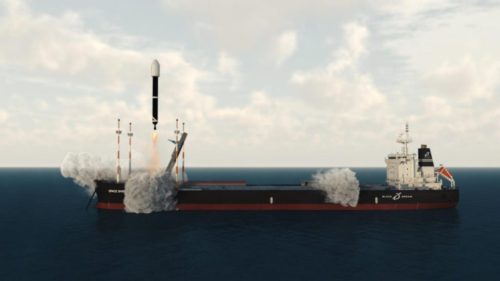
** Black Arrow Space Technologies in the UK obtains investment to fund launcher development program. Black Arrow

is a new British company developing spaceflight technologies designed to launch satellites into orbit. Black Arrow unique offer is their seaborne launch system – commercial rockets launched from their own Space Ship! This will enable Britain to offer a global service unavailable elsewhere in the world, bypassing many of the issues faced by land launches. Initially, the company aims to launch payloads of up to 500Kg into Polar Low Earth Orbit or 300Kg into Sun Synchronous Orbit. This will support a growing niche in the space market, currently under-served by the international ‘access to space’ sector. In time, the concept will be developed to enable much larger payloads to be launched to higher altitudes and more trajectories.

Black Arrow Space Technologies has negotiated an agreement with a major investor to fully fund the company development activities, up to the completion of the test launch phase of the project, which is anticipated to take between two and three years.

Design and development work will take place in the Oxfordshire area, with engine test stands and the ship fleet, including the launch vessel and support ships, based in South Wales. It is anticipated that around 300 high-skilled jobs will be created by the time that commercial launches begin. Initial launches are planned to take place from the Atlantic Ocean, South West of Ireland.

A Black Arrow rocket launches from a sea-going vessel. Credits: Black Arrow

More at:

** Rocket Fuel Injectors – Things Kerbal Space Program Doesn’t Teach – Scott Manley

Rocket Propellent Injectors are critical parts of the engine design, they take the propellents and mix them so that they can quickly burn in the combustion chamber. Injectors can make or (literally) break a rocket design, and over the years we’ve seen rocket engines move from injector plate designs to more efficient options as engineers have come to understand what works well. Thanks to Copenhagen Suborbitals for sharing some video of their injectors being tested, I hope get get to see some more flights with these: https://copenhagensuborbitals.com/

** Briefs:

** SpaceX:

**** SpaceX set to launch another batch of 60 Starlink satellites on March 14th. Liftoff time of the Starlink 5 mission is around 9:36 am EDT (1336 GMT). A static firing on Pad-39A probably will happen on Friday March 13th.

**** SpaceX Falcon 9 launched CRS-20 cargo mission with final Dragon 1 successfully on March 6th. Future cargo missions will use the Dragon 2 vehicles. The first stage booster made a successful landing back at the Cape. This marked the 50th successful landing of a F9 booster.

CRS-20 Mission

****** SpaceX Webcast

****** Watch SpaceX launch their LAST Dragon 1 Capsule for CRS-20Everyday Astronaut

****** SpaceX – CRS20 – The Last Dragon – Launch 4K 03-06-2020 – USLaunchReport

**** Cargo Dragon berthed to the ISS on the morning of March 9:

**** Elon Musk spoke about Falcon 9, Crew Dragon, Starship, Starlink, etc during an on-stage interview this week at the Satellite 2020 conference:

**** SpaceX raising more money for development projects: SpaceX raising $500 million in new funding for Elon Musk’s company – CNBC.com

SpaceX is raising half a billion dollars in new funding, according to documents seen by CNBC on Monday, as the Elon Musk company continues work on three ambitious projects.

The company authorized $500.06 million at a price of $220 per share, the documents show, and values SpaceX at around $36 billion — up from $33.3 billion last year. Notably, the round is about double the $250 million that SpaceX was looking to raise, as CNBC reported previously.

**** Starship

**** Following SN1 pressure test failure last week, a second propellant tank was built and tested over the weekend successfully:

Can now proceed with test flight vehicles:

See also: SpaceX’s latest Starship test was uneventful and that’s great news for its flight debut – Teslarati.

***** SN2 Tank Test – March 8 – SPadre – YouTube

******  SpaceX Boca Chica – Starship SN2 Test Tank Cryo Test – March.8.2020 – – NASASpaceflight – YouTube

At SpaceX’s Boca Chica launch site, the Starship SN2 Test Tank underwent what appears to have been a successful cryo proof test under pressurization. Videos and Photos from Mary (@bocachicagal).

****** SpaceX Boca Chica – Post SN2 success, facility grows for more Starships – March.9.2020 – NASASpaceflight – YouTube

As SpaceXers prepare to remove SN2 from the launch site, Starship SN3 is being constructed amid a large scale work on growing production facility in Boca Chica. Videos and Photos from Mary (@bocachicagal).

****** SpaceX Boca Chica – Starship Rings on the move amid more construction – March.10.2020 – NASASpaceflight – YouTube

Lots happening at Boca Chica as SpaceXers lay the foundations for yet another new facility, while Starship rings dodge the concrete smoothers and SN3 continues to prepare for stacking. Videos and Photos from Mary (@bocachicagal).

== Amazon Ad ==

The Case for Space:
How the Revolution in Spaceflight Opens Up
a Future of Limitless Possibility

Space transport roundup – Mar.5.2020

A sampling of recent articles, videos, and images dealing with space transport (find previous roundups here):

** SpaceX aims to launch Cargo Dragon on CRS-20 mission to the ISS this Friday evening (March 6th) at 11:49 pm EST (0449 GMT Saturday). This will be the final flight with an original Dragon 1 (i.e. Cargo Dragon) design. Subsequent cargo missions will use reconfigured Dragon 2 or Crew Dragon spacecraft. Initially, the Crew Dragon vehicles will fly astronauts only once so they will subsequently become available for uncrewed Cargo missions.

This will be the third flight for this Dragon 1: SpaceX’s first orbital spacecraft set to smash reusability record on last launch – Teslarati.

The CRS-20 Falcon 9 first stage was test fired on Pad 39A last Sunday: SpaceX test-fires rocket, preps for final flight of first-generation Dragon capsule – Spaceflight Now

The Falcon 9 booster for SpaceX’s next mission fired up briefly on a Cape Canaveral launch pad Sunday in a routine pre-flight test before a scheduled launch Friday night to kick off the final flight of the first version of the company’s Dragon cargo capsule to the International Space Station.

Nine Merlin 1D main engines at the base of the Falcon 9 booster fired up at 11 a.m. EST (1600 GMT) Sunday at Cape Canaveral’s Complex 40 launch pad. Hold-down clamps kept the rocket firmly on the ground as the engines throttled up to produce 1.7 million pounds of thrust for several seconds.

There will be a briefing today (March 5th) at 3:00 pm EST on NASA TV about the science and technology payloads on the Dragon.

Find more SpaceX items below

** Blue Origin videos show completed New Glenn nosecone fairing:

Here’s an inside look at how a New Glenn 7 meter fairing is designed, and the capabilities it brings to commercial, civil and national security customers. https://www.blueorigin.com/new-glenn/

2020 is shaping up to be a busy year for the Blue team in Florida – starting with the completion of the first full scale New Glenn 7 meter fairing at our rocket factory in Cape Canaveral.

** Blue releases a video about construction of the New Glenn tanks:

** Roads on Cape Canaveral to be modified to accommodate delivery of New Glenn rockets to the launch site: Changes coming to KSC and Cape Canaveral for Blue Origin New Glenn rocket – Florida Today

Roughly 30 miles of roadways winding through Kennedy Space Center and Cape Canaveral Air Force Station will soon see multimillion-dollar infrastructure changes, making room for the future transport of Blue Origin’s massive New Glenn rocket.

The journey for New Glenn first stages, which measure around 200 feet in length before attachment of the second stage and nose cone, will begin at the company’s factory just east of the KSC main gate. But in order to follow the 20-plus-mile trek to its pad at Launch Complex 36, changes will need to be made to road widths, light posts, fences, signs, and more.

** Blue may fly New Shepard this month: Blue Origin still plans to launch people this year – Axios

Blue Origin is planning to launch another test flight of its suborbital New Shepard space system as early as this month, with human test flights expected before the end of the year.

The big picture: The Jeff Bezos-backed rocket company pumped the brakes on its test flight program last year but is now gearing up to launch its next round of flights ahead of its first tests with human passengers.

“[We’ll have] about three to four more flights before we go fly people. So we’re still on target for this year for doing that, but there’s a lot of work to be done.” — Blue Origin CEO Bob Smith to Axios

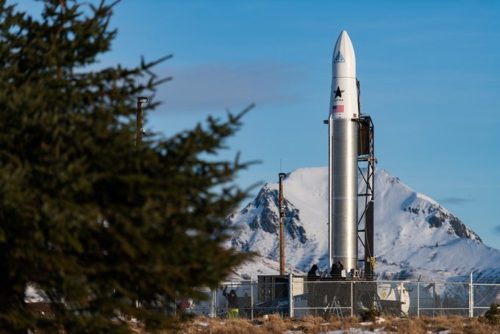
** Astra fails to win DARPA Challenge award. The contest deadline passed on Monday after the company’s final attempt to launch from the Pacific Spaceport Complex on Kodiak Island, Alaska was scrubbed. Rocket 1 Of 3, Launch Attempt 1 – Astra

Today, Astra began countdown of the first orbital launch as the final remaining competitor in the DARPA launch challenge. Our team decided to hold the launch at T-53 seconds after a sensor reported unexpected data that could have impacted the success of the flight. Out of our commitment to safety, and to increase the probability of overall success of the three-launch campaign, we have decided to prioritize fully investigating the issue over attempting to win the DARPA challenge today.

We are incredibly grateful to our team who have worked many late nights and weekends for the past few months to prepare our launch system for our first launch. We would also like to thank the team at DARPA, the FAA, and the team at Pacific Spaceport Complex for making an orbital launch attempt possible within a few days.

We remain determined to reach orbit and plan to attempt another launch attempt as soon as possible.  Thank you for the continued support as we move forward in our mission to observe, connect and improve life on earth.

Astra rocket “1 of 3” on the pad on Kodiak Island: Credits: Astra

More about Astra:

** Virgin Galactic may fly Branson but not commercial customers this yearVirgin Galactic hints at more delays for start of SpaceShipTwo commercial flights – SpaceNews.com

Those projections [of profits] assumed the start of commercial operations in June 2020, but during the call George Whitesides, chief executive of Virgin Galactic, hinted that commercial service, already delayed by years, might slip again.

“We continue to focus on our top priority of the year, which is to fly Richard Branson into space on a commercial flight,” he said. Branson, founder of Virgin Galactic, has long said he will be on the company’s first commercial flight.

However, there may be few, if any, additional commercial flights in the year. “While we would like to have some commercial revenue this year, the main focus for this year, from a company and engineering perspective, is working to get the vehicles, and our operations, prepared for long-term, regular commercial service,” Whitesides said. That includes completing the flight test program for SpaceShipTwo, optimizing the “end-to-end customer experience” that includes events before and after each flight, and readying the vehicles for long-term, high-flight-rate operations.

** Masten Space and Univ. of Central Florida study how rocket plumes could produce craters while landing on and launching from the Moon:

Masten Space Systems and University of Central Florida (UCF) collaborated on a NASA program to study the physics of how craters form. This work involved experimental tests to see how gravity, plume type, and air pressure affects crater formation during simulated landings.

** ULA making progress on  next-gen Vulcan rocket development:

** Virgin Orbit animation describes the LauncherOne project:

** Update on Relativity Space and 3D printed rockets: Relativity Space has big dreams. Is the company for real? – Ars Technica

… Giger and his company, Relativity Space, seek to create the most futuristic of rockets. To do so, they have come to the [Stennis] NASA center [in Mississippi] where rocket scientists tested the mighty engines that carried humans to the Moon half a century ago. Relativity has, over the last two years, steadily occupied more buildings and test stands here as part of its quest to build a rocket made almost entirely of 3D-printed parts. And if that goal were not fantastical enough, Relativity also seeks to automate as much of the rocket assembly and test process as possible, with the ultimate goal of additively manufacturing a rocket on the surface of Mars.

It is a wild, seemingly impossible dream—and yet it has captured the fancy of aerospace investors. Relativity has raised $185 million in four years and hired industry leaders like Giger. Now the program manager for the company’s Terran 1 rocket, Giger spent more than a decade at SpaceX, where he led development of the Crew Dragon spacecraft. Today he superintends Relativity’s plans for launching its first rocket into space, perhaps as early as next year. So as we stood on top of the E-4 test stand in Mississippi last month, I tried to do more than simply admire the view.

I wanted very much to see if Relativity Space could possibly be for real.

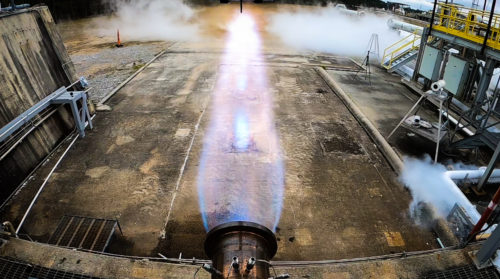
Engine test at Stennis. “Our new injectors have to be test fired with a copper development article before they get replaced with our printed nickel chambers.” Credits: Relativity

The company also announced plans to locate its HQ in Long Beach: Relativity Space Secures New Headquarters Facility In The Heart Of Southern California’S Next-Generation Aerospace Community — Relativity Space

** DARPA attempts to kickstart development of in-space nuclear propulsion systems:

Demonstration Rocket for Agile Cislunar Operations (DRACO), formerly known as “Reactor on a Rocket (ROAR)” — $21 million, up from an initial $10 million in 2020. DRACO “will develop and demonstrate a High-Assay LowEnriched Uranium (HALEU)uel for commercial light-water reactors when enriched to between 3 and 5 percent; the Navy’s nuclear reac nuclear thermal propulsion (NTP) system.” NASA is working on similar nuclear thermal propulsion rockets, which use low-enriched — between 5 and 20 percent — uranium-235 (U-235). U-235 is the basic nuclear ftors use U-235 fuel enriched to 90 percent. The new rocket would allow the US military to operate spacecraft in cislunar space, which DARPA’s budget documents call the “new high-ground” that is “in danger of being defined by the adversary.” DARPA budget documents say the Air Force is the targeted customer for DRACO.

** Briefs:

** SpaceX:

** SpaceX wins a NASA launch contract for a Falcon Heavy for the first time. In  NASA Awards Launch Services Contract for the Psyche Mission | NASA

NASA has selected SpaceX of Hawthorne, California, to provide launch services for the agency’s Psyche mission. The Psyche mission currently is targeted to launch in July 2022 on a Falcon Heavy rocket from Launch Complex 39A at Cape Canaveral Air Force Station in Florida.

The total cost for NASA to launch Psyche and the secondary payloads is approximately $117 million, which includes the launch service and other mission related costs.

The Psyche mission will journey to a unique metal-rich asteroid, also named Psyche, which orbits the Sun between Mars and Jupiter. The asteroid is considered unique, as it appears to largely be made of the exposed nickel-iron core of an early planet – one of the building blocks of our solar system.

Deep within rocky, terrestrial planets, including Earth, scientists infer the presence of metallic cores, but these lie unreachably far below the planet’s rocky mantles and crusts. Because we cannot see or measure Earth’s core directly, the mission to Psyche offers a unique window into the violent history of collisions and accretion that created terrestrial planets.

**** Next Starlink launch set for March 14th:

**** The Falcon 9 for the Cargo Dragon mission got a replacement second stage courtesy of the F9 previously arranged for the Starlink mission: SpaceX’s Starlink launch ambitions just saved a space station resupply mission from big delays – Teslarati

**** Falcon 9 launches can’t keep up with Starlink satellite production: During an on-stage conversation at the Air Force Association’s 2020 Air Warfare Symposium (AWS2020), Elon commented on Starlink satellite production:

See also: SpaceX is building Starlink satellites faster than it can launch them – Teslarati

**** At the AWS2020 event, Elon Musk also emphasized the importance of fully reusable space transportsElon Musk participated in a fireside chat at Air Force Association’s 2020 Air Warfare Symposium – Tesmanian

Lt. General Thompson conversed about the new branch of the Air Force, the U.S Space Force among other related subjects with Musk. During today’s symposium Musk talked about SpaceX rocket reusability, he said that reusability in space is important. The company’s Falcon 9 rocket is a true innovation in the aerospace industry, the first-stage rocket booster has the capability of carrying payload into space then returning to land on autonomous drone ships at sea; performs a controlled landing powered by its own engines. No other aerospace company has achieved this level of control over their spacecraft. Recovering the Falcon 9’s first-stage rocket booster enables SpaceX to reuse it for up to 10 times, which reduces manufacturing and operational costs.

“When you have assured low cost access to space other technologies will be enabled. Many things are possible once the transport problem is solved . Establishing a self sustaining base on Mars opens opportunities.”

Musk calls reusability the “holy grail” of rocketry. Falcon 9 is partially reusable, today he mentioned that their next-generation rocket, known as Starship, has the potential for full reusability but that creating a reusable system at on a large production scale, “Volume production and volume launch of a reusable system is super super hard. Not reusable like the Space Shuttle. Has to be agile like an aircraft. Shuttle too expensive, Musk said.

“The vehicle we’re working on, Starship is the holy grail of which is full reusability.”

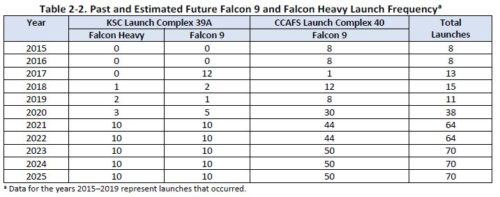
**** SpaceX plans for up to 70 F9/FH launches per year at Cape Canaveral AF Station & Kennedy Space Center: Draft Environmental Assessment for SpaceX Falcon Launches at Kennedy Space Center and Cape Canaveral Air Force Station – SpaceX/FAA – Feb. 2020 (pdf)

SpaceX Falcon 9/Heavy launch rates in the past and estimated for the future. Credits: FAA and SpaceX

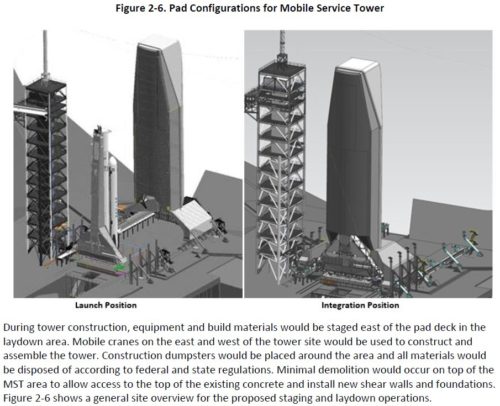
To handle Defense Dept. payloads that require vertical integration into the rockets, SpaceX will build a Mobile Service Tower.

Proposed design for a Mobile Service Tower for Pad 39A to integrate military satellites into Falcon 9/Heavy nosecone. Credits: FAA & SpaceX.

See also: FAA Environmental Assessment details SpaceX plans at Cape Canaveral – NASASpaceFlight.com

**** A year ago the Crew Dragon vehicle, with no astros aboard, took a test drive to the ISS:

On March 2, 2019, Falcon 9 launched Crew Dragon on its first demonstration mission, and the next day it became the first American spacecraft to autonomously dock with the International Space Station. After its stay at the space station, the spacecraft successfully splashed down in the Atlantic Ocean, completing its mission and demonstrating SpaceX’s capabilities to safely and reliably fly astronauts to and from the space station as part of NASA’s Commercial Crew Program.

**** An update on improvements to systems to deal with F9 booster landing and recovery: SpaceX eyes major drone ship fleet upgrades and a new rocket recovery robot – Teslarati

SpaceX has kicked off a series of major upgrades planned for its East Coast fleet of drone ships, centered around Just Read The Instructions (JRTI) and most recently culminating in the apparent fabrication of a second tank-like rocket recovery robot.

**** Starship

****** Eric Berger has posted an extended article about the Starship and the activities underway at Boca Chica Beach, Texas. He interviews Elon Musk who describes the efforts to create a production line that will enable rapid iterative improvements of the Starship design and eventually allow for making the massive number of vehicles he believes are needed to build and support a city on Mars: Inside Elon Musk’s plan to build one Starship a week—and settle Mars – Ars Technica

Yet Musk has not been spending so much of his time in South Texas just to build a Starship. Rather, he’s trying to build a production line for Starships. He wants to build a lot of them. And fast, always fast.

“Production is at least 1,000 percent harder than making one of something,” he said. “At least 1,000 percent harder.”

Musk should know. He lived through “production hell” at Tesla in 2017 and 2018, building up factories, changing processes, spending many sleepless nights and going through all manner of mental agony. Now, Tesla is making as many as 10,000 cars a week.

He wants to implement a similar system in South Texas. Musk, in fact, aims to reach a point where the company builds a Starship a week by the end of this year. And after that? Maybe they’ll go faster. SpaceX is designing its factory here to build a Starship every 72 hours.

Eric is answering questions about the article on Twitter.

****** The propellant tank section of the Starship SN1 prototype failed during pressure testing on Friday evening (Feb.28). Elon Musk later indicated that the welding for a plug section called the “puck” at the bottom gave way (see the Ars Technica article mentioned above for details). Earlier remarks (e.g. Elon Musk on Twitter: “Starship SN1 tank preparing for Raptor attachment & static fire”) had indicated that the SN1 was going to be a suborbital flight test vehicle.  OTOH, there had also been indications that the welding was not properly done for SN1 and would be improved for SN2, whose construction was already underway last week.

****** SpaceX Boca Chica – Starship SN1 cryo proof test failure – Feb 28, 2020

Starship SN1 was filled with LN2 for a cryo proof test on Friday evening at Boca Chica, before failing. Videos and Photos from Mary (@bocachicagal) for NSF. Edited by Jack Beyer (@thejackbeyer)

***** SpaceX Starship Explosion/Implosion Wide View Time Lapse – Feb.28.2020 – LabPadre – YouTube

02.28.2020 10PM CST Starship suffered massive failure at Boca Chica, Texas. SpaceX will build another.

****** SpaceX Boca Chica – Examining the remains of Starship SN1 – Feb.29.2020 – NASASpaceflight – YouTube

Following Starship SN1’s pop during the cryo proofing test on Friday night, Mary took a look at the remains on Saturday morning. Videos and Photos from Mary (@bocachicagal) for NSF.

****** SpaceX Boca Chica – Starship SN2 taking shape as SN1 remains removed – Mar.1.2020 – NASASpaceflight – YouTube

****** SpaceX Boca Chica – Starship SN2 Sections Assemble – Mar.2.2020 – NASASpaceflight – YouTube

The next Starship – albeit one that will be mostly used for proof testing – is being assembled inside the Boca Chica windbreak. Some hardware – such as the new nosecone – will likely be allocated to SN3. Videos and Photos from Mary (@bocachicagal) for NSF. Edited by Jack Beyer (@thejackbeyer)

****** SpaceX Boca Chica – Constructing Starship SN2 inside a building under construction – Mar.2.2020 – NASASpaceflight – YouTube

SpaceX’s Boca Chica Starship pace becomes obvious when the SN2 continues to be assembled inside a building (VAB/Windbreak) that is still under construction. Videos and Photos from Mary (@bocachicagal) for NSF. Edited by Jack Beyer (@thejackbeyer)

****** SpaceX Boca Chica – Starship Taxi arrives as SN2 and SN3 continue production – Mar.4.2020 – NASASpaceflight – YouTube

The roll-lift that transports Starships to the launch pad has arrived, as SN2 continues to be assembled and sections of SN3 follow closely behind. Videos and Photos from Mary (@bocachicagal) for NSF. Edited by Jack Beyer (@thejackbeyer)

****** A test stand at the McGregor, Texas facility has been upgraded to allow for vertical test firings of the powerful new Raptor engines: SpaceX’s new Starship test stand to make life a little easier for Raptor engine engineers – Teslarati

=== Amazon Ad ===

Large and Dangerous Rocket Ships:
The History of High-power Rocketry’’s Ascent to the Edges of Outer Space

Space transport roundup – Feb.19.2020

A sampling of recent articles, videos, and images dealing with space transport (find previous roundups here):

** Arianespace launches Ariane V with two spacecraft Tuesday evening:  the communications satellite JCSAT-17 for SKY Perfect JSAT Corp. and the environmental monitoring satellite Geo-Kompsat-2B for the Korea Aerospace Research Institute.

** Blue Origin opens a new engine manufacturing plant in Huntsville, Alabama

Huntsville, AL –  February 17, 2020 – Today, Blue Origin opened its rocket engine production facility in Huntsville, AL. The world-class engine manufacturing facility in The Rocket City will conduct high rate production of the BE-4 and BE-3U engines. These engines will undergo testing at NASA Marshall Space Flight Center on the historic Test Stand 4670. BE-7, our lunar landing engine, is also currently in test at NASA Marshall.

“At the core of every successful launch vehicle program are the engines that power those vehicles to space. Early on in Blue Origin’s history, we made a crucial decision to invest in developing the next generation of reusable rocket engines. And now, it’s an exciting time for Blue, our partners and this country –we are on the path to deliver on our promise to end the reliance on Russian made engines – and it’s all happening right here, right now, in the great state of Alabama. We couldn’t be prouder to call this our home for engine production,” said Bob Smith, CEO of Blue Origin.

Blue will add more than 300 jobs to the local economy with an investment of over $200 million in the facility.

The factory will build the big  BE-4 engine, seven of which will power New Glenn’s reusable 1st-stage booster, and two will be used on the 1st-stage of United Launch Alliance’s Vulcan launch vehicle.

  • Manufacturing facility in Huntsville, Alabama is starting production of the engine.
  • ULA will get the first two production engines this year.
  • Currently carrying out full life-cycle firings on the test stand.
  • Starting development of an upgraded version.
  • Expect to achieve 25+ flights per engine with minimal maintenance between flights.
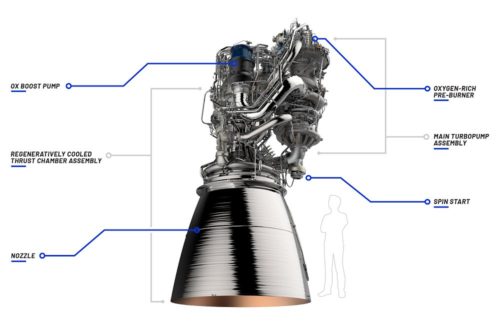
Diagram of Blue Origin’s liquefied natural gas (LNG) fueled BE-4 engine. Credits: Blue Origin

See also: Blue Origin opens Alabama engine factory and lays out production plan – GeekWire.

**** SpaceShipTwo Unity arrives at Spaceport America: Virgin Galactic Welcomes SpaceShipTwo Unity to Spaceport America, New Mexico – Virgin Galactic

VSS Unity, attached to the carrier aircraft, VMS Eve, made the journey from Mojave, California, where the Company’s manufacturing facilities are based. The vehicle landed at 15:49MT, where it was greeted by an enthusiastic group of teammates who will operate the spaceship in New Mexico.

This captive carry flight provided an opportunity for engineers to evaluate VSS Unity for over three hours at high altitude and cold temperatures, a longer period of time than is experienced during missions to space. These environmental evaluations of system performance are difficult to replicate at ground level, making captive carry missions a vital component of VSS Unity’s flight test plan.

….

The relocation of VSS Unity to Spaceport America enables the Company to engage in the final stages of its flight test program. This will begin with a number of initial captive carry and glide flights from the new operating base in New Mexico, allowing the spaceflight operations team to familiarize themselves with the airspace and ground control. Once these tests are complete, the team will carry out a number of rocket-powered test flights from Spaceport America to continue the evaluation of VSS Unity’s performance.  During this phase, the final spaceship cabin and customer experience evaluations will also be concluded in preparation for the start of commercial spaceflight operations.

The Spaceship Company, Virgin Galactic’s design, testing and manufacturing arm, remains firmly rooted in Mojave, California.  While VMS Eve and VSS Unity are now based in New Mexico, they will make periodic journeys back to Mojave to support ground and flight tests of new spaceships, as well as for vehicle maintenance and upgrade activities.  There is significant progress being made on the next two spaceships, including achieving the Weight on Wheels milestone for the second spaceship and completing over 50% of the structural and system part fabrication for the third spaceship, which were announced in January.

**  Rocket Crafters rocket engine test goes bad and sends debris flying: Rocket engine test in Cocoa sends debris flying, starts fire – ClickOrlando.com

**  More about Astra‘s plans for low cost rocket launches for smallsats: Astra emphasizes rapid iteration in its quest for low-cost, rapid launch – SpaceNews.com

The launch window for Astra’s first orbital launch from Pacific Spaceport Complex – Alaska now opens Feb. 25, according to a U.S. Coast Guard notice published Feb. 12. The company will have daily windows from 3:30 to 7:00 p.m. Eastern through March 3.

In a Feb. 13 interview, Chris Kemp, chief executive of Astra, confirmed that launch window but didn’t give a specific date when the company would make its first launch attempt. The rocket, dubbed “One of Three,” will be flying to the spaceport on Kodiak Island, Alaska, in a few days.

That launch, he confirmed, will be the first of two missions as part of the DARPA Launch Challenge, a competition by DARPA to demonstrate responsive launch capabilities. Astra is the sole remaining competitor in the challenge after the other two finalists, Vector and Virgin Orbit, dropped out last year.

** Northrop Grumman Cygnus cargo vehicle berthed to the ISS on Tuesday following the launch on an Antares rocket from Wallops Island last Saturday. Cygnus Cargo Craft Attached to Station for Three-Month Stay – Space Station/NASA blogs

** SpaceX:

** A SpaceX Falcon 9 put 60 more Starlink satellites into orbit after a launch from Cape Canaveral on Monday. Unfortunately, the booster missed the landing platform floating in the Atlantic. No word yet on what went wrong. The two ships with nets failed to capture the nosecone fairings as they returned via parasails.

More at:

Scott Manley speculates on why the booster landing failure:

**** Parachute testing for Crew Dragon should finish soon: SpaceX Crew Dragon spacecraft nears last parachute tests before astronaut launch debut – Teslarati

SpaceX’s Crew Dragon spacecraft is likely just a few weeks away from its last few parachute drop tests, the successful completion of which should give NASA all the technical data it needs to okay its astronaut launch debut.

After facing several major failures during intentionally challenging drop tests both last year and the year before, SpaceX and supplier Airborne have been working relentlessly to better understand the complex physics behind parachutes and then design and build better ones with that information.

Most recently, SpaceX has been aggressively testing the latest Mark 3 (Mk3) parachute variant with great success and has completed some two-dozen consecutively-successful drop tests since October 2019. Now, NASA and SpaceX are working together to settle on a design for two final Crew Dragon parachute tests, the results of which will almost certainly determine when the spacecraft’s astronaut launch debut will occur.

**** Crew Dragon for first mission with astronauts aboard is now at KSC: SpaceX Crew Dragon Arrives for Demo-2 Mission – SpaceX/NASA blog

**** Starship

**** Robert Zubrin reports on a discussion with Elon Musk about Starship plans: The Space Show – Tue, 02/11/2020Dr. Robert Zubrin

Summary: Zubrin shares new info about Starship. : spacex/reddit

– employees: 300 now, probably 3000 in a year

– production target: 2 starships per week

– Starship cost target: $5M

– first 5 Starships will probably stay on Mars forever

– When Zubrin pointed out that it would require 6-10 football fields of solar panels to refuel a single Starship Elon said “Fine, that’s what we will do”.

– Elon wants to use solar energy, not nuclear.

– It’s not Apollo. It’s D-Day.

– The first crew might be 20-50 people

– Zubrin thinks Starship is optimized for colonization, but not exploration

– Musk about mini-starship: don’t want to make 2 different vehicles (Zubrin later admits “show me why I need it” is a good attitude)

– Zubrin thinks landing Starship on the moon probably infeasible due to the plume creating a big crater (so you need a landing pad first…). It’s also an issue on Mars (but not as significant). Spacex will adapt (Zubrin implies consideration for classic landers for Moon or mini starship).

– no heatshield tiles needed for LEO reentry thanks to stainless steel (?!), but needed for reentry from Mars

– they may do 100km hop after 20km

– currently no evidence of super heavy production

– Elon is concerned about planetary protection roadblocks

– Zubrin thinks it’s possible that first uncrewed Starship will land on Mars before Artemis lands on the moon

Elon later corrected Zubrin about the heat shield requirements:

***** Interesting diagram of Starship design and parts under construction:

***** Details on Starship facility at Port of Los Angeles : SpaceX’s California Starship factory plans detailed ahead of permitting decision – Teslarati

According to SpaceX’s updated 2020 Port of Los Angeles regulatory documents, the company has major ambitions for its resurrected California Starship factory. In simple terms, it really does want to build a true Starship factory instead of something smaller or more specialized. Specifically, SpaceX wants Berth 240 to be able to independently form Starship’s steel rings, stack and weld those rings together, outfit integrated barrel sections with all necessary access ports, plumbing, and flight-related hardware, and build any number of other Starship parts (likely fins, legs, noses, etc.).

****** Latest videos showing activities at Boca Chica Beach facilities:

SpaceX Boca Chica, Texas VAB Progress – Feb.16.2020 – LabPadre – YouTube

02.15.2020 Saturday’s progress on the new VAB with a few still shots for reference. Also Bulkhead stack work behind the onion tent. Lots of speculation on the height.

SpaceX Pops Out Starship’s Buckled Steel (Time Lapse) – Feb.17.2020 – LabPadre – YouTube

After a few tries SpaceX pulls a hat trick and fixes the buckle steel in the bottom stack. We have some skilled hands on site! This 24/7 stream is powered by LabPadre, in cooperation with Sapphire Condominiums and @BocaChicaMaria1 (Twitter) @SpaceXBocaChica (Facebook).

SpaceX LabPadre New Location Samples And North Side Shipyard Progress – Feb.18.2020 – LabPadre – YouTube

New camera location sample shots along with progress on the North side back end of the rocket shipyard along with Tesla Transport hidden goodies. Video credit: Maria Pointer on Twitter @BocaChicaMaria1

SpaceX Boca Chica – Starship SN1 into Stacking Operation – Feb.18.2020- NASASpaceflight – YouTube

At SpaceX Boca Chica, the stacking operations for Starship SN1 began this week as the vehicle enters preparations to be ready for rollover to the launch site for its Static Fire test. Filmed and edited by Jack Beyer (@thejackbeyer) for NSF.

SpaceX Boca Chica – SN1 tank sections welded together ahead of next stacking – Feb.18.2020- NASASpaceflight – YouTube

SpaceX teams completed the welds between the two tank sections on Tuesday. Stacking of the next piece of SN1 is expected to begin shortly. Filmed and edited by Jack Beyer (@thejackbeyer) for NSF.

== Amazon Ad ==

The Case for Space:
How the Revolution in Spaceflight Opens Up
a Future of Limitless Possibility

Space transport roundup – Feb.13.2020

A sampling of recent articles, videos, and images dealing with space transport (find previous roundups here):

** The Antares launch of a Cynus cargo vehicle to the ISS is set for this Friday, Feb. 14th at 3:43 pm EST (2043 GMT). The original target liftoff date was last Sunday but there was a scrub at the last few minute due to a pad equipment malfunction. See the previous roundup here for links to info about the mission.

** Another SpaceX Falcon 9 launch of a batch of 60 Starlink satellites is set for Saturday, Feb. 15th at 1546 GMT (10:46 a.m. EST) from Cape Canaveral. There should be a test firing on the pad a day or two before Saturday.

More SpaceX items below

** Multiple launches in the past few days:

**** ULA Atlas V launches ESA/NASA Solar Orbiter spacecraft: Liftoff for Solar Orbiter, ESA’s mission to face the Sun up close – ESA

Solar Orbiter lofted to space aboard the US Atlas V 411 rocket from NASA’s spaceport in Cape Canaveral, Florida at 04:03 GMT (05:03 CET) on 10 February 2020. An ESA-led mission with strong NASA participation, Solar Orbiter carries a set of ten instruments for imaging the surface of the Sun and studying the environment in its vicinity. The spacecraft will travel around the Sun on an elliptical orbit that will take it as close as 42 million km away from the Sun’s surface, about a quarter of the distance between the Sun and Earth. The orbit will allow Solar Orbiter to see some of the never-before-imaged regions of the Sun, including the poles, and shed new light on what gives rise to solar wind, which can affect infrastructure on Earth.

**** A Japanese H-IIA rocket built by Mitsubishi launched a military reconnaissance spacecraft on Feb.9th:

**** Soyuz launch of 34 OneWeb satellites from Baikonur:

** Update on construction of the Blue Origin facilities at Cape Canaveral:

Just below their tallest points, the skeletal forerunner of a massive hangar and processing facility is also taking shape here, designed to process New Glenn rockets before they roll out to the pad. Some 300 feet in height, New Glenn will rise over most structures at the complex, save for the launch tower and lightning towers.

But eyes gazing toward the tip of the Cape can’t miss one more soaring figure at Launch Complex 36: a 351-foot-tall water tower.

Designed to store hundreds of thousands of gallons of water for liftoff sound suppression and temperature control, the new tower’s gray exterior has yet to be painted, showing where teams joined its massive segments. Even from miles away, it’s visible to the naked eye.

** NASA and Boeing discuss additional problems on Starliner’s uncrewed test flight:

An audio recording of a press briefing by NASA and Boeing:

** More about the Astra rocket company : Astra unveils plans for frequent, low-cost launches – SpaceNews.com

Many in the space industry, though, had heard of Astra, which also went by the name of Astra Space in regulatory filings and Stealth Space Company in job listings. The company performed two suborbital test launches from Pacific Spaceport Complex – Alaska in 2018, both of which the Federal Aviation Administration, which licensed them, classified as mishaps. On its website, Astra said the first mission was “launched successfully,” but notes the second launch “was shorter than planned” without elaborating.

Even before those launches the company’s activities were visible. Shortly before the first launch a traffic helicopter for a television station in San Francisco spotted one of the company’s rockets being tested on the tarmac of the former naval air station that’s home to Astra and its 250,000-square-foot factory.

The company is developing a small launch vehicle designed to place up to about 200 kilograms in low Earth orbit, according to the Bloomberg article, and do so frequently. Company executives said in the article their goal is to be able to perform hundreds of launches a year at a price per launch as low as $1 million.

** Update on the Danish Copenhagen Suborbitals organization, a non-profit, all-volunteer organization that is working methodically towards sending a rocket with a person on board to suborbital space:

** Rocket briefs:

** SpaceX:

** Components for the the first Crew Dragon mission with astronauts to go to orbit are reaching Cape Canaveral: SpaceX’s first astronaut-ready spaceship wraps up final factory tests before heading to Florida – Teslarati

Set to become the first commercial spacecraft ever to launch NASA astronauts, SpaceX has revealed that its newest Crew Dragon spaceship is in the midst of its final major factory tests, meaning that it could be just a matter of days before it ships to Florida.

Originally built to support SpaceX’s first operational NASA astronaut launch (PCM-1), an explosion that destroyed capsule C201 forced the company to shuffle its fleet and reassign that spacecraft (capsule C206) to an inaugural crewed test flight known as Demo-2. Thankfully, although C201 did explode during post-recovery static fire testing, the spacecraft had flawlessly completed an uncrewed test flight (Demo-1) the month prior, demonstrating a nominal Falcon 9 launch, space station rendezvous, docking, orbital reentry, and splashdown without a single visible hiccup. In short, Crew Dragon’s Demo-1 launch debut could not have gone better.

Ultimately, Crew Dragon C206, its Demo-2 trunk section, and Falcon 9’s booster and upper stage are all expected to be at SpaceX’s Florida processing and launch facilities by the end of the month.

A video of the Crew Dragon C206 during tests:

For the first time,  a realistic date is being targeted for the first crew flight:

**** SpaceX hires a former top NASA honcho:

From CNBC:

SpaceX is only a couple of months away from its first attempt at launching astronauts and the company has brought in one of the foremost experts in human spaceflight to help it do so successfully.

William Gerstenmaier, the former leader of NASA’s human spaceflight program, has now begun working at SpaceX headquarters in Hawthorne, California, people familiar with his hiring told CNBC. In his new role Gerstenmaier is reporting to SpaceX vice president of mission assurance Hans Koenigsmann, those people said, as the company prepares to begin launching astronauts.

A SpaceX spokesperson confirmed that Gerstenmaier is a consultant for the company’s reliability engineering team.

**** Falcon 9 reusability operations are improving:  The  Op-ed | SpaceX’s adaptation to market changes – SpaceNews.com

SpaceX has been learning and experimenting with reusability for several years, and its progress has been relatively fast and linear. Euroconsult’s tracking of reused Falcon 9 boosters suggests that boosters with more recent serial numbers are seeing shorter turnaround times between launches, as SpaceX acquires experience and learns to optimize refurbishment. While roughly a year was necessary to refurbish and relaunch the B1021 booster for SpaceX’s very first re-use of a recovered first stage for commercial customer SES-10 in early 2017, only 82 days were necessary to recondition and relaunch the first stage that launched CRS-18 in 2019. This is a significant improvement in terms of turnaround time, which goes a long way to enable a launch rate increase, and thus a launch cost decrease via the amortization of overhead costs over a greater number of launches. The average turnaround time between the first and second reuse of a booster (i.e., between the second and third launches of a first stage) is 160 days, and as low as 118 days in the case of B1046.

The fastest turnaround time between two launches of the same first stage was achieved in 2018 when SpaceX used the B1045 to launch NASA’s TESS and CRS-15 missions 72 days apart. This year, SpaceX turned around a pair of boosters, B1052 and B1053, for two Falcon Heavy launches 74 days apart.

**** Starship

****** The fully reusable Starship, however,  is the true key to opening up space to development: Op-Ed: The Railroad To Space – SpaceWatch.Global

With vehicles like Starship, the price per kilogram to LEO may drop to something like a few hundred Dollars, even assuming the company does not proactively cut its gross margin. All in all, the drop in average launch cost in the near future vs. recent history may hence well exceed 90%.

This is significant. Industries do not stay the same when their cost drops by an order of magnitude – think e.g. about the internet dropping the cost of accessing consumers’ eyeballs. For a comparison more directly related to transportation (which is what space launches are in the end), we can look back approximately 150 years to the time when railroads were built out to the U.S. West. The railroads allowed far higher passenger and cargo volumes than the previous mode of transportation – stagecoaches – and dropped the cost of reaching the U.S. West by an estimated 85%. The effects were dramatic. California’s population increased from 92597 (first census, in 1850) to 1.485 million in 1900. The real GDP of the United States increased 8.5x over the same timeframe. Transportation stocks exploded to represent up to 60% of the total stock market capitalization in the U.S. The dramatically lower cost of accessing the U.S. West made this possible, by enabling e.g. large-scale settlement and agriculture.

****** SpaceX holds job fair at Boca Chica Beach as work activity expands to a round the clock rate: SpaceX CEO Elon Musk greets Starship Career Day hopefuls at festive event – Teslarati

At present, the SpaceX chief is focused on the construction and assembly of Starship, the new rocket that is intended to fly humanity into deep space. Earlier this week, Musk announced on Twitter that SpaceX will be holding a career day at its Boca Chica facility, with the goal of hiring full-time production staff that can cover four shifts for round-the-clock operations. Musk said he will be at the event himself.

SpaceX also filed an application with the FCC seeking permission to use radio frequencies to communicate with the Starship SN1 prototype on a planned test flight dated for any time between March 16 and September 16.

****** Some highlights of Boca Chica activities over the past few days:

******  SpaceX Boca Chica – VAB construction, Starship SN1 Rings on the MoveNASASpaceflight – YouTube – Feb.8.2020

SpaceX Boca Chica’s new VAB is continuing construction as preps continue on the new Starship SN1 bulkhead, all while rings continue to be staged around the site. Photos and Videos from Mary (@bocachicagal) for NSF

****** SpaceX Boca Chica – Starship SN1 Bulkhead FlipNASASpaceflight – YouTube – Feb.9.2020

At SpaceX Boca Chica, the barrel section with bulkhead was flipped in preparation for stacking operations. Photos and Videos from Mary (@bocachicagal) for NSF

****** SpaceX Boca Chica – VAB construction, Starship SN1 Rings on the MoveNASASpaceflight – YouTube – Feb.10.2020

SpaceX Boca Chica’s new VAB is continuing construction as preps continue on the new Starship SN1 bulkhead, all while rings continue to be staged around the site. Photos and Videos from Mary (@bocachicagal) for NSF

****** SpaceX Boca Chica – Walking a Starship Ring, SN1 Welds, VABNASASpaceflight – YouTube – Feb11.2020

At SpaceX Boca Chica an apparently scrapped Starship Ring was relocated while welding on the SN1 barrel section continued. More work – via a herd of cranes – on the huge VAB was also conducted. Videos and Photos from Mary (@bocachicagal) for NSF.

****** SpaceX Boca Chica – Starship SN1 gains valves and pressurization systemsNASASpaceflight – YouTube – Feb12.2020

More progress on Starship SN1 as SpaceXers appear to install the opening elements of an autogenous pressurization system, along with valves and potentially thrusters. Meanwhile, the VAB begins work on Tier 3. Videos and Photos from Mary (@bocachicagal) for NSF.

=== Amazon Ad ===

Large and Dangerous Rocket Ships:
The History of High-power Rocketry’’s Ascent to the Edges of Outer Space