Category Archives: Rockets

Video: USC rocket propulsion lab tests Kiwi motor

The University of Southern California Rocket Propulsion Laboratory (USCRPL) “is an undergraduate research laboratory that designs, builds and tests experimental rocketry and propulsion hardware”.  They are carrying out tests in Mojave of their rockets and rocket components and yesterday they posted the following (via Ben Brockert): Twitter / USCRPL:

Check out this video of our four #Kiwi firings from this semester! http://www.youtube.com/watch?feature=player_embedded&v=TIFoL7g-COU …

Find more of their videos at USCRPL’s Channel – YouTube.

Copenhagen Suborbitals: Turbopump testing

Copenhagen Suborbitals as begun making hydrogen peroxide (see earlier post with video), which they will use to test the turbo pump for their liquid fuel engine: DIY Rocket Grade Hydrogen Peroxide – Wired Science/Wired.com

Turbo pump tests were performed today with success running at app 2500 rpm as a start. Eventually this pump might be used for pressure feeding our LOX/alcohol engine.

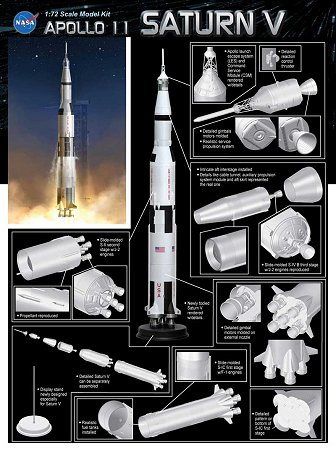
Apollo 11 Saturn V model kit

Check out the cool Saturn V Rocket “Apollo 11” Model Kit 1:72 at Bad Cat toys. Link via Cheaper Saturn V – The Unwanted Blog

badcattoys_Apollo11SaturnVModel

DIYROCKETS and the 3D Rocket Challenge

DIYROCKETS.com describes itself as

a global space company helping humanity establish a civilization in space by building an open space frontier.

​Our mission is to lower the cost of space exploration as much as possible by generating extremely low-cost knowledge and technology through open sourcing and crowdsourcing. We believe in harnessing the talent and resources of all to build a democratized space industry

Their  partners include Sunglass, Shapeways, the Silicon Valley Space Center, and Citizens in Space.

They are currently sponsoring a 3D ROCKET CHALLENGE

DIYROCKETS Challenges YOU to Collaboratively Design an Open Source 3D Printed Rocket Engine that Could Carry Nano-Satellites into Space

THE CHALLENGE

​Over the last few years multiple companies, institutions and individuals have started building nano-satellites and other small satellites. These little satellites are packed with electronics and range from the size of a computer chip to a smart phone to a pumpkin. With their communication and research capabilities, they have multiple applications working individually or in coordination with one another. But, with the high cost of earth to space transport, how in the world are they going to get up into space?

We challenge YOU to design a 3D printed rocket engine that could become part of a propulsion system and vehicle to carry nano-satellites into space.
 

The FrankenFalcon rocket + Navy railguns as lunar mass drivers

John Hare considers the capability of a monster (in more ways than one) rocket that combines a stretched SpaceX Falcon 9 with  Shuttle solid rocket boosters to put about 140 tons into orbit: SFalconLS – Selenian Boondocks.

===
Chuck Lesher notes that  Navy railgun development has reached a level of capability already sufficient to hurl small amounts of material from the Moon at escape velocities: Is the US Navy Preparing to Conquer Space? – Moonandback

Even at this early stage, the railgun is already capable of launching a 23 pound payload off the surface of the moon. We have our mass driver but getting it operational on the moon along with all the support needed to supply it with payloads… well, solving that problem must wait for another blog entry.