Category Archives: Exoplanets

ESO: 7 Earth-sized worlds found in dwarf star system – 3 in habitable zone

ESO makes a big announcement about a dwarf star with lots of earth-sized planets:

Ultracool Dwarf and the Seven Planets
Temperate Earth-sized Worlds Found in
Extraordinarily Rich Planetary System
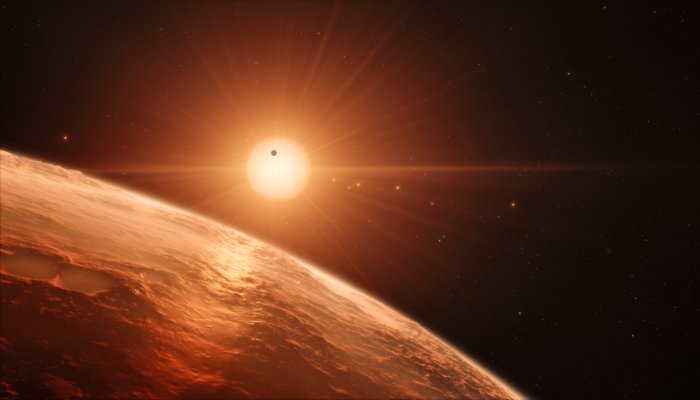
This artist’s impression shows the view from the surface of one of the planets in the TRAPPIST-1 system. At least seven planets orbit this ultra cool dwarf star 40 light-years from Earth and they are all roughly the same size as the Earth. They are at the right distances from their star for liquid water to exist on the surfaces of several of them. This artist’s impression is based on the known physical parameters for the planets and stars seen, and uses a vast database of objects in the Universe. [Full size image]
Astronomers have found a system of seven Earth-sized planets just 40 light-years away. Using ground and space telescopes, including ESO’s Very Large Telescope, the planets were all detected as they passed in front of their parent star, the ultracool dwarf star known as TRAPPIST-1. According to the paper appearing today in the journal Nature, three of the planets lie in the habitable zone and could harbour oceans of water on their surfaces, increasing the possibility that the star system could play host to life. This system has both the largest number of Earth-sized planets yet found and the largest number of worlds that could support liquid water on their surfaces.

Astronomers using the TRAPPIST–South telescope at ESO’s La Silla Observatory, the Very Large Telescope (VLT) at Paranal and the NASA Spitzer Space Telescope, as well as other telescopes around the world [1], have now confirmed the existence of at least seven small planets orbiting the cool red dwarf star TRAPPIST-1 [2]. All the planets, labelled TRAPPIST-1b, c, d, e, f, g and h in order of increasing distance from their parent star, have sizes similar to Earth [3].
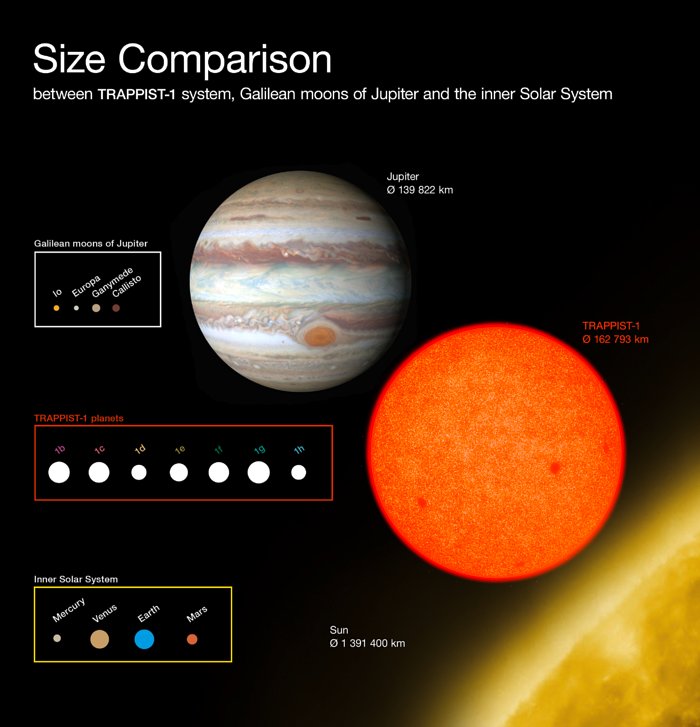
This diagram compares the sizes of the newly-discovered planets around the faint red star TRAPPIST-1 with the Galilean moons of Jupiter and the inner Solar System. All the planets found around TRAPPIST-1 are of similar size to the Earth. [Full size image.]
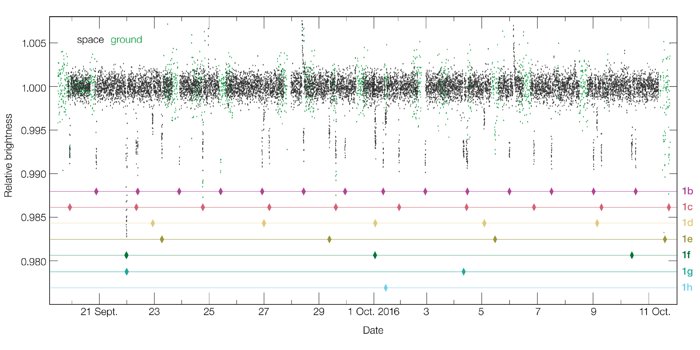
Dips in the star’s light output caused by each of the seven planets passing in front of it — events known as transits — allowed the astronomers to infer information about their sizes, compositions and orbits [4]. They found that at least the inner six planets are comparable in both size and temperature to the Earth.

This diagram shows the changing brightness of the ultra cool dwarf star TRAPPIST-1 over a period of 20 days in September and October 2016 as measured by NASA’s Spitzer Space Telescope and many other telescopes on the ground. On many occasions the brightness of the star drops for a short period and then returns to normal. These events, called transits, are due to one or more of the star’s seven planets passing in front of the star and blocking some of its light. The lower part of the diagram shows which of the system’s planets are responsible for the transits. [Full size image]

Lead author Michaël Gillon of the STAR Institute at the University of Liège in Belgium is delighted by the findings:

“This is an amazing planetary system — not only because we have found so many planets, but because they are all surprisingly similar in size to the Earth!”

With just 8% the mass of the Sun, TRAPPIST-1 is very small in stellar terms — only marginally bigger than the planet Jupiter — and though nearby in the constellation Aquarius (The Water Carrier), it appears very dim. Astronomers expected that such dwarf stars might host many Earth-sized planets in tight orbits, making them promising targets in the hunt for extraterrestrial life, but TRAPPIST-1 is the first such system to be found.

Co-author Amaury Triaud expands:

“The energy output from dwarf stars like TRAPPIST-1 is much weaker than that of our Sun. Planets would need to be in far closer orbits than we see in the Solar System if there is to be surface water. Fortunately, it seems that this kind of compact configuration is just what we see around TRAPPIST-1!”

The team determined that all the planets in the system are similar in size to Earth and Venus in the Solar System, or slightly smaller. The density measurements suggest that at least the innermost six are probably rocky in composition.
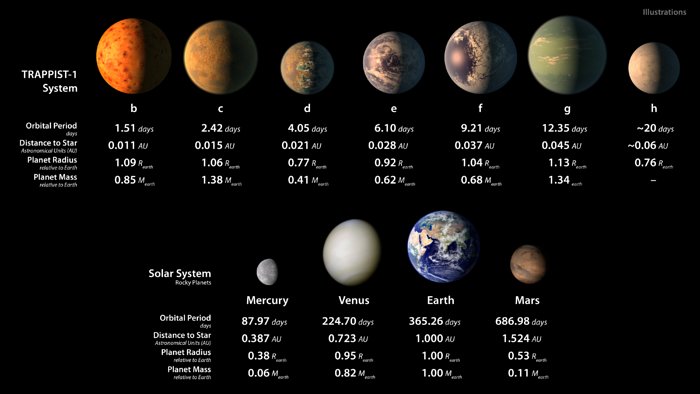
This infographic displays some artist’s illustrations of how the seven planets orbiting TRAPPIST-1 might appear — including the possible presence of water oceans — alongside some images of the rocky planets in our Solar System. Information about the size and orbital periods of all the planets is also provided for comparison; the TRAPPIST-1 planets are all approximately Earth-sized. [Full sized image]
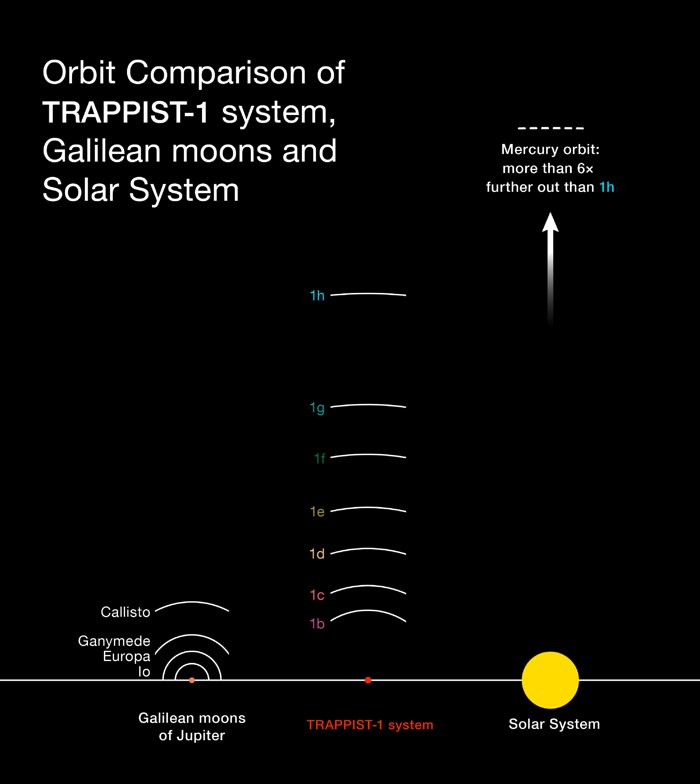
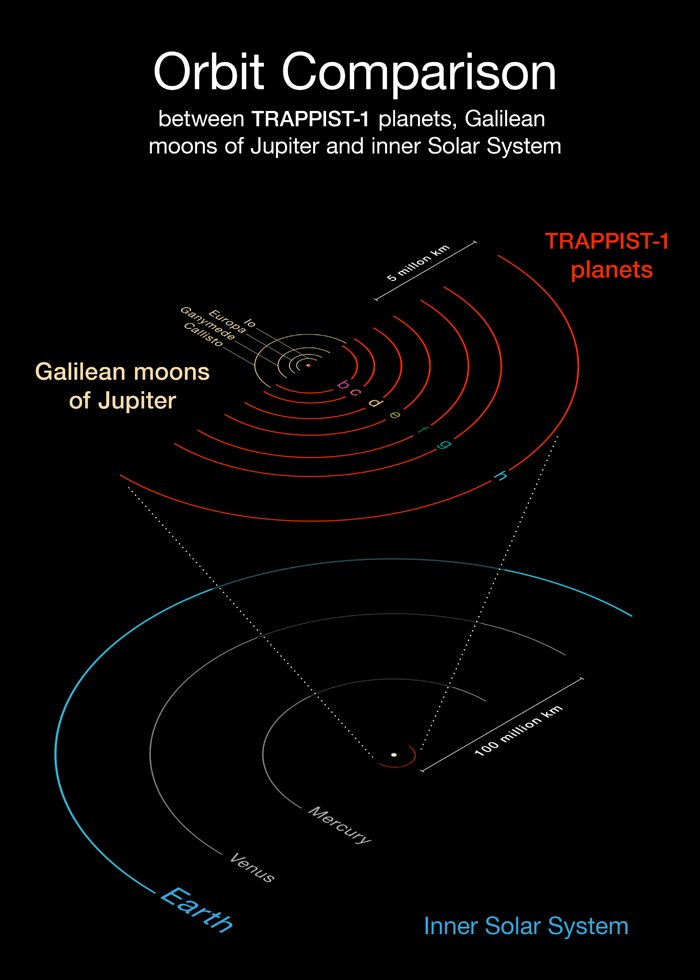
The planetary orbits are not much larger than that of Jupiter’s Galilean moon system, and much smaller than the orbit of Mercury in the Solar System. However, TRAPPIST-1’s small size and low temperature mean that the energy input to its planets is similar to that received by the inner planets in our Solar System; TRAPPIST-1c, d and f receive similar amounts of energy to Venus, Earth and Mars, respectively.

This diagram compares the orbits of the newly-discovered planets around the faint red star TRAPPIST-1 with the Galilean moons of Jupiter and the inner Solar System. All the planets found around TRAPPIST-1 orbit much closer to their star than Mercury is to the Sun, but as their star is far fainter, they are exposed to similar levels of irradiation as Venus, Earth and Mars in the Solar System. [Full size image ]
All seven planets discovered in the system could potentially have liquid water on their surfaces, though their orbital distances make some of them more likely candidates than others. Climate models suggest the innermost planets, TRAPPIST-1b, c and d, are probably too hot to support liquid water, except maybe on a small fraction of their surfaces. The orbital distance of the system’s outermost planet, TRAPPIST-1h, is unconfirmed, though it is likely to be too distant and cold to harbour liquid water — assuming no alternative heating processes are occurring [5]. TRAPPIST-1e, f, and g, however, represent the holy grail for planet-hunting astronomers, as they orbit in the star’s habitable zone and could host oceans of surface water [6].

This diagram compares the orbits of the newly-discovered planets around the faint red star TRAPPIST-1 with the Galilean moons of Jupiter and the inner Solar System. All the planets found around TRAPPIST-1 orbit much closer to their star than Mercury is to the Sun, but as their star is far fainter, they are exposed to similar levels of irradiation as Venus, Earth and Mars in the Solar System. [Full size image]
These new discoveries make the TRAPPIST-1 system a very important target for future study. The NASA/ESA Hubble Space Telescope is already being used to search for atmospheres around the planets and team member Emmanuël Jehin is excited about the future possibilities:

“With the upcoming generation of telescopes, such as ESO’s European Extremely Large Telescope and the NASA/ESA/CSA James Webb Space Telescope, we will soon be able to search for water and perhaps even evidence of life on these worlds.”

This video takes the viewer on a quick trip from Earth, past the Moon and far beyond. We finally arrive at the faint red ultracool dwarf star TRAPPIST-1, which has a remarkable seven planets orbiting it, all having sizes similar to the Earth.

The stars in the animation are accurately positioned as in reality. The tiny ultracool dwarf TRAPPIST-1 is so dim that it would remain invisible to the naked eye until the imaginary traveller gets very close, when its seven orbiting planets can also be seen.

The artist’s impression in this video is based on the known physical parameters for the planets and stars seen, and uses a vast database of objects in the Universe. Credit: ESO/L. Calçada/spaceengine.org

Notes

[1] As well as the NASA Spitzer Space Telescope, the team used many ground-based facilities: TRAPPIST–South at ESO’s La Silla Observatory in Chile, HAWK-I on ESO’s Very Large Telescope in Chile,  TRAPPIST–North in Morocco, the 3.8-metre UKIRT in Hawaii, the 2-metre Liverpool and 4-metre William Herschel telescopes at La Palma in the Canary Islands, and the 1-metre SAAO telescope in South Africa.

[2] TRAPPIST–South (the TRAnsiting Planets and PlanetesImals Small Telescope–South) is a Belgian 0.6-metre robotic telescope operated from the University of Liège and based at ESO’s La Silla Observatory in Chile. It spends much of its time monitoring the light from around 60 of the nearest ultracool dwarf stars and brown dwarfs (“stars” which are not quite massive enough to initiate sustained nuclear fusion in their cores), looking for evidence of planetary transits. TRAPPIST–South, along with its twin TRAPPIST–North, are the forerunners to the SPECULOOS system, which is currently being installed at ESO’s Paranal Observatory.

[3] In early 2016, a team of astronomers, also led by Michaël Gillon announced the discovery of three planets orbiting TRAPPIST-1. They intensified their follow-up observations of the system mainly because of a remarkable triple transit that they observed with the HAWK-I instrument on the VLT. This transit showed clearly that at least one other unknown planet was orbiting the star. And that historic light curve shows for the first time three temperate Earth-sized planets, two of them in the habitable zone, passing in front of their star at the same time!

[4] This is one of the main methods that astronomers use to identify the presence of a planet around a star. They look at the light coming from the star to see if some of the light is blocked as the planet passes in front of its host star on the line of sight to Earth — it transits the star, as astronomers say. As the planet orbits around its star, we expect to see regular small dips in the light coming from the star as the planet moves in front of it.

[5] Such processes could include tidal heating, whereby the gravitational pull of TRAPPIST-1 causes the planet to repeatedly deform, leading to inner frictional forces and the generation of heat. This process drives the active volcanism on Jupiter’s moon Io. If TRAPPIST-1h has also retained a primordial hydrogen-rich atmosphere, the rate of heat loss could be very low.

[6] This discovery also represents the largest known chain of exoplanets orbiting in near-resonance with each other. The astronomers carefully measured how long it takes for each planet in the system to complete one orbit around TRAPPIST-1 — known as the revolution period — and then calculated the ratio of each planet’s period and that of its next more distant neighbour. The innermost six TRAPPIST-1 planets have period ratios with their neighbours that are very close to simple ratios, such as 5:3 or 3:2. This means that the planets most likely formed together further from their star, and have since moved inwards into their current configuration. If so, they could be low-density and volatile-rich worlds, suggesting an icy surface and/or an atmosphere.

====

Videos: SETI for very non-human-like ETs + SETI at Harvard + SETI in optical wavelengths

** In this video, British science writer Philip Ball advocates a search for extraterrestrials based on the assumption that they share extremely little with humans in terms of biology, ways of thinking, etc (via Leonard David)

** Here is a Google talk by Paul Horowitz of Harvard about, “The Search for Extraterrestrial Intelligence“:

Paul Horowitz visited Google’s office in Cambridge, MA to discuss the SETI (Search for Extraterrestrial Intelligence) project at Harvard University.

Establishing an electromagnetic communications link across a thousand light-years presents unique technological challenges. In his talk, Prof. Horowitz visits some highlights of the science and technology of SETI — Do THEY exist? Is communication possible? What is the best way? Is this just completely insane? — and describes interesting searches his project and others have been doing.

Paul Horowitz is a Research Professor of Physics and of Electrical Engineering at Harvard, and is co-author of The Art of Electronics.

**  The SETI Institute takes many approaches to the search for ET. Here is a talk by Eliot Gillium about looking for optical rather than radio signals from ET – A Novel Approach to OSETI:

The Search for Extraterrestrial Intelligence is a blind search across many dimensions—space and time being the most obvious. Every good SETI researcher does their very best to make the minimal reasonable assumptions, but time and resources are always limited, so various strategic optimizations have been adopted. A potentially more efficacious approach is to simply cover as much of the search space as possible. The SETI Institute has made this the starting point of their ambitious and groundbreaking idea to survey the entire night sky, all night, every night at optical wavelengths. This talk will further detail the motivation and planned operation of this new instrument, a panoptic eye for interstellar laser pulses.

====

Video: Overview of the TESS mission to look for exoplanets around nearby stars

Dr. George Ricker is the Principle Investigator of the TESS (Transiting Exoplanet Survey Satellite) Mission, which will succeed Kepler as the primary US space observatory looking for exoplanets. He reviews the mission, which will launch in 2017, in this video:

From the caption:

The Transiting Exoplanet Survey Satellite (TESS) will discover thousands of exoplanets in orbit around the brightest stars in the sky. In its two-year prime survey mission, TESS will monitor more than 200,000 bright stars in the solar neighborhood for temporary drops in brightness caused by planetary transits. This first-ever spaceborne all-sky transit survey will identify planets ranging from Earth-sized to gas giants, around a wide range of stellar types and orbital distances.

TESS stars will typically be 30-100 times brighter than those surveyed by the Kepler satellite; thus, TESS planets will be far easier to characterize with follow-up observations. For the first time it will be possible to study the masses, sizes, densities, orbits, and atmospheres of a large cohort of small planets, including a sample of rocky worlds in the habitable zones of their host stars.

An additional data product from the TESS mission will be full frame images (FFI) with a cadence of 30 minutes. These FFI will provide precise photometric information for every object within the 2300 square degree instantaneous field of view of the TESS cameras. These objects will include more than 1 million stars and bright galaxies observed during sessions of several weeks. In total, more than 30 million objects brighter than magnitude I=16 will be precisely photometered during the two-year prime mission. In principle, the lunar-resonant TESS orbit could provide opportunities for an extended mission lasting more than a decade, with data rates in excess of 100 Mbits/s.

An extended survey by TESS of regions surrounding the North and South Ecliptic Poles will provide prime exoplanet targets for characterization with the James Webb Space Telescope (JWST), as well as other large ground-based and space-based telescopes of the future.

A NASA Guest Investigator program is planned for TESS. The TESS legacy will be a catalog of the nearest and brightest main-sequence stars hosting transiting exoplanets, which should endure as the most favorable targets for detailed future investigations.

TESS is currently targeted for launch in late 2017 as a NASA Astrophysics Explorer mission.

=====

Kickstarter: Project Blue aims to see exoplanets at Alpha Centauri with low cost space observatory

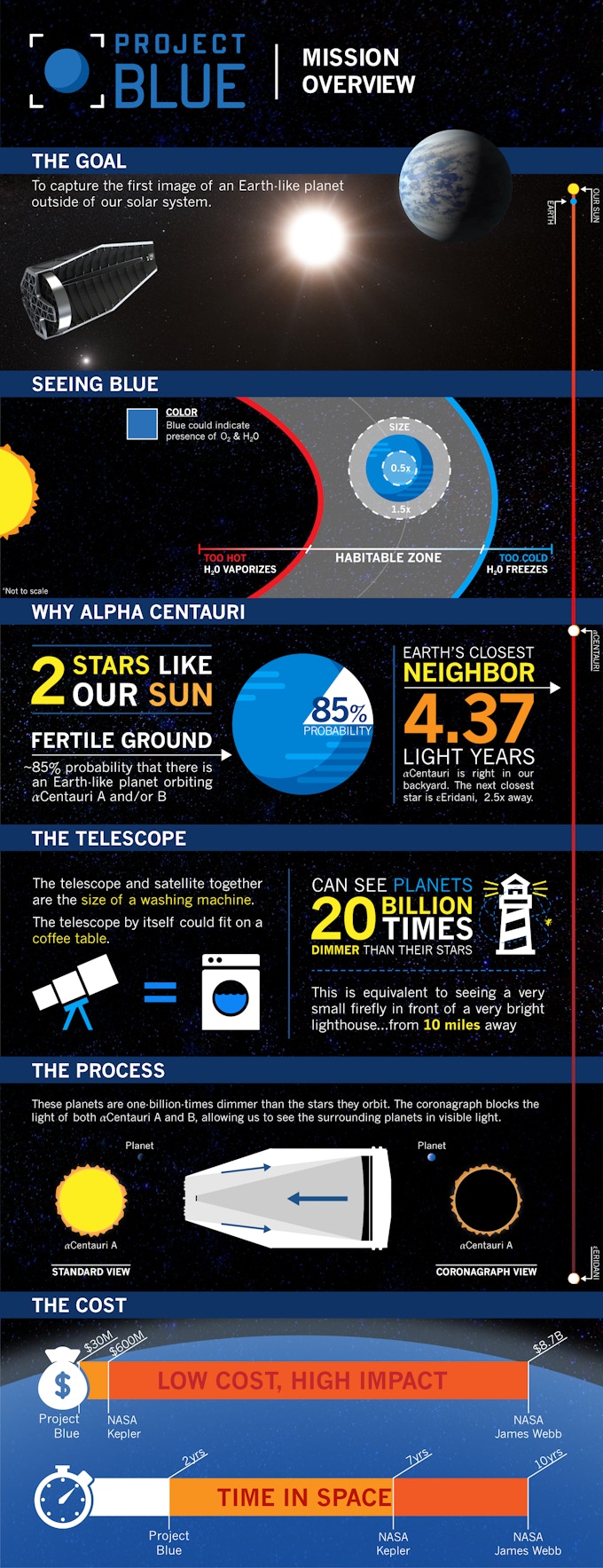
Project Blue intends to develop a small, low cost space telescope that looks continually at our nearest neighboring star system, Alpha Centauri, and try to directly image any planets orbiting it. A coronagraph will be used to block the otherwise blinding glare of the stars.

The project has opened a Kickstarter campaign to raise $1M to fund the initial design study for the system, which is expected eventually to cost around $30M.

… we need your help. This isn’t a traditional space mission. Within astrophysics, NASA has traditionally funded projects with a much broader scope, like Kepler and Hubble, rather than a project like ours that is focused on a single target. So we started this campaign with the belief that together, people all over the world could push the boundaries of discovery in space, and possibly achieve one of the greatest milestones of human exploration.

With the formation of Project Blue, we brought together the technical experts who can build and launch this telescope: scientists from organizations like BoldlyGo Institute, Mission Centaur, the SETI Institute, and the University of Massachusetts Lowell. And now we’re asking for your support to get involved, and make Project Blue a reality.

Here is a video about the project:

From the website:

Project Blue is a new science initiative to capture the first photograph of a potential Earth-like planet orbiting another Sun-like star. The mission aims to launch a lightweight space telescope to directly image exoplanets around Earth’s nearest star system, Alpha Centauri A and B. With a budget the fraction of the cost of a mid-size astrophysics mission, and a planned launch by the end of the decade, this venture represents an ambitious leap forward in low-cost, high-impact space exploration. Through active collaboration between research institutions, universities, private industry and citizens, Project Blue seeks to make space exploration a participatory, collective endeavor and inspire millions worldwide to engage in scientific inquiry.


More at Project Blue kicks off planet-hunting campaign – Alan Boyle/Geekwire –

The plan is to build a telescope to stare at those two closely paired stars over the course of two years. Because they’re so close to us in astronomical terms — a mere 4.37 light-years, or 26 trillion miles — it would be possible to get a direct image of any potentially habitable planets using a telescope that has a 20-inch-wide (0.5-meter-wide) mirror, Morse said.

What’s more, the telescope would be able to analyze the light reflected by those planets. That could tell scientists what their atmospheres are made of. If the planet shines with the right shade of blue, that would suggest it’s an alien Earth.

Here is an infographic (larger version):

Project Blue Infographic


Citizen scientists find debris disk around red dwarf where planets can form

Another example of citizen scientists contributing to a published scientific finding:

Citizen Scientists Discover Potential New Exoplanet Hunting Ground

Via a NASA-led citizen science project, eight people with no formal training in astrophysics helped discover what could be a fruitful new place to search for planets outside our solar system – a large disk of gas and dust encircling a star known as a circumstellar disk.

awi0005x3s-cropped1
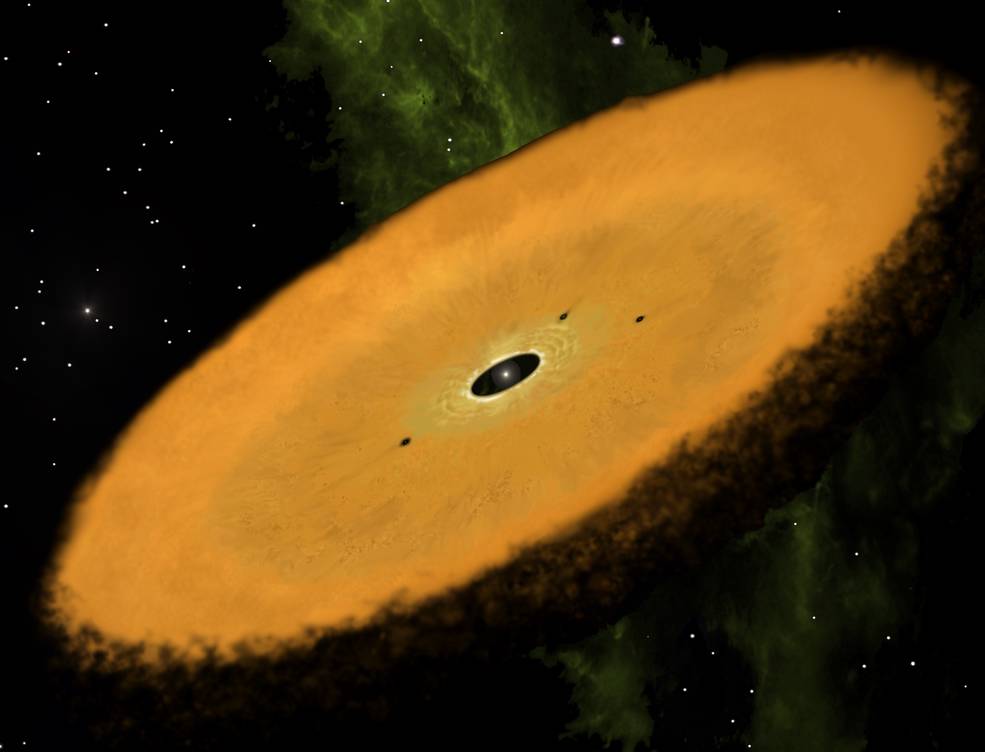
Artist’s concept of the newly discovered disk. Credits: Jonathan Holden

A paper, published in The Astrophysical Journal Letters and coauthored by eight citizen scientists involved in the discovery, describes a newly identified red dwarf star, AWI0005x3s, and its warm circumstellar disk, the kind associated with young planetary systems. Most of the exoplanets, which are planets outside our solar system, that have been imaged to date dwell in disks similar to the one around AWI0005x3s.

The disk and its star are located in what is dubbed the Carina association – a large, loose grouping of similar stars in the Carina Nebula approximately 212 light years from our sun. Its relative proximity to Earth will make it easier to conduct follow-on studies.

“Most disks of this kind fade away in less than 30 million years,” said Steven Silverberg, a graduate student at Oklahoma University and lead author of the paper. “This particular red dwarf is a candidate member of the Carina association, which would make it around 45 million years old. It’s the oldest red dwarf system with a disk we’ve seen in one of these associations.”

Since the launch of NASA’s Disk Detective website in January 2014, approximately 30,000 citizen scientists have performed roughly two million classifications of stellar objects, including those that led to this discovery. Through Disk Detective, citizen scientists study data from NASA’s Wide-field Infrared Survey Explorer mission (WISE), the agency’s Two-Micron All Sky Survey project, and other stellar surveys.

“Without the help of the citizen scientists examining these objects and finding the good ones, we might never have spotted this object,” said Marc Kuchner, an astrophysicist at NASA’s Goddard Space Fight Center in Greenbelt, Maryland, who leads Disk Detective. “The WISE mission alone found 747 million objects, of which we expect a few thousand to be circumstellar disks.” 

The eight citizen scientist co-authors, members of an advanced user group, volunteered to help by researching disk candidates. Their data led to the discovery of this new disk.

“I’ve loved astronomy since childhood and wanted to be part of the space program, as did every boy my age,” adds Milton Bosch, a citizen scientist co-author from California. “I feel very fortunate to be part of such a great group of dedicated people, and am thrilled to partake in this adventure of discovery and be a co-author on this paper.”

Disk Detective is a collaboration between NASA, Zooniverse, the University of Oklahoma, University of Córdoba in Argentina, National Astronomical Observatory of Japan, Space Telescope Science Institute, Harvard-Smithsonian Center for Astrophysics, Carnegie Institution of Washington, University of Hawaii and Korea Astronomy and Space Science Institute.

To learn more about opportunities for the public to participate in NASA science and technology projects, visit: www.nasa.gov/solve