Category Archives: Exoplanets

The weather on Neptune-sized HAT-P-11b exoplanet + Weathermap of exoplanet WASP-43b

John Batchelor and David Livingston spoke yesterday with  Dr. Heather Knutson about Exoplanet HAT-P-11b: The John Batchelor Show Hotel Mars, Wednesday, 10-8-14 – Thespaceshow’s Blog

The exoplanet has been found to have

clear skies and water vapor in its atmosphere. Dr. Knutson explained how clear skies and atmospheric water vapor [were] confirmed, what it means for this specific Neptune size exoplanet and what it means for our planet searches in general.  We talked about it having a hot atmosphere, a core but not a solid surface.  The exoplanet is not habitable.  HAT-P-11b is 120 light years from Earth.  Dr. Knutson also explained why so many exoplanets have a cloudy atmosphere and why that limits our research into the exoplanet.

Listen to the show:

====

And here is an announcement today from the ESA Hubble Telescope group about measurements of the atmosphere of another exoplanet:

Hubble reveals most detailed exoplanet weather map ever

A team of scientists using the NASA/ESA Hubble Space Telescope have made the most detailed map ever of the temperature of an exoplanet’s atmosphere, and traced the amount of water it contains. The planet targeted for both of the investigations was the hot-Jupiter exoplanet WASP-43b.

WASP-43b is a planet the size of Jupiter but with double the mass and an orbit much closer to its parent star than any planet in the Solar System. It has one of the shortest years ever measured for an exoplanet of its size — lasting just 19 hours.

A team of astronomers working on two companion studies have now created detailed weather maps of WASP-43b. One study mapped the temperature at different layers in the planet’s atmosphere, and the other traced the amount and distribution of water vapour within it — detail is shown in the video created by the team.

“Our observations are the first of their kind in terms of providing a two-dimensional map of the planet’s thermal structure,” said Kevin Stevenson from University of Chicago, USA, lead author of the thermal map study. “These maps can be used to constrain circulation models that predict how heat is transported from an exoplanet’s hot day side to its cool night side.”

The planet has different sides for day and night because it is tidally locked, meaning that it keeps one hemisphere facing the star, just as the Moon keeps one face toward Earth. The Hubble observations show that the exoplanet has winds that howl at thespeed of sound from a day side that is hot enough to melt iron — soaring above 1500 degrees Celsius — to the pitch-black night side that sees temperatures plunge to a comparatively cool 500 degrees Celsius.

To study the atmosphere of WASP-43b the team combined two previous methods of analysing exoplanets for the first time.

By looking at how the parent star’s light filtered through the planet’s atmosphere — a technique called transmission spectroscopy — they determined the water abundance of the atmosphere on the boundary between the day and night hemispheres.

In order to make the map more detailed the team also measured the water abundances and temperatures at different longitudes. To do this they took advantage of the precision and stability of Hubble’s instruments to subtract more than 99.95% of the light from the parent star, allowing them to study the light coming from the planet itself — a technique called emission spectroscopy. By doing this at different points of the planet’s orbit around the parent star they could map the atmosphere across its longitude.
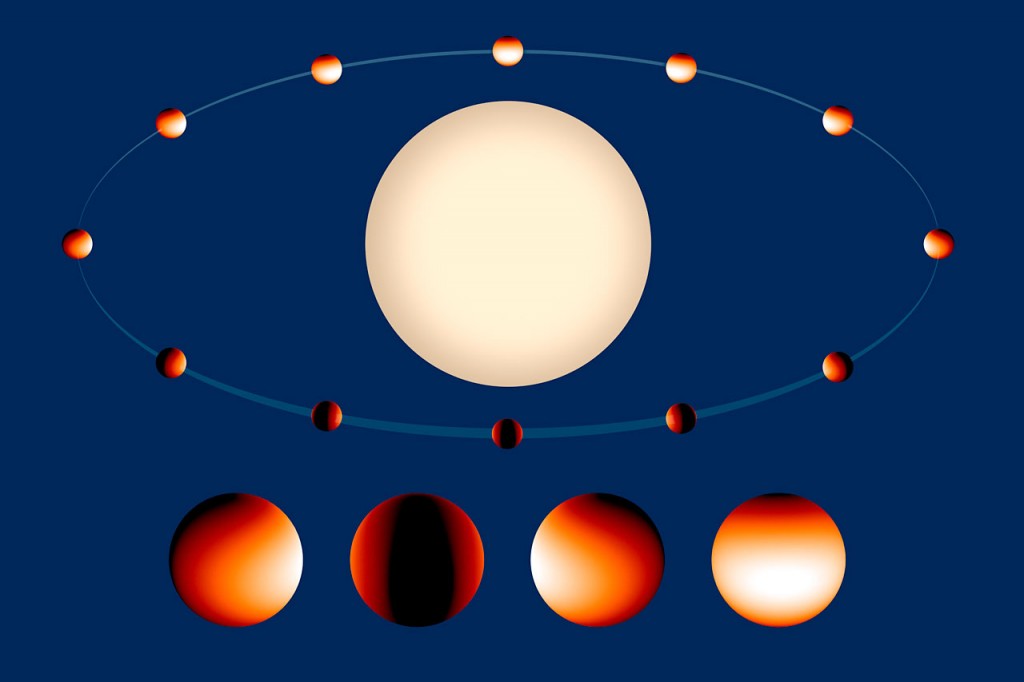
Exoplanet WASP-43b orbits its parent star

In this artist’s illustration the Jupiter-sized planet WASP-43b orbits its parent star in one of the closest orbits ever measured for an exoplanet of its size — with a year lasting just 19 hours.

The planet is tidally locked, meaning it keeps one hemisphere facing the star, just as the Moon keeps one face toward Earth.

The colour scale on the planet represents the temperature across its atmosphere. This is based on data from a recent study that mapped the temperature of WASP-43b in more detail than has been done for any other exoplanet.

“We have been able to observe three complete rotations — three years for this distant planet — during a span of just four days,” explained Jacob Bean from the University of Chicago, USA, leader of the research project. “This was essential in allowing us to create the first full temperature map for an exoplanet and to probe its atmosphere to find out which elements it held and where.”

Finding the proportions of the different elements in planetary atmospheres provides vital clues to understanding how planets formed.

“Because there’s no planet with these tortured conditions in the Solar System, characterising the atmosphere of such a bizarre world provides a unique laboratory with which to acquire a better understanding of planet formation and planetary physics,” said Nikku Madhusudhan of Cambridge University, UK, co-author of both studies. “In this case the discovery fits well with pre-existing models of how such planets behave.”

The team found that WASP-43b reflected very little of its host star’s light. An atmosphere like that on Earth, with clouds that reflect most of the sunlight, is not present on WASP-43b, but the team did find water vapour in the planet’s atmosphere.

“The planet is so hot that all the water in its atmosphere is vapourised, rather than condensed into the icy clouds we find on Jupiter,” said team member Laura Kreidberg of the University of Chicago, lead author of the study mapping water on the planet. Kreidberg describes both results in her online video.

Water is thought to play an important role in the formation of giant planets. Astronomers theorise that comet-like bodies bombard young planets, delivering most of the water and other molecules that we observe. However, the water abundances in the giant planets of the Solar System are poorly known because water is locked away as ice, deep in their atmospheres which makes it difficult to identify.

“Space probes have not been able to penetrate deep enough into Jupiter’s atmosphere to obtain a clear measurement of its water abundance. But this giant planet is different,” added Derek Homeier of the École Normale Supérieure de Lyon, France, co-author of the studies. “WASP-43b’s water is in the form of a vapour that can be much more easily traced. So we could not only find it, we were able to directly measure how much there is and test for variations along the planet’s longitude.”

In WASP-43b the team found the same amount of water as we would expect for an object with the same chemical composition as the Sun.

“This tells us something fundamental about how the planet formed,” added Kreidberg.“Next, we aim to make water-abundance measurements for different planets to explore their chemical abundances and learn more about how planets of different sizes and types come to form around our own Sun and the stars beyond it.” [1]

The results are presented in two new papers, one on the thermal mapping of the planet’s atmosphere — published online in Science Express on 9 October — and the other on mapping the water content of the atmosphere — published in The Astrophysical Journal Letters on 12 September 2014.
Video: ‘100 Year Starship’ – panel discussion

A panel discussion sponsored by the SETI Institute on the DARPA initiated 100 Year Starship program:

The panel included:

  • Mae Jemison – an American physician and NASA astronaut.
  • Richard Rhodes – the author or editor of twenty-four books including The Making of the Atomic Bomb
  • Bill Nye – scientist, engineer, comedian, author, and inventor
  • Dana Backman – director of SOFIA’s Outreach programs.
  • Moderator: Adrian Brown – a planetary scientist at the SETI Institute


Hubble telescope detects water in atmosphere of Neptune-sized exoplanet

An announcement from NASA/ESA Hubble Telescope program:

Clear skies on exo-Neptune

Smallest exoplanet ever found to have water vapour

Astronomers using data from the NASA/ESA Hubble Space Telescope, the Spitzer Space Telescope, and the Kepler Space Telescope have discovered clear skies and steamy water vapour on a planet outside our Solar System. The planet, known as HAT-P-11b, is about the size of Neptune, making it the smallest exoplanet ever on which water vapour has been detected. The results will appear in the online version of the journal Nature on 24 September 2014.

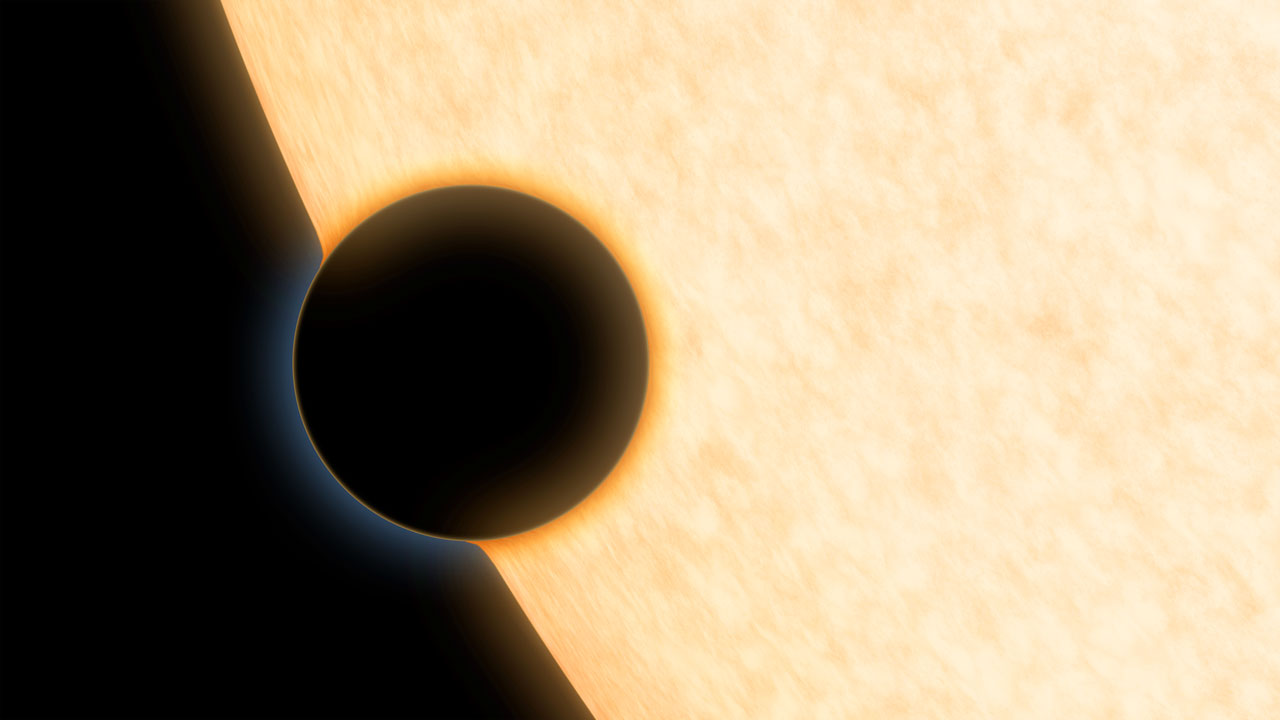
Artist Illustration of planet HAT-P-11b

This is an artist’s concept of the silhouette of the extrasolar planet HAT-P-11b
as it passes its parent star. The planet was observed as it crossed in front of its star in order to learn more about its atmosphere.

In this method, known as transmission or absorption spectroscopy, starlight filters through the rim of the planet’s atmosphere and into the telescope. If molecules like water vapour are present, they absorb some of the starlight, leaving distinct signatures in the light that reaches our telescopes. Using this technique, astronomers discovered clear skies and steamy water vapour on the planet.

The discovery is a milestone on the road to eventually finding molecules in the atmospheres of smaller, rocky planets more akin to Earth. Clouds in the atmospheres of planets can block the view of what lies beneath them. The molecular makeup of these lower regions can reveal important information about the composition and history of a planet. Finding clear skies on a Neptune-size planet is a good sign that some smaller planets might also have similarly good visibility.

“When astronomers go observing at night with telescopes, they say ‘clear skies’ to mean good luck,” said Jonathan Fraine of the University of Maryland, USA, lead author of the study. “In this case, we found clear skies on a distant planet. That’s lucky for us because it means clouds didn’t block our view of water molecules.”

Parent star HAT-P-11

This image, taken with the NASA/ESA Hubble Space Telescope’s Wide Field Camera 3, shows the star HAT-P-11.

Not visible here is a Neptune-sized planet named HAT-P-11b which orbits the star.  Astronomers have discovered clear skies and steamy water vapour on the planet. It is the smallest planet ever for which water vapour has been detected.

The small bright object next to the star is not the planet in question; in fact it is not a planet at all, but another star.

The reason for the graininess in this image is that it is a very short exposure. The star itself is so bright that it is saturated, it would otherwise be a small dot  like the faint star next to it. The rings and the cross are caused by the diffraction — the bouncing of light — inside the telescope.

HAT-P-11b is a so-called exo-Neptune — a Neptune-sized planet that orbits another star. It is located 120 light-years away in the constellation of Cygnus (The Swan). Unlike Neptune, this planet orbits closer to its star, making one lap roughly every five days. It is a warm world thought to have a rocky core, a mantle of fluid and ice, and a thick gaseous atmosphere. Not much else was known about the composition of the planet, or other exo-Neptunes like it, until now.

Part of the challenge in analysing the atmospheres of planets like this is their size. Larger Jupiter-like planets are easier to observe and researchers have already been able to detect water vapour in the atmospheres of some of these giant planets. Smaller planets are more difficult to probe — and all the smaller ones observed to date have appeared to be cloudy.

The team used Hubble’s Wide Field Camera 3 and a technique called transmission spectroscopy, in which a planet is observed as it crosses in front of its parent star. Starlight filters through the rim of the planet’s atmosphere and into the telescope. If molecules like water vapour are present, they absorb some of the starlight, leaving distinct signatures in the light that reaches our telescopes.

“We set out to look at the atmosphere of HAT-P-11b without knowing if its weather would be cloudy or not,” said Nikku Madhusudhan, from the University of Cambridge, UK, part of the study team. “By using transmission spectroscopy, we could use Hubble to detect water vapour in the planet. This told us that the planet didn’t have thick clouds blocking the view and is a very hopeful sign that we can find and analyse more cloudless, smaller, planets in the future. It is groundbreaking!”

Before the team could celebrate they had to be sure that the water vapour was from the planet and not from cool starspots — “freckles” on the face of stars — on the parent star. Luckily, Kepler had been observing the patch of sky in which HAT-P-11b happens to lie for years. Those visible-light data were combined with targeted infraredSpitzer observations. By comparing the datasets the astronomers could confirm that the starspots were too hot to contain any water vapour, and so the vapour detected must belong to the planet.

The results from all three telescopes demonstrate that HAT-P-11b is blanketed in water vapour, hydrogen gas, and other yet-to-be-identified molecules. So in fact it is not only the smallest planet to have water vapour found in its atmosphere but is also the smallest planet for which molecules of any kind have been directly detected using spectroscopy [1]. Theorists will be drawing up new models to explain the planet’s makeup and origins.

Zoom in on the star:

Loading player…


Although HAT-P-11b is dubbed as an exo-Neptune it is actually quite unlike any planet in our Solar System. It is thought that exo-Neptunes may have diverse compositions that reflect their formation histories. New findings such as this can help astronomers to piece together a theory for the origin of these distant worlds.

“We are working our way down the line, from hot Jupiters to exo-Neptunes,” said Drake Deming, a co-author of the study also from University of Maryland, USA. “We want to expand our knowledge to a diverse range of exoplanets.”

The astronomers plan to examine more exo-Neptunes in the future, and hope to apply the same method to smaller super-Earths — massive, rocky cousins to our home world with up to ten times the mass of Earth. Our Solar System does not contain a super-Earth, but other telescopes are finding them around other stars in droves and the NASA/ESA James Webb Space Telescope, scheduled to launch in 2018, will search super-Earths for signs of water vapour and other molecules. However, finding signs of oceans and potentially habitable worlds is likely a way off.

This work is important for future studies of super-Earths and even smaller planets. It could allow astronomers to pick out in advance the planets with atmospheres clear enough for molecules to be detected. Once again, astronomers will be crossing their fingers for clear skies.

Notes

[1] Molecular hydrogen has been inferred to exist in many planets, including planets smaller than HAT-P-11b, but no molecule has actually been detected, using spectroscopy, in a planet this small, until now.

Video: Panel on artists, exoplanets, and getting it right

Here’s a SETI Institute video of a panel discussion  on the topic of accurately depicting exoplanets:  Artists Imaging Exoworlds-Getting It Right (SETI Con 2)


From the caption:

Panelists:

  • Lynette Cook – most widely known as an out-of-this-world space artist, Cook has enthralled others with the wonders of the cosmos via her depictions of planets discovered outside our solar system. Published worldwide in books, periodicals, and documentaries, these renderings have been featured on ABC7 News and in USA Today.
  • Danielle Futselaar – owner of ArtSource Graphic Design Studio in the Netherlands. Artist/Illustrator and Graphic Designer. Her clients include UNICEF, TNT and AS Watson. Danielle is also the SETI Institute’s TeamSETI Volunteer Captain of Creative Design where she has illustrated and created complete graphic design packages for fundraising campaigns and SETIcon II. She also created the official artist impression of Asteroid Minerva and its Two Moons discovered by SETI Institute’s Franck Marchis.
  • Eric Hanson- A visual effects designer specializing in the creation of digital environments and effects for feature films, Eric Hanson has worked with noted visual effects houses such as Digital Domain, Sony Imageworks, Dream Quest Images, and Walt Disney Feature Animation. His credits include The Fifth Element (1997), Bicentennial Man (1999), Cast Away (2000), Hollow Man (2000), Mission to Mars (2000), Spider-Man (2002) and Atlantis as well as many special-venue films.
  • Mark Showalter – Showalter is rabid about rings. While everyone knows about Saturn’s spectacular ring system, it’s often forgotten that Jupiter, Uranus, and Neptune are also encircled by fainter and narrower rings. Each of these systems interacts closely with a family of small, inner moons. Showalter works on some of NASA’s highest-profile missions to the outer planets, including Cassini, now orbiting Saturn, and New Horizons, which flew past Jupiter en route to its 2015 encounter with Pluto. He has even searched for the rings of Mars, although so far with no success. Known for his persistence in planetary image analysis, Mark’s work on the earlier Voyager mission led to his discovery of Jupiter’s faint, outer “gossamer” rings and Saturn’s tiny ring-moon, Pan.

Moderator:

  • Franck Marchis – Dr. Franck Marchis is a Planetary Astronomer at the Carl Sagan Center of the SETI Institute and also an associate astronomer at the Observatoire de Paris. Our solar system is characterized by considerable diversity of its constituent bodies. Franck Marchis’ first involvement in the study of this diversity started in 1996 while working at the UNAM Astronomy Department in Mexico City. He made the first ground-based observations of the volcanoes on the jovian moon Io, using the first Adaptive Optics (AO) systems available on the European Southern Observatory (ESO) 3.6 m telescope in Chile. After a brief stay in London and four years in Chile at ESO, he completed in 2000 his PhD in France. Since then, he has been studying asteroids with large telescopes and he discovered in 2005 the first triple using the Very Large Telescope in Chile. His work consists in using and developing adaptive optics on current and future 30m telescopes dedicated to the study of the solar system and extra solar planets.

Citizens science: Planet Hunters 2.0

With the revived Kepler space observatory once again looking for planets orbiting other stars, the citizens science program Planet Hunters is graduating to Planet Hunters 2.0A Brand New Planet Hunters – Planet Hunters

On December 16, 2010, the Zooniverse launched Planet Hunters to enlist the public’s help to search for extrasolar planets (exoplanets) in the data from NASA’s Kepler spacecraft. Back then we didn’t know what we would find. It may have been the case that no new planets were discovered and that computers had the job down to a fine art. The project was a gamble on the ability of human pattern recognition to beat machines just occasionally and spot the telltale dip in a star’s brightness due to a transiting planet that was missed by automated routines looking for repeating patterns.

Nearly four years later, Planet Hunters has become a success beyond anyone’s expectation. To date 8 published scientific papers have resulted from the efforts of nearly 300,000 volunteers worldwide. Planet Hunters has discovered 9 planet candidate co-discoveries with the Kepler effort, over 30 unknown planet candidates not previously identified by the Kepler team, a confirmed transiting circumbinary planet in a quadruple star system  (PH1b), a confirmed Jupiter-sized planet in the habitable zone of a Sun-like star (PH2b), and identified the 7th planet candidate of a 7 planet star system.

Today in collaboration with JPL’s PlanetQuest, the Planet Hunters science team and the Zooniverse are proud to announce the launch of Planet Hunters version 2.0. We’ve taken your feedback and the lessons learned over the past 3.5 years to build a fast new interface that we think will take the project to the next stage. Using the Zooniverse’s latest technology, Planet Hunters 2.0 is built specifically with the next generation of transiting exoplanet surveys in mind, including the new K2 mission, which repurposes the Kepler spacecraft.

Kepler had been monitoring ~170,000 stars for the signatures of transiting exoplanets over the past 4 years in the Kepler field located in the constellations of Cygnus and Lyra. The new-two wheel Kepler mission dubbed ‘K2‘ will have Kepler observing brand new sets of 10,000-20,000 stars every 75 days. These stars are different from the sources that Kepler had been monitoring in the past. Your eyes will be one of the first to gaze upon these observations. Most of the K2 target stars will have never before been searched for planets, providing a new opportunity to find distant worlds. K2 observations will be made available by NASA and the Kepler team to the entire astronomical community and the public shortly after being transmitted to Earth and processed. We aim to get them on Planet Hunters 2.0 as fast as we can.

Continue…

See also

Kepler's Second Light: How K2 Will Work
This conception illustration depicts how solar pressure can be used to balance
NASA’s Kepler spacecraft, keeping the telescope stable enough to continue
searching for transiting planets around distant stars.
Image Credit: NASA Ames/W Stenzel