The SETI Institute has posted a big set of videos of presentations from a conference on the topic of “Communicating Across the Cosmos“:
For over a half century, astronomers involved in the Search for Extraterrestrial Intelligence (SETI) have scanned the skies for signals from distant civilizations. Would humans be able to decode information-rich signals from another planet? Could we create a “universal language” that would be meaningful to an independently evolved civilization? To help answer these questions, on November 10-11 the SETI Institute will convene a multidisciplinary, international workshop at its headquarters in Mountain View, California. Speakers from six countries will draw on disciplines ranging from astronomy and mathematics, to anthropology and linguistics, as they debate the best ways to create meaningful messages. While the two-day workshop is closed to the public, all talks will later be posted on the SETI Institute’s Youtube channel.
Here’s a video of a panel summarizing the conference discussions:
The TESS (Transiting Exoplanet Survey Satellite) project is developing a follow-on observatory to the Kepler mission to look for planets around other stars using the transit method (i.e. the dimming of the starlight when a planet crosses between the star and the line of sight to earth.)
The Transiting Exoplanet Survey Satellite (TESS) is an Explorer-class planet finder. In the first-ever spaceborne all-sky transit survey, TESS will identify planets ranging from Earth-sized to gas giants, orbiting a wide range of stellar types and orbital distances. The principal goal of the TESS mission is to detect small planets with bright host stars in the solar neighborhood, so that detailed characterizations of the planets and their atmospheres can be performed.
TESS will monitor the brightnesses of more than 500,000 stars during a two year mission, searching for temporary drops in brightness caused by planetary transits. Transits occur when a planet’s orbit carries it directly in front of its parent star as viewed from Earth. TESS is expected to catalog more than 3000 transiting exoplanet candidates, including a sample of ∼500 Earth-sized and ‘Super Earth’ planets, with radii less than twice that of the Earth. TESS will detect small rock-and-ice planets orbiting a diverse range of stellar types and covering a wide span of orbital periods, including rocky worlds in the habitable zones of their host stars.
A panel discussion at last summer’s SETICon 2 event that examined the question, What Can SETI Learn from Kepler?
The panel included:
Geoff Marcy – an astronomy professor at both UC Berkeley and at San Francisco State University. Together with his collaborators, he has discovered over 250 extrasolar planets.
Martin Still – Still began his role as Director of the Kepler Guest Observer Office in August 2009. His scientific interests lie in the study of accretion, compact binary stars, black hole physics, gamma-ray bursts and exoplanet detection and characterization.
Seth Shostak – Senior Astronomer, Seth is an enthusiastic participant in the Institute’s SETI observing programs. He also heads up the International Academy of Astronautics’ SETI Permanent Committee ….and is the host of the SETI Institute’s weekly science radio show, “Big Picture Science.”
Douglas Caldwell – Physicist Doug Caldwell is an expert on one of the most promising schemes for finding small worlds far beyond our solar system: looking for the slight dimming of a star caused when a planet crosses between it and us.
Moderator: Andrew Fraknoi – Chair of the Astronomy Department at Foothill College and Senior Educator at the Astronomical Society of the Pacific.
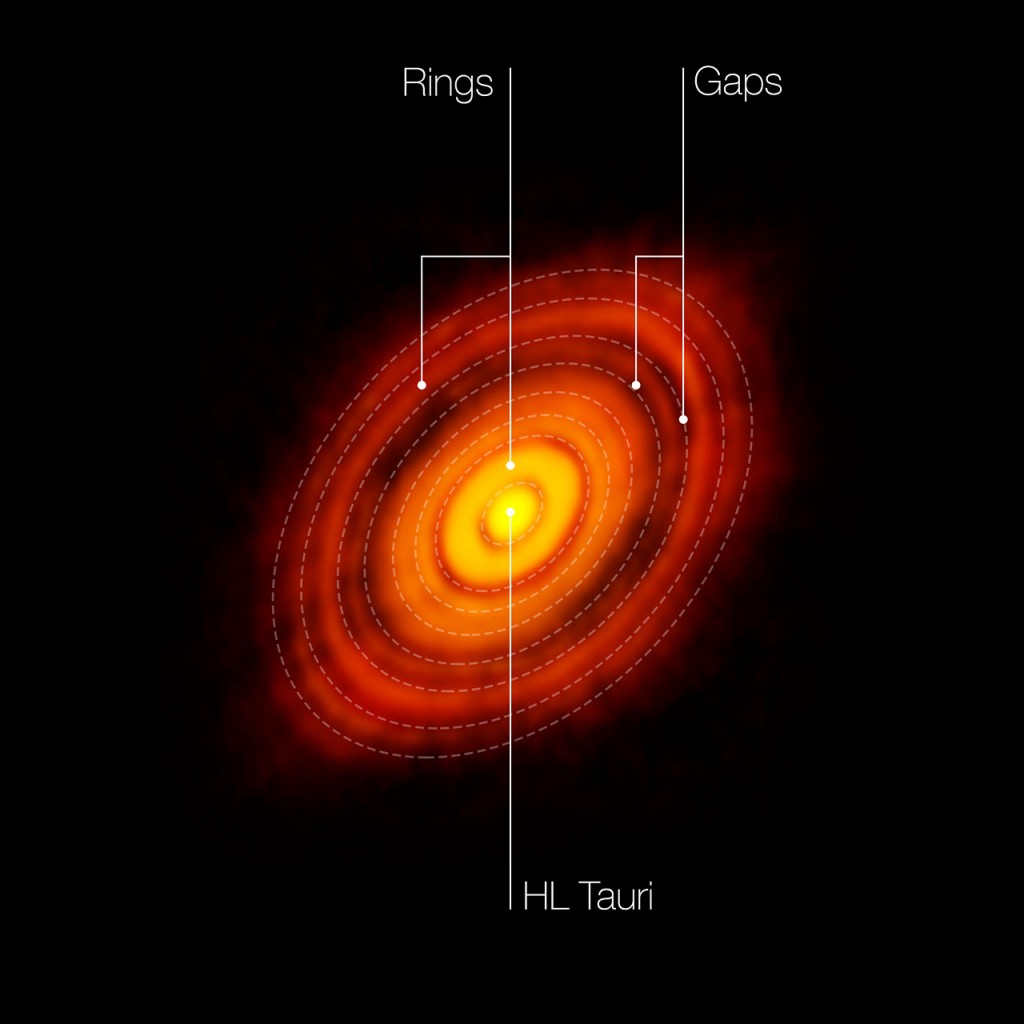
This new image from ALMA, the Atacama Large Millimeter/submillimeter Array, reveals extraordinarily fine detail that has never been seen before in the planet-forming disc around a young star. These are the first observations that have used ALMA in its near-final configuration and the sharpest pictures ever made at submillimetre wavelengths. The new results are an enormous step forward in the observation of how protoplanetary discs develop and how planets form.
For ALMA’s first observations in its new and most powerful mode, researchers pointed the antennas at HL Tauri — a young star, about 450 light-years away, which is surrounded by a dusty disc [1]. The resulting image exceeds all expectations and reveals unexpectedly fine detail in the disc of material left over from star birth. It shows a series of concentric bright rings, separated by gaps [2].
“These features are almost certainly the result of young planet-like bodies that are being formed in the disc. This is surprising since such young stars are not expected to have large planetary bodies capable of producing the structures we see in this image,” said Stuartt Corder, ALMA Deputy Director.
“When we first saw this image we were astounded at the spectacular level of detail. HL Tauri is no more than a million years old, yet already its disc appears to be full of forming planets. This one image alone will revolutionise theories of planet formation,” explained Catherine Vlahakis, ALMA Deputy Program Scientist and Lead Program Scientist for the ALMA Long Baseline Campaign.
HL Tauri’s disc appears much more developed than would be expected from the age of the system. Thus, the ALMA image also suggests that the planet-formation process may be faster than previously thought.
Such high resolution can only be achieved with the long baseline capabilities of ALMA and provides astronomers with new information that is impossible to collect with any other facility, even the NASA/ESA Hubble Space Telescope. “The logistics and infrastructure required to place antennas at such distant locations required an unprecedented coordinated effort by an expert international team of engineers and scientists,” said ALMA Director, Pierre Cox. “These long baselines fulfill one of ALMA’s major objectives and mark an impressive technological, scientific and engineering milestone.”
Young stars like HL Tauri are born in clouds of gas and fine dust, in regions which have collapsed under the effects of gravitation, forming dense hot cores that eventually ignite to become young stars. These young stars are initially cocooned in the remaining gas and dust, which eventually settles into a disc, known as a protoplanetary disc.
Through many collisions the dust particles will stick together, growing into clumps the size of sand grains and pebbles. Ultimately, asteroids, comets and even planets can form in the disc. Young planets will disrupt the disc and create rings, gaps and holes such as those seen in the structures now observed by ALMA [3].
The investigation of these protoplanetary discs is essential to our understanding of how Earth formed in the Solar System. Observing the first stages of planet formation around HL Tauri may show us how our own planetary system may have looked more than four billion years ago, when it formed.
“Most of what we know about planet formation today is based on theory. Images with this level of detail have up to now been relegated to computer simulations or artist’s impressions. This high resolution image of HL Tauri demonstrates what ALMA can achieve when it operates in its largest configuration and starts a new era in our exploration of the formation of stars and planets,” says Tim de Zeeuw, Director General of ESO.
Yale grad student Joseph R. Schmitt says that the discovery of a new exoplanet was enabled by the work of volunteers in the Planet Hunters citizens science program. Schmitt is first author on a paper about the discovery:
We’re happy to announce the discovery of a new planet discovered by Planet Hunters volunteers, which is now published in The Astrophysical Journal. You can read the article for free on the arXiv here.
The star (PH3/Kepler-289/KOI-1353/KIC 7303287) is young and Sun-like. Two planets in the system, with periods of 35 and 126 days, had been previously validated statistically, the outer planet being a gas giant. However, Planet Hunters volunteers discovered a third transit signal between these two planets at a period of 66 days (PH3 c).
A quirk in the system allowed us to actually measure the mass of all the planets using only the exact times that each planet transited. The outer two planets, PH3 c and d, do not have a constant period like most planets do. Instead, it oscillates around an average value in a regular manner, which meant that it had been missed by computer algorithms but was easy to find for human eyes. In particular, the period of PH3 c changes by 10.5 hours in just 10 orbits due to the gravitational influence of the outer gas giant tugging on the middle planet. If Earth experienced such large changes, then if 2014 were 365 days long, 2024 would be 367.4 days long, almost two and a half days longer than 2014.
The new planet is about 2.7 times the radius of Earth and 4 times as massive. Its low density means that, despite its low mass, a large chunk of the planet must be composed of hydrogen and helium: 2% by mass and 50% by radius. The outer planet, on the other hand, is like a warm version of our Saturn, while the inner planet’s mass is poorly known. It could be mostly rocky, watery, or gassy.
We would like to thank all of the people involved in the project and all of the Planet Hunters volunteers for making this possible. We hope to find more gems like this in the future.
Below is another panel discussion from the SETI Institute‘s SETIcon 2 event. This one is titled: Do Any Exoplanets Have Intelligent Occupants? As listed in the caption, the panelists include:
Jon M. Jenkins – Jon is the Analysis Lead for Kepler space observatory.
Jill Tarter – Jill directs the SETI Institute’s searches for intelligent life elsewhere, and is the holder of the Bernard M. Oliver Chair for SETI.
Margaret Turnbull- Margaret is an American astronomer. She received her PhD in Astronomy from the University of Arizona in 2004.
Dan Werthimer – Dan is co-founder and chief scientist of the SETI@home project and directs other UC Berkeley SETI searches at radio, infrared and visible wavelengths, including the Search for Extra-Terrestrial Radio Emissions from Nearby Developed Intelligent Populations (SERENDIP).