Category Archives: Exoplanets

ESO: New telescope array in Chile to look for exoplanets

The latest news item from ESO (European Southern Observatory):

New Exoplanet-hunting Telescopes on Paranal

The Next-Generation Transit Survey (NGTS) has achieved first light at ESO’s Paranal Observatory in northern Chile. This project will search for transiting exoplanets — planets that pass in front of their parent star and hence produce a slight dimming of the star’s light that can be detected by sensitive instruments. The telescopes will focus on discovering Neptune-sized and smaller planets, with diameters between two and eight times that of Earth.
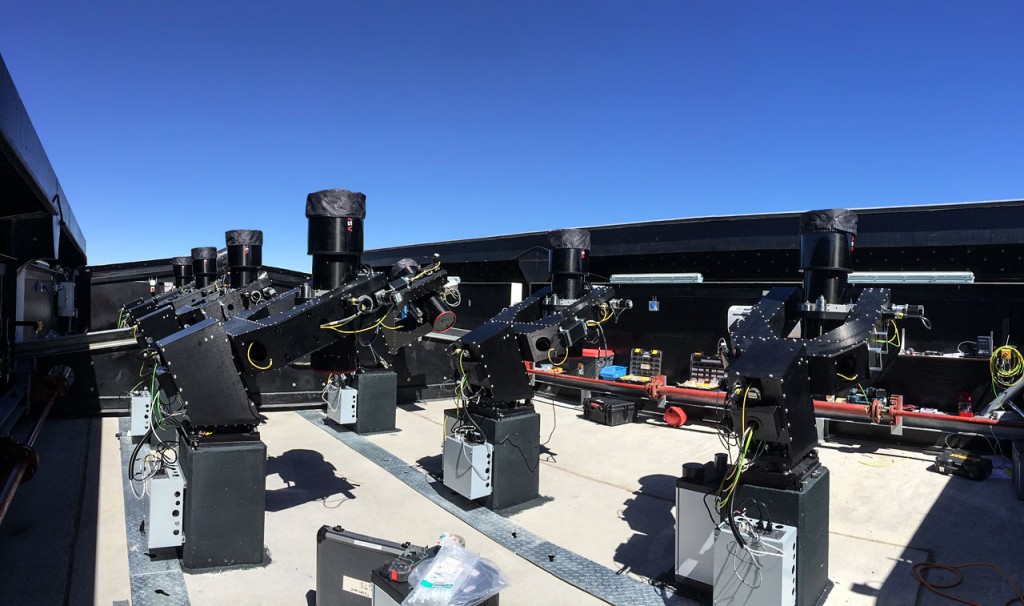
The Next-Generation Transit Survey (NGTS) at Paranal

The Next-Generation Transit Survey (NGTS) is located at ESO’s Paranal Observatory in northern Chile. This project will search for transiting exoplanets — planets that pass in front of their parent star and hence produce a slight dimming of the star’s light that can be detected by sensitive instruments. The telescopes will focus on discovering Neptune-sized and smaller planets, with diameters between two and eight times that of Earth.

Most of the 20-centimetre telescopes that form the survey system are shown in this picture taken during testing.  Credit: ESO/R. West

The Next-Generation Transit Survey (NGTS) is a wide-field observing system made up of an array of twelve telescopes, each with an aperture of 20 centimetres [1]. This new facility, built by a UK, Swiss and German consortium, is located at ESO’s Paranal Observatory in northern Chile and benefits from the superb observing conditions and excellent support facilities available at this site.

We needed a site where there were many clear nights and the air was clear and dry so that we could make very accurate measurements as often as possible — Paranal was the best choice by far,” says Don Pollacco of the University of Warwick in the UK and one of the NGTS project leads.

NGTS is designed to operate in a robotic mode and it will continuously monitor the brightness of hundreds of thousands of comparatively bright stars in the southern skies. It is searching for transiting exoplanets and will reach a level of accuracy in measuring the brightness of stars — one part in a thousand — that has never before been attained with a ground-based wide-field survey instrument [2].

This great accuracy of brightness measurement, across a wide field, is technically demanding, but all the key technologies needed for NGTS were demonstrated using a smaller prototype system, which operated on La Palma in the Canary Islands during 2009 and 2010. NGTS also builds on the success of the SuperWASP experiment, which up to now leads in the detection of large gaseous planets.

The discoveries of NGTS will be studied further using other larger telescopes, including the ESO Very Large Telescope. One goal is to find small planets that are bright enough for the planetary mass to be measured. This will allow planetary densities to be deduced, which in turn provides clues about the composition of the planets. It may also be possible to probe the atmospheres of the exoplanets whilst they are in transit. During the transit some of the star’s light passes through the planet’s atmosphere, if it has one, and leaves a tiny, but detectable, signature. So far only a few such very delicate observations have been made, but NGTS should provide many more potential targets.

This is the first telescope project hosted, but not operated, by ESO on Paranal. Several telescope projects operating under similar arrangements are already at work at the older La Silla Observatory. The NGTS data will flow into the ESO archivesystem and will be available to astronomers worldwide for decades to come.

Peter Wheatley, one of the NGTS project leads from the University of Warwick, concludes: “We are excited to begin our search for small planets around nearby stars. The NGTS discoveries, and follow-up observations by telescopes on the ground and in space, will be important steps in our quest to study the atmospheres and composition of small planets such as the Earth.

The NGTS Consortium is composed of the University of Warwick, UK; the Queen’s University of Belfast, UK; the University of Leicester, UK; the University of Cambridge, UK; Geneva University, Switzerland and DLR Berlin, Germany.

Space art: PlanetQuest Exoplanet Travel Posters

NASA’s PlanetQuest website, which provides info on the search for earth-like exoplanets, now offers beautiful posters in the Exoplanet Travel Series.  The set currently includes posters for three distant planets of particular interest:

Kepler-186f_39x27[1]


Kepler-186f is the first Earth-size planet discovered in the potentially ‘habitable zone’ around another star, where liquid water could exist on the planet’s surface. Its star is much cooler and redder than our Sun. If plant life does exist on a planet like Kepler-186f, its photosynthesis could have been influenced by the star’s red-wavelength photons, making for a color palette that’s very different than the greens on Earth. This discovery was made by Kepler, NASA’s planet hunting telescope.

HD_40307g_20x30[1]


Twice as big in volume as the Earth, HD 40307g straddles the line between “Super-Earth” and “mini-Neptune” and scientists aren’t sure if it has a rocky surface or one that’s buried beneath thick layers of gas and ice. One thing is certain though: at eight time the Earth’s mass, its gravitational pull is much, much stronger.

Kepler-16b_20x-30[1]


Like Luke Skywalker’s planet “Tatooine” in Star Wars, Kepler-16b orbits a pair of stars. Depicted here as a terrestrial planet, Kepler-16b might also be a gas giant like Saturn. Prospects for life on this unusual world aren’t good, as it has a temperature similar to that of dry ice. But the discovery indicates that the movie’s iconic double-sunset is anything but science fiction.

Low cost exoplanet hunting and gathering

A number of projects are showing that finding and studying exoplanets can be done with relatively low cost systems:   : Brave new world-hunters spot exoplanets on the cheap – New Scientist.

Such systems do not replace the space-based observatories like Kepler or the ground-based work by giant telescopes. These systems can look at thousands of stars with high resolution and sensitivity. Instead, the small guys can focus for long periods on just a handful of star systems. This can be done to hunt for new exoplanets or to gather more information on those found by the big systems.

Since Kepler’s staggering number of finds implied most stars probably have planets, astronomers are increasingly aiming for detailed planet studies instead of just making discoveries, Johnson says.

“This is no longer the day of swashbuckling scientists trying to get as many kills as possible,” [Greg Laughlin, an astronomer at the University of California at Santa Cruz,] says. “There is so much great science just sitting on the floor… with the Kepler statistics in hand, we’re no longer in the area of planet hunting. We’re in the era of planet gathering.”

For example, there is the Minerva exoplanet observatory, which describes itself as follows –

Minerva will be an array of small-aperture robotic telescopes outfitted for both photometry and high-resolution spectroscopy. It will be the first U.S. observatory dedicated to exoplanetary science capable of both precise radial velocimetry and transit studies. The multi-telescope concept will be implemented to either observe separate targets or a single target with a larger effective aperture. The flexibility of the observatory will maximize scientific potential and also provide ample opportunities for education and public outreach. The design and implementation of Minerva will be carried out by postdoctoral and student researchers at Caltech.

The primary science goal of Minerva is to discover Earth-like planets in close-in (less than 50-day) orbits around nearby stars, and super-Earths (3-15 times the mass of Earth) in the habitable zones of the closest Sun-like stars. The secondary goal will be to look for transits (eclipses) of known and newly-discovered extrasolar planets, which provide information about the radii and interior structures of the planets….

[]

Aqawan 1 and Telescope 1 at the Caltech
commissioning site. Image credit: M. Wong

Such a system is even accessible for (wealthy) amateurs. From the NS article:

Minerva uses four 0.7-metre-wide, 2.5-metre-tall commercial telescopes built by a company called PlaneWave, which also sells them to hobbyists for about $200,000 – Amazon founder Jeff Bezos bought one just before Minerva’s team.

The Mearth Project is another exoplanet observatory using arrays of off-the-shelf telescopes.

[]

There is also the HATNet Exoplanet Survey (Hungarian-made Automated Telescope Network) project.

[]

HATNet telescopes located at the Fred Lawrence Whipple Observatory (FLWO)
on Mount Hopkins in Arizona, USA (5 telescopes),


Kepler verifies more exoplanets and finds 554 new candidates

Further analysis of data from the Kepler space observatory results in another big batch of candidate exoplanets plus eight former candidates are moving to the verified category. Several new candidates are in the earth sized range and orbit in their star system’s habitable zone where water can remain liquid if the atmosphere is dense enough.

NASA’s Kepler Marks 1,000th Exoplanet Discovery,
Uncovers More Small Worlds in Habitable Zones

How many stars like our sun host planets like our Earth? NASA’s Kepler Space Telescope continuously monitored more than 150,000 stars beyond our solar system, and to date has offered scientists an assortment of more than 4,000 candidate planets for further study — the 1,000th of which was recently verified.

15-004_0[1]Click for large image.

Using Kepler data, scientists reached this millenary milestone after validating that eight more candidates spotted by the planet-hunting telescope are, in fact, planets. The Kepler team also has added another 554 candidates to the roll of potential planets, six of which are near-Earth-size and orbit in the habitable zone of stars similar to our sun.

Three of the newly-validated planets are located in their distant suns’ habitable zone, the range of distances from the host star where liquid water might exist on the surface of an orbiting planet. Of the three, two are likely made of rock, like Earth.

“Each result from the planet-hunting Kepler mission’s treasure trove of data takes us another step closer to answering the question of whether we are alone in the Universe,” said John Grunsfeld, associate administrator of NASA’s Science Mission Directorate at the agency’s headquarters in Washington. “The Kepler team and its science community continue to produce impressive results with the data from this venerable explorer.”

To determine whether a planet is made of rock, water or gas, scientists must know its size and mass. When its mass can’t be directly determined, scientists can infer what the planet is made of based on its size.

Two of the newly validated planets, Kepler-438b and Kepler-442b, are less than 1.5 times the diameter of Earth. Kepler-438b, 475 light-years away, is 12 percent bigger than Earth and orbits its star once every 35.2 days. Kepler-442b, 1,100 light-years away, is 33 percent bigger than Earth and orbits its star once every 112 days.

Both Kepler-438b and Kepler-442b orbit stars smaller and cooler than our sun, making the habitable zone closer to their parent star, in the direction of the constellation Lyra. The research paper reporting this finding has been accepted for publication in The Astrophysical Journal.

“With each new discovery of these small, possibly rocky worlds, our confidence strengthens in the determination of the true frequency of planets like Earth,” said co-author Doug Caldwell, SETI Institute Kepler scientist at NASA’s Ames Research Center at Moffett Field, California. “The day is on the horizon when we’ll know how common temperate, rocky planets like Earth are.”

With the detection of 554 more planet candidates from Kepler observations conducted May 2009 to April 2013, the Kepler team has raised the candidate count to 4,175. Eight of these new candidates are between one to two times the size of Earth, and orbit in their sun’s habitable zone. Of these eight, six orbit stars that are similar to our sun in size and temperature. All candidates require follow-up observations and analysis to verify they are actual planets.

“Kepler collected data for four years — long enough that we can now tease out the Earth-size candidates in one Earth-year orbits”, said Fergal Mullally, SETI Institute Kepler scientist at Ames who led the analysis of a new candidate catalog. “We’re closer than we’ve ever been to finding Earth twins around other sun-like stars. These are the planets we’re looking for”.

These findings also have been submitted for publication in The Astrophysical Journal Supplement.

Work is underway to translate these recent discoveries into estimates of how often rocky planets appear in the habitable zones of stars like our sun, a key step toward NASA’s goal of understanding our place in the universe.

Scientists also are working on the next catalog release of Kepler’s four-year data set. The analysis will include the final month of data collected by the mission and also will be conducted using sophisticated software that is more sensitive to the tiny telltale signatures of small Earth-size planets than software used in the past.

Ames is responsible for Kepler’s mission operations, ground system development and science data analysis. NASA’s Jet Propulsion Laboratory in Pasadena, California, managed Kepler mission development. Ball Aerospace & Technologies Corp. in Boulder, Colorado, developed the Kepler flight system and supports mission operations with the Laboratory for Atmospheric and Space Physics at the University of Colorado in Boulder. The Space Telescope Science Institute in Baltimore archives, hosts and distributes Kepler science data. Kepler is NASA’s 10th Discovery Mission and was funded by the agency’s Science Mission Directorate in Washington.

For more information about the Kepler mission, visit: www.nasa.gov/kepler

Video: “Interstellar Voyaging – An Evolutionary Transition” – Cameron M. Smith

Cameron M, Smith is an archaeologist  who has become involved in the study of spaceflight and space settlement. He has become known in the space blog-o-sphere for his DIY space suit projects (see a list of posts here). Below is a video of a lecture he gave recently for the Public Lecture Series at the Perimeter Institute for Theoretical Physics in Waterloo, Ontario, Canada. The lecture was titled, Interstellar Voyaging: An Evolutionary Transition :

The discovery of countless exoplanets and new ideas in propulsion physics have resurrected international interest in the ancient concept of humanity traveling far beyond Earth. Such voyages will take place over many generations, requiring careful attention to both biological and cultural change over time. In this talk Cameron Smith will outline the foundations of a biocultural science of long-term space settlement.