Last summer billionaire Yuri Milner announced he would fund a $100M initiative for the search for extraterrestrial intelligent life. The organization formed to implement the program is called Breakthrough Initiatives and its chairman is Pete Worden, former director of NASA Ames Research Center. Below is a video of an interesting and entertaining SETI Institute talk given by Worden in which he discusses the history of SETI, exoplanets, the possibility of earth-like planets around nearby star systems, the feasibility of interstellar travel, and other topics.
On July 20, 2015, the 46th anniversary of the Apollo 11 moon landing, the Breakthrough Prize Foundation announced in London, UK a new initiative to study life in the universe. The announcement was made by Silicon Valley billionaire Yuri Milner and physicist Steven Hawking. The Breakthrough Initiatives currently consist of two primary elements, Breakthrough Listen which is a $100M renewed search for intelligent extraterrestrial signals, and Breakthrough Message, a global competition with a $1M prize to create, but not send a message representing humanity. S. Pete Worden, the former Center Director of the NASA Ames Research Center, is the Chairman of the Breakthrough Prize Foundation. He will talk about these initiatives in the broader context of our search for life in the universe.
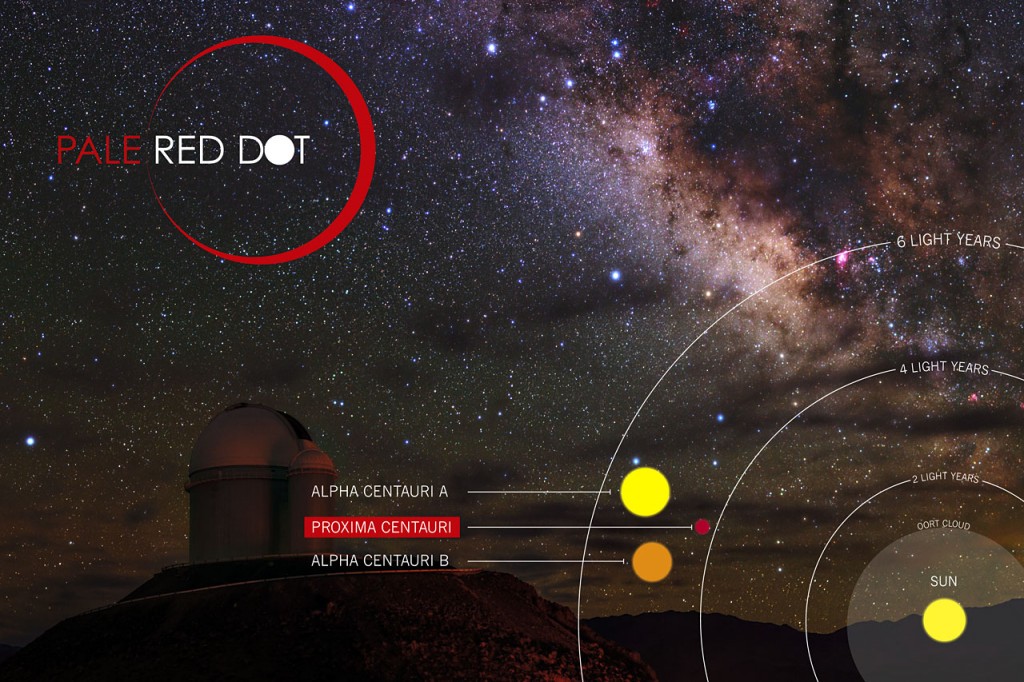
ESO opens a new outreach program that allows the general public to follow closely the hunt for an earth-like exoplanet around the nearest star Proxima Centauri:
A unique outreach campaign has been launched that will allow the general public to follow scientists from around the globe as they search for an Earth-like exoplanet around the closest star to us, Proxima Centauri. The observing campaign will run from January to April 2016 and will be accompanied by blog posts and social media updates. No one knows what the outcome will be. In the months following the observations, the scientists will analyse the data and submit the results to a peer-reviewed journal.
Pale Red Dot is an international search for an Earth-like exoplanet around the closest star to us, Proxima Centauri. It will use HARPS, attached to ESO’s 3.6-metre telescope at La Silla Observatory, as well as the Las Cumbres Observatory Global Telescope Network (LCOGT) and the Burst Optical Observer and Transient Exploring System (BOOTES). It will be one of the few outreach campaigns allowing the general public to witness the scientific process of data acquisition in modern observatories. The public will see how teams of astronomers with different specialities work together to collect, analyse and interpret data, which may or may not be able to confirm the presence of an Earth-like planet orbiting our nearest neighbour . The outreach campaign consists of blog posts and social media updates on the Pale Red Dot Twitter account and using the hashtag #PaleRedDot. For more information visit the Pale Red Dot website: http://www.palereddot.org
At a distance of just 4.2 light-years from the Sun, and located in the constellation of Centaurus, Proxima Centauri is the closest known star to the Sun. Previous observations have provided tantalising, but weak hints of a small companion orbiting this red dwarf star, but this new campaign will make a more sensitive search for the telltale wobbles in the dwarf star’s orbital motion that might reveal the presence of an Earth-like orbiting planet.
Observations will be made with the High Accuracy Radial velocity Planet Searcher (HARPS), attached to ESO’s 3.6-metre telescope at La Silla Observatory. The HARPS data will be complemented by images from an assortment of robotic telescopes located across the world [1].
The telescopes that comprise the Burst Optical Observer and Transient Exploring System (BOOTES) and the Las Cumbres Observatory Global Telescope Network (LCOGT) will support the search by measuring the brightness of Proxima Centauri every night during the two and a half month long project. These observations will help astronomers determine whether any detected wobbles in the star’s motion are caused by features on its turbulent surface or by an orbiting planet.
Once the data have been collected by the various telescopes, astronomers can start their analysis. In the following months, their research methods and conclusions will be described in a paper submitted to a peer-reviewed scientific journal. When the scientific community has validated the research, the results will be published, concluding a long and substantial programme of scientific research.
Apart from following the scientific observations as they arrive, the Pale Red Dot outreach campaign [2] gives the public the opportunity to see how science is done in modern observatories, and how teams of astronomers with different specialities work together to collect, analyse and interpret data, which may or may not be able to confirm the presence of an Earth-like planet orbiting our nearest neighbour.
“We are taking a risk to involve the public before we even know what the observations will be telling us — we cannot analyse the data and draw conclusions in real time. Once we publish the paper summarising the findings it’s entirely possible that we will have to say that we have not been able to find evidence for the presence of an Earth-like exoplanet around Proxima Centauri. But the fact that we can search for such small objects with such extreme precision is simply mind-boggling,” said Guillem Anglada-Escude, the Project Coordinator.
“We want to share the excitement of the search with people and show them how science works behind the scenes, the trial and error process and the continued efforts that are necessary for the discoveries that people normally hear about in the news. By doing so, we hope to encourage more people towards STEM [3] subjects and science in general,” adds Guillem.
The Pale Red Dot outreach campaign will illuminate the often unseen side of planet hunting with background articles and through social media. A bustling array of blog posts on many topics — including planet-hunting techniques, ESO’s European Extremely Large Telescope (E-ELT), and the lives of stars — are planned, written by the astronomers, scientists and engineers from the observatories involved, as well as science writers, observers and other experts in the field.
There will be daily social media updates, briefing the public on how the observations are going and any events taking place at the three observatories involved. To receive updates, people are invited to follow the Pale Red Dot Twitter accountand the hashtag #PaleRedDot.
The name of the campaign was inspired by the famous “pale blue dot” image of the Earth, taken in 1990 by Voyager 1 on its way to interstellar space. The phrase was later used by Carl Sagan for his essay, Pale Blue Dot: A Vision of the Human Future in Space. As Proxima Centauri is a red dwarf star, astronomers expect that an exoplanet orbiting it will appear reddish. At the same time, just as Voyager’s image of Earth was a remarkable achievement for humanity, finding an Earth-like exoplanet around the closest star to us would be a another step towards answering humanity’s biggest question: Are we alone?
The Pale Red Dot campaign will begin in earnest on 15 January 2016 with observations commencing just three days later from ESO’s La Silla Observatory, situated at the edge of the Chilean Atacama Desert, and continuing until the first week of April. All of the scientific data obtained as part of the project are expected to become publicly available for all to exploit in late 2016.
Notes
[1] The team of astronomers leading the observations and outreach campaign are: Guillem Anglada-Escude, Gavin Coleman, John Strachan (Queen Mary University of London, UK), James Jenkins (Universidad de Chile, Chile), Cristina Rodriguez-Lopez, Zaira M. Berdinas, Pedro J. Amado (Instituto de Astrofisica de Andalucia/CSIC), Julien Morin (Universite de Montpellier, France), Mikko Tuomi (Centre for Astrophysics Research/University of Hertfordshire, UK), Yiannis Tsapras (Heidelberg/LCOGT, Astronomisches Rechen-Institut – Heidelberg & LCOGT) and Christopher J. Marvin (University of Goettingen).
[2] The outreach campaign is coordinated by the project team with support from the outreach departments of ESO, Queen Mary University of London, Instituto de Astrofisica de Andalucia/CSIC, Universite de Montpellier, University of Goettingen, Universidad de Chile and Las Cumbres Observatory Global Telescope Network.
[3] STEM, Science, Technology, Engineering and Mathematics.
While the transit method works best with space telescopes like Kepler for finding and studying new exoplanets, there are some special cases of where large exoplanets that orbit close to its star can be seen by ground based telescopes. Here is an interesting account of such an observation via the site Deep Sky Videos – Videos about the Depths of Space.
Astronomers have used the NASA/ESA Hubble Space Telescope and the NASA Spitzer Space Telescope to study the atmospheres of ten hot, Jupiter-sized exoplanets in detail, the largest number of such planets ever studied. The team was able to discover why some of these worlds seem to have less water than expected — a long-standing mystery. The results are published in “Nature”.
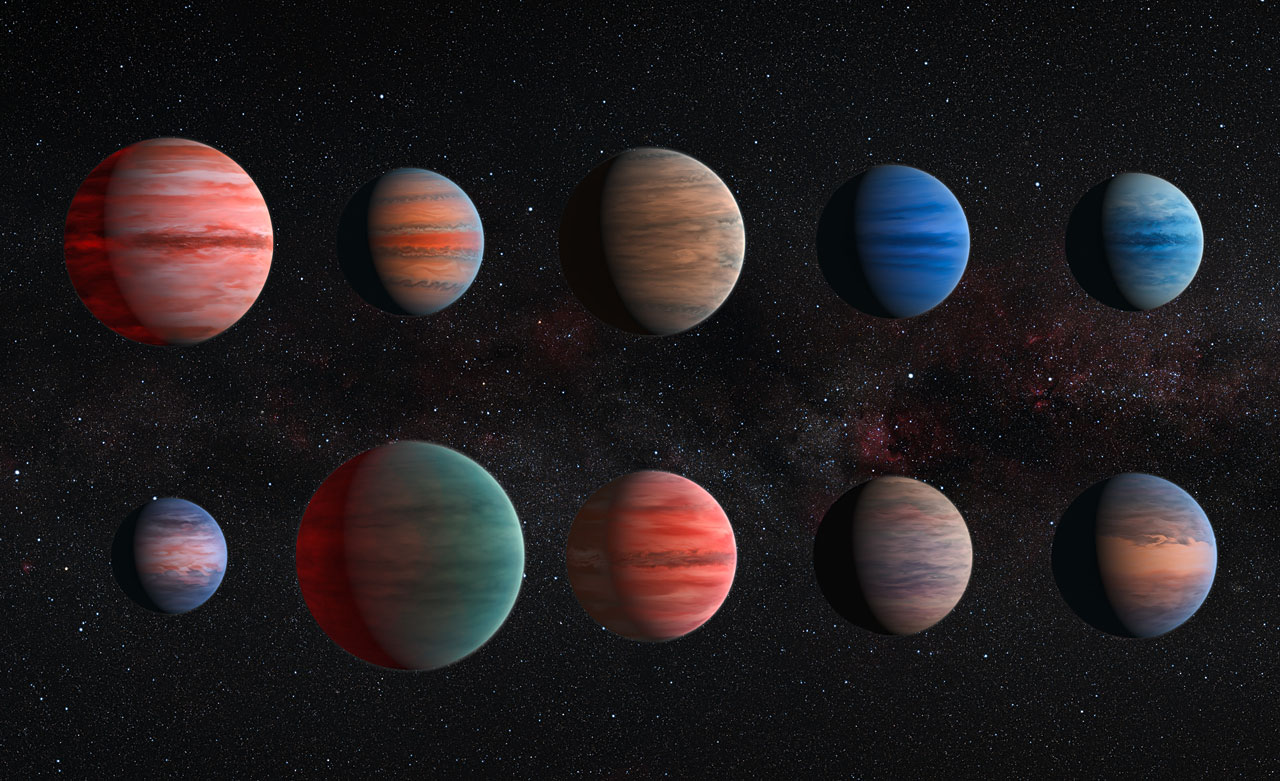
This image shows an artist’s impression of the ten hot Jupiter exoplanets studied by David Sing and his colleagues. From top left to to lower left these planets are WASP-12b, WASP-6b, WASP-31b, WASP-39b, HD 189733b, HAT-P-12b, WASP-17b, WASP-19b, HAT-P-1b and HD 209458b. The images are to scale with each other. HAT-P-12b, the smallest of them, is approximately the size of Jupiter, while WASP-17b, the largest planet in the sample, is almost twice the size. The planets are also depicted with a variety of different cloud properties. There is almost no information about the colours of the planets available, with the exception of HD 189733b, which became known as the blue planet (heic1312). The hottest planets within the sample are portrayed with a glowing night side. This effect is strongest on WASP-12b, the hottest exoplanet in the sample, but also visible on WASP-19b and WASP-17b. It is also known that several of the planets exhibit strong Rayleigh scattering. This effect causes the blue hue of the daytime sky and the reddening of the Sun at sunset on Earth. It is also visible as a blue edge on the planets WASP-6b, HD 189733b, HAT-P-12b, and HD 209458b. The wind patterns shown on these ten planets, which resemble the visible structures on Jupiter, are based on theoretical models. [Annotated image]To date, astronomers have discovered nearly 2000 planets orbiting other stars. Some of these planets are known as hot Jupiters — hot, gaseous planets with characteristics similar to those of Jupiter. They orbit very close to their stars, making their surface hot, and the planets tricky to study in detail without being overwhelmed by bright starlight.
Due to this difficulty, Hubble has only explored a handful of hot Jupiters in the past, across a limited wavelength range. These initial studies have found several planets to hold less water than expected (opo1436a, opo1354a).
This video shows an artist’s impression of the ten hot Jupiter exoplanets studied by David Sing and his colleagues. From top left to to lower left these planets are WASP-12b, WASP-6b, WASP-31b, WASP-39b, HD 189733b, HAT-P-12b, WASP-17b, WASP-19b, HAT-P-1b and HD 209458b…
Now, an international team of astronomers has tackled the problem by making the largest ever study of hot Jupiters, exploring and comparing ten such planets in a bid to understand their atmospheres [1]. Only three of these planetary atmospheres had previously been studied in detail; this new sample forms the largest ever spectroscopic catalogue of exoplanet atmospheres.
The team used multiple observations from both the NASA/ESA Hubble Space Telescope and NASA’s Spitzer Space Telescope. Using the power of both telescopes allowed the team to study the planets, which are of various masses, sizes, and temperatures, across an unprecedented range of wavelengths [2].
“I’m really excited to finally ‘see’ this wide group of planets together, as this is the first time we’ve had sufficient wavelength coverage to be able to compare multiple features from one planet to another,” says David Sing of the University of Exeter, UK, lead author of the new paper. “We found the planetary atmospheres to be much more diverse than we expected.”
All of the planets have a favourable orbit that brings them between their parent star and Earth. As the exoplanet passes in front of its host star, as seen from Earth, some of this starlight travels through the planet’s outer atmosphere. “The atmosphere leaves its unique fingerprint on the starlight, which we can study when the light reaches us,” explains co-author Hannah Wakeford, now at NASA Goddard Space Flight Center, USA.
These fingerprints allowed the team to extract the signatures from various elements and molecules — including water — and to distinguish between cloudy and cloud-free exoplanets, a property that could explain the missing water mystery.
The team’s models revealed that, while apparently cloud-free exoplanets showed strong signs of water, the atmospheres of those hot Jupiters with faint water signals also contained clouds and haze — both of which are known to hide water from view. Mystery solved!
“The alternative to this is that planets form in an environment deprived of water — but this would require us to completely rethink our current theories of how planets are born,” explained co-author Jonathan Fortney of the University of California, Santa Cruz, USA. “Our results have ruled out the dry scenario, and strongly suggest that it’s simply clouds hiding the water from prying eyes.”
The study of exoplanetary atmospheres is currently in its infancy, with only a handful of observations taken so far. Hubble’s successor, the James Webb Space Telescope, will open a new infrared window on the study of exoplanets and their atmospheres.
Notes
[1] To date, studies of exoplanet atmospheres have been dominated by a small number of well-studied planets. The team used Hubble and Spitzer observations of two such planets, HD 209458b (heic0303, opo0707b) and HD 189733b (heic1312, heic0720a), and used Hubble to observe eight other exoplanets — WASP-6b, WASP-12b, WASP-17b, WASP-19b, WASP-31b, WASP-39b, HAT-P-1b, HAT-P-12b. These planets have a broad range of physical parameters.
[2] The observations spanned from the ultraviolet (0.3 μm) to the mid-infrared (4.5 μm).
An interesting review by Fergal Mullally of the SETI Institute on how the Kepler Space Observatory finds indications that a planet is orbiting a distant star and then how they examine the data to confirm whether or not the exoplanet is real:
Seminar abstract:
Dr. Mullally will present the 7th catalog of Planet Candidates found by Kepler. Uniformly vetted lists of detected planet candidates are a key step towards measuring the occurrence rates of planets, as well as providing interesting individual objects for potential follow-up. The 7th catalog includes 8826 objects of interest, of which 4696 are deemed viable planet candidates.
This catalog is the first to be uniformly vetted in an entirely objective manner by algorithm, instead of by manual inspection. This algorithmic approach enables us to test our results against simulated data sets allowing us to measure our performance for the first time. Dr. Mullally will discuss some novel features of the vetting pipeline, discuss the performance and limitations, and highlight some interesting individual planets.