4. Sunday, Feb.20, 2022; 12-1:30 pm PST (2-3:30 pm CST, 3-4:30 pm EST): We welcome back Dr. Abraham (Avi) Loeb to discuss his new Galileo Project with us.
Some recent shows:
** Sunday, Feb.13.2022 – Joe Carroll discussed “his ideas on LEO space debris solutions. Be sure to follow along with his PPT slides uploaded to our blog for this program“.
** Friday, Feb.11.2022 – Brett Hoffstadt and Steve Tanaka talked about “their new children’s bedtime story book, Goodnight Moon Base [Amazon commission link, including] the illustrations, inspiring young children to dream big and do big things, to learn about the Moon and much more”.
** Tuesday, Feb.8.2022 – Douglas Messier discussed “the FAA and related issues to Starship being able to test and launch from Boca Chica. Other topics and timely news were also discussed“.
Here is the latest episode in NASA’s Space to Ground weekly report on activities related to the International Space Station:
** STEMonstrations: Centripetal Force – NASA Johnson
NASA Astronaut Shane Kimbrough discusses centripetal force and its connection to keeping the International Space Station safely orbiting Earth. Watch JAXA astronaut Aki Hoshide demonstrate centripetal force in the weightless-simulated environment aboard the space station and find out what happens to a revolving object when the centripetal force is lost. Be sure to check out https://www.nasa.gov/stemonstrations for more videos like this, along with their corresponding classroom connection lesson plans.
The International Space Station (ISS) is a one-of-a-kind research platform that is capable of groundbreaking innovations that are not possible on Earth. Just as importantly, the orbiting laboratory also provides a novel venue to inspire and engage the next generation of researchers and explorers. This year’s virtual Destination Station event took place Wednesday, Feb. 2, 2022, and featured NASA astronaut Victor Glover on what it is like to live and work in space. Additionally, representatives from NASA and the ISS National Lab offered overviews of the capabilities on station as well as current research opportunities to become part of the space station research community!
** Expedition 66 Astronaut Mark Vande Hei Answers Virginia Student Questions – Feb. 10, 2022 – NASA Video
Aboard the International Space Station, NASA Expedition 66 Flight Engineer Mark Vande Hei of NASA answered pre-recorded questions about life and work on the orbital laboratory during an in-flight event Feb. 10 with students attending Virginia Western Community College in Roanoke, Virginia. Vande Hei is in the midst of a record setting mission for a single spaceflight by a U.S. astronaut living and working aboard the microgravity laboratory to advance scientific knowledge and demonstrate new technologies for future human and robotic exploration missions as part of NASA’s Moon and Mars exploration approach, including lunar missions through NASA’s Artemis program.
** Media Briefing: Space Station Science Highlights on Northrop Grumman’s 17th Resupply Mission – NASA Video
Scientist, engineer, test subject and tradesperson – astronauts in orbit wear many different hats. In this 360° timelapse, ESA astronaut Matthias Maurer works to repair a faulty valve behind EXPRESS-Rack 3. Water On-Off Valve 8 (WOOV-8), along with WOOV-6 and WOOV-7, determines whether the cooling water of Europe’s Columbus module flows through, or bypasses, the heat exchange system that transfers waste heat to downstream cooling circuits outside the International Space Station. The valve has been a problem child for ground teams and astronauts for the past few years and was first replaced during a complicated operation in 2013. It was last replaced by ESA astronaut Thomas Pesquet in October 2021, but continued issues led Matthias to try out a reserve valve to see if an unplanned conversion was possible.
The operation was successfully completed on the real WOOV-8 in December 2021, and all involved breathed a sigh of relief. Performing maintenance and repair tasks in weightlessness is especially difficult as astronauts have the added challenge of trying to hold themselves in position while turning a screw or securing a hatch. Watch Matthias carefully fold down the rack, set-up lighting and complete the task as you explore his workspace in 360°.
Matthias was launched to the International Space Station for his Cosmic Kiss mission on 11 November 2021. He will spend approximately six months living and working in orbit, supporting over 35 European and many more international experiments on board. Follow Matthias: https://bit.ly/ESACosmicKiss
** China to Complete Space Station with Six More Missions in 2022: Blue Book – CCTV Video News Agency
China plans to make a record six launches in 2022 to finish building its space station, according to a blue paper released by China Aerospace Science and Technology Corporation (CASC), the main contractor of China’s space program, on Wednesday.
** Mechanical Arm on China’s Space Station Completes Another Grab Operation – CCTV Video News Agency
The mechanical arm attached to China’s Tiangong space station firmly grabbed a docking port in one operation, as shown in a video clip released by China Manned Space Agency on Tuesday.
Currently, live views from the ISS are streaming from an external camera mounted on the ISS module called Node 2. Node 2 is located on the forward part of the ISS. The camera is looking forward at an angle so that the International Docking Adapter 2 (IDA2) is visible. If the Node 2 camera is not available due to operational considerations for a longer period of time, a continuous loop of recorded HDEV imagery will be displayed. The loop will have “Previously Recorded” on the image to distinguish it from the live stream from the Node 2 camera. After HDEV stopped sending any data on July 18, 2019, it was declared, on August 22, 2019, to have reached its end of life. Thank You to all who shared in experiencing and using the HDEV views of Earth from the ISS to make HDEV so much more than a Technology Demonstration Payload!
1. Tuesday, Feb.8, 2022; 7 pm PST (9 pm CST, 10 pm EST): Douglas Messier of Parabolic Arc returns with all that is happening in space news to date in 2022.
2. Wednesday, Feb. 9, 2022; 1:00 pm PST (3:00 pm CST, 4:00 pm EST): No Hotel Mars this week.
3. Friday, Feb.11, 2022; 9:30-11 am PST (11:30 am-1 pm CST, 12:30-2 pm EST): Brett Hoffstadt with Steve Tanaka are guests regarding their new children’s book [Goodnight Moon Base (Amazon commission link)] and lunar development effort. See book URL and info on the upcoming menu on our home page.
4. Sunday, Feb.13, 2022; 12-1:30 pm PST (2-3:30 pm CST, 3-4:30 pm EST): Joe Carroll is back with his ideas and solutions for solving our space debris issues and problems.
Some recent shows: (There were no live shows in the previous week.)
** Tuesday, Jan.25.2022 – Dennis Wingo discussed “Starship, returning to the Moon, commercial space and space mining economics and challenges, much needed in-space vehicles, Mars, returning to the Moon, U.S.-Russia space relationship and much more“.
their new book, Beyond the Covid Shock: The Great Economic Transition“. We applied much of the economics from the book and the discussion to both the public and commercial space industry. Listeners and callers also asked lots of general economic questions given the state of today’s economy and how the pandemic is impacting it.
** Tuesday, Jan.18.2022 – Robert Zimmerman talked about “[a]nnual launch rates and predictions, China’s Long March 5B, Mars rovers, ancient molecular life on Mars, light carbon atoms, life in the solar system, Carbon-12, UV light, Musk and Starship, Georgia’s preliminary spaceport approval, exploring the lunar poles and more“.
Here is the latest episode in NASA’s Space to Ground weekly report on activities related to the International Space Station:
** STEMonstrations: Vestibular System – NASA Johnson
NASA Astronauts Mark Vande Hei and Shane Kimbrough demonstrate the effects of the weightless-simulated environment on their perception of motion, spatial orientation, and balance aboard the International Space Station. Watch as NASA astronaut Megan McArthur and JAXA astronaut Aki Hoshide discuss the vestibular system and learn how the human body relies on external cues to provide us with important information about our environment. Be sure to check out https://www.nasa.gov/stemonstrations for more videos like this, along with their corresponding Classroom Connection lesson plans.
** Media Briefing: NASA, SpaceX to Provide Update on Crew-4 Space Station Mission – NASA Video
** Expedition 66 Space Station Astronauts Answer Wisconsin Student Questions – Feb. 3, 2022 – NASA Video
Aboard the International Space Station, NASA Expedition 66 Flight Engineers Tom Marshburn and Kayla Barron of NASA answered pre-recorded questions about life and work as astronauts on the orbital laboratory during an in-flight event Feb. 3 with students attending the Random Lake School in Random Lake, Wisconsin. Marshburn and Barron are in the midst of long duration missions living and working aboard the microgravity laboratory to advance scientific knowledge and demonstrate new technologies for future human and robotic exploration missions as part of NASA’s Moon and Mars exploration approach, including lunar missions through NASA’s Artemis program.
** China’s space station decorated for lunar new year by crew – VideoFromSpace
China’s Shenzhou-13 crew Zhai Zhigang, Wang Yaping and Ye Guangfu decorated the Tiangon space station to celebrate lunar new year. Credit: Space.com | footage courtesy: China Central Television | produced & edited by Steve Spaleta
Spaceflight participants Yusaku Maezawa and Yozo Hirano and Russian cosmonaut Alexander Misurkin were welcomed to the International Space Station on 8 December 2021 for a 12 day stay in space. Experience their arrival and farewell in 360° as captured by ESA astronaut Matthias Maurer from within the Russian segment. Also seen in this video are Expedition 66 Commander Anton Shkaplerov, @Roscosmos Mediacosmonaut Pyotr Dubrov and @NASA astronauts Mark Vande Hei, Raja Chari, Tom Marshburn, and Kayla Barron. Matthias was launched to the International Space Station for his six-month ESA mission known as Cosmic Kiss on 11 November 2021. During his time on board, he will support around 35 European and many more international experiments in orbit. Follow Matthias: https://bit.ly/ESACosmicKiss
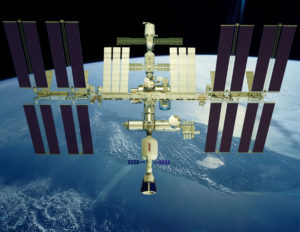
The Nasa ISS is broadcasting live from the International Space Station as it circles the earth at the edge of space in low earth orbit, 240 miles (405 km) above the planet.
Currently, live views from the ISS are streaming from an external camera mounted on the ISS module called Node 2. Node 2 is located on the forward part of the ISS. The camera is looking forward at an angle so that the International Docking Adapter 2 (IDA2) is visible. If the Node 2 camera is not available due to operational considerations for a longer period of time, a continuous loop of recorded HDEV imagery will be displayed. The loop will have “Previously Recorded” on the image to distinguish it from the live stream from the Node 2 camera. After HDEV stopped sending any data on July 18, 2019, it was declared, on August 22, 2019, to have reached its end of life. Thank You to all who shared in experiencing and using the HDEV views of Earth from the ISS to make HDEV so much more than a Technology Demonstration Payload!
** What’s Up: February 2022 Skywatching Tips from NASA – NASA JPL
What are some skywatching highlights in February 2022? Jupiter is the lone planet lingering in twilight skies after sunset in February. It exits the evening sky this month leaving no bright planets there until August (save for a brief appearance from Mercury in April). Also Venus is at peak brightness for the year in the a.m., and it’s a great time to view the Orion Nebula.
0:00 Intro
0:10 New Moon 0:30 Quadrantid meteors
1:28 Dusk / Dawn Highlights
2:28 Moon Phases
Additional information about topics covered in this episode of What’s Up, along with still images from the video, and the video transcript, are available at https://solarsystem.nasa.gov/skywatch….
In February, the Winter Triangle is your guide to the night sky: The northern hemisphere is treated to views of the stars Procyon, Sirius, and Betelgeuse. Keep watching for the awe-inspiring space-based views of the Orion Nebula, which is sculpted by the stellar winds of central bright stars.
About this Series
“Tonight’s Sky” is a monthly video of constellations you can observe in the night sky. The series is produced by the Space Telescope Science Institute, home of science operations for the Hubble Space Telescope, in partnership with NASA’s Universe of Learning. This is a recurring show, and you can find more episodes—and other astronomy videos—at https://hubblesite.org/resource-galle….