A sampling of recent articles, press releases, etc. related to student and amateur CubeSat / SmallSat projects and programs (find previous smallsat roundups here):
** University of Tokyo’s AQT-D: AQUA Thruster-Demonstrator was delivered to the ISS in the HTV-8 cargo module launched by a H-IIB rocket on Sept.24th. The student built CubeSat will be deployed from the station later this year. The goal is to demonstrate the AQUARIUS (AQUA ResIstojet propUlsion System) water micro-propulsion system, which is suitable for smallsats.
A sampling of recent articles, press releases, etc. related to student and amateur CubeSat / SmallSat projects and programs:
[ Update: A satellite developed by China’s AMSAT group and the Beijing Institute of Technology ( BIT ) is set to launch this month on a Chinese commercial rocket:
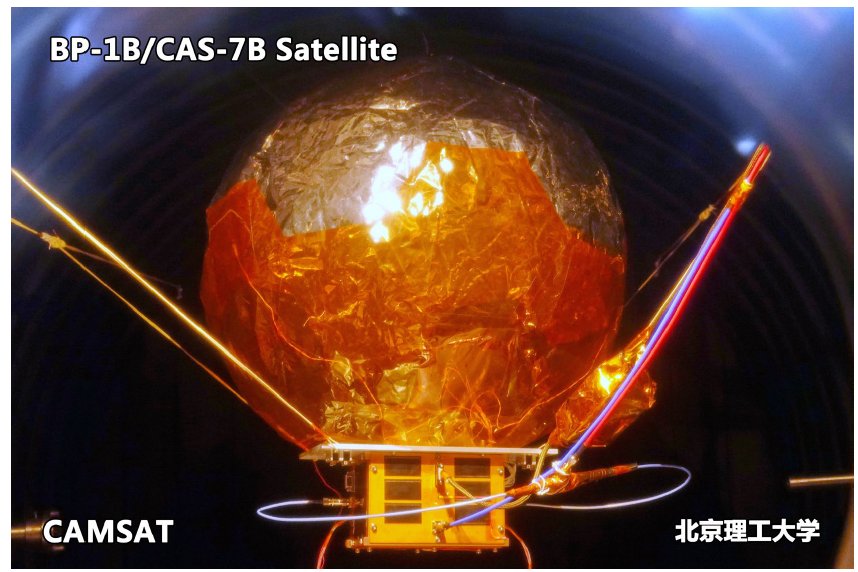
… the CAS-7B satellite, also designated as BP-1B, a short-lived spacecraft that will carry an Amateur Radio payload. An unusual feature of the spacecraft is its “sail ball” passive stabilization system. The 1.5-U CubeSat is attached to a 500-millimeter flexible film ball — or sail — that will offer passive “pneumatic resistance” stabilization. CAS-7B is expected to remain in orbit for up to 1 month.
The spacecraft will carry an Amateur Radio transponder and educational mission. CAMSAT is working with Beijing Institute of Technology (BIT), a top aerospace school, which is providing launch support in launch of the satellite. BIT faculty and students are participating in the development and testing of the satellite, and, with CAMSAT’s help, the university has established an Amateur Radio club (call sign BI1LG). CAMSAT said many students are now members, “learning Amateur Radio satellite communication and experience[ing] endless fun.”
The CAMSAT BP-1B/CAS-7B cubesat duringa thermal vacuum test with the “sail ball” deployed.
The next phase of this project involves the construction of a 4U (40 cm3) CubeSat in accordance with the UAE’s Environment Vision 2030.
Amity University, Dubai has launched a satellite ground station on their campus, which will allow students to track satellites, predict weather patterns and pollution levels, as reported by Khaleej Times.
The station at Amity University is aimed at garnering the participation of students studying aerospace, electrical, electronics, computer science or nanotechnology engineering.
Commenting on the initiative, Dr Vajhat Hussain, CEO of Amity University Dubai, as quoted by the English daily, said: “The main goal of the ground station is to give students the opportunity to perform the following operations – telemetry data visualisation and storage, antenna control and positioning system, radio communication using very high frequency (VHF) and satellite data analysis. Through this initiative, students will not only learn how to read and analyse such data but also get the support they need for research projects.”
Creating satellites to explore space is no longer just for adults.
At Grace Brethren High School, a group of about 20 students have made it their mission to launch a small satellite into orbit by 2020.
Known as CubeSat, the device contains a payload that can be monitored from the ground and is equipped with small yet strong LED lights that will send satellite-operating information to the mission operations center at the Grace Brethren Space Lab, said Annabelle Hynes, an 18-year-old graduate who worked on the project.
“Being the only girl involved in the spacecraft class and working on CubeSat has been an interesting experience, and we’ve gotten to do a lot of really exciting, hands-on things with this project,” Annabelle said.
“We’re still figuring out the basics, but . . . the plan is to track the satellite from the school and communicate with it. It will be open to other organizations so they can use the data we collect.”
EIRSAT-1 will be fully designed, assembled, tested and operated in Ireland by staff and students at UCD. This is primarily a technology demonstration and science mission with three payloads, a gamma-ray detector, a materials science experiment and a novel spacecraft control algorithm. It will also demonstrate a low-profile UHF/VHF Antenna Deployment Mechanism. Clyde Space are providing UCD with its full set of CubeSat avionics, including a flight proven onboard computer, an attitude determination and control system and its high-performance power system products.
Led by Professor Karu Esselle of the School of Engineering, the team has developed an antenna system with a steerable beam which will enable scientific data downloading from spacecrafts to labs on earth 24 hours a day.
As the first move towards rapidly growing space systems, the low-profile antenna system was designed for US company Audacy who launched the world’s first entirely Ka-band CubeSat (a type of miniaturised satellite that can be used for a variety of space applications including earth imaging, astronomy, science experiments, climate monitoring and surveillance) called Audacy Zero into space via a SpaceX Falcon 9 Rocket in December 2018.
Audacy, a company spun off Stanford University and based in California, is developing the world’s first commercial inter-satellite data relay network. Audacy Zero was the first iteration of a radio that will enable Audacy customers’ spacecraft to connect to this network.
“Data from your CubeSat will travel through the relay system down to earth to the internet and cloud,” explains Prof Esselle.
“Without such a space relay network, a CubeSat can be seen from a fixed ground station only for a few minutes per day and that is often not enough to download all the data collected by the CubeSat.
On March 14, a group of Yale students learned some stellar news — NASA selected their satellite to be launched into space. The announcement marks the first time a Yale undergraduate group will launch a spacecraft.
The team — which consists of members of the Yale Undergraduate Aerospace Association — received the launch grant through NASA’s CubeSat Launch Initiative competition. Over the course of four years, students designed a satellite called BLAST, which stands for Bouchet Low-Earth Alpha/Beta Space Telescope.
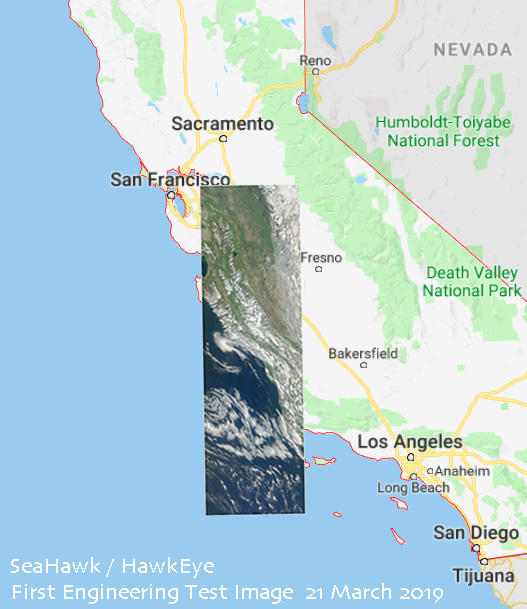
SeaHawk-1 is a 3U CubeSat (size 30x10x10cm and weight 5kg) designed and built by AAC Clyde Space and launched in December 2018 aboard SpaceX Falcon 9. SeaHawk-1 CubeSat was one of the 64 satellites included in the Spaceflight SSO-A Small Sat Express: their first dedicated ride-share mission for small satellites.
SeaHawk-1 is also the first 3U CubeSat specifically designed to carry an ocean color instrument payload (HawkEye). The goal of this proof-of-concept mission is to provide free high-spatial resolution images of Earth’s coastal regions. HawkEye, designed by Cloudland Instruments, is an 8-band multispectral instrument similar to SeaWiFS (one of the most successful ocean color missions to date).
It differs in that: it was miniaturized (10x10x10cm) to fit inside the CubeSat, band 7 was modified to improve atmospheric correction, all bands were designed not to saturate over land, and the entire sensor was built with low-cost, off-the-shelf materials.
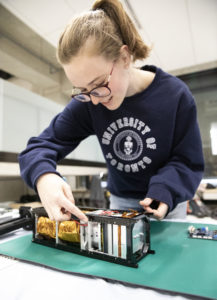
The Space Systems Division is preparing to launch the first fully student-funded Canadian satellite into orbit. The small satellite, or cubesat — about the size of a loaf of bread — will carry a biological payload and will analyze the behavior of bacteria in space with the aim of assessing the risk of infections during a long-term space mission.
The team has a busy summer ahead: they’ll be testing the accuracy of the sensors on the cubesat, running hundreds of hours of electronics tests and conducting thermal tests to ensure their satellite’s components can withstand the extreme temperatures it will experience in orbit, between -40 and 80 degrees C.
The cubesat is scheduled to launch on the Indian Space Research Organization’s Polar Satellite Launch Vehicle in January 2020.
“Cassandra Chanen (Year 2 EngSci) shows off the Heron MK II, a cubesat that will take a microbiology payload to space. (Credit: Erica Rae Chong)”
** More about the Hampton University students developing CubeSat software in a project sponsored by the Virginia Space Grant Consortium:
Hampton University is part of a collaborative project of the Virginia Space Grant Consortium where students from three Virginia universities delivered small satellites to NanoRacks in Houston, to be integrated into a CubeSat deployer (NRCSD), which will be launched into space on April 17, 2019. Four undergraduate Hampton University students worked on the project by developing software to perform analysis on the data that will be received from the satellites.
“Hampton University has always been on the forefront of innovation. The work our students are doing is being recognized and utilized by industry leaders, and we are excited to be part of this collaboration,” said Hampton University President, Dr. William R. Harvey.
The satellites will communicate data to ground stations at Virginia Tech, University of Virginia and Old Dominion University for subsequent analysis using an analytical tool being developed by Hampton University students from the Atmospheric and Planetary Science Department.
More than 140 undergraduate students have been hard at work on the mission since June 2016 as a cross-institutional team. Undergraduate student leaders and team members from physics, electrical engineering, aerospace engineering, mechanical engineering, chemical engineering and computer science disciplines have worked together to make the mission a reality. The students have been coached by faculty advisors and have benefitted greatly from advice from NASA, industry and academic advisors, and NanoRacks, the world’s leading commercial space station company.
“Asanji Chofor at the CubeSat build AGILE workshop.”
An inflatable space antenna designed by University of Arizona students is one of 16 small research satellites from 10 states NASA has selected to fly as auxiliary payloads aboard space missions planned to launch in 2020, 2021 and 2022.
CatSat is the size of a large cereal box. When fully deployed, the inflatable expands in a bubble gum fashion, forming a sphere three feet across that sticks out from one side of the box. An aluminized spot inside the inflated sphere is used as the communication antenna to beam data back to the Earth. Since Catsat will be in low Earth orbit, the data can be downloaded using a ground station located at the UA.
CatSat is mainly a technology demonstration mission to mature this inflatable concept in Earth orbit. The ultimate goal is to fly such an antenna on an interplanetary mission that Reddy wants to lead to explore small bodies in the solar system.
College students from all around Virginia, including in Hampton, are working on a major project that will analyze data of tiny satellites sent into space.
Four undergrad students from Hampton University are working with students from three other state universities to deliver small satellites to NanoRacks in Houston, Texas to be integrated into a CubeSat deployer (NRCSD).
A reader who keeps me up-to-date on the project says the system now includes
“improved color images and the addition of IR enhancements showing storm intensity for Band 13 images as well as IR color enhancements for Band 8 images.”