Category Archives: Space Settlement

Video: Gwynne Shotwell of SpaceX interviewed by Matt Desch of Iridium

At a symposium held this week by AOPA (Aircraft Owners and Pilots Association) dealing with the organization’s high school STEM initiatives, there was an on-stage interview with SpaceX President Gwynne Shotwell by Iridium CEO Matt Desch:

SpaceX President and COO Gwynne Shotwell talks about successes and failures in their rocket program, encouraging girls to pursue technical and scientific careers and “build big machines. She tells teachers at the AOPA High School Aviation STEM Symposium about the need for kids with training in science, technology, engineering and math.

[ Nov.9.2018: For some reason, the interview video unfortunately was taken down from Youtube. Will keep a lookout for a re-posting of it.

I did fined this clip taken from the video showing the SpaceX highlights reel presented by Shotwell:

]

In a video that she presents early in the interview, there is a brief but interesting clip from a camera on a Falcon 9 fairing as it separates from the upper stage:

====

The High Frontier: An Easier Way

Blue Origin video: “Millions of people living and working in space”

I recently posted here about large rotating in-space habitats that could provide earth-like environments for large numbers of residents to live and prosper. In a new video, Jeff Bezos, founder and CEO of Amazon.com, describes the efforts of his company Blue Origin to help enable a future where residents on “a rocky moon or colonies floating in open space” will look to the stars and appreciate the progress today that made their lives in space possible:

Blue Origin believes in a future where millions of people are living and working in space. Why? Because we believe that in order to preserve Earth, our home, for our grandchildren’s grandchildren, we must go to space to tap its unlimited resources and energy. If we can lower the cost of access to space with reusable launch vehicles, we can enable this dynamic future for humanity. It’s a hopeful vision.  Blue Origin is committed to building a road to space so our children can build a future. www.blueorigin.com

===

Gskyer Telescope, 80mm AZ Space Astronomical Refractor Telescope, German Technology Scope

Frontier space settlements in equatorial orbit

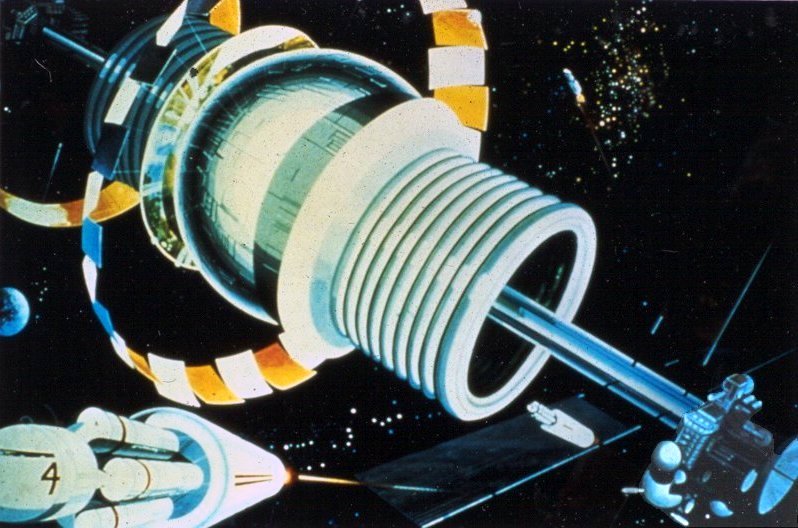
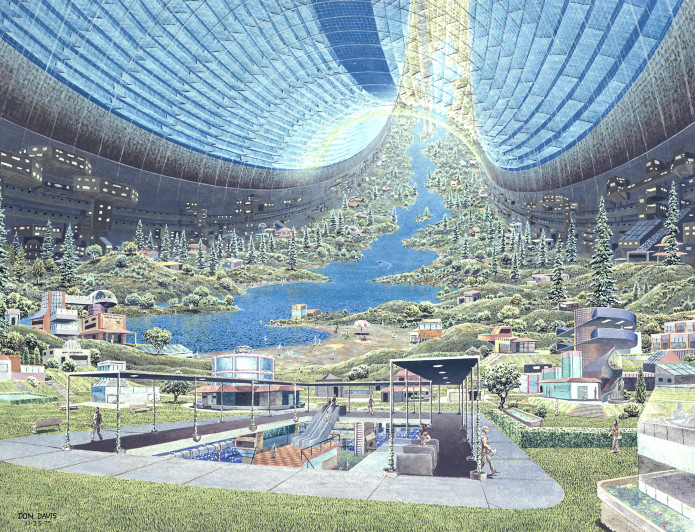
Gigantic in-space habitats proposed by the late Princeton physicist Gerard O’Neill as sites for permanent settlements have inspired many space enthusiasts over the years. Jeff Bezos, for example, plans to spend a big chunk of his Amazon holdings to try to make it possible for millions of people one day to live off-earth and for heavy industry to be moved into space to reduce environmental stress on the Earth.

“A Human Community in Space – Island One is sized for supporting a population of 10,000 in a state of relative independence.” Credits: Space Studies Institute

For most people, however, there is always an obvious sense of incredulity about how such giant structures far from earth can come to be. How do we get from here to there:

The huge structures would rotate to provide 1g artificial gravity along the inside. The outer shell of material would provide shielding from solar flares and cosmic rays.

Studies of the O’Neill habitats in the 1970s assumed that the Space Shuttles would drastically lower the cost of getting people and cargo to space. The Moon would also provide the bulk of the material for the habitats, which would reside in deep space at points where the gravitational pulls of the Earth and Moon are balanced and objects reside there indefinitely.

The Shuttles, however, failed to lower space transport costs. Today, we are finally seeing viable reusable, fast turnaround vehicles coming on line from SpaceX and Blue Origin. These will provide major reductions in transport cost. However, they still won’t enable O’Neill habitats on their own.

Most every city on earth started from a small structure or two and expanded over time. Something like that will have to happen for in-space settlements to become feasible. NASA Ames engineer Al Globus has been working on one such approach involving rotating habitats of modest size in low earth orbit.  A collection of technical papers by Globus and his collaborators can be found here.

Globus and Tom Marotta have now written the book – The High Frontier: An Easier Way – for a general audience. Globus says the book describes

how new scientific discoveries, new advances in launch technology, and new social trends are making space settlement much, much easier to contemplate.

The High Frontier: An Easier Way by Tom Marotta and AL Globus

The two key discoveries relate to radiation shielding and rotation adaptation. Specifically, it turns out that equatorial low earth orbit is a very low radiation environment (by space standards) so people there will need very little dedicated radiation shielding, perhaps none at all. This reduces settlement mass by one to two orders of magnitude.

Secondly, an extensive literature search suggests that people can adapt to rotation much faster than commonly thought. By spinning fast, the minimum size settlement is about an order of magnitude smaller than previous designs.

When taken together, along with advances in the launch industry, these developments mean that free space settlements can be built much closer, simpler, and cheaper than previously thought. Perhaps cheap enough to sell condos in space at a profit. We detail these findings and more in a fast-paced, fun book full of interesting anecdotes about space-related personalities.

Perhaps Bezos or other space mogul will take up the challenge of making such settlements happen sooner rather than later.

The book is available in both e-book format and paperback as well at Amazon.

See also:


NASA opens the “CO2 Conversion Challenge” competition

Settlers on Mars will need to live off the land and off the atmosphere as well. For example, methane for rocket fuel can be derived from the Red Planet’s abundant carbon dioxide (CO2).  NASA has now opened a Centennial Challenges contest to find an efficient and Mars-base compatible way to convert that CO2 into other “useful compounds”, particularly glucose.

The NASA CO2 Conversion Challenge invites teams from schools and private industry to compete for the one million dollar purse.

Help us discover ways to develop novel synthesis technologies that use carbon dioxide (CO2) as the sole carbon source to generate molecules that can be used to manufacture a variety of products, including “substrates” for use in microbial bioreactors.

Because CO2 is readily abundant within the Martian atmosphere, such technologies will translate into in-situ manufacturing of products to enable humans to live and thrive on the planet, and also be implemented on Earth by using both waste and atmospheric CO2 as a resource.

The contest will be in two phases:

NASA envisions this competition having two phases with a total prize purse of up to $1 million. Phase 1 (the current phase) is the Concept Phase with a prize purse of up to $250,000. The initiation of Phase 2, a Demonstration Challenge with a prize purse of up to $750,000, is contingent on the emergence of promising submissions in Phase 1 that demonstrate a viable approach to achieve the Challenge goals. The official rules for Phase 2 will be released prior to the opening of Phase 2.

See the timeline for assembling your team, registering, etc:

Do you have an idea to develop or adapt technology for converting CO2 into compounds like glucose, which can then be used to manufacture “food” for microbial bioreactors? You must first register no later than Thursday, January 24, 2019, at 5:00 PM Central.

Here is the official announcement:

NASA CO2 Conversion Challenge 

When astronauts begin exploring Mars, they’ll need to use local resources, freeing up launch cargo space for other mission-critical supplies. Carbon dioxide is one resource readily abundant within the Martian atmosphere. NASA’s new CO2 Conversion Challenge, conducted under the Centennial Challenges program, is a public competition seeking novel ways to convert carbon dioxide into useful compounds. Such technologies will allow us to manufacture products using local, indigenous resources on Mars, and can also be implemented on Earth by using both waste and atmospheric carbon dioxide as a resource.

“Enabling sustained human life on another planet will require a great deal of resources and we cannot possibly bring everything we will need. We have to get creative.” said Monsi Roman, program manager of NASA’s Centennial Challenges program. “If we can transform an existing and plentiful resource like carbon dioxide into a variety of useful products, the space – and terrestrial – applications are endless.”

Carbon and oxygen are the molecular building blocks of sugars. Developing efficient systems that can produce glucose from carbon dioxide will help advance the emerging field of biomanufacturing technology on Earth.

While sugar-based biomaterials are inexpensively made on Earth by plants, this approach cannot be easily adapted for space missions because of limited resources such as energy, water and crew time. The CO2Conversion Challenge aims to help find a solution. Energy rich sugars are preferred microbial energy sources composed of carbon, hydrogen and oxygen atoms. They could be used as the feedstock for systems that can efficiently produce a variety of items. Glucose is the target sugar product in this challenge because it is the easiest to metabolize, which will optimize conversion efficiency.

The competition is divided into two phases. During Phase 1, teams must submit a design and description of a conversion system that includes details of the physical-chemical approaches to convert carbon dioxide into glucose. NASA will award up to five teams $50,000 each, to be announced in April 2019. Phase 2, the system construction and demonstration stage, is contingent on promising submissions in Phase 1 that offer a viable approach to achieving challenge goals. Phase 2 will carry a prize purse of up to $750,000, for a total challenge prize purse of $1 million.

The Centennial Challenges program, part of NASA’s Space Technology Mission Directorate, bridges the innovation gap between NASA and the nation by stimulating research and technology solutions inside and outside of the traditional aerospace community. The program offers incentive prizes to generate revolutionary solutions to problems of interest to NASA and the nation. Centennial Challenges is managed at NASA’s Marshall Space Flight Center in Huntsville, Alabama.

===

See also NASA Mars Mission Contest Will Award $1M for Turning CO2 into Glucose | Fortune

====


Video: Robert Zubrin opens the 21st Annual Mars Society convention

Mars Society founder and president Robert Zubrin gives a vigorous presentation opening the 21st Annual International Mars Society Convention:

====