Category Archives: Contests and Games

The Hackaday Prize – A trip to space for best electronic device

Create a great electronic networked gadget and possibly win a trip to space: The Hackaday Prize – Hackaday Projects

WIN A TRIP TO SPACE

That’s right, one hardware hacker will get a trip into space as the grand prize.

There are incredible top prizes for the other four finalists, and hundreds of other rewards for the most interesting submissions.

And

This is about doing, not about about waiting for something to happen.

The Hackaday Prize will send one person into space for building the next evolution of hardware.

Here are the requirements:

    • You must actually build something
    • It must involve some type of electronics that are connected to something
    • Our main requirements have to do with documentation. This includes lists of parts, schematics, images, and videos. Remember, Openness is a Virtue.


RevUp Render Lunar Iditarod – racing lunar micro-rovers

A readers points me to the debut of the RevUp Render Lunar Iditarod, a micro-rover contest involving stages of competition that ultimately will result in a race on the Moon as the final stage:

Micro Rover Race

The RevUp Render Lunar Iditarod is a micro rover race. Participants will build very small rovers to race, both for time and against one another. The Lundar Iditarod will take the top three participants to the moon for a final challenge.

Gated Challenge

The RevUp Render Lunar Iditarod is a gated challenge.  Participants must partake in the lower level before being allowed to participate in the next.  The different levels will be called “Stages.” Having different stages will provide funding for competition and also prevent individuals from jumping in at the last second and stealing the “prize” of racing on the moon.

There will be five stages:

Each stage has its own entry requirements.  Each stage will have a separate entry fee.  Each stage will have separate rewards.  Teams may participate in as many stages as they pay for and qualify for in a single event.  However, no fees are refundable.

The first and second stage competitions will be held quarterly starting on September 6th, 2014.  The third stage will be held on to-be-determined dates concurrent with the first and second stage competitions once there are 16 qualified entrants.

The fourth stage race will take place seven months prior to the launch of the payloads to the moon.

Each stage of competition among the micro rovers (called DogeSleds) is laid out. Here is, for example, stage one:

Teams must connect their DogeSled to the competition wifi network.   All teams must successfully start from a fixed position and travel nine meters in lunar regolith simulant across a finish line in under ten minutes.

The entry fee is 2,250,000 dogecoin.

A prize for the fastest time in an event will be awarded.  That prize will be 3,000,000 dogecoins.

As you can see, the fees and prizes are expressed in Dogecoin, “an open source peer-to-peer digital currency”. Find the latest value in US dollars at DogePay – DogeCoin Price.

The schedule is still being worked out:

The first two stages will be held quarterly up to seven months before the launch.  The third stage will be announced and held when 16 participants have advanced through the first two stages.  The fourth stage will feature a bracketed race-off that will take place seven months before the launch from which the top three DogeSleds will advance to the moon. DogeSleds will be placed into the stowage for the launch to the moon six months prior to the launch.

The primary sponsor is RevUp Render a cloud computing service.

Requirements and Registration are now available.

European Rover Challenge 2014: 24 teams to compete in Poland, Sept 5-7

An announcement from the European Rover Challenge:

Mars rovers will invade Poland

The registration period for the European Rover Challenge 2014 is over – 24 teams, from all over the world, have applied to step up to the Challenge. The main event will be held September 5th to 7th, at the Regional Science-Technology Centre in Podzamcze near Chęciny.

ERC_04

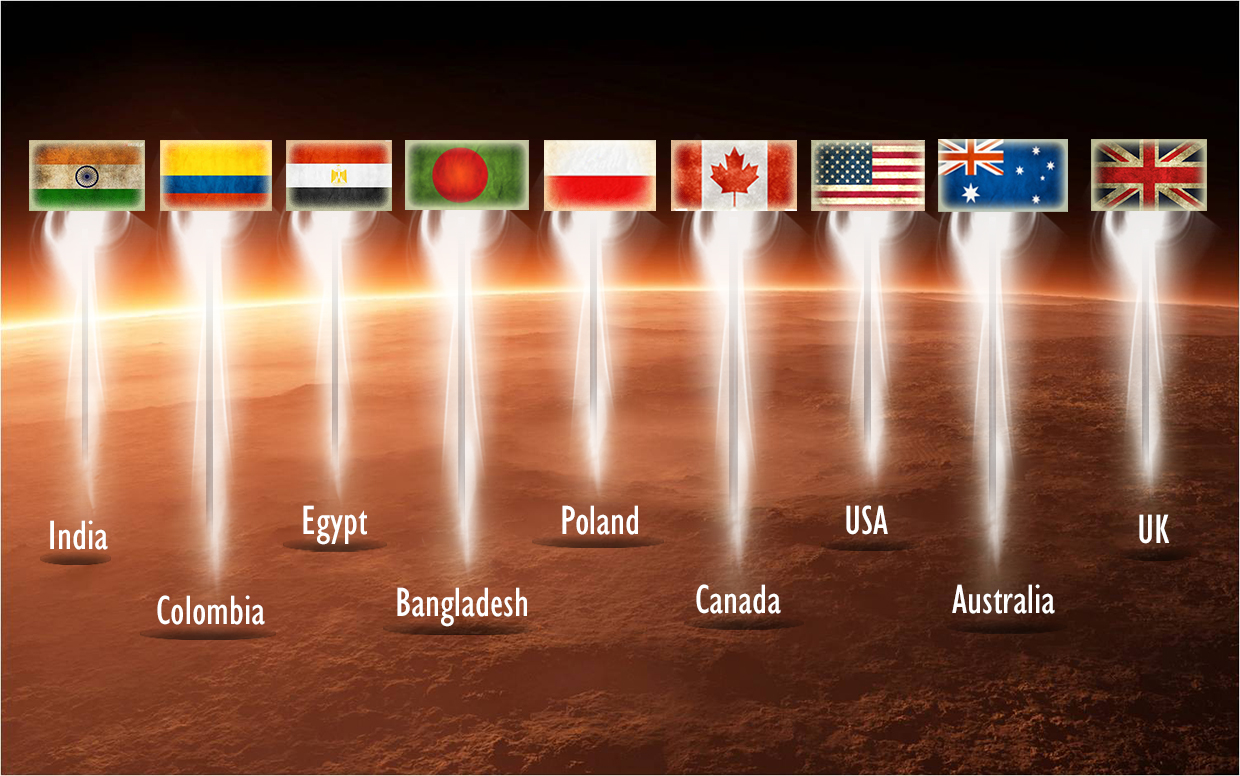
Egypt, India, Bangladesh, Australia, Colombia, Canada, the US and the UK will all have their representatives at the ERC. Poland will field teams from a number of Universities of Technology – Wroclaw, Kielce, Warsaw, Czestochowa, Lodz, Poznan, Lublin – as well as the West Pomeranian University of Technology in Szczecin, th AGH University of Science and Technology and the University of Technology and Life Sciences in Bydgoszcz.

‘When we came out with the idea of organizing the ERC, we were aware events like this were in high demand, bet we weren’t expecting that many teams to register.’ – says Łukasz Wilczyński, a representative of Mars Society Polska, the ERC 2014 organizer. ‘We are very happy that the roster is really international and has a strong Polish presence – a living proof of the high potential of Polish students and engineers.’

The ERC is a contest for teams of higher education students and recent graduates. Advised by the faculty, the teams must design and build analogues of Mars rovers, which will be presented to the Jury and take on four tasks simulating Mars exploration. Performance during the four field tasks and the jury presentation is scored and the rover with the highest total score is declared the Challenge winner.

As part of the ERC 2014 event schedule, the Da Vinci Science Centre in Podzamcze near Chęciny will also host the conference “Humans in Space”, to be attended by international experts from the space industry, medicine and other sciences, as well as various entrepreneurs. A two day long, open air science popularization festival is also planned on the Challenge grounds – on September 6th and 7th the challenge audience will have a chance to take part in numerous scientific workshops and presentations organized at the nearly Science Picnic

Detailed information about ERC 2014, including a full list of registered teams, is available on the official event website: www.roverchallenge.eu

The event is organized by Mars Society Polska, in cooperation with Planet PR, the Marshal Office of the Świętokrzyskie Voivodeship, and the Regional Science-Technology Centre in Podzamcze near Chęciny. The Polish National Centre for Research and Development, the Polish Agency for Enterprise Development, Com Creation, Axis Communications, the Austrian Space Forum and ABM Space Education are event Partners. The Polish Ministry of Economy and the European Commission Representation in Poland have taken honorary patronage over the event.

ERC2014_countries

NASA announces Z-2 EVA spacesuit design style contest winner

I wrote a post here at the end of March about NASA’s Z-2 Spacesuit contest. They announced the winner on Thursday:

NASA’s Next Prototype Spacesuit has a Brand New Look,
and it’s All Thanks to You

With 233,431 votes, the “Technology” option has won NASA’s Z-2 Spacesuit design challenge with just over 63% of the total vote. This design now will be incorporated into the final version of the suit, which is expected to be ready for testing by November 2014.

z2_final_0

NASA’s Z-2 suit is the newest prototype in its next-generation spacesuit platform, the Z-series. With the agency laser focused on a path to Mars, work to develop the technologies astronauts one day will use to live and work on Mars has already begun. Each iteration of the Z-series will advance new technologies that one day will be used in a suit worn by the first humans to step foot on the Red Planet.

There are many key advances to be found in the Z-2 suit when compared to the previous Z-1. The most significant is that the Z-1 had a soft upper torso and the Z-2 has a hard composite upper torso. This composite hard upper torso provides the much-needed long-term durability that a planetary Extravehicular Activity (EVA) suit will require. The shoulder and hip joints differ significantly based on extensive evaluations performed during the last two years with the Z-1 to look at different ways of optimizing mobility of these complex joints. Lastly, the boots are much closer in nature to those that would be found on a suit ready for space, and the materials used on the Z-2 are compatible with a full-vacuum environment.

Besides the typical fit checks and mobility evaluations, NASA currently is planning a very comprehensive test campaign for the Z-2 suit. Engineers will conduct multiple vacuum chamber tests, including one series at full vacuum, mimicking the lack of atmosphere found in space. The suit will be tested at NASA’s Johnson Space Center in Houston in the Neutral Buoyancy Lab, the huge indoor pool used to train astronauts to spacewalk. Further testing at a site at Johnson that imitates the rocky Martian surface  will help evaluate the suit’s mobility, comfort and performance. Ultimately, all of these tests will guide engineers in designing the Z-3.

With the Z-2, NASA will employ cover layer design elements, like electroluminescent wiring, never used before in a spacesuit. The designs that were available for voting were produced in collaboration with ILC Dover, the primary suit vendor, and Philadelphia University. The intent of the designs was to highlight certain mobility features for testing. To take it a step further, NASA offered the public the opportunity to decide which of three candidates will be built.

Because the Z-series is still in the prototype, or non-flight, phase, the design won’t be making a trip to space. The cover layer of a non-flight suit still performs an important function in ground-based testing. The cover protects the lower layers and technical details from abrasion and snags during testing. It also serves to provide the suit with an aesthetic appeal. The cover layer on flight suits used for spacewalks performs many other important functions like protecting the spacewalker from micrometeorite strikes, the extreme temperatures in space and the harmful effects of radiation. These requirements drive selection of specific high-performance materials and design details that aren’t necessary at this stage in a prototype suit.

NASA’s Z-2 Spacesuit is a project under the Advanced Exploration Systems Division which pioneers the development and demonstration of new technologies for future human missions beyond Earth orbit as part of the Human Exploration and Operations Mission Directorate.

Engineers and scientists around the country are working hard to develop the technologies astronauts will use one day to live and work on Mars and safely return home from the next giant leap for humanity. Follow our progress at www.nasa.gov/exploration and http://www.nasa.gov/mars.

NASA declares winners in annual Moonbuggy races held in Huntsville

NASA held its latest NASA Rover Challenge in Huntsville, Alabama on Friday and Saturday:

Academy of Arts, Careers and Technology in Reno, Nev., and University of Puerto Rico
at Humacao Win Top Honors at First NASA Human Exploration Rover Challenge

NASA today declared the winners of the first NASA Human Exploration Rover Challenge, held April 11-12 at the U.S. Space & Rocket Center in Huntsville, Ala. Student racers from the Academy of Arts, Careers and Technology in Reno, Nev., claimed first place in the high school division; the University of Puerto Rico at Humacao Team 2 won the top prize in the college division.

team4_0fd0612First place, college race: University of Puerto Rico at Humacao, Team 2.
Image Credit: NASA/MSFC/Fred Deaton

They raced to victory against 70 high school, college and university teams from 19 states, Puerto Rico, Germany, India, Mexico and Russia. All told, more than 500 students — drivers, engineers and mechanics, plus team advisers and “cheering sections” — took part in the competition.

The winning teams posted the fastest vehicle assembly and race times in their divisions, with the fewest on-course penalties. The team from the Academy of Arts, Careers and Technology finished the half-mile course in 3 minutes, 37 seconds. The University of Puerto Rico at Humacao Team 2 finished in 4 minutes, 9 seconds. In addition to the winning trophy, first-place teams received a cash prize of $3,000, courtesy of The Boeing Co. of Huntsville.
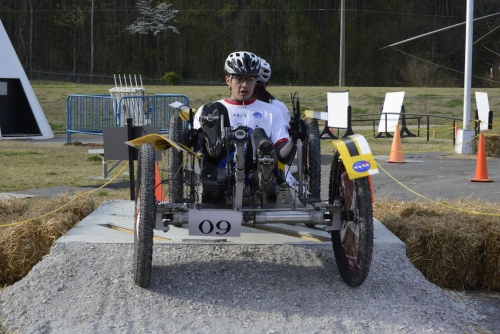
team9_0fd0644First place, high school race: Academy of Arts, Careers & Tech, Reno, Nev.
Image Credit: NASA/MSFC/Fred Deaton

Finishing in second place in the high school division was Team 2 from the Vocational High School Teodoro Aguilar Mora in Yabucoa, Puerto Rico. In third place was the International Space Education Institute team from Moscow, Russia. Southern Illinois University Carbondale Team 2 won second place in the college division and Team 1 from the school finished in third place. (For a complete list of additional awards for design, most improved and spirit, see below.)

Organized by NASA’s Marshall Space Flight Center in Huntsville and building on two decades of competitive student innovation in the NASA Great Moonbuggy Race (held in the “Rocket City” from 1994-2013), the new event challenges students to design, build and race lightweight, human-powered roving vehicles, solving technical problems along the way just like NASA engineers must do.

Those NASA engineers are paying attention: Students’ most innovative vehicle and hardware designs could help inform NASA’s own development of rovers and other space transportation systems for future exploration missions across the solar system.


Video streaming by Ustream
One of several videos from the event.

Just as importantly, the experience is designed to provide the future workforce to realize those new missions, inspiring students to pursue careers in the technical “STEM” fields — science, technology, engineering and mathematics — so crucial to the agency’s endeavors.

The NASA Human Exploration Rover Challenge is sponsored by the Human Exploration and Operations Mission Directorate at NASA Headquarters in Washington, and organized by the Marshall Center’s Academic Affairs Office. Major corporate sponsors for the race are The Boeing Co., Lockheed Martin Corp., Aerojet Rocketdyne, Jacobs Engineering ESSSA Group, and Northrop Grumman Corp., all with operations in Huntsville.

Full replays of the race will be available in coming days on the Marshall Center’s official UStream site, where Marshall Center media personnel and television crews provided continuous, streaming coverage of the event: http://www.ustream.tv/channel/nasa-msfc

For more information about the race, visit: www.nasa.gov/roverchallenge

Race enthusiasts are encouraged to follow the annual event via social media channels:  www.facebook.com/roverchallenge and www.twitter.com/roverchallenge

For information about other NASA education programs, visit: http://education.nasa.gov

—-

Continue to list of award winners.