On July 19th, China launched three satellites – Shijian 15, Chuangxin 3 and Shiyan 7. Since then they seem to be demonstrating formation flying, satellite servicing and/or anti-satellite techniques but it’s not really clear what they are doing:
Category Archives: In Space Infrastructure
NASA Mighty Eagle and Masten Xombie rocket vehicles flown today
The Mighty Eagle vertical takeoff and landing rocket vehicle made another test flight at Marshall Spaceflight Center in Huntsville, Alabama today. The lander was developed by designed and developed by NASA and JHU/APL.
That had lots of posts and pictures at Mighty Eagle (NASAMightyEagle) on Twitter. For example:
- Twitter / NASAMightyEagle: Midair with no dust. Should have gotten a bunch of stereo camera pictures of the hazard field! pic.twitter.com/41Due4MqbW

- Twitter / NASAMightyEagle: Landing with style. pic.twitter.com/WtnT3aKimT

Here is a video of the test. The first four minutes of the video are just of the flight of the quadcopter with the camera. The ME flight starts around 4 minutes into the video:
===
Meanwhile, Masten Space flew their Xombie vehicle in Mojave today presumably for a project with NASA JPL and Draper Labs – Twitter / mastenspace:
Great day for flying. Just finished what may be Xombie’s farthest flight. ~800m Data review pending
Video: John S. Lewis talk on asteroids and mining them
Here is a video of the talk by asteroid guru John Lewis (see earlier post) given in Silicon Valley last night:
“To the Asteroids – and Beyond” – John S. Lewis talk webcast
Long time asteroid mining proponent John S Lewis will give a SETI Institute public talk this evening that will also be available online (7 pm PDT, 10 pm EDT):
Please join us tonight at 7pm for a free public talk at the SETI Institute Headquarters at 189 Bernardo Ave, Mountain View.
If you can’t be at the SETI Institute in person, the talk will be broadcast online and live at the following link: https://plus.google.com/events/cfij418phv10tocljpb2dp56630
****************************************************************
Title: “To The Asteroids – and beyond!”
Speaker: John Lewis (UAz)
When: Tonight, 10 September 7pm PDT, 2013
Where: Colloquium Room, SETI Headquarters, 189 Bernardo Ave, Mountain View
Poster: http://www.seti.org/sites/default/files/csc-Sep-13.pdf
Live link: https://plus.google.com/events/cfij418phv10tocljpb2dp56630
****************************************************************
Abstract:
Tsiolkovsii and Goddard dreamed of the day when we would have access to the resources of the asteroids. Today, with an enormous and rapidly growing body of data on meteorites, the Near-Earth Asteroids (NEAs) and their more distant counterparts, we can envision the propulsion systems, transportation system architectures, ores, processing schemes and markets for products made from materials sourced in nearby space. Most of these products are of greatest value and significance in space; some, such as platinum-group metals and
energy, would be worth returning to Earth.
The resources of the NEAs also provide the propellants and structural materials for a broad expansion of human presence in space.
Dr. John Lewis is the author of the 1997 book “Mining the Sky” and is an Emeritis Professor of Planetary Science at University of Arizona. This talk will survey the what, where, how and why of space resource utilization– and raise the timely question of when.
Update: Here is the talk:
“To the Asteroids – and Beyond” – John S. Lewis talk webcast
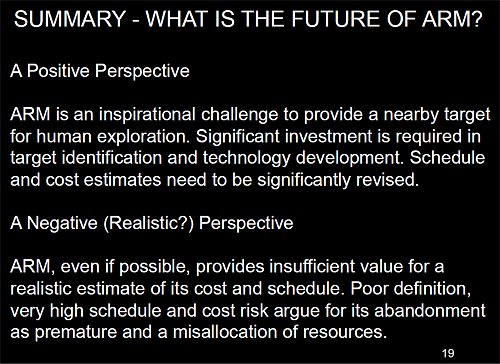
FISO: Small Bodies Assessment Group’s low assessment of the asteroid retrieval mission
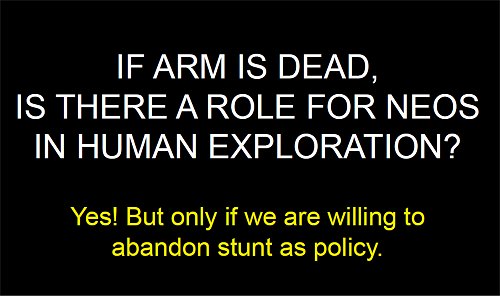
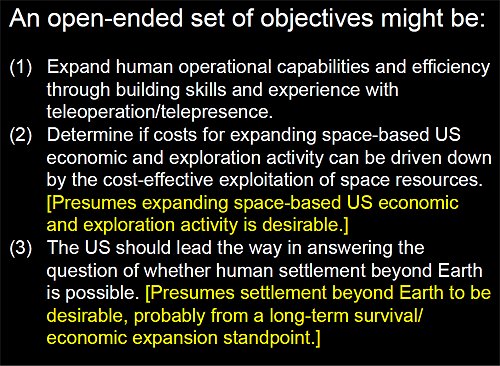
The latest presentation to the Future In-Space Operations (FISO) study group is now posted in the FISO Working Group Presentations Archive. Both slides (pdf) and audio (mp3) are available for the talk, “SBAG Findings on ARM – Is There a Role for NEOs in Human Exploration?”, Mark Sykes, Planetary Science Institute – Sept.4.13
Mark V. Sykes of the Planetary Science Institute reports on the negative review of NASA’s proposed Asteroid Retrieval/Redirect Mission (ARM) by the Small Bodies Assessment Group (SBAG).
A sampling of his slides: