Astronaut Jessica Meir is no stranger to extreme environments. She’s studied penguins in Antarctica and mapped caves in Italy, all of which prepared her for the ultimate extreme environment: space.
** Expedition 61 Crew Docks to the International Space Station
After launching earlier in the day in their Soyuz MS-15 spacecraft from the Baikonur Cosmodrome in Kazakhstan, Expedition 61 Soyuz Commander Oleg Skripochka of Roscosmos, NASA Flight Engineer Jessica Meir and Spaceflight Participant Hazzaa Ali Almansoori of the United Arab Emirates arrived at the International Space Station September 25. Their arrival completed a six-hour journey when they docking their Soyuz spacecraft to the Poisk module on the Russian segment of the complex.
** Expedition 60 Artemis Interviews Randy Bresnik Kentucky Media – September 26, 2019
Microbes – bacteria and fungi – live everywhere, even the International Space Station. Scientists at NASA’s Johnson Space Center constantly monitor the station’s microbial community and now are testing using DNA sequencing to identify its tiny residents without returning samples to Earth – an important step to keep crews, and the places they visit, safe on future deep-space missions. Read more about space station microbiology: https://go.nasa.gov/2IbtgAL Learn more about the research being conducted on station: https://www.nasa.gov/iss-science
** T-60 Seconds with Jessica Meir
You’ve got to know a lot to earn a master’s degree in space science and a doctorate in marine biology, and that’s before you consider all you need to learn to become a NASA astronaut. As it turns out, little of that knowledge applied as astronaut Jessica Meir sat for a barrage of questions just before her launch to the International Space Station—take a look.
** SpaceCast Weekly Sept 20 2019
SpaceCast Weekly is a NASA Television broadcast from the Johnson Space Center in Houston featuring stories about NASA’s work in human spaceflight, including the International Space Station and its crews and scientific research activities, and the development of Orion and the Space Launch System, the next generation American spacecraft being built to take humans farther into space than they’ve ever gone before.
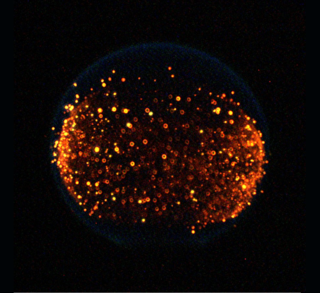
The Flame Design investigation is studying the quantity of soot produced under different flame conditions. The results of this experiment occurring aboard the International Space Station could enable the design of flames that are more sooty or soot-free, and allow for the creation of burner designs which are more efficient and less polluting. Read more about this and other flame research aboard the International Space Station: [https://www.nasa.gov/mission_pages/station/research/news/combustion-research…]
Learn more about the research being conducted on Station: https://www.nasa.gov/iss-science
“This flame was one of many ignited as part of the Flame Design investigation inside of CIR to investigate the amount of soot that is produced in different conditions. The yellow spots are soot clusters that glow yellow when hot. These clusters grow larger in microgravity than on Earth because the soot remains within the flame longer.” Credits: NASA
** STEMonstrations: Engineering Design – Trusses
The structure of the International Space Station relies heavily on a series of trusses engineered to withstand compression, tension, torsion and shear forces the station may encounter in low-Earth orbit. In this episode, Expedition 55/56 Flight Engineer Ricky Arnold explains the significance of these resilient structures and the forces they are up against in microgravity. Use the lesson plan that coincides with this video to emphasize the value of the engineering design process in your STEM classroom. Visit https://nasa.gov/stemonstation for more educational resources that explore the research and technology of the International Space Station.
** Expedition 60 Live Interviews with Doug Wheelock – September 12, 2019
Live Interviews with NASA Astronaut Doug Wheelock located at Glenn Research Center in Cleveland, Ohio and broadcast from the Johnson Space Center. Astronaut Doug Wheelock, who is currently working at Glenn Research Center on the Orion spacecraft, discusses life in space and NASA’s plans to put the first woman and next man on the Moon by 2024 through the agency’s Artemis program. The interviews were conducted on September 12, 2019.
Here is the latest Space to Ground report from NASA on activities related to the International Space Station:
** Researching Regolith on the International Space Station
** Views of Hurricane Dorian from the International Space Station – August 29, 2019
** SpaceX Dragon undocking – August 27, 2019
** NASA in Silicon Valley Live: Space Robots
Robots + astronauts = a match made in space exploration 🤖👩🚀! Join us at 7 p.m. EDT for a new episode of NASA in Silicon Valley Live to hear our experts explain how we design & build robots to work with humans in space