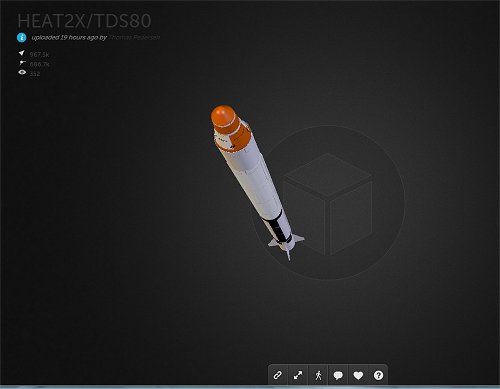
Orbital Sciences plans to launch a Minotaur I rocket on November 19th and it holds 29 satellites, including 24 cubesats. Among these is a satellite built by students at Thomas Jefferson High School for Science and Technology in Alexandria, Virginia :
(Dulles, VA 13 November 2013) — Orbital Sciences Corporation (NYSE: ORB), one of the world’s leading space technology companies, will launch the first satellite designed and built by high school students into Earth orbit aboard a Minotaur I rocket next week. The small satellite, known as TJCubeSat (TJ³Sat), will be launched aboard the U.S. Air Force’s ORS-3 mission as one of more than two dozen secondary payloads the Minotaur rocket will carry into orbit. The mission is scheduled to take place from the Mid-Atlantic Regional Spaceport located at NASA’s Wallops Flight Facility in eastern Virginia. The launch is currently scheduled for Tuesday, November 19, 2013, at approximately 7:30 p.m. (EST).
The TJ³Sat is a small-size CubeSat developed, built and tested by students from the Thomas Jefferson High School for Science and Technology in Alexandria, Virginia. Over the past several years, volunteers from Orbital’s technical staff mentored the student team and provided engineering oversight, while the company made its space testing facilities available and provided financial support for the satellite project. TJ³Sat was assigned to the ORS-3 mission launch through NASA’s Educational Launch of Nanosatellites (ELaNa) program based on launch manifest availability.
“Since the beginning of the TJ³Sat program, Orbital has purchased flight hardware and contributed mentors and advice throughout the process, as well as assistance with final testing prior to launch,” said Mr. David W. Thompson, Orbital’s President and Chief Executive Officer. “We are thrilled to see the hard work and dedicated efforts of the students at Thomas Jefferson High School come to fruition and look forward to the educational benefits this satellite will bring to other students around the world.”
The TJ³Sat project was conceived as a method to interest students around the world in space-related science, technology, engineering and math (STEM) education. TJ3Sat utilizes the CubeSat standard design developed by Stanford University and California Polytechnic State University. The cube-shaped satellite measures approximately 3.9×3.9×4.5 inches (10x10x12 centimeters) and has a mass of about 2.0 pounds (0.89 kilograms). The TJ3Sat’s payload is a phonetic voice synthesizer that converts strings of text to voice. Once converted, the voice is transmitted back to Earth over amateur radio frequencies. Students from around the world can submit text strings to be uploaded to the satellite for transmission. The satellite’s design and operations data is public, enabling students from other countries to use it freely.
“This partnership between our school and Orbital has allowed the students to gain valuable real-world experience in aerospace engineering and related disciplines, which will serve them well as they continue on their future careers,” said Dr. Evan Glazer, Principal of Thomas Jefferson High School.