What astronomy highlights can you see in the sky in May 2020? Venus, Sirius and the Milky Way. With so many of us staying home these days, here’s a look into the sky at dusk and dawn with an eye toward the vast stretches of wide open space right above our heads. Additional information about topics covered in this episode of What’s Up, along with still images from the video, and the video transcript, are available at https://solarsystem.nasa.gov/whats-up… Credit: NASA/JPL-Caltech
In May, we are looking away from the crowded, dusty plane of our own galaxy toward a region where the sky is brimming with distant galaxies. Locate Virgo to find a concentration of roughly 2,000 galaxies and search for Coma Berenices to identify many more. Keep watching for space-based views of galaxies like the Sombrero Galaxy, M87, and M64.
Xplore’s Xcraft™ Now Featured in XTRONAUT 2.0: The Game of Solar System Exploration, the award-winning space-themed board game
SEATTLE (PRWEB) March 26, 2020: Xplore Inc., a commercial space company providing Space as a Service™, today announced sponsorship of the Kickstarter campaign for Xtronaut 2.0, an award-winning STEM-themed board game.
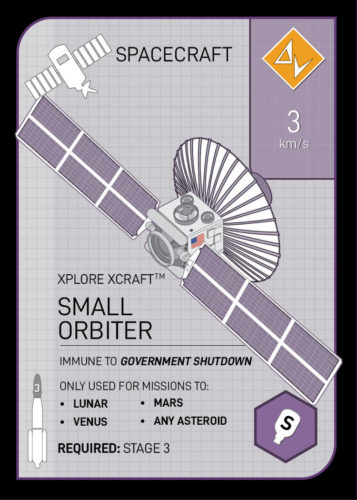
Xplore Xcraft™ playing card in Xtronaut 2.0 Game
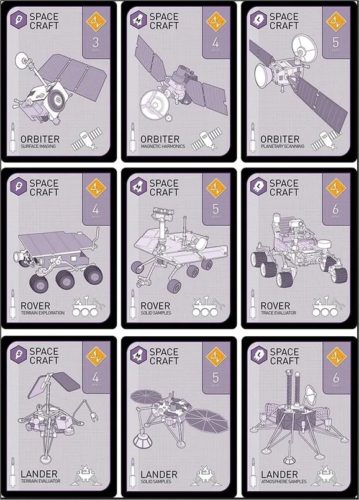
Xtronaut 2.0, a fun, multi-player game for players ages eight and up, teaches the real-world challenges of solar system exploration and educates players on how to plan missions to deep space. Xplore’s high-performance spacecraft, the Xcraft™, is a new feature in Xtronaut 2.0, which mirrors real-life space missions. Players can plan exploration missions and send the Xcraft™ to the Moon, Mars, Venus, and asteroids, including Bennu, the target of NASA’s OSIRIS-REx Asteroid Sample Return mission. Spacecraft in the game can launch on SpaceX, ULA, and NASA-SLS rockets. Planetary scientist Dr. Dante Lauretta created Xtronaut with CEO Michael Lyon. Lauretta is a University of Arizona Professor and Principal Investigator for OSIRIS-REx. Lyon, while at Space Adventures, helped orchestrate the private astronaut flights for Dennis Tito and Mark Shuttleworth to the International Space Station.
Xplore founder and Chief Operating Officer Lisa Rich said,
“Xtronaut 2.0 provides valuable education about space missions, builds strategic skills, and inspires players to pursue STEM careers. We are proud to have the Xcraft™ featured in Xtronaut 2.0 and are delighted that our sponsorship enables us to give 120 games to the youth organization of our choice. Xplore selected The Boeing Academy for STEM Learning at The Museum of Flight to receive our gift to support their mission to enhance educational opportunities for young people, particularly students of color, females, and those from low income families and communities to access and pursue STEM pathways.”
Reba Gilman, Vice President of Education for The Museum of Flight said,
“The Boeing Academy for STEM Learning at The Museum of Flight is pleased to accept Xplore’s generous gift of 120 Xtronaut 2.0 games, and we look forward to distributing them among our students. Xplore aligns well with our goal of promoting STEM opportunities. They are a creative company that thinks out-of-the box in terms of how their commercial missions to space will impact the lives of others. While scientists, universities, national space agencies, civilian space agencies, national security space agencies and others will fly with them, our students can also benefit from their missions to space.” She added, “We appreciate the leadership of Xplore’s female founder, Lisa Rich, and are thankful Xplore is giving us this positive stay-at-home activity that students will enjoy during these uncertain times.”
Dr. Dante Lauretta said:
“We are excited to include Xplore as a real-world example of next-generation missions to space. Our original game allows players to fly heritage spacecraft. With Xtronaut 2.0, we have the added feature of flying the Xcraft™ as a small payload with enhanced capability for missions to our solar system. Our players will love this feature as it adds another layer of real-world authenticity to the game.” He added, “We are pleased that our game will support The Museum of Flight. Xtronaut 2.0 is a constructive way for students enrolled in The Boeing Academy for STEM Learning’s programs to expand their knowledge of the aerospace industry and encourage them to be a part of it.”
About Xplore: Xplore is a Seattle-based commercial deep space company offering Space as a ServiceTM. Xplore provides hosted payloads, communication relay services and exclusive datasets to its customers via a fleet of networked multi-mission spacecraft.
The mission of Xplore is to expand robotic exploration via commercial Xpeditions™ at and beyond Earth, to the Moon, Mars, Venus, Lagrange Points and near-Earth asteroids in the inner solar system. Xplore provides hosted payload services for scientific instruments and technology demonstrations for national space agencies, national security agencies, sovereign space agencies and universities. Visit: https://www.xplore.com
Here is an interview with Xtronaut CEO Michael Lyon by Jason Kanigan of the Cold Star Project:
Michael Lyon is an attorney, startup accelerator mentor and space tourism pioneer. I’ve interviewed him for the full format Cold Star Project show (link below), and today he’s back to share Xtronaut 2.0. It’s a fun and educational space board game he has co-created that has already achieved 2X its funding target on Kickstarter. Xtronaut 2.0 was co-created by Dante Lauretta of Osiris-REx fame. Bill Nye and the Planetary Society are also involved. I want you to have the chance to hear about it, and maybe pick up some of the cool swag that comes along with backing the idea. Check out the Kickstarter for Xtronaut 2.0 here: https://coldstartech.com/msbxtronaut
The winners of NASA’s Langley Research Center’s 2020 Student Art Contest have been selected out of nearly 1,300 entries from 40 states and Puerto Rico.
This year’s contest received a record 1,277 entries from students across the United States. These students, part of the Artemis generation, depicted the theme “We Are Going” with insightful compositions and beautiful creativity. Each piece is wonderfully imaginative, and each student, from kindergarten to 12th grade, used their incredible talents to showcase their interpretation of the theme.
The art contest is intended to illustrate where NASA is going next in the realms of research, development, missions and innovations that highlight NASA’s human exploration activities which touch aspects of our lives here on Earth.
This year’s guest judge was Michael Kagan, an award-winning artist who’s had his artistic talents showcased in solo and group exhibitions all over the world. His most recent exhibition at the Virginia Museum of Contemporary Art, entitled “I Was There When It Happened,” featured Kagan’s lifelong interest in NASA, technology, space and innovation.
Finalist # 39) 8th Grade Kendra Vincent – 2nd Place / 8th Grade
The simplest of ideas can turn into the grandest of results. One high school student took the simple idea that space is reachable, translated that idea into art, and is now the grand-prize winner of NASA’s Langley Research Center’s 2020 Student Art Contest.
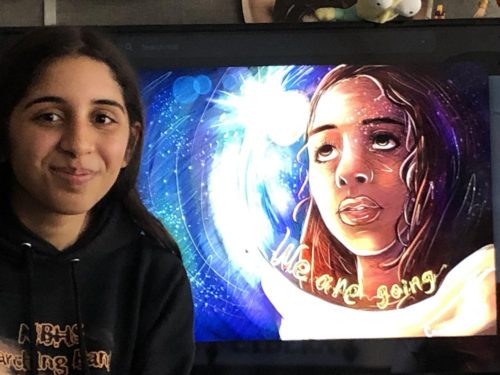
Camila Garcia, a tenth-grader at North Bergen High School in North Bergen, New Jersey, earned the highest honor in the yearly competition.
“Camila Garcia, a tenth-grader at North Bergen High School in North Bergen, New Jersey, was named the grand-prize winner for her entry in the 2020 NASA Langley Student Art Contest.” Credits: NASA Langley Research Center
“My inspiration for my artwork was simply the idea of things being reachable,” she said. “It was a very consistent concept within my thumbnail sketches, especially since they all revolved around people.”
Camila’s winning entry is a woman astronaut gazing out into space and the Moon with the words “We Are Going” at the bottom of her helmet.
“In the case of my artwork in particular, it’s more emotionally centered around the idea of something being reachable as the mere gaze I have (I am the subject of my drawing) towards the Moon is that of amazement at how far I’ve truly come,” she said.
(Finalist # 14) 3rd Grade Daniel Chia – 3rd Place / 3rd Grade
Chesley Bonestell was an architect and painter who worked on the Golden Gate Bridge and the Chrysler Building. He worked on famous movies like Citizen Kane as a matte artist, and his mesmerizing paintings of planets and star systems helped inspire America’s space program. Why is it that no one knows who he is today?
Producer Douglass Stewart, was interviewed last year on The Space Show about Bonestell and the film:
During this one segment 72 minute program, not only did our guest take us through the life and art of Chesley Bonestell, but the same for documentary film making, distribution and film festival issues plus lots more.
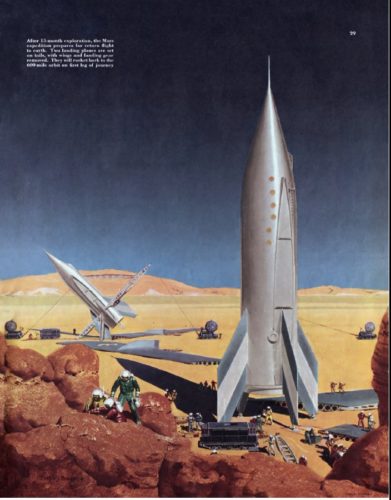
Bonestell’s visions are still coming to life. Here is an illustration he created for an article by Werner von Braun and Cornelius Ryan in Colliers Magazine, April 30, 1954:
Illustration of a Mars expedition landing site by Chesley Bonestell for Colliers Magazine, April 30, 1954. Via Sept/Oct. 2013 issue of Horizons, the newsletter for the Houston chapter of the AIAA
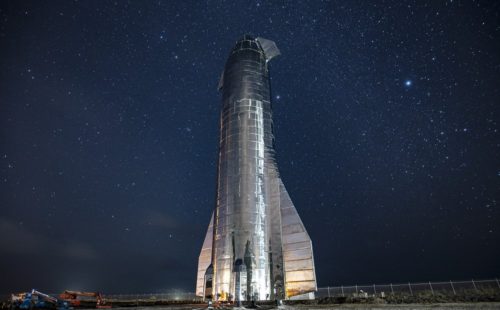
And here is a full-scale 1st-gen prototype of the Starship, a fully reusable space transport currently in development by SpaceX:
The Starship Mk-1 prototype on display at the SpaceX Boca Chica, Texas facility in 2019. Credits: SpaceX
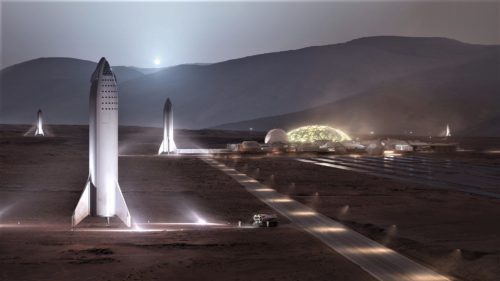
And a SpaceX illustrator’s vision of Starships at a Mars settlement:
HOUSTON – Today Axiom Space announced it is planning history’s first fully private human spaceflight mission to the International Space Station.
Axiom has signed a contract with SpaceX for a Crew Dragon flight which will transport a commander professionally trained by Axiom alongside three private astronauts to and from the International Space Station. The mission, set to launch as soon as the second half of 2021, will allow the crew to live aboard the ISS and experience at least eight days of microgravity and views of Earth that can only be fully appreciated in the large, venerable station.
“This history-making flight will represent a watershed moment in the march toward universal and routine access to space,”
Axiom CEO Michael Suffredini said.
“This will be just the first of many missions to ISS to be completely crewed and managed by Axiom Space – a first for a commercial entity. Procuring the transportation marks significant progress toward that goal, and we’re glad to be working with SpaceX in this effort.”
This is the first of Axiom’s proposed “precursor missions” to the ISS envisioned under its Space Act Agreement (SAA) with NASA. Discussions with NASA are underway to establish additional enabling agreements for the private astronaut missions to ISS.
Axiom plans to offer professional and private astronaut flights to ISS at a rate of up to two per year to align with flight opportunities as they are made available by NASA, while simultaneously constructing its own privately funded space station.
“Since 2012, SpaceX has been delivering cargo to the International Space Station in partnership with NASA and later this year, we will fly NASA astronauts for the first time,”
said SpaceX President and Chief Operating Officer Gwynne Shotwell.
“Now, thanks to Axiom and their support from NASA, privately crewed missions will have unprecedented access to the space station, furthering the commercialization of space and helping usher in a new era of human exploration.”
With its team’s vast experience in human spaceflight, Axiom serves as a one-stop shop overseeing all elements of its missions. In addition to contracting with SpaceX for a Crew Dragon vehicle to transport its crew to the ISS, Axiom’s turnkey service for the mission – two days in transit and at least eight days aboard the ISS – includes training, mission planning, hardware development, life support, medical support, crew provisions, hardware and safety certifications, on-orbit operations and overall mission management.
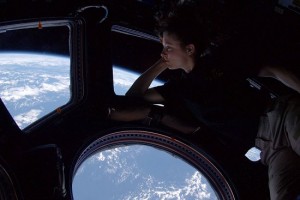
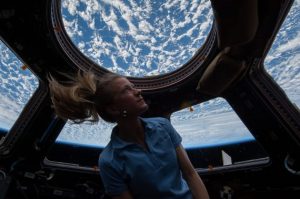
A phenomenal view – the world as seen by NASA astronaut Karen Nyberg from the Cupola of the International Space Station.
NASA recently selected Axiom’s proposal to attach its space station modules to the ISS beginning in the second half of 2024, ultimately creating a new ‘Axiom Segment’ which will expand the station’s usable and habitable volume. When the ISS reaches its retirement date, the Axiom complex will detach and operate as a free-flying commercial space station.
By serving the market for immediate access to space while building the future platform for a global user base, Axiom is leading the development and settlement of low Earth orbit now and into the future.
About Axiom Space: Axiom Space was founded in 2016 with the aim of creating humanity’s home in space to ensure a prosperous future for everyone, everywhere. While building and launching the Axiom Segment of the International Space Station to one day form the world’s first commercial space station, Axiom provides access to the ISS today by conducting crewed missions for professional and private astronauts. More information about Axiom can be found at www.axiomspace.com.
Begin the countdown to the first-ever fully private human spaceflight mission to the International Space Station.