** What’s Up: September 2020 – Skywatching Tips from NASA JPL
What are some skywatching highlights in September 2020? Spot the Moon together with Mars and Venus, along with the flickering star Fomalhaut, which had itself a planet…until it didn’t! Additional information about topics covered in this episode of What’s Up, along with still images from the video, and the video transcript, are available at https://solarsystem.nasa.gov/whats-up… .
In September, Pegasus becomes increasingly prominent in the southeastern sky, allowing stargazers to locate globular star clusters and a nearby double star, Alpha Capricorni. Keep watching for space-based views of densely packed, spherical collections of ancient stars in visible and X-ray light.
** What’s in the Night Sky September 2020Aurora Borealis | Harvest Moon – Alyn Wallace – YouTube
What can you see in the night sky? Astronomers Pete Lawrence and Paul Abel reveal their stargazing tips for September 2020. In 2020 we’re celebrating 15 years of our Virtual Planetarium: https://www.skyatnightmagazine.com/sp…
For September’s night sky, scan the southern heavens to see bright Jupiter and a dim Saturn. You can’t miss these large planets near the constellation Sagittarius.
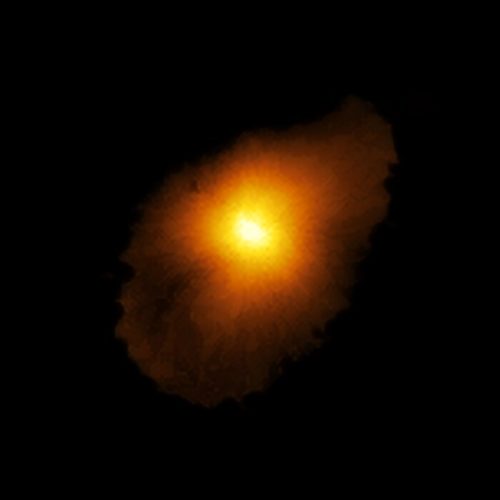
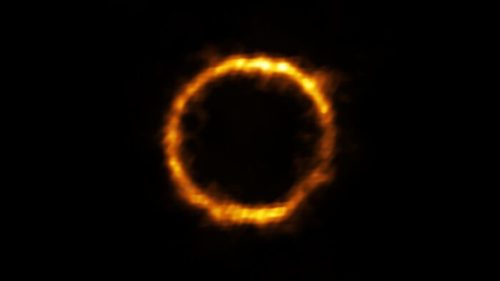
Astronomers using ALMA, in which the ESO is a partner, have revealed an extremely distant galaxy that looks surprisingly like our Milky Way. The galaxy, SPT0418-47, is gravitationally lensed by a nearby galaxy, appearing in the sky as a near-perfect ring of light. The research team reconstructed the distant galaxy’s true shape, shown here, and the motion of its gas from the ALMA data using a new computer modelling technique.
Astronomers using the Atacama Large Millimeter/submillimeter Array (ALMA), in which the European Southern Observatory (ESO) is a partner, have revealed an extremely distant and therefore very young galaxy that looks surprisingly like our Milky Way. The galaxy is so far away its light has taken more than 12 billion years to reach us: we see it as it was when the Universe was just 1.4 billion years old. It is also surprisingly unchaotic, contradicting theories that all galaxies in the early Universe were turbulent and unstable. This unexpected discovery challenges our understanding of how galaxies form, giving new insights into the past of our Universe.
“This result represents a breakthrough in the field of galaxy formation, showing that the structures that we observe in nearby spiral galaxies and in our Milky Way were already in place 12 billion years ago,”
says Francesca Rizzo, PhD student from the Max Planck Institute for Astrophysics in Germany, who led the research published today in Nature. While the galaxy the astronomers studied, called SPT0418-47, doesn’t appear to have spiral arms, it has at least two features typical of our Milky Way: a rotating disc and a bulge, the large group of stars packed tightly around the galactic centre.
This is the first time a bulge has been seen this early in the history of the Universe, making SPT0418-47 the most distant Milky Way look-alike.
“The big surprise was to find that this galaxy is actually quite similar to nearby galaxies, contrary to all expectations from the models and previous, less detailed, observations,”
says co-author Filippo Fraternali, from the Kapteyn Astronomical Institute, University of Groningen in the Netherlands. In the early Universe, young galaxies were still in the process of forming, so researchers expected them to be chaotic and lacking the distinct structures typical of more mature galaxies like the Milky Way.
Studying distant galaxies like SPT0418-47 is fundamental to our understanding of how galaxies formed and evolved. This galaxy is so far away we see it when the Universe was just 10% of its current age because its light took 12 billion years to reach Earth. By studying it, we are going back to a time when these baby galaxies were just beginning to develop.
Because these galaxies are so far away, detailed observations with even the most powerful telescopes are almost impossible as the galaxies appear small and faint. The team overcame this obstacle by using a nearby galaxy as a powerful magnifying glass — an effect known as gravitational lensing — allowing ALMA to see into the distant past in unprecedented detail. In this effect, the gravitational pull from the nearby galaxy distorts and bends the light from the distant galaxy, causing it to appear misshapen and magnified.
The gravitationally lensed, distant galaxy appears as a near-perfect ring of light around the nearby galaxy, thanks to their almost exact alignment. The research team reconstructed the distant galaxy’s true shape and the motion of its gas from the ALMA data using a new computer modelling technique. “When I first saw the reconstructed image of SPT0418-47 I could not believe it: a treasure chest was opening,” says Rizzo.
“What we found was quite puzzling; despite forming stars at a high rate, and therefore being the site of highly energetic processes, SPT0418-47 is the most well-ordered galaxy disc ever observed in the early Universe,”
stated co-author Simona Vegetti, also from the Max Planck Institute for Astrophysics.
“This result is quite unexpected and has important implications for how we think galaxies evolve.”
The astronomers note, however, that even though SPT0418-47 has a disc and other features similar to those of spiral galaxies we see today, they expect it to evolve into a galaxy very different from the Milky Way, and join the class of elliptical galaxies, another type of galaxies that, alongside the spirals, inhabit the Universe today.
Astronomers using ALMA, in which the ESO is a partner, have revealed an extremely distant galaxy that looks surprisingly like our Milky Way. The galaxy, SPT0418-47, is gravitationally lensed by a nearby galaxy, appearing in the sky as a near-perfect ring of light.
This unexpected discovery suggests the early Universe may not be as chaotic as once believed and raises many questions on how a well-ordered galaxy could have formed so soon after the Big Bang. This ALMA finding follows the earlier discovery announced in May of a massive rotating disc seen at a similar distance. SPT0418-47 is seen in finer detail, thanks to the lensing effect, and has a bulge in addition to a disc, making it even more similar to our present-day Milky Way than the one studied previously.
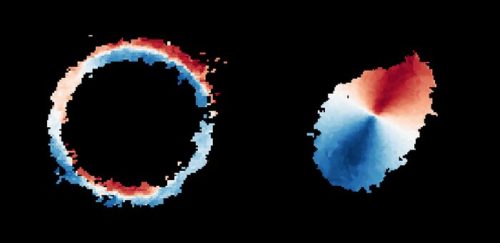
Astronomers using ALMA, in which the ESO is a partner, have revealed an extremely distant galaxy that looks surprisingly like our Milky Way. The galaxy, SPT0418-47, is gravitationally lensed by a nearby galaxy, appearing in the sky as a near-perfect ring of light (left). The research team reconstructed the distant galaxy’s true shape and the motion of its gas (right) from the ALMA data using a new computer modelling technique. The observations indicate that SPT0418-47 is a disc galaxy with a central bulge and the material in it rotates around the centre. Gas moving away from us is shown in red, while gas moving in the direction of the observer is shown in blue.
Future studies, including with ESO’s Extremely Large Telescope, will seek to uncover how typical these ‘baby’ disc galaxies really are and whether they are commonly less chaotic than predicted, opening up new avenues for astronomers to discover how galaxies evolved.
** What’s Up: August 2020 Skywatching Tips from NASA
What are some skywatching highlights in August 2020? See the Moon posing with various planets throughout the month, plus catch the peak of the annual Perseid meteor shower. Additional information about topics covered in this episode of What’s Up, along with still images from the video, and the video transcript, are available at https://solarsystem.nasa.gov/whats-up….
In August, a flock of star-studded figures soars overhead. Look for the Vega and Lyra constellations, which point to Epsilon Lyrae and the Ring Nebula. You can also spot three bright summer stars: Vega, Deneb, and Altair, which form the Summer Triangle. Keep watching for space-based views of these and other stars and nebulas.
** What’s in the Night Sky August 2020 #WITNS Comet NEOWISE | Perseid Meteor Shower – Alyn Wallace
** What to see in the night sky, August 2020
What can you see in the night sky? Astronomers Pete Lawrence and Paul Abel reveal their stargazing tips for August 2020. In 2020 we’re celebrating 15 years of our Virtual Planetarium. Discover more here: https://www.skyatnightmagazine.com/sp...
A sampling of recent articles, videos, and images from space-related science news items (find previous roundups here):
Mars
** Launch of the UAE Hope Mars mission on a Japanese H-IIA rocket on July 19th was a success. The spacecraft is on course to reach Mars and go into orbit in February. It’s primary mission is to study the Martian atmosphere and weather.
HOPE-2 infographic shows mission phases from launch to Mars orbit operations.
We received the Hope probe’s first sighting of its destination, Mars, after the spacecraft travelled one million km into space. Beyond the sky is where our dreams start. pic.twitter.com/jN7MBxKa7U
If you could stand on the surface of Mars, what would you hear? While 8 missions have returned stunning views from the surface of the Red Planet, none have returned any sound.
That’s about to change. NASA’s Perseverance rover, which is days away from blasting off on a mission to search for signs of past life and collect samples for future return to Earth, will have not one, but two microphones aboard. One will listen as the rover plummets through the Martian atmosphere for landing, and another will record sounds as the rover does its scientific work in Jezero Crater—an ancient river delta where life may have flourished.
“Even if only a few minutes of Martian sounds are recorded from this first experiment, the public interest will be high and the opportunity for scientific exploration real,” Sagan wrote.
NASA’s InSight lander has been using its robotic arm to help the heat probe known as the “mole” burrow into Mars. The mission is providing the first look at the Red Planet’s deep interior to reveal details about the formation of Mars and, ultimately, all rocky planets, including Earth.
Akin to a 16-inch-long (40-centimeter-long) pile driver, the self-hammering mole has experienced difficulty getting into the Martian soil since February 2019. It’s mostly buried now, thanks to recent efforts to push down on the mole with the scoop on the end of the robotic arm. But whether it will be able to dig deep enough – at least 10 feet (3 meters) – to get an accurate temperature reading of the planet remains to be seen. Images taken by InSight during a Saturday, June 20, hammering session show bits of soil jostling within the scoop – possible evidence that the mole had begun bouncing in place, knocking the bottom of the scoop.
NASA InSight’s ‘Mole’ Taps the Bottom of the Lander’s Scoop – NASA’s InSight Mars Lander: After the scoop on the end of NASA’s Mars InSight lander was used to push down on the top of the spacecraft’s “mole,” or self-hammering heat probe, it was held in place to essentially block the mole from popping out of the soil. The movement of sand grains in the scoop, seen here, suggested that the mole had began bumping up against the bottom of the scoop while hammering on June 20, 2020. Credit: NASA/JPL-Caltech.
Comparative images from NASA’s InSight Mars lander from Sol 10 to Sol 578 show that the spacecraft is quite dusty.
Robotic arm-mounted, Instrument Deployment Camera (IDC) images taken on December 7, 2018, Sol 10 and recent July 12, 2020, Sol 578 photos reveal the coating of Mars dust.
InSight landed on the Red Planet on November 26, 2018.
** The latest on Curiosity rover’s activities and plans:
NASA’s Curiosity Mars rover has started a road trip that will continue through the summer across roughly a mile (1.6 kilometers) of terrain. By trip’s end, the rover will be able to ascend to the next section of the 3-mile-tall Martian (5-kilometer-tall) mountain it’s been exploring since 2014, searching for conditions that may have supported ancient microbial life.
Located on the floor of Gale Crater, Mount Sharp is composed of sedimentary layers that built up over time. Each layer helps tell the story about how Mars changed from being more Earth-like – with lakes, streams and a thicker atmosphere – to the nearly-airless, freezing desert it is today.
Once they complete this week’s drilling effort, expect the rover to quickly head east again, aiming for the gap between the very rough Greenheugh Piedmont and the first steep cliffs of Mt. Sharp. They hope to reach this point in the fall, when the rover will finally leave the foothills of Mt Sharp and begin climbing the mountain. Their goal is the dark canyon in the first image above, uphill from where Curiosity sits now.
** Leonard David also gives frequent updates on Curiosity’s roving:
It’s a banner year for sample return missions. Not since the 1970s has there been so much invested in returning rocks to Earth from space. This year, China, Japan, and the United States will all have sample return missions in flight, seeking to retrieve material from near-Earth asteroids, the Moon, and eventually Mars.
It might seem a bit far-fetched but yes, it’s true: if you could line up all of the other planets in our Solar System in a row edge-to-edge (or more geometrically accurately, limb-to-limb) and for good measure even include Pluto, the entire queue would easily fit within the space between Earth and the Moon.
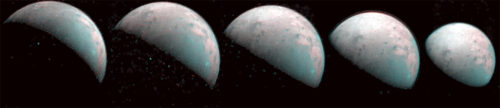
On its way inbound for a Dec. 26, 2019, flyby of Jupiter, NASA’s Juno spacecraft flew in the proximity of the north pole of the ninth-largest object in the solar system, the moon Ganymede. The infrared imagery collected by the spacecraft’s Jovian Infrared Auroral Mapper (JIRAM) instrument provides the first infrared mapping of the massive moon’s northern frontier.
Larger than the planet Mercury, Ganymede consists primarily of water ice. Its composition contains fundamental clues for understanding the evolution of the 79 Jovian moons from the time of their formation to today.
Ganymede is also the only moon in the solar system with its own magnetic field. On Earth, the magnetic field provides a pathway for plasma (charged particles from the Sun) to enter our atmosphere and create aurora. As Ganymede has no atmosphere to impede their progress, the surface at its poles is constantly being bombarded by plasma from Jupiter’s gigantic magnetosphere. The bombardment has a dramatic effect on Ganymede’s ice.
“The JIRAM data show the ice at and surrounding Ganymede’s north pole has been modified by the precipitation of plasma,” said Alessandro Mura, a Juno co-investigator at the National Institute for Astrophysics in Rome. “It is a phenomenon that we have been able to learn about for the first time with Juno because we are able to see the north pole in its entirety.”
“These images [from the JIRAM instrument aboard NASA’s Juno spacecraft [taken] on Dec. 26, 2019, provide the first infrared mapping of Ganymede’s northern frontier. Frozen water molecules detected at both poles have no appreciable order to their arrangement and a different infrared signature than ice at the equator.” Credits: NASA/JPL-Caltech/SwRI/ASI/INAF/JIRAMSee also: First Images of Jovian Moon Ganymede’s North Pole | Mission Juno.
Astronomy
** A big list of the most exotic objects detected in the universe is being maintained by the Berkeley SETI program:
San Francisco, CA – June 22, 2020 – Breakthrough Listen, the initiative to find signs of intelligent life in the Universe, today released an innovative catalog of “Exotica” – a diverse list of objects of potential interest to astronomers searching for technosignatures (indicators of technology developed by extraterrestrial intelligence). The catalog is a collection of over 700 distinct targets intended to include “one of everything” in the observed Universe – ranging from comets to galaxies, from mundane objects to the most rare and violent celestial phenomena.
The comprehensive new catalog is the first in recent times that aims to span the entire breadth of astrophysical phenomena, from distant galaxies, to objects in our own Solar System. The Listen team developed it conceptually, compiled it, and shared it with the astronomical community in the hope that it can guide future surveys – studying life beyond Earth and/or natural astrophysics – and serve as a general reference guide for the field.
“Many discoveries in astronomy were not planned,” remarked the lead author of the new catalog, Dr. Brian Lacki. “Sometimes a major new discovery was missed when nobody was looking in the right place, because they believed nothing could be found there. This happened with exoplanets, which might have been detected before the 1990s if astronomers looked for solar systems very different than ours. Are we looking in the wrong places for technosignatures? The Exotica catalog will help us answer that question.”
“The catalog is not just limited to SETI, though,” noted Lacki. “My hope is that any program with a new capability may use the Exotica catalog as a shakedown cruise around the Universe.”
Sun
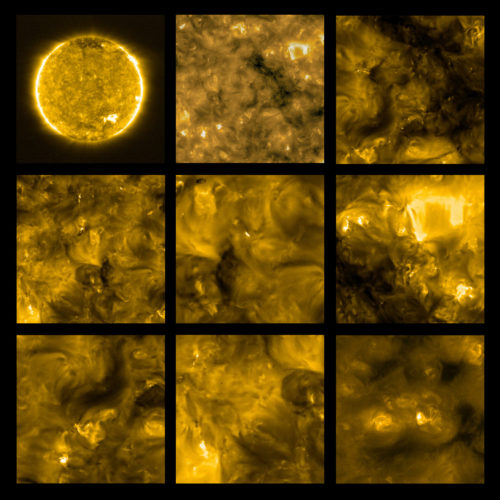
** First images from ESA/NASA Solar Orbiter released.
“The Extreme Ultraviolet Imager (EUI) on ESA’s Solar Orbiter spacecraft took these images on 30 May 2020. They show the Sun’s appearance at a wavelength of 17 nanometers, which is in the extreme ultraviolet region of the electromagnetic spectrum. Images at this wavelength reveal the upper atmosphere of the Sun, the corona, with a temperature of around 1 million degrees.”. Credits: ESA
The ratio of next cycle sunspots vs sunspots from the past maximum has also been shifting. More and more, the new sunspots belong to the next cycle and less to the last. The ramp up to the next maximum is definitely beginning, though to call it a “ramp up” at this point is a big exaggeration. Sunspot activity remains low, though the last few months have seen some activity, unlike the seven months of nothing seen during the second half of last year.
The upcoming prediction for the next maximum calls for it to be very weak. Interestingly, the activity in June surpassed that prediction. This does not mean that the prediction will be wrong, only that June was more active when compared to the smooth prediction curve. As the cycle unfolds the monthly numbers will fluctuate up and down, as they did last cycle. The question will be whether their overall numbers will match closely with the prediction. In the past cycle actual sunspot activity was consistently below all predictions. It is too soon to say how well the new prediction is doing.
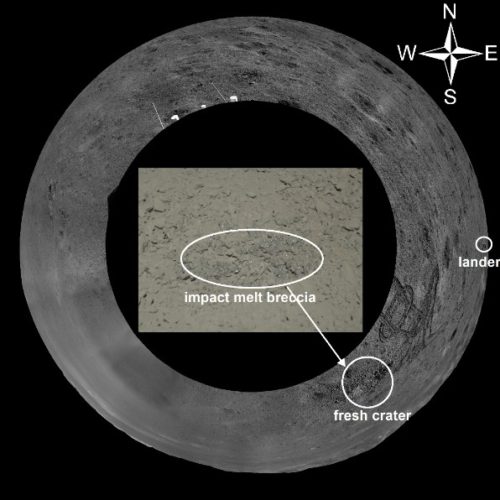
The unusual dark greenish and glistening “gel-like” substance in a crater on the far side of the moon has attracted widespread interest following its discovery by the Chang’e-4 rover in July 2019.
A research team led by Prof. DI Kaichang from the Aerospace Information Research Institute (AIR) of the Chinese Academy of Sciences and their collaborators analyzed the substance in detail by using multiple datasets from the rover’s panoramic camera (Pancam), hazard avoidance camera (Hazcam), and the visible and near-infrared spectrometer (VNIS).
The researchers found that the unusual substance is actually an impact melt breccia, and the provenance of the rover measured surrounding regolith might originate from a differentiated melt pool or from a suite of igneous rocks. Their findings were published in Earth and Planetary Science Letters.
“Impact melt breccia and surrounding context.” Credits: CNSA, CLEP, and AIR
What started out as a hunt for ice lurking in polar lunar craters turned into an unexpected finding that could help clear some muddy history about the Moon’s formation.
Team members of the Miniature Radio Frequency (Mini-RF) instrument on NASA’s Lunar Reconnaissance Orbiter (LRO) spacecraft found new evidence that the Moon’s subsurface might be richer in metals, like iron and titanium, than researchers thought. That finding, published July 1 in Earth and Planetary Science Letters, could aid in drawing a clearer connection between Earth and the Moon.
“The LRO mission and its radar instrument continue to surprise us with new insights about the origins and complexity of our nearest neighbor,” said Wes Patterson, Mini-RF principal investigator from the Johns Hopkins Applied Physics Laboratory (APL) in Laurel, Maryland, and a study coauthor.
** Investigating ancient volcanism on the Moon with images and altimetry data from the Lunar Reconnaissance Orbiter (LRO):
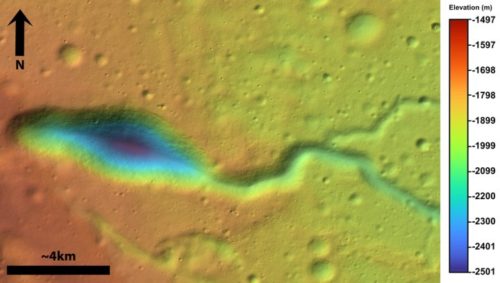
“Kathleen, a pyroclastic vent, and Rima Mozart extending east from the vent found in the eastern-most DTM in the Featured Image (seen above). Centered at 25.3263°N, 359.322°E – here in Quickmap.” Credits: LRO
The image above, reduced to post here, is a colorized digital terrain model produced from Lunar Reconnaissance Orbiter (LRO) data. On top of the original mosaic of photos the LRO science team has overlaid the elevation data obtained by LRO’s laser altimeter. It shows a tadpole shaped pit dubbed Kathleen, with its tail trailing off to the southeast. As they note:
Kathleen is a pyroclastic vent with a sinuous rille (colloquially known as Rima Mozart [Not IAU confirmed]) that extends from the southeast end of the vent. Rilles are large channels formed by sustained channelized lava flows. This vent is a great location to investigate ancient volcanism on the Moon.
The elevation data reveals one interesting feature: The lowest part of the vent pit is not at its western end, where one would think at first glance, based on the general dip that produced the rill flowing to the east. That the lowest point is at the widest section of the pit instead suggests that this pit no longer looks as it did when it was venting. In the almost four billion years since it is thought all volcanic activity here ceased, there has been plenty of time for the slow erosion processes on the Moon, caused by radiation, micrometeorites, and the solar wind, to partly fill this pit and round out its cliff walls.
A near-Earth binary asteroid system, named after the Greek word for ‘twin’, Didymos’s main body measures about 780 m across, with its previously nameless moonlet about 160 m in diameter, approximately the size of Egypt’s Great Pyramid.
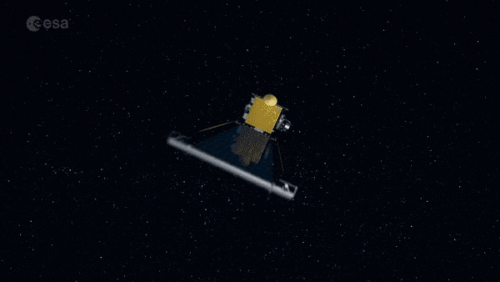
In 2022, this moonlet will be the target of NASA’s Double Asteroid Redirection Test (DART), the first full-scale demonstration of an asteroid deflection technology for planetary defence. ESA’s Hera mission will be launched two years later, to perform a close-up survey of Dimorphos, along with its parent asteroid, following DART’s impact.
NASA DART will impact the small Dimorphos companion to the Didymos asteroid in 2022. Credits: ESA
“Dimorphos is Greek for ‘having two forms’,” says Kleomenis Tsiganis, a planetary scientist at the Aristotle University of Thessaloniki and member of both the DART and Hera teams, who suggested the name.
“It has been chosen in anticipation of its future status as the first celestial body to have its ‘physique’ intentionally altered by human intervention, the kinetic impact of DART. Hence, it will be known to us by two, very different forms, the one seen by DART before impact and the other seen by Hera, a few years later.”
DART’s kinetic impact into Dimorphos is expected to alter its orbit around Didymos as well as create a substantial crater, which will be studied by the Hera spacecraft when it arrives several years later. The DART impact itself will be recorded by the Italian-made LICIACube CubeSat, deployed from DART several days earlier, with longer-term effects studied by telescopes on Earth’s surface and in space.
Japan’s Hayabusa2 spacecraft is nearly home. Having collected samples from the asteroid Ryugu last year, the spacecraft is just months away from returning them to Earth. The samples contain material that likely dates back to the dawn of the solar system, 4.6 billion years ago. They could provide fresh insights into how celestial bodies came to be and even how life on Earth began. But before all that, there is the small matter of getting Hayabusa2’s precious cargo down from the harsh vacuum of space and safely into scientists’ hands.
On July 14 the Japanese Aerospace Exploration Agency (JAXA), in partnership with the Australian Space Agency, announced the landing date for the samples: December 6, 2020. JAXA’s landing site for the mission is a 122,000-square-kilometer region of South Australian outback known as the Woomera Range Complex. “Woomera is a very remote area,” says Karl Rodrigues, acting deputy director of the Australian Space Agency. “It makes it ideal for the safe management and landing of this particular craft and capsule.”
** Watch Comet Neowise from the ISS to the accompaniment of a nice soundtrack:
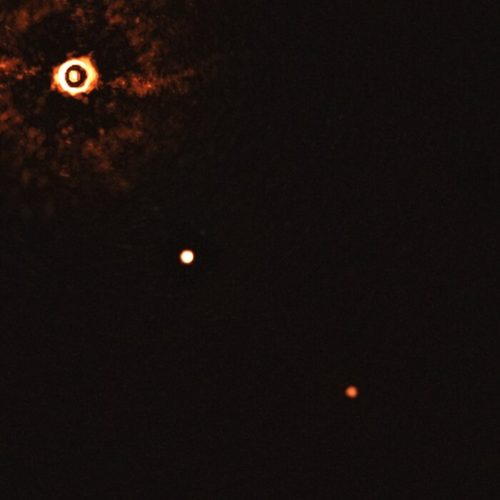
The European Southern Observatory’s Very Large Telescope (ESO’s VLT) has taken the first ever image of a young, Sun-like star accompanied by two giant exoplanets. Images of systems with multiple exoplanets are extremely rare, and — until now — astronomers had never directly observed more than one planet orbiting a star similar to the Sun. The observations can help astronomers understand how planets formed and evolved around our own Sun.
This image, captured by the SPHERE instrument on ESO’s Very Large Telescope, shows the star TYC 8998-760-1 accompanied by two giant exoplanets. This is the first time astronomers have directly observed more than one planet orbiting a star similar to the Sun. The image was captured by blocking the light from the young, Sun-like star (on the top left corner) using a coronagraph, which allows for the fainter planets to be detected. The bright and dark rings we see on the star’s image are optical artefacts. The two planets are visible as two bright dots in the centre and bottom right of the frame.
Just a few weeks ago, ESO revealed a planetary system being born in a new, stunning VLT image. Now, the same telescope, using the same instrument, has taken the first direct image of a planetary system around a star like our Sun, located about 300 light-years away and known as TYC 8998-760-1.
“This discovery is a snapshot of an environment that is very similar to our Solar System, but at a much earlier stage of its evolution,”
says Alexander Bohn, a PhD student at Leiden University in the Netherlands, who led the new research published today in The Astrophysical Journal Letters.
“Even though astronomers have indirectly detected thousands of planets in our galaxy, only a tiny fraction of these exoplanets have been directly imaged,” says co-author Matthew Kenworthy, Associate Professor at Leiden University, adding that “direct observations are important in the search for environments that can support life.”
The direct imaging of two or more exoplanets around the same star is even more rare; only two such systems have been directly observed so far, both around stars markedly different from our Sun. The new ESO’s VLT image is the first direct image of more than one exoplanet around a Sun-like star. ESO’s VLT was also the first telescope to directly image an exoplanet, back in 2004, when it captured a speck of light around a brown dwarf, a type of ‘failed’ star.
“Our team has now been able to take the first image of two gas giant companions that are orbiting a young, solar analogue,”
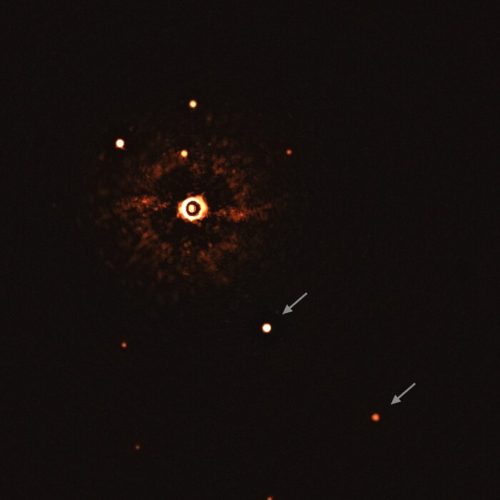
says Maddalena Reggiani, a postdoctoral researcher from KU Leuven, Belgium, who also participated in the study. The two planets can be seen in the new image as two bright points of light distant from their parent star, which is located in the upper left of the frame (click on the image to view the full frame). By taking different images at different times, the team were able to distinguish these planets from the background stars.
This image, captured by the SPHERE instrument on ESO’s Very Large Telescope, shows the star TYC 8998-760-1 accompanied by two giant exoplanets, TYC 8998-760-1b and TYC 8998-760-1c. This is the first time astronomers have directly observed more than one planet orbiting a star similar to the Sun. The two planets are visible as two bright dots in the centre (TYC 8998-760-1b) and bottom right (TYC 8998-760-1c) of the frame, noted by arrows. Other bright dots, which are background stars, are visible in the image as well. By taking different images at different times, the team were able to distinguish the planets from the background stars. The image was captured by blocking the light from the young, Sun-like star (top-left of centre) using a coronagraph, which allows for the fainter planets to be detected. The bright and dark rings we see on the star’s image are optical artefacts.
The two gas giants orbit their host star at distances of 160 and about 320 times the Earth-Sun distance. This places these planets much further away from their star than Jupiter or Saturn, also two gas giants, are from the Sun; they lie at only 5 and 10 times the Earth-Sun distance, respectively. The team also found the two exoplanets are much heavier than the ones in our Solar System, the inner planet having 14 times Jupiter’s mass and the outer one six times.
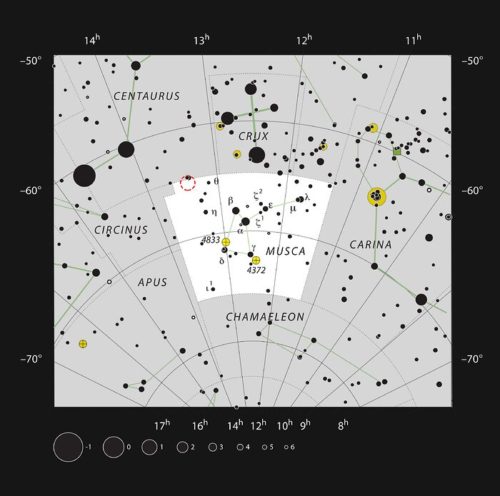
Bohn’s team imaged this system during their search for young, giant planets around stars like our Sun but far younger. The star TYC 8998-760-1 is just 17 million years old and located in the Southern constellation of Musca (The Fly). Bohn describes it as a “very young version of our own Sun.”
These images were possible thanks to the high performance of the SPHERE instrument on ESO’s VLT in the Chilean Atacama desert. SPHERE blocks the bright light from the star using a device called coronagraph, allowing the much fainter planets to be seen. While older planets, such as those in our Solar System, are too cool to be found with this technique, young planets are hotter, and so glow brighter in infrared light. By taking several images over the past year, as well as using older data going back to 2017, the research team have confirmed that the two planets are part of the star’s system.
Further observations of this system, including with the future ESO Extremely Large Telescope (ELT), will enable astronomers to test whether these planets formed at their current location distant from the star or migrated from elsewhere. ESO’s ELT will also help probe the interaction between two young planets in the same system. Bohn concludes:
“The possibility that future instruments, such as those available on the ELT, will be able to detect even lower-mass planets around this star marks an important milestone in understanding multi-planet systems, with potential implications for the history of our own Solar System.”
This chart shows the location of the TYC 8998-760-1 system. This map shows most of the stars visible to the unaided eye under good conditions and the system itself is marked with a red circle.