** What’s Up: December 2024 Skywatching Tips from NASA – NASA JPL
What are some skywatching highlights in December 2024?
This month, enjoy dazzling views of Venus as the “Evening Star,” Jupiter at its brightest during opposition, and Mars doubling in brightness, and look for the Winter Triangle. The Geminid meteor shower peaks under challenging moonlight conditions, but you might get lucky and catch a shooting star that week before sunrise!
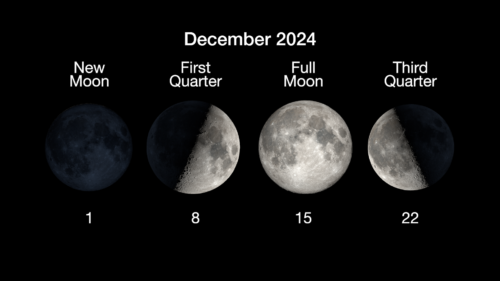
0:00 Intro 0:14 December planet highlights 1:31 The Winter Stars 1:57 The Winter Triangle 2:42 Geminid Meteor Shower 3:14 December Moon phases
Additional information about topics covered in this episode of What’s Up, along with still images from the video, and the video transcript, are available at https://solarsystem.nasa.gov/skywatch….
Pete Lawrence and Paul Abel reveal their pick of the best things to see in the night sky this month.
** Sky & Telescope’s Sky Tour Podcast – December 2024 | Jupiter Shines, Winter Stars, and Many Meteors – Sky & Telescope Youtube
Our monthly Sky Tour #astronomy #podcast provides an informative and entertaining 10-minute guided tour of the #night #sky. Join us for the December 2024 episode and mark the #solstice, be amazed by #Jupiter, welcome the arrival of winter’s bright #stars, and prep for what’s usually the year’s best #meteorshower.
Listen and subscribe to this podcast at https://skyandtelescope.org/observing/ and don’t forget to subscribe to S&T’s YouTube channel to get alerts about new videos, including this monthly podcast.
** NASA Astronaut Suni Williams Talks with New England Sports Network – Tuesday, November 12, 2024 – NASA Video
Aboard the International Space Station, Expedition 72 Commander Suni Williams of NASA discussed life and work aboard the orbital outpost during an in-flight interview Nov. 12 with the New England Sports Network for the New England Sports Network Clubhouse Kids Show. Williams is in the midst of a long-duration mission living and working aboard the microgravity laboratory to advance scientific knowledge and demonstrate new technologies for future human and robotic exploration flights as part of NASA’s Moon and Mars exploration approach, including lunar missions through NASA’s Artemis program.
Welcome #Ax4 crew to @esa‘s European Astronaut Centre!
They’re gearing up with European @Space_Station science and Columbus lab training for their upcoming mission. Led by @Axiom_Space‘s @AstroPeggy , the assigned crew includes pilot Shubhanshu Shukla , ESA project… pic.twitter.com/JjMqtdn4fF
— The latest burst test of a Sierra inflatable habitat prototype model brings them a step closer to certification and the construction of operational habitats.
We have successfully completed our sixth stress test and fourth Ultimate Burst Pressure (UBP) test for our LIFE® 10 commercial space station technology, achieving a rupture at 255 psi, the highest pressure yet.
This test exceeded NASA’s Factor of Safety recommendations, demonstrating a safety factor greater than 16x in Low Earth Orbit (LEO) and 23x in lunar environments.
Our team continues to lead in the development of expandable structures for various space applications, as we build the world’s first commercial space station.
In the same work area as the Shooting Star modules, Sierra Space engineers are also working on the Large Integrated Flexible Environment (LIFE) habitat. A key aspect of that project is evaluating and testing the use of softgoods to fashion expandable structures using Vectran, a weave of high-performance liquid crystal polymer fiber that’s stronger than steel when inflated.
Decades have passed since a space station primary structure has been manufactured in the United States . @vast is changing that. Our Haven-1 qualification primary structure is in its final stage of welding at our HQ facility. Next, the completed structure will go to our… pic.twitter.com/94pJHaYqvO
The Czech Ministry of Transport has signed a Memorandum of Understanding (MoU) with Vast, the U.S.-based pioneer in space habitation technologies. The Memorandum, signed as part of Czech Space Week, outlines a commitment by Vast and the Ministry of Transport to explore ways to partner on future human spaceflight projects, whether through private astronaut missions (PAM) to the International Space Station (ISS) before it is retired in 2030, or on missions to Vast’s own Haven space stations, and to engage with a growing Czech Space industry and start-up ecosystem.
Mitsubishi Corporation has been a key player in commercial space for decades. They served as the sole sales agent for the SPACEHAB Laboratory, a module designed to fly as part of NASA’s space shuttle program. SPACEHAB enabled JAXA, other national space agencies, and private… pic.twitter.com/75kefQeb6c
China’s Shenzhou-19 crew aboard the orbiting Tiangong space station received a shipment of supplies from Earth on Saturday, after the Tianzhou-8 cargo spacecraft successfully docked with the space station.
** Shenzhou-19 Crew Conduct Tasks in Orderly Manner After Receiving Supplies from Earth – CCTV Video News Agency
China’s Shenzhou-19 crew aboard the orbiting Tiangong space station has been carrying out space experiments, performing equipment maintenance, and conducting other tasks in an orderly manner over the past week after receiving supplies from the Earth in mid-November.
We welcomed Peter to discuss one of his recent blog posts, Planetocracy.org, regarding the steps needed to be completed before humans to Mars happens. Peter’s article is on the blog for this program. Not only did we go over the steps Peter outlined in his excellent article, he got calls and listener questions asking about other issues for humans to Mars. Most often he heard comments about Musk, SpaceX and how the human factors or medical issues might be resolved for those going to Mars. This mostly focused on microgravity and radiation. Don’t miss these discussions.
=== Other space habitat and settlement news and articles:
** Live Video from the International Space Station (Official NASA Stream) – NASA
Watch live video from the International Space Station, including inside views when the crew aboard the space station is on duty. Views of Earth are also streamed from an external camera located outside of the space station. During periods of signal loss due to handover between communications satellites, a blue screen is displayed.
The space station orbits Earth about 250 miles (425 kilometers) above the surface. An international partnership of five space agencies from 15 countries operates the station, and it has been continuously occupied since November 2000. It’s a microgravity laboratory where science, research, and human innovation make way for new technologies and research breakthroughs not possible on Earth. More: https://go.nasa.gov/3CkVtC8
Did you know you can spot the station without a telescope? It looks like a fast-moving star, but you have to know when to look up. Sign up for text messages or email alerts to let you know when (and where) to spot the station and wave to the crew: https://spotthestation.nasa.gov
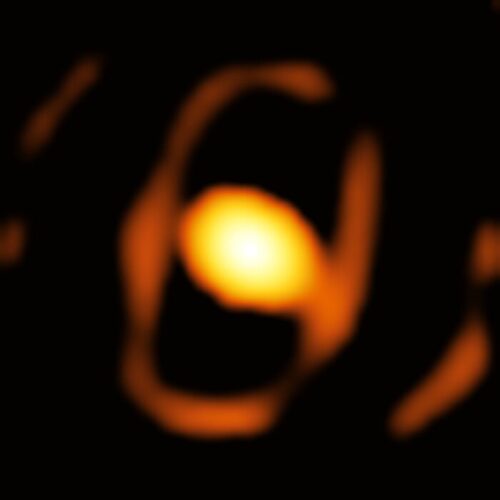
This is an image of the star WOH G64, taken by the GRAVITY instrument on the European Southern Observatory’s Very Large Telescope Interferometer (ESO’s VLTI). This is the first close-up picture of a star outside our own galaxy, the Milky Way. The star is located in the Large Magellanic Cloud, over 160 000 light-years away. The bright oval at the centre of this image is a dusty cocoon that enshrouds the star. A fainter elliptical ring around it could be the inner rim of a dusty torus, but more observations are needed to confirm this feature.
“For the first time, we have succeeded in taking a zoomed-in image of a dying star in a galaxy outside our own Milky Way,”
says Keiichi Ohnaka, an astrophysicist from Universidad Andrés Bello in Chile. Located a staggering 160 000 light-years from us, the star WOH G64 was imaged thanks to the impressive sharpness offered by the European Southern Observatory’s Very Large Telescope Interferometer (ESO’s VLTI). The new observations reveal a star puffing out gas and dust, in the last stages before it becomes a supernova.
“We discovered an egg-shaped cocoon closely surrounding the star,” says Ohnaka, the lead author of a study reporting the observations published today in Astronomy & Astrophysics. “We are excited because this may be related to the drastic ejection of material from the dying star before a supernova explosion.”
While astronomers have taken about two dozen zoomed-in images of stars in our galaxy, unveiling their properties, countless other stars dwell within other galaxies, so far away that observing even one of them in detail has been extremely challenging. Up until now.
The newly imaged star, WOH G64, lies within the Large Magellanic Cloud, one of the small galaxies that orbits the Milky Way. Astronomers have known about this star for decades and have appropriately dubbed it the ‘behemoth star’. With a size roughly 2000 times that of our Sun, WOH G64 is classified as a red supergiant.
Ohnaka’s team had long been interested in this behemoth star. Back in 2005 and 2007, they used ESO’s VLTI in Chile’s Atacama Desert to learn more about the star’s features, and carried on studying it in the years since. But an actual image of the star had remained elusive.
For the desired picture, the team had to wait for the development of one of the VLTI’s second-generation instruments, GRAVITY. After comparing their new results with other previous observations of WOH G64, they were surprised to find that the star had become dimmer over the past decade.
“We have found that the star has been experiencing a significant change in the last 10 years, providing us with a rare opportunity to witness a star’s life in real time,”
says Gerd Weigelt, an astronomy professor at the Max Planck Institute for Radio Astronomy in Bonn, Germany and a co-author of the study. In their final life stages, red supergiants like WOH G64 shed their outer layers of gas and dust in a process that can last thousands of years.
“This star is one of the most extreme of its kind, and any drastic change may bring it closer to an explosive end,”
The team thinks that these shed materials may also be responsible for the dimming and for the unexpected shape of the dust cocoon around the star. The new image shows that the cocoon is stretched-out, which surprised scientists, who expected a different shape based on previous observations and computer models. The team believes that the cocoon’s egg-like shape could be explained by either the star’s shedding or by the influence of a yet-undiscovered companion star.
As the star becomes fainter, taking other close-up pictures of it is becoming increasingly difficult, even for the VLTI. Nonetheless, planned updates to the telescope’s instrumentation, such as the future GRAVITY+, promise to change this soon.
“Similar follow-up observations with ESO instruments will be important for understanding what is going on in the star,”
concludes Ohnaka.
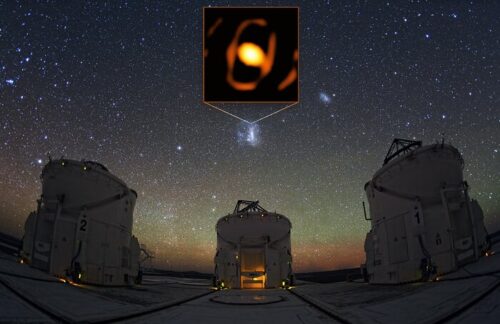
The Large Magellanic Cloud is a satellite galaxy to the Milky Way, located 160 000 light-years away from us. Despite the staggering distance, the GRAVITY instrument of the European Southern Observatory’s Very Large Telescope Interferometer (ESO’s VLTI), managed to take a closed-up picture of the giant star WOH G64. This image shows the location of the star within the Large Magellanic Cloud, with with some of the VLTI’s Auxiliary Telescopes in the foreground.
More information
ESO’s Very Large Telescope Interferometer is able to combine light collected by the telescopes of ESO’s Very Large Telescope (VLT), either the four 8-metre Unit Telescopes or the four smaller Auxiliary Telescopes, creating highly detailed pictures of the cosmos. Effectively, this makes the VLTI a “virtual” telescope with a resolution equivalent to the maximum distance between the individual telescopes. This process is highly complex and needs instruments especially dedicated to this task. Back in 2005 and 2007 Ohnaka’s team had access to the first generation of these instruments: MIDI. While impressive for its time, those observations with MIDI only combined the light from two telescopes. Now, researchers have access to GRAVITY, a second-generation instrument able to capture the light of four telescopes. Its improved sensitivity and resolution made the image of WOH G64 possible. But there is more to come. GRAVITY+ is a planned upgrade of GRAVITY which will be able to take advantage of different technological updates performed at the VLTI and VLT. With these, the VLTI will be able to see objects fainter and farther than ever before.
** SpaceX Dragon moved to new parking spot on space station – VideoFromSpace
The SpaceX Crew-9 astronauts, including two crew members formerly aboard Boeing’s Starliner spacecraft, moved their Crew Dragon capsule to another docking port to make way for a new cargo Dragon arrival.
** NASA’s SpaceX 31st Cargo Resupply Services Rendezvous and Docking – Tuesday, Nov. 5, 2024 – NASA Video
Loaded with scientific experiments and supplies, an unpiloted SpaceX Dragon cargo spacecraft automatically docked to the International Space Station’s earth-facing port of the Harmony module Nov. 5. The SpaceX resupply spacecraft launched from launch pad 39-A at NASA’s Kennedy Space Center in Florida Nov. 4 as part of the company’s 31st commercial resupply mission for the agency and will remain at the station for one month.
** NASA’s SpaceX CRS-31 Research: Bristol Myers Squibb and Redwire Space – ISS National Lab
On SpaceX’s 31st Commercial Resupply Services mission for NASA to the International Space Station, Bristol Myers Squibb will build on its legacy of protein crystallization in order to support the manufacturing of more effective therapeutics. This video provides an overview on their investigation and the impacts it may have on future patient care.
** NASA Astronaut Don Pettit Talks with KATU-TV Portland 241029 – Tuesday, October 29, 2024 – NASA Video
Aboard the International Space Station, Expedition 72 Flight Engineer Don Pettit of NASA discussed life and work aboard the orbital outpost during an in-flight interview Oct. 29 with KATU-TV in Portland, Oregon. Pettit is in the midst of a long-duration mission living and working aboard the microgravity laboratory to advance scientific knowledge and demonstrate new technologies for future human and robotic exploration flights as part of NASA’s Moon and Mars exploration approach, including lunar missions through NASA’s Artemis program.
** NASA Astronaut Butch Wilmore Talks with Tennessee Tech – Tuesday, November 5, 2024 – NASA Video
Aboard the International Space Station, Expedition 72 Flight Engineer Butch Wilmore of NASA discussed life and work aboard the orbital outpost during an in-flight interview Nov. 5 with Tennessee Tech University. Wilmore, an alumnus of the university, is in the midst of a long-duration mission living and working aboard the microgravity laboratory to advance scientific knowledge and demonstrate new technologies for future human and robotic exploration flights as part of NASA’s Moon and Mars exploration approach, including lunar missions through NASA’s Artemis program.
** IAF GNF SESSION – Space Stations 2.0: Opportunities on Commercial LEO Destinations – Int. Astronautical Fed.
The International Space Station (ISS) has been a spectacular platform for scientific research, technology development, and worldwide diplomacy for over 20 years. The orbiting laboratory’s contributions to humanity for both terrestrial applications and the future of spaceflight are unparalleled. However, the lifetime of the ISS is coming to an end in the near future, and the realm of government-run assets in low-Earth orbit (LEO) will soon transition to commercial space stations run by private companies.
Will the scientific discoveries and international partnerships of the last two decades still be possible in this new era? This panel session will explore the opportunities, capabilities, and frameworks of commercial space stations from the perspective of astronauts, microgravity researchers, technologists, investors, and policymakers around the world.
=== Chinese space habitats
** China’s Shenzhou 19 crew enters Tiangong space station after docking – VideoFromSpace
China’s Shenzhou 19 crew, Cai Xuzhe, Song Lingdong and Wang Haoze, completed ingress into the Tiangong space station shortly after docking on Oct. 29, 2024 (Oct 30 – Beijing time). See their launch: https://www.space.com/space-explorati…
** China’s Shenzhou-18 Astronauts Ready to Return After In-Orbit Crew Handover – CCTV Video News Agency
The Shenzhou-18 astronauts transferred control of the Tiangong space station to the newly arrived Shenzhou-19 crew on Friday as they prepared to return to Earth.
** Shenzhou-18 Astronauts Return to Earth with Scientific Materials – CCTV Video News Agency
The three astronauts of China’s Shenzhou-18 crewed spaceflight mission have returned to Earth with scientific materials from the Tiangong space station.
The Shenzhou-18 (神舟十八) crew spacecraft undocked from the Tianhe Core Module (天和核心舱), departing the China Space Station (中国空间站), on 3 November 2024, at 08:12 UTC (16:12 China Standard Time). The Shenzhou-18 spacecraft is expected to make a parachute-assisted landing at the Dongfeng landing site, Inner Mongolia Autonomous Region, China, returning the seventh crew of three astronauts on a mission to the China Space Station (中国空间站): Guangfu Ye (叶光富, commander), Cong Li (李聪) and Guangsu Li (李广苏).
** Starship is the Easy Part – Mars Society’s Zubrin Charts the Real Challenges on our way to Mars – SpaceWatch.Global TV
Guest: Dr. Robert Zubrin, Founder of the Mars Society and Author of “The New World on Mars”
In this expansive conversation, Dr. Robert Zubrin takes us beyond the technical challenges of reaching Mars to explore the complex realities of establishing permanent human settlements on the Red Planet. While the world watches Starship development, Zubrin reveals how energy production, food sustainability, radiation protection, and governance structures pose the real challenges for human survival on Mars. His insights challenge common misconceptions and propose innovative solutions for everything from terraforming to creating new societies, demonstrating how Mars settlement could reshape human civilization both on and off Earth.
Quotable Insights:
1. “Mars will be ruled by the Martians. Different groups of people will emigrate to Mars with very different ideals as to what the ideal society should be.” 2. “We don’t go to Mars to desert the Earth. We go to Mars to expand the capacity of the human race, to create new branches of human civilization.” 3. “I believe that humans are not the enemies of life, humans are the vanguards of life.” 4. “We have in our power to begin the world anew.”
Cosmic Timeline (Timestamps):
• [00:00:00] Opening: Mars governance and future civilizations • [00:02:23] Realistic timeline for human Mars missions within next decade • [00:03:46] Energy challenges on Mars – nuclear vs. solar power • [00:06:20] First expedition structure and duration • [00:09:31] Economics of Mars transportation and Starship development • [00:13:51] Transition from expeditions to permanent settlements • [00:20:00] Mars Against Hunger Prize and food production innovations • [00:30:34] Radiation protection strategies and reality check • [00:34:23] Living arrangements: underground vs. surface habitats • [00:40:56] Terraforming possibilities using fluorocarbon gases • [00:42:42] Alternative terraforming methods using iron nanoparticles • [00:49:23] Mars governance models and settlement structures • [00:56:18] Immigration and settlement competition between colonies • [01:05:06] Mars as human expansion rather than planetary backup • [01:08:32] Personal motivations and future vision • [01:09:57] Music selection: Beethoven’s Third Symphony
Share this episode with anyone interested in exploration, sustainable technology, or the future of human civilization. This conversation goes beyond the typical space exploration narrative to explore how
=== Other space habitat and settlement news and articles:
** Hurricane Rafael makes landfall in Cuba, barrels into the Gulf in satellite time-lapse – VideoFromSpace
NOAA’s GOES-East satellite captured Hurricane Rafael from Nov. 5-7, 2024.
** Live Video from the International Space Station (Official NASA Stream) – NASA
Watch live video from the International Space Station, including inside views when the crew aboard the space station is on duty. Views of Earth are also streamed from an external camera located outside of the space station. During periods of signal loss due to handover between communications satellites, a blue screen is displayed.
The space station orbits Earth about 250 miles (425 kilometers) above the surface. An international partnership of five space agencies from 15 countries operates the station, and it has been continuously occupied since November 2000. It’s a microgravity laboratory where science, research, and human innovation make way for new technologies and research breakthroughs not possible on Earth. More: https://go.nasa.gov/3CkVtC8
Did you know you can spot the station without a telescope? It looks like a fast-moving star, but you have to know when to look up. Sign up for text messages or email alerts to let you know when (and where) to spot the station and wave to the crew: https://spotthestation.nasa.gov
Check out the night sky this month, November 2024. Here are videos and a list of websites highlighting the top sights to observe.
** What’s Up: November 2024 Skywatching Tips from NASA – NASA JPL
What are some skywatching highlights in November 2024?
This month, catch planetary views of Saturn, Jupiter, and Mars, witness a close pass of the Parker Solar Probe by Venus, and get ready for an occultation of the bright star Spica by the Moon.
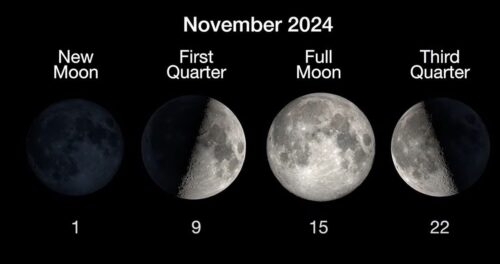
0:00 Intro 0:20 November planet highlights 1:38 Venus & Parker Solar Probe’s flyby 3:03 Occultation of Spica 4:25 October photo highlights 4:38 November Moon phases
Additional information about topics covered in this episode of What’s Up, along with still images from the video, and the video transcript, are available at https://solarsystem.nasa.gov/skywatch….
** Comet A3, meteor showers and Solar System moons. What’s in the night sky, November 2024 – BBC Sky at Night Magazine
Pete Lawrence and Paul Abel reveal what’s in the night sky in November 2024, including where Comet C/2023 A3 will be, this month’s meteor showers and transits of Jupiter’s and Saturn’s moons.
00:00 Intro 00:15 Inner Solar System 03:20 Outer Solar System 10:16 Galilean Moons 12:18 Saturn’s moons 12:58 Face in Albategnius, Eyes of Clavius 13:58 Jupiter and 11th mag star 15:28 Northern Taurid meteor shower 16:05 Star Tipped Mountain and perigee full Moon 17:50 Leonid meteor shower 17:26 Titan shadow transit 18:46 Comet C/2023 A3 Tsuchinshan-ATLAS 20:28 Deep sky
** Sky & Telescope’s Sky Tour Podcast – November 2024 | Meteor Showers, the Moon, and Mars – Sky & Telescope Youtube
Our monthly Sky Tour #astronomy #podcast provides an informative and entertaining 10-minute guided tour of the #night #sky. Join us for the November 2024 episode and get in sync with the #Moon’s phases, watch the #sky for all five bright #planets (#jupiter, #venus, #mars, #mercury, #saturn), get the lowdown on a #celestial queen, and get ready for three #meteorshower viewings.
Listen and subscribe to this podcast at https://skyandtelescope.org/observing/ and don’t forget to subscribe to S&T’s YouTube channel to get alerts about new videos, including this monthly podcast
Learn more about #observing and #stargazing on our website, https://skyandtelescope.org/ and subscribe to our monthly magazine at https://skyandtelescope.org/subscribe.
Saturn’s moon Titan Mars and the Beehive Cluster
Lacus Mortis
✨ Constellation of the Month: Cetus
Whether you’re a beginner or an expert, looking at the night sky with the naked eye, binoculars or a telescope, check out our Tour of the Night Sky to find out what you can see this month. #WINS#Astronomy#WhatsInTheNightSky
Looking to expand your astronomy knowledge even further? The Astronomy Hub is the place to learn everything from what’s in the sky this month, to what gear can help you capture the best celestial images. Learn more here ➡️ https://www.highpointscientific.com/a…
Follow us on Instagram / highpointscientific Follow us on Facebook / highpointscientific Sign up for our email newsletter https://www.highpointscientific.com/c…
#highpointscientific #astronomy #november
Chapters 00:00 – Introduction 00:38 – Andromeda Galaxy 01:27 – The Double Cluster 02:15 – Mesarthim 02:42 – The Little Dumbbell 03:27 – Nearest Neighbors 04:45 – Uranus at Opposition 05:36 – Conclusion