The Next Big Future blog hosts the latest Carnival of Space.
Carnival of Space #409 – Next Big Future
The Next Big Future blog hosts the latest Carnival of Space.
The Next Big Future blog hosts the latest Carnival of Space.
The latest photos of Ceres from the Dawn spacecraft:
![pia19568_main-1041[1]](http://www.nasa.gov/sites/default/files/thumbnails/image/pia19568_main-1041.jpg) The brightest spots on dwarf planet Ceres are seen in this image taken
The brightest spots on dwarf planet Ceres are seen in this image taken
by NASA’s Dawn spacecraft on June 6, 2015. Full image and caption
Bright Spots Shine in Newest Dawn Ceres Images
New images of dwarf planet Ceres, taken by NASA’s Dawn spacecraft, show the cratered surface of this mysterious world in sharper detail than ever before. These are among the first snapshots from Dawn’s second mapping orbit, which is 2,700 miles (4,400 kilometers) above Ceres.
The region with the brightest spots is in a crater about 55 miles (90 kilometers) across. The spots consist of many individual bright points of differing sizes, with a central cluster. So far, scientists have found no obvious explanation for their observed locations or brightness levels.
 A large crater in the southern hemisphere of dwarf planet Ceres is
seen in this image taken by NASA’s Dawn spacecraft on June 6, 2015.
Full image and caption
“The bright spots in this configuration make Ceres unique from anything we’ve seen before in the solar system. The science team is working to understand their source. Reflection from ice is the leading candidate in my mind, but the team continues to consider alternate possibilities, such as salt. With closer views from the new orbit and multiple view angles, we soon will be better able to determine the nature of this enigmatic phenomenon,” said Chris Russell, principal investigator for the Dawn mission based at the University of California, Los Angeles.
Numerous other features on Ceres intrigue scientists as they contrast this world with others, including protoplanet Vesta, which Dawn visited for 14 months in 2011 and 2012. Craters abound on both bodies, but Ceres appears to have had more activity on its surface, with evidence of flows, landslides and collapsed structures.
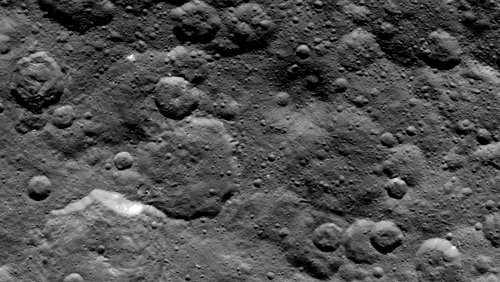
Craters in the northern hemisphere of dwarf planet Ceres are seen
in this image taken by NASA’s Dawn spacecraft on June 6, 2015.
Full image and caption
Additionally, new images from Dawn’s visible and infrared mapping spectrometer (VIR) show a portion of Ceres’ cratered northern hemisphere, taken on May 16, including a true-color view and a temperature image. The temperature image is derived from data in the infrared light range. This instrument is also important in determining the nature of the bright spots.
Having arrived in its current orbit on June 3, Dawn will observe the dwarf planet from 2,700 miles (4,400 kilometers) above its surface until June 28. In orbits of about three days each, the spacecraft will conduct intensive observations of Ceres. It will then move toward its next orbit of altitude 900 miles (1,450 kilometers), arriving in early August.
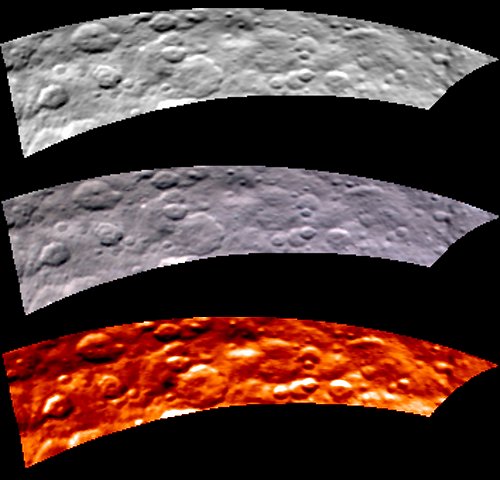 Images from Dawn’s visible and infrared mapping spectrometer (VIR)
show a portion of Ceres’ cratered northern hemisphere, taken on
May 16, 2015. Full image and caption
On March 6, 2015, Dawn made history as the first mission to visit a dwarf planet, and the first to orbit two distinct extraterrestrial targets. At its previous target, Vesta, Dawn took tens of thousands of images and made many observations about the body’s composition and other properties.
Dawn’s mission is managed by JPL for NASA’s Science Mission Directorate in Washington. Dawn is a project of the directorate’s Discovery Program, managed by NASA’s Marshall Space Flight Center in Huntsville, Alabama. UCLA is responsible for overall Dawn mission science. Orbital ATK Inc., in Dulles, Virginia, designed and built the spacecraft. The German Aerospace Center, Max Planck Institute for Solar System Research, Italian Space Agency and Italian National Astrophysical Institute are international partners on the mission team. For a complete list of mission participants, visit: dawn.jpl.nasa.gov/mission
More information about Dawn is available at the following sites:
A new report from ESO (European Southern Observatory):
A Celestial Butterfly Emerges from its Dusty Cocoon
Some of the sharpest images ever made with ESO’s Very Large Telescope have, for the first time, revealed what appears to be an ageing star giving birth to a butterfly-like planetary nebula. These observations of the red giant star L2 Puppis, from the ZIMPOL mode of the newly installed SPHERE instrument, also clearly showed a close companion. The dying stages of stars continue to pose astronomers with many riddles, and the origin of such bipolar nebulae, with their complex and alluring hourglass figures, doubly so.
![eso1523a[1]](http://hobbyspace.com/Blog/wp-content/uploads/2015/06/eso1523a1-1024x1024.jpg)
Some of the sharpest images ever made with ESO’s Very Large Telescope have for the first time revealed what appears to be an ageing star in the early stages of forming a butterfly-like planetary nebula. These observations of the red giant star L2 Puppis from the ZIMPOL mode of the newly installed SPHERE instrument also reveal a close companion. The dying stages of the lives of stars continue to pose many riddles for astronomers. Credit: ESO/P. Kervella
At about 200 light-years away, L2 Puppis is one of the closest red giants to Earth known to be entering its final stages of life. The new observations with the ZIMPOL mode of SPHERE were made in visible light using extreme adaptive optics, which corrects images to a much higher degree than standard adaptive optics, allowing faint objects and structures close to bright sources of light to be seen in greater detail. They are the first published results from this mode and the most detailed of such a star.
ZIMPOL can produce images that are three times sharper than those from the NASA/ESA Hubble Space Telescope, and the new observations show the dust that surrounds L2 Puppis in exquisite detail [1]. They confirm earlier findings, made using NACO, of the dust being arranged in a disc, which from Earth is seen almost completely edge-on, but provide a much more detailed view. The polarisation information from ZIMPOL also allowed the team to construct a three dimensional model of the dust structures [2].
![eso1523b[1]](http://hobbyspace.com/Blog/wp-content/uploads/2015/06/eso1523b1-1024x1024.jpg)
Some of the sharpest images ever made with ESO’s Very Large Telescope have for the first time revealed what appears to be an ageing star in the early stages of forming a butterfly-like planetary nebula. The observations of the red giant star L2 Puppis from the ZIMPOL mode of the newly installed SPHERE instrument are combined here with infrared data from NACO, also on the VLT, which shows a dust loop deployed on the far side of the upper part of the nebula. The dying stages of the lives of stars continue to pose many riddles for astronomers. Credit: ESO/P. Kervella
The astronomers found the dust disc to begin about 900 million kilometres from the star — slightly farther than the distance from the Sun to Jupiter — and discovered that it flares outwards, creating a symmetrical, funnel-like shape surrounding the star. The team also observed a second source of light about 300 million kilometres — twice the distance from Earth to the Sun — from L2 Puppis. This very close companion star is likely to be another red giant of slightly lower mass, but less evolved.
The combination of a large amount of dust surrounding a slowly dying star, along with the presence of a companion star, mean that this is exactly the type of system expected to create a bipolar planetary nebula. These three elements seem to be necessary, but a considerable amount of good fortune is also still required if they are to lead to the subsequent emergence of a celestial butterfly from this dusty chrysalis.
This zoom video sequence takes the viewer from a broad vista of the southern Milky Way into a rich part of the constellation of Puppis. We finish with a very close-up look at the red giant star L2 Puppis, which is coming to the end of its life and probably starting to create a bipolar planetary nebula. Credit: ESO/P. Kervella/N. Risinger (skysurvey.org)/DSS. Music: Johan B. Monell (www.johanmonell.com)
Lead author of the paper, Pierre Kervella, explains: “The origin of bipolar planetary nebulae is one of the great classic problems of modern astrophysics, especially the question of how, exactly, stars return their valuable payload of metals back into space — an important process, because it is this material that will be used to produce later generations of planetary systems.”
In addition to L2 Puppis’s flared disc, the team found two cones of material, which rise out perpendicularly to the disc. Importantly, within these cones, they found two long, slowly curving plumes of material. From the origin points of these plumes, the team deduces that one is likely to be the product of the interaction between the material from L2 Puppis and the companions star’s wind and radiation pressure, while the other is likely to have arisen from a collision between the stellar winds from the two stars, or be the result of an accretion disc around the companion star.
Although much is still to be understood, there are two leading theories of bipolar planetary nebulae, both relying on the existence of a binary star system [3]. The new observations suggest that both of these processes are in action around L2 Puppis, making it appear very probable that the pair of stars will, in time, give birth to a butterfly.
Pierre Kervella concludes: “With the companion star orbiting L2 Puppis only every few years, we expect to see how the companion star shapes the red giant’s disc. It will be possible to follow the evolution of the dust features around the star in real time — an extremely rare and exciting prospect.”
[1] SPHERE/ZIMPOL use extreme adaptive optics to create diffraction-limited images, which come a lot closer than previous adaptive optics instruments to achieving the theoretical limit of the telescope if there were no atmosphere. Extreme adaptive optics also allows much fainter objects to be seen very close to a bright star. These images are also taken in visible light — shorter wavelengths than the near-infrared regime, where most earlier adaptive optics imaging was performed. These two factors result in significantly sharper images than earlier VLT images. Even higher spatial resolution has been achieved with VLTI, but the interferometer does not create images directly.
[2] The dust in the disc was very efficient at scattering the stars’ light towards Earth and polarising it, a feature that the team could use to create a three-dimensional map of the envelope using both ZIMPOL and NACO data and a disc model based on the RADMC-3D radiative transfer modeling tool, which uses a given set of parameters for the dust to simulate photons propagating through it.
[3] The first theory is that the dust produced by the primary, dying star’s stellar wind is confined to a ring-like orbit about the star by the stellar winds and radiation pressure produced by the companion star. Any further mass lost from the main star is then funneled, or collimated, by this disc, forcing the material to move outwards in two opposing columns perpendicular to the disc.
The second holds that most of the material being ejected by the dying star is accreted by its nearby companion, which begins to form an accretion disc and a pair of powerful jets. Any remaining material is pushed away by the dying star’s stellar winds, forming an encompassing cloud of gas and dust, as would normally occur in a single star system. The companion star’s newly created bipolar jets, moving with much greater force than the stellar winds of the dying star, then carve dual cavities through the surrounding dust, resulting in the characteristic appearance of a bipolar planetary nebula.
Bob Zimmerman reports on a new scientific paper that describes a type of pit seen on the Mars surface that looks very similar to cave openings on earth: Finding caves on Mars -Behind The Black.
Bob notes that a cluster of such pits are in area where there could be significant water ice deposits. If the pits lead into extended lava tube caves, these could be used as shelter by future settlers and the water would be a key resource for them as well. He explains why lava tubes could be more common on Mars than on earth.
Here is the paper: Atypical pit craters on Mars: New insights from THEMIS, CTX, and HiRISE observations – Cushing – 2015 – Journal of Geophysical Research: Planets.
The first trailer for Ridley Scott’s film version of Andrew Weir’s book, The Martian: A Novel
From the caption:
THE MARTIAN | Official Trailer: During a manned mission to Mars, Astronaut Mark Watney (Matt Damon) is presumed dead after a fierce storm and left behind by his crew. But Watney has survived and finds himself stranded and alone on the hostile planet. With only meager supplies, he must draw upon his ingenuity, wit and spirit to subsist and find a way to signal to Earth that he is alive. Millions of miles away, NASA and a team of international scientists work tirelessly to bring “the Martian” home, while his crewmates concurrently plot a daring, if not impossible rescue mission. As these stories of incredible bravery unfold, the world comes together to root for Watney’s safe return. Based on a best-selling novel, and helmed by master director Ridley Scott, THE MARTIAN features a star studded cast that includes Jessica Chastain, Kristen Wiig, Kate Mara, Michael Peña, Jeff Daniels, Chiwetel Ejiofor, and Donald Glover.
In Theaters – November, 2015
Cast: Matt Damon, Jessica Chastain, Kristen Wiig, Jeff Daniels, Michael Peña, Kate Mara, Sean Bean, Sebastian Stan, Aksel Hennie, and Chiwetel Ejiofor