Mar orbiter images Curiosity parachute flapping in the wind

The Mars Reconnaissance Orbiter spots the parachute used to bring the Curiosity rover onto the Red Planet surface:

Mars Science Laboratory: Used Parachute On Mars Flaps In The Wind
PIA16813-br

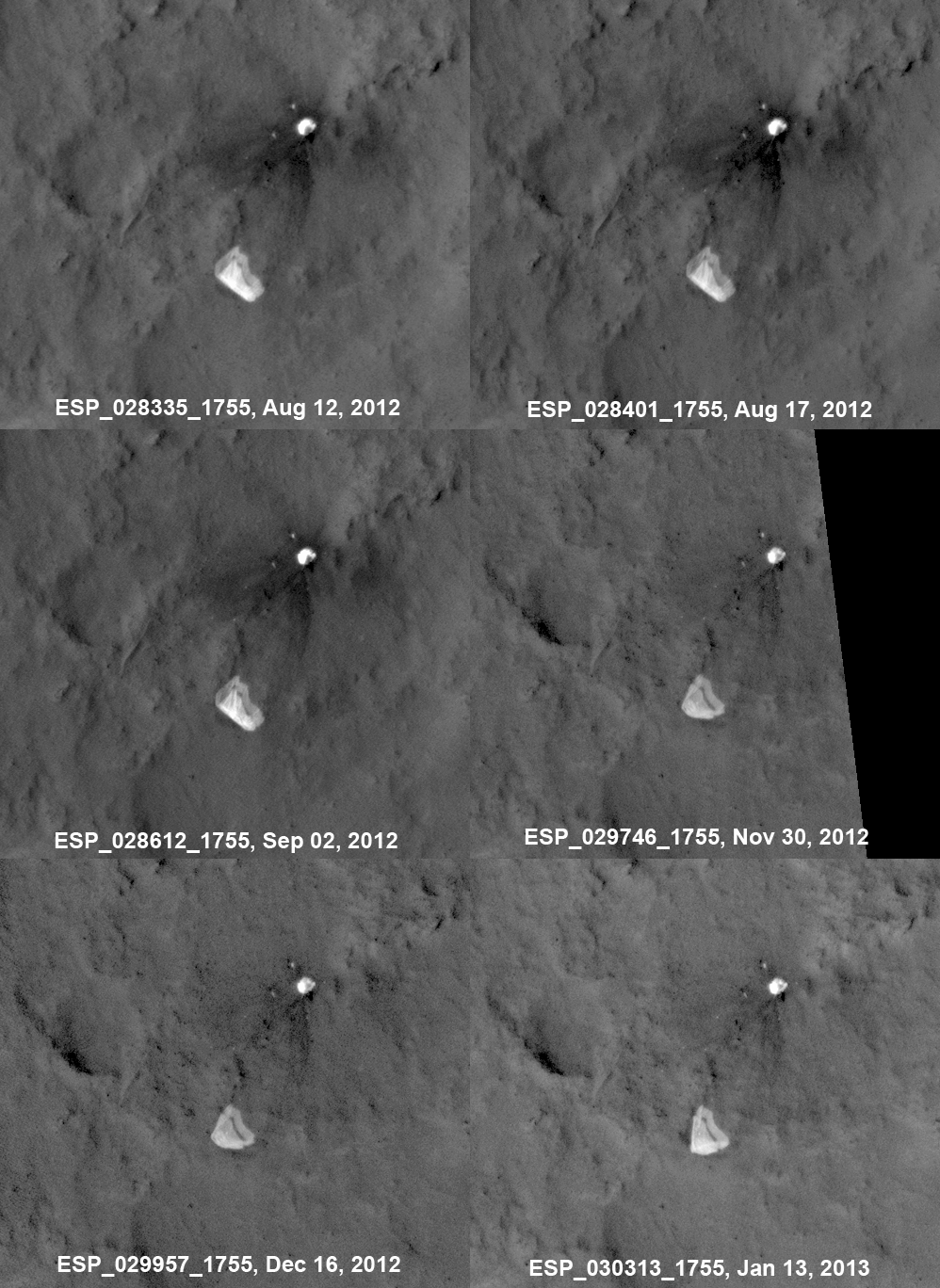
Curiosity’s Parachute Flapping in the Wind
This sequence of seven images from the High Resolution Imaging Science Experiment  (HiRISE) camera on NASA’s Mars Reconnaissance Orbiter shows wind-caused changes in the parachute of NASA’s Mars Science Laboratory spacecraft as the chute lay on the Martian ground during months after its use in safe landing of the Curiosity rover.

PASADENA, Calif. – Photos from NASA’s Mars Reconnaissance Orbiter show how the parachute that helped NASA’s Curiosity rover land on Mars last summer has subsequently changed its shape on the ground.

The images were obtained by the High Resolution Imaging Science Experiment (HiRISE) camera on Mars Reconnaissance Orbiter.

Seven images taken by HiRISE between Aug. 12, 2012, and Jan. 13, 2013, show the used parachute shifting its shape at least twice in response to wind.

The images in the sequence of photos are available online at http://uahirise.org/releases/msl-chute.php and at http://photojournal.jpl.nasa.gov/catalog/PIA16813 .

Researchers have used HiRISE to study many types of changes on Mars. Its first image of Curiosity’s parachute, not included in this series, caught the spacecraft suspended from the chute during descent through the Martian atmosphere.

HiRISE is operated by the University of Arizona, Tucson. The instrument was built by Ball Aerospace & Technologies Corp., Boulder, Colo. The Mars Reconnaissance Orbiter Project and Curiosity are managed by NASA’s Jet Propulsion Laboratory, Pasadena, Calif., for NASA’s Science Mission Directorate, Washington. JPL is a division of the California Institute of Technology in Pasadena.

For more information about the Mars Reconnaissance Orbiter, which has been studying Mars from orbit since 2006, visit http://www.nasa.gov/mro .

Sci-Tech: MIT study finds promise in Ion Wind propulsion

An MIT study finds the so-called ion wind technique, something hobbyists and students have been experimenting with for many years, might offer a practical propulsion system if it can be scaled up: A mighty wind: Thrusters powered by ionic wind may be an efficient alternative to conventional atmospheric propulsion technologies. – MIT News


Copenhagen Suborbitals: Sapphire rocket update

Copenhagen Suborbitals posts a video about their Sapphire rocket project. From the video caption:

Copenhagen Suborbitals is just weeks away from our first actively guided rocket flight. The Sapphire rocket has a liftoff mass of 200 kg, and stands six meters tall. Its nitrous oxide / polyurethane HATV type hybrid, controlled by servo operated copper jet vanes in the rocket jet. These powerful motors have a flawless record.

The instrumentation and payload is now passing parachute separation tests – and the two test performed confirmed our expectations for the parachute system.

The purpose of Copenhagen Suborbitals is to launch a human into space. You can god to space with a passive stable finn only rocket – but the initial acceleration needed to stay on course is too high for humans to endure. Therefore CS must master active guidance.

The fist and last purpose of the Sapphire mission is to test active guidance.

http://youtu.be/7yF05V4ZDZs

AMS experiment on ISS finds signs of dark matter but not yet conclusive

The first reported positron/electron ratio results from the Alpha Magnetic Spectrometer (AMS-02) experiment (see earlier post) on the ISS show consistency with production from dark matter interactions but more data will be needed to insure this is not due to other sources: Shining light on elusive dark matter / DAMA mission –  ESA

Scientists are confident that AMS-02 will deliver the data needed to solve the riddle of where the changes in positron ratio come from in the near future.

“Over the coming months, AMS will be able to tell us conclusively whether these positrons are a signal for dark matter, or whether they have some other origin.” says Professor Samuel Ting, the project’s lead investigator.

See also

British Interplanetary Society plaque to go to space on UK satellite

A plaque to commemorate the British Interplanetary Society‘s 80th anniversary will go to space on a Surrey Satellite Technology spacecraft later this year. Here is a recent press release from Reaction Engines Ltd, which sponsored the making of the plaque:

The British Interplanetary Society Delivers a Plaque to SSTL
for Flight on UK’s TechDemoSat-1

Guildford, Tuesday 5th March 2013

TechDemoSat-1 whose launch arrangements were announced today by Surrey Satellite Technology Ltd (SSTL) will be carrying a plaque commemorating the 80th Anniversary of the founding of the British Interplanetary Society (BIS). The Plaque will be mounted on TechDemoSat-1 and then carried into orbit.

Plaque handover; on left Doug Liddle and Luis Gomes of SSTL and on the right Gerry Webb of CST and BISPlaque handover; on left Doug Liddle and Luis Gomes of SSTL
and on the right Gerry Webb of CST and BIS.

The Plaque was handed over to Surrey Satellite Technology Ltd (SSTL) last month in a ceremony conducted by BIS Council Member Gerry Webb, and Luis Gomes of the SSTL TechDemoSat-1 team who are building the satellite.

Gerry Webb is General Director of Commercial Space Technologies Limited who are the brokers for the launch of SSTL TechDemoSat-1 with the Russian Space Agency. Roscosmos. He arranged for the Plaque to be carried with both SSTL and Roscosmos.

The President of the British Interplanetary Society, Alistair Scott said, “This is a fantastic way of celebrating our 80th year and reminding people of the work we have done since the early 1930s to promote spaceflight and the exploration and use of space. We are so grateful to Surrey Satellite Technology Ltd and the TechDemoSat-1 Team for allowing us to fly with them”

Sir Martin Sweeting, Executive Chairman of SSTL commented “I am delighted that SSTL is able to offer this opportunity to BIS, an organisation which has done so much to promote and foster the UK’s interest in space”. TechDemoSat-1 is a truly British spacecraft, designed and manufactured here and flying British payloads, so it is a fitting vehicle for this commemorative plaque.”

The Plaque mounted on TD SatMark Hempsell (REL) hands over the BIS 80th Anniversary
plaques for their journey to the ISS.

The plaque is identical to the two plaques that will be carried to the International Space Station in April 2013. It is a 4cm diameter disk, 3mm deep and made of high grade aluminium alloy. Weighing less than 5g each it is precision machined to depict the Society’s 80th Anniversary Logo. It was sponsored by Reaction Engines Limited, and was made by the company’s precision machining division, Brite Precision.