An announcement from the The Mars Society:
Massive Worldwide Response to Inspiration Mars Student Design Contest
The Mars Society’s Inspiration Mars International Student Design Competition has drawn a massive worldwide response. As of the January 31, 2014 deadline, letters of intent to compete have been received from 38 teams representing 56 universities in 15 countries.
Nations represented include the United States, Canada, Russia, the Netherlands, Germany, Austria, Italy, the United Kingdom, Portugal, Poland, Mauritius, India, Bangladesh, Japan and Colombia.
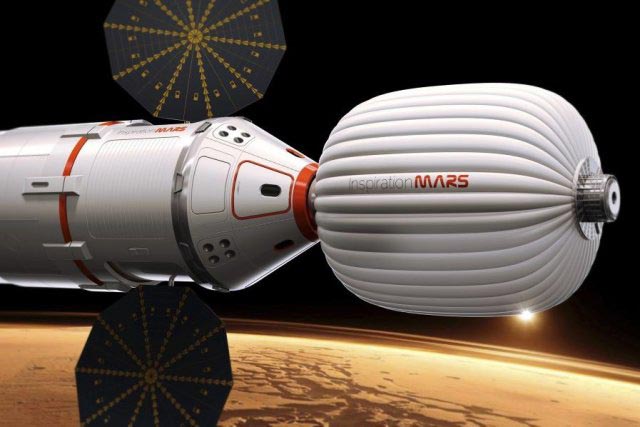 An early concept for the Inspiration Mars transport system.
A sampling of some of the institutions signed up to participate include: John Hopkins University, St. Petersburg State Polytechnical University, Ohio State University, Warsaw University of Technology, University of Notre Dame, Indira Gandhi National Open University, York University, International Space University, Purdue University, Islamic University of Technology, University of Stuttgart, Keio University, and University of Glasgow. To view a complete list of participating schools, please click here.
The Inspiration Mars International Student Design Competition was officially announced during the 16th Annual International Mars Society Convention held in Boulder, Colorado in August 2013. The contest is open to university engineering student teams from around the world.
Inspiration Mars Executive Director Dennis Tito and Program Manager Taber MacCallum were present for the announcement. “Inspiration Mars is looking for the most creative ideas from engineers all over the world,” said Tito at that time. “Furthermore, we want to engage the explorers of tomorrow with a real and exciting mission, and demonstrate what a powerful force space exploration can be in inspiring young people to develop their talent. This contest will accomplish both of those objectives.”
Commenting on the global response to the competition, Mars Society President Dr. Robert Zubrin said, “This contest is providing a tremendous opportunity for legions of young engineers to directly contribute their talent to this breakthrough project to open the space frontier. From what we are seeing right now, there are many ready to take up that challenge. Inspiration Mars said they wanted to show that space exploration can inspire youth to develop their talent. Well, they have delivered. The call has been sounded, and from all over the world, young people have answered. Just imagine what the effect would be on STEM (science, technology, engineering and mathematics) education if a full-scale program to explore and settle the Red Planet were set in motion. Consider what the vast number of new young scientists, engineers, investors, medical researchers and technology entrepreneurs resulting from such an inspiring challenge could do to advance humanity.”
The requirement of the Inspiration Mars International Student Design Competition is to design a two-person Mars flyby mission for 2018 as cheaply, safely and simply as possible. All other design variables are open.
Alumni, professors and other university staff may participate in the contest as well, but the teams must be predominantly composed of and led by university students. All competition presentations must be completed exclusively by students. Teams will be required to submit their design reports of no more than 50 pages in writing by March 15, 2014. From there, a down-select will occur with the top ten finalist teams invited to present and defend their designs before a panel of six judges chosen (two each) by the Mars Society, Inspiration Mars and NASA. The presentations will take place during a public event at NASA Ames Research Center in April 2014.
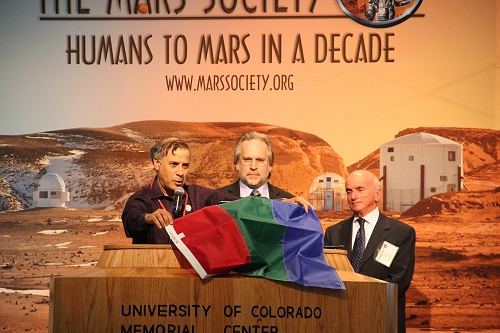 Robert Zubrin of the Mars Society, Taber MacCallum of
Paragon Space Development Corp., and Dennis Tito who
is funding Inspiration Mars.
The first place team will receive a prize of $10,000, an all-expenses paid trip to the 2014 International Mars Society Convention to be held August 7-10 in Houston, Texas and a trophy to be presented by Dennis Tito at that event. Prizes of $5,000, $3,000, $2,000 and $1,000 will also be awarded for second through fifth place.
For more details about the Mars Society and the Inspiration Mars International Student Design Competition, please visit our web site at: www.marssociety.org.
 The two bodies in this portion of an evening-sky view by