Category Archives: Mars

Hubble takes a great close-up picture of Mars

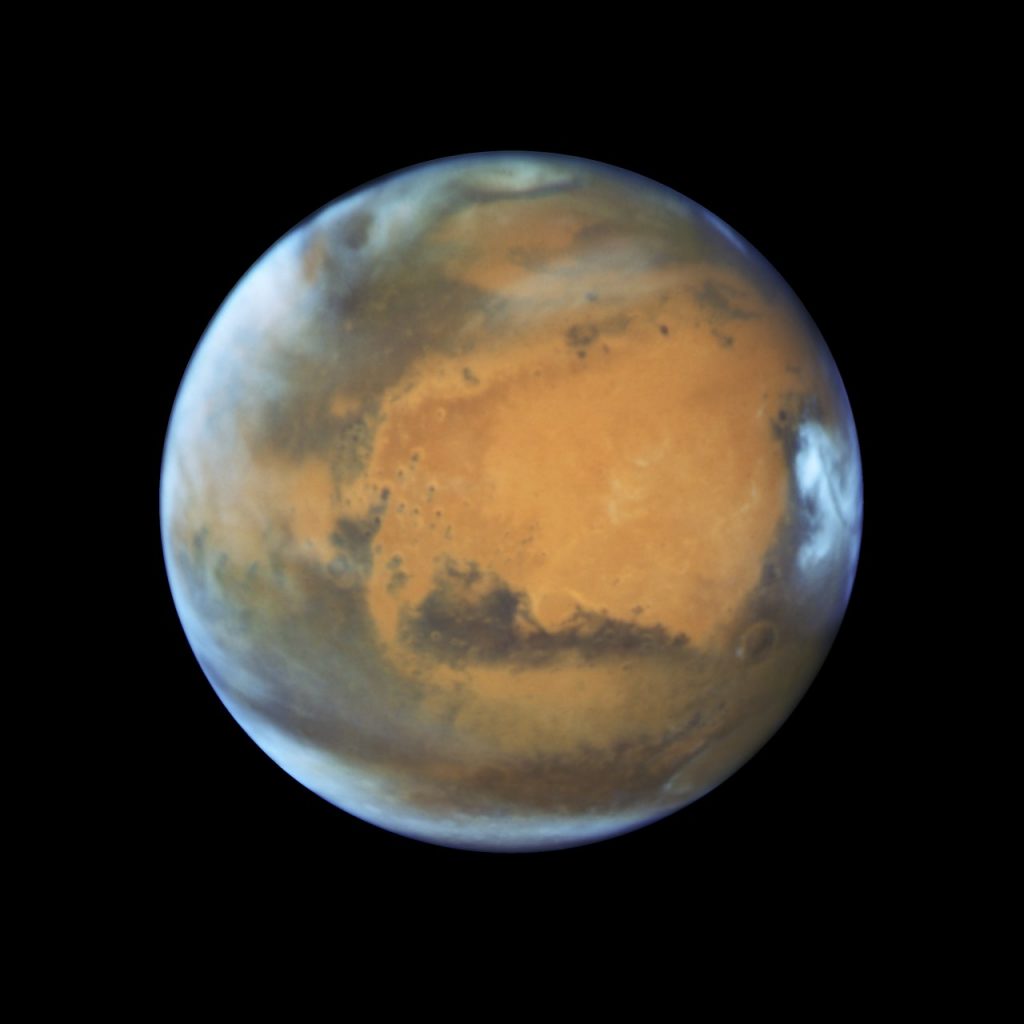
Orbiters around Mars can take very detailed images of the surface with far higher resolution than the NASA/ESA Hubble Space Telescope. However, Hubble is able to see a whole hemisphere at once. Below is a Hubble image of Mars taken this month when the orbits of the two planets bring them the closest distance (a mere 75.28 million kilometers or 196 times farther away than the Moon is from Earth) they have been in ten years. It shows many well-defined features of the planet including clouds.
Close-up of the Red Planet

This image shows our neighbouring planet Mars, as it was observed shortly before opposition in 2016 by the NASA/ESA Hubble Space Telescope. Some prominent features of the planet are clearly visible: the ancient and inactive shield volcano Syrtis Major; the bright and oval Hellas Planitia basin; the heavily eroded Arabia Terra in the centre of the image; the dark features of Sinus Sabaeous and Sinus Meridiani along the equator; and the small southern polar cap.

During May 2016 the Earth and Mars get closer to each other than at any time in the last ten years. The NASA/ESA Hubble Space Telescope has exploited this special configuration to catch a new image of our red neighbour, showing some of its famous surface features. This image supplements previous Hubble observations of Mars and allows astronomers to study large-scale changes on its surface.

On 22 May Mars will come into opposition, the point at which the planet is located directly opposite the Sun in the sky. This means that the Sun, Earth and Mars line up, with Earth sitting in between the Sun and the red planet.

Opposition also marks the planet’s closest approach to Earth, so that Mars appears bigger and brighter in the sky than usual. This event allows astronomers using telescopes in space and on the ground to see more details on the Martian surface [1]. For observers using ground-based instruments the opposing planet is visible throughout the night and is also fully illuminated, making it a great opportunity for detailed studies [2].
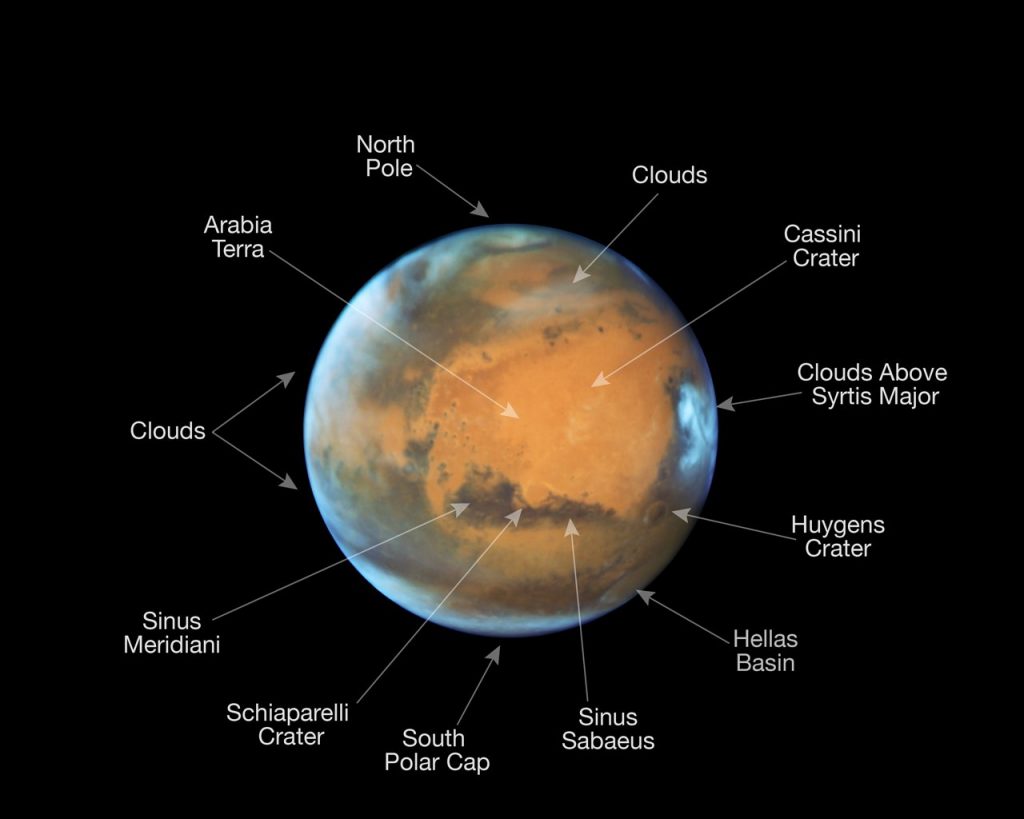
This image shows our neighbouring planet Mars, as it was observed shortly before opposition in 2016 by the NASA/ESA Hubble Space Telescope. Some prominent features on the surface of the planet have been annotated.

On 12 May Hubble took advantage of this favourable alignment and turned its gaze towards Mars to take an image of our rusty-hued neighbour, adding it to the collection of previous images. From this distance the telescope could see Martian features as small as 30 kilometres across.

Hubble observed Mars using its Wide Field Camera 3 (WFC3). The final image shows a sharp, natural-colour view of Mars and reveals several prominent geological features, from smaller mountains and erosion channels to immense canyons and volcanoes.

The large, dark region to the far right is Syrtis Major Planitia, one of the first features identified on the surface of the planet by seventeenth century observers. Syrtis Major is an ancient, inactive shield volcano. Late-afternoon clouds surround its summit in this view. The oval feature south of Syrtis Major is the bright Hellas Planitia basin, the largest crater on Mars. About 1,800 kilometres across and eight kilometres deep, it was formed about 3.5 billion years ago by an asteroid impact.

The orange area in the centre of the image is Arabia Terra, a vast upland region. The landscape is densely cratered and heavily eroded, indicating that it could be among the oldest features on the planet.

South of Arabia Terra, running east to west along the equator, are the long dark features known as Sinus Sabaeous (to the east) and Sinus Meridiani (to the west). These darker regions are covered by bedrock from ancient lava flows and other volcanic features.

An extended blanket of clouds can be seen over the southern polar cap. The icy northern polar cap has receded to a comparatively small size because it is now late summer in the northern hemisphere.

For Mars, the average time between successive oppositions — known as the planet’s synodic period — is 780 days — so the previous time that the planet was in opposition was April 2014. Hubble has observed Mars at (or near) opposition many times, including in 1995, 1999 (twice), 2001, 2003 (twice), 2005, and 2007. For a combined view of Mars’s appearance during the 1995-2007 oppositions see here, or see more Hubble images of Mars here.

Notes

[1] The dates of opposition and closest approach differ slightly. For 2016, opposition will occur on 22 May at 11:10 UTC, while Mars’s closest approach to Earth will occur on 30 May at 21:36 UTC, when Mars will be a distance of 0.503 au, or 75.28 million kilometres, from us. Mars’s closest ever recorded oppositional approach occurred in 2003, when it passed 55.76 million kilometres from us — the closest in 60 000 years.

[2] This is enhanced by the opposition effect, where an object’s surface appears particularly bright when the Sun’s light illuminating the surface is incident from directly behind our position as observers on Earth, as it is when Mars is at opposition. Opposition is also tied to Mars’s apparent retrograde motion, where the planet periodically appears to zig-zag backwards through the sky.

ESA uses LEGO ExoMars model in rover operations simulation

The European Space Agency (ESA) reports that a Lego ExoMars rover model can help with visualization of a rover’s movements in simulated remote control operations:

Lego ExoMars model

Lego_ExoMars_model_node_full_image_2[1]

This Lego model of Europe’s ExoMars rover on its lander was not built solely for fun – but is actually a tool, being used by robotics engineers in the midst of a major ‘egress’ test campaign.

Making a safe landing on Mars will be key to the success of Europe’s mobile Mars mission. Then comes the next most important step: to successfully drive the wheeled rover from the top of its lander, otherwise known as egress.

The biggest decision of all will be which direction to drive – forwards or backwards – based on the limited data that operators have to hand. The lander will have two sets of tracks for the rover to descend in case one side is blocked, for instance by rocks (one also reproduced here in Lego).

To build up experience of egress and remote rover operations, ESA’s Automation and Robotics section together with ESOC’s Advance Mission Concepts section are conducting a long-distance test campaign in collaboration with the French space agency CNES. The ExoMars project team is monitoring the ongoing activities.

A half-scale rover on a mock-up lander has been placed in the outdoor 80 x 50 m ‘Mars Yard’ at CNES Toulouse. An operations team based a thousand kilometres away at ESA’s ESTEC technical centre in the Netherlands has first to egress the rover, then move it further across the simulated Marscape to explore and accomplish various tasks.

Across a series of tests that continue throughout this week, the ESTEC team has no knowledge of the lander’s precise placing but must work with the limited camera views and sensor data the rover and lander sends back to them, with results received and telecommands sent during a limited set of communication passes.

The Lego model lets the engineers easily visualise and communicate complicated telemetry data.

This campaign follows on from a previous egress campaign that took place last autumn.

Video: Update on the Curiosity rover on Mars

The latest update on the Curiosity rover on Mars focuses on the planet’s seasons: Second Cycle of Martian Seasons Completing for Curiosity Rover – Mars Science Laboratory.

After two Martian years, NASA’s Curiosity Mars rover is more than a geologist, scientist and explorer. It’s a weather reporter, too!  See the changing seasons on Mars, and find out about clouds, frost and methane on the Red Planet.


Here is a infographic on Mars seasons: Seasonal Cycles in Curiosity’s First Two Martian Years – Mars Science Laboratory –

mars-curiosity-atmosphere-labeled-pia20600-br2[1]

Opportunity rover spots a dust devil scooting by

Dust devils have been images several times by Mars rovers over the years but this one is particularly clear and close:

Opportunity’s Devilish View from on High

PIA20012-16[1]

From its perch high on a ridge, NASA’s Mars Exploration Rover Opportunity recorded this image of a Martian dust devil twisting through the valley below. The view looks back at the rover’s tracks leading up the north-facing slope of “Knudsen Ridge,” which forms part of the southern edge of “Marathon Valley.”

Opportunity took the image using its navigation camera (Navcam) on March 31, 2016, during the 4,332nd Martian day, or sol, of the rover’s work on Mars.

Dust devils were a common sight for Opportunity’s twin rover, Spirit, in its outpost at Gusev Crater. Dust devils have been an uncommon sight for Opportunity, though.

Just as on Earth, a dust devil is created by a rising, rotating column of hot air. When the column whirls fast enough, it picks up tiny grains of dust from the ground, making the vortex visible.

During the uphill drive to reach the top of Knudsen Ridge, Opportunity’s tilt reached 32 degrees, the steepest ever for any rover on Mars.

NASA’s Jet Propulsion Laboratory, a division of the California Institute of Technology in Pasadena, manages the Mars Exploration Rover Project for NASA’s Science Mission Directorate, Washington.

More information about Opportunity is at these sites:

Mars Reconnaissance Orbiter reaches 10 year milestone

This video shows a small sample of the many magnificent images of the Martian surface taken by the Mars Reconnaissance Orbiter MRO during its first 10 years of operation:

NASA’s Mars Reconnaissance Orbiter has clocked more than a decade of service at the Red Planet and has yielded scientific discoveries and magnificent views of a distant world. These images taken by MRO’s HiRISE camera are not in true color because they are optimized for geological science.

Here is a release from NASA noting the 10 year milestone:

Ten Years of Discovery by Mars Reconnaissance Orbiter

True to its purpose, the big NASA spacecraft that began orbiting Mars a decade ago this week has delivered huge advances in knowledge about the Red Planet.

NASA’s Mars Reconnaissance Orbiter (MRO) has revealed in unprecedented detail a planet that held diverse wet environments billions of years ago and remains dynamic today.

One example of MRO’s major discoveries was published last year, about the possibility of liquid water being present seasonally on present-day Mars.  It drew on three key capabilities researchers gained from this mission: telescopic camera resolution to find features narrower than a driveway; spacecraft longevity to track seasonal changes over several Martian years; and imaging spectroscopy to map surface composition.

pia20167_esp_043961_1740-excerpt[1]
NASA’s Mars Reconnaissance Orbiter, nearing the 10th anniversary of its arrival at Mars, used its High Resolution Imaging Science Experiment (HiRISE) camera to obtain this view of an area with unusual texture on the southern floor of Gale Crater. Credits: NASA/JPL-Caltech/Univ. of Arizona
Other discoveries have resulted from additional capabilities of the orbiter. These include identifying underground geologic structures, scanning atmospheric layers and observing the entire planet’s weather daily. All six of the orbiter’s science instruments remain productive in an extended mission more than seven years after completion of the mission’s originally planned primary science phase.

“This mission has helped us appreciate how much Mars — a planet that has changed greatly over time — continues to change today,” said MRO Project Scientist Rich Zurek of NASA’s Jet Propulsion Laboratory, Pasadena, California. JPL manages the mission.

Data from MRO have improved knowledge about three distinct periods on Mars. Observations of the oldest surfaces on the planet show that diverse types of watery environments existed — some more favorable for life than others. More recently, water cycled as a gas between polar ice deposits and lower-latitude deposits of ice and snow, generating patterns of layering linked to cyclical changes similar to ice ages on Earth.

mro-infographic-by-the-numbers[1]

Dynamic activity on today’s Mars includes fresh craters, avalanches, dust storms, seasonal freezing and thawing of carbon dioxide sheets, and summertime seeps of brine.

The mission provides three types of crucial support for rover and stationary lander missions to Mars. Its observations enable careful evaluation of potential landing sites. They also help rover teams choose routes and destinations. Together with NASA’s Mars Odyssey, which has been orbiting Mars since 2001, MRO relays data from robots on Mars’ surface to NASA Deep Space Network antennas on Earth, multiplying the productivity of the surface missions.

The mission has been investigating areas proposed as landing sites for future human missions in NASA’s Journey to Mars.

“The Mars Reconnaissance Orbiter remains a powerful asset for studying the Red Planet, with its six instruments all continuing capably a decade after orbit insertion. All this and the valuable infrastructure support that it provides for other Mars missions, present and future, make MRO a keystone of the current Mars Exploration Program,” said Zurek.

Arrival at Mars

On March 10, 2006, the spacecraft fired its six largest rocket engines for about 27 minutes, slowing it down enough for the gravity of Mars to catch it into orbit. Those engines had been used only once before, for 15 seconds during the first trajectory adjustment during the seven-month flight from Earth to Mars. They have been silent since arrival day. Smaller engines provide thrust for orbit adjustment maneuvers.

For its first three weeks at Mars, the spacecraft flew elongated, 35-hour orbits ranging as far as 27,000 miles (43,000 kilometers) from the Red Planet. During the next six months, a process called aerobraking used hundreds of carefully calculated dips into the top of the Martian atmosphere to gradually adjust the size of the orbit. Since September 2006, the craft has been flying nearly circular orbits lasting about two hours, at altitudes from 155 to 196 miles (250 to 316 kilometers).

The spacecraft’s two large solar panels give MRO a wingspan the length of a school bus. That surface area helped with atmospheric drag during aerobraking and still cranks out about 2,000 watts of electricity when the panels face the sun. Generous power enables the spacecraft to transmit a torrent of data through its main antenna, a dish 10 feet (3 meters) in diameter. The total science data sent to Earth from MRO — 264 terabits — is more than all other interplanetary missions combined, past and present.

Lockheed Martin Space Systems, Denver, built the spacecraft with the capability to transmit copious data to suit the science goals of revealing Mars in great detail, which requires plenty of data.

For example, the mission’s High Resolution Imaging Science Experiment (HiRISE) camera, managed by the University of Arizona, Tucson, has returned images that show features as small as a desk anywhere in observations that now have covered about 2.4 percent of the Martian surface, an area equivalent to two Alaskas, with many locations imaged repeatedly. The Context Camera (CTX), managed by Malin Space Systems, San Diego, has imaged more than 95 percent of Mars, with resolution showing features smaller than a tennis court. The Compact Reconnaissance Imaging Spectrometer (CRISM), managed by Johns Hopkins University Applied Physics Laboratory, Laurel, Maryland, also has imaged nearly 98 percent of the planet in multiple visual-light and infrared wavelengths, providing composition information at scales of 100 to 200 yards or meters per pixel.

For more information about MRO, visit:

For more information about NASA’s journey to Mars, visit: www.nasa.gov/topics/journeytomars