Category Archives: Mars

Video: “Bringing Nuclear Power to Mars” – Dr. Frank H. Shu, UCB

Here is a SETI Institute seminar by Dr. Frank H. Shu, professor emeritus of UC Berkeley, on Bringing Nuclear Power to Mars

Establishing a lunar base is probably a wise first first step to colonizing Mars, and colonizing Mars will be a giant leap forward for humankind to travel to the stars. We begin our discussion by noting that the bare minimum for sustaining life on the Moon exists in the water brought by comets to the bottoms of some lunar craters. Electrolysis of this dirty water can produce clean oxygen (and hydrogen) for the lunar base, A reliable source of primary energy is needed for such tasks, but anywhere on the surface of the Moon, there is no sunlight two weeks out of four, and no wind whatsoever. Nuclear power is the default option, just as is the case of naval submarines where the crews need to live and work in closed environments submerged under the water of the ocean for months at a time. However, the light water reactors of naval submarines are not a good choice for environments that lack large bodies of water, and we argue, as first realized by a former NASA Engineer, Kirk Sorensen, that molten salt reactors, of the type invented by Oak Ridge National Lab in the 1960s, are much better suited for a lunar base, or for that matter, a Mars colony.

Dr. Shu will then discuss his patented design for the best possible two-fluid molten-salt breeder-reactor (2F-MSBR) that one could build, using thorium that can be mined locally without requiring shipments from mother Earth. He will close by considering two spin-off applications:

(1) saving civilization on Earth from the worst ravages of climate change by scaled-up 2F-MSBRs;
(2) using the fission fragments of related nuclear fission reactions for ion-propulsion that produces rockets two to three orders of magnitude faster than achievable with chemical rockets, making possible, perhaps, a first generation of starships.

Apollo 11 and Viking 1 anniversaries today

Today is the 47th anniversary of the Apollo 11 landing on the Moon. There will be a new documentary debuting today – Go: The Great Race – Moon Landing Special on ‘Through the Decades’ – Decades TV Network – July 20, 2016 – but there are many older ones available on line, e.g.:

Today on The Space Show (7-8:30 pm PDT, 10-11:30 pm EDT, 9-10:30 pm CDT) Rand Simberg and Bill Simon will discuss the Evoloterra ceremony. See my report here on Our Evoloterra evening from a few years ago.

Today is also the 40th anniversary of the landing of the first Viking spacecraft on Mars:

Video: ‘The Martian’ soundtrack and echos of Cosmos

A view of the Harry Gregson-Williams sound track for The Martian movie: Echoes of Vangelis – Why I love the music from ‘The Martian’ 

Here is a collection of Vangelis’s music including some from the Cosmos series soundtrack:

====

Mars explorer travel posters

Check out the free Mars Posters at NASA JPL . Here is a sampling:

P01-Explorers-Wanted-NASA-Recruitment-Poster-600x[1]
Explorers Wanted on the Journey to Mars Hike the solar system’s largest canyon, Valles Marineris on Mars, where you can catch blue sunsets in the twilight, and see the two moons of Mars (Phobos and Deimos) in the night sky.
P02-Work-The-Night-Shift-NASA-Recruitment-Poster-600x[1]
Work the Night Shift on Martian Moon Phobos Night owls welcome! If you lived on Mars’ moon Phobos, you’d have an office with a view, mining for resources with Mars in the night sky. Settlers below on Mars would see Phobos rise and set not once, but twice in one day!
P03-Farmers-Wanted-NASA-Recruitment-Poster-600x[1]
Farmers Wanted for Survival on Mars Got a green thumb? This one’s for you! In space, you can grow tomatoes, lettuce, peas, and radishes just like you would find in your summer garden. New ways of growing fresh food will be needed to keep brave explorers alive.
P07-Some-User-Assembly-Required-NASA-Recruitment-Poster-600x[1]
Assembly Required to Build Our Future on Mars and its Moons Are you someone who can put things together, solving challenges to ensure survival? Dare to forge our future with space-age tools – build spaceships to carry us to Mars and back, and habitats to protect us while we’re there.

Mars rover Opportunity wrapping up study of Marathon Valley

The Mars  rover Opportunity, in operation since January 2004, continues to explore and make new discoveries. Here is its latest report:

Rover Opportunity Wrapping up Study of Martian Valley

IDL TIFF file
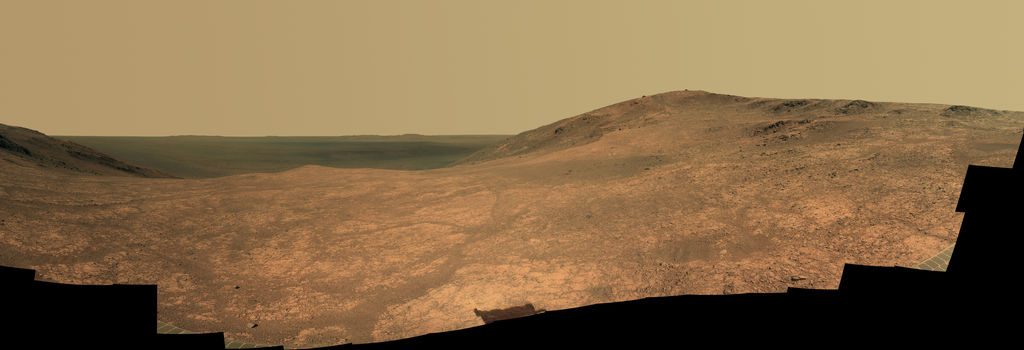
Mars Rover Opportunity’s Panorama of ‘Marathon Valley’ “Marathon Valley” on Mars opens to a view across Endeavour Crater in this scene from the Pancam of NASA’s Mars rover Opportunity. The scene merges many exposures taken during April and May 2016. The view spans from north (left) to west-southwest. Its foreground shows the valley’s fractured texture. Continue

“Marathon Valley,” slicing through a large crater’s rim on Mars, has provided fruitful research targets for NASA’s Opportunity rover since July 2015, but the rover may soon move on.

Opportunity recently collected a sweeping panorama from near the western end of this east-west valley. The vista shows an area where the mission investigated evidence about how water altered the ancient rocks and, beyond that, the wide floor of Endeavour Crater and the crater’s eastern rim about 14 miles (22 kilometers) away.

Marathon Valley lured the mission because researchers using NASA’s Mars Reconnaissance Orbiter had mapped water-related clay minerals at this area of the western rim of Endeavour Crater. The rover team chose the valley’s informal name because Opportunity’s arrival at this part of the rim coincided closely with the rover surpassing marathon-footrace distance in total driving since its January 2004 Mars landing.

“We are wrapping up our last few activities in Marathon Valley and before long we’ll drive away, exiting along the southern wall of the valley and heading southeast,” said Opportunity Principal Investigator Steve Squyres, of Cornell University, Ithaca, New York.

As Opportunity examined the clay-bearing rocks on the valley floor that were detected from orbit, the rover’s own observations of the valley’s southern flank revealed streaks of red-toned, crumbly material. The science team chose to investigate this apparently weathered material. The rover approached exposures of it to prepare for using the Rock Abrasion Tool, called the RAT. This tool grinds away a rock’s surface to expose the interior for inspection.

“What we usually do to investigate material that’s captured our interest is find a bedrock exposure of it and use the RAT,” Squyres said. “What we didn’t realize until we took a close-enough look is that this stuff has been so pervasively altered, it’s not bedrock. There’s no solid bedrock you could grind with the RAT.”

Instead, the rover exposed some fresh surfaces for inspection by scuffing some of the reddish material with a wheel.

Squyres said,

“In the scuff, we found one of the highest sulfur contents that’s been seen anywhere on Mars. There’s strong evidence that, among other things, these altered zones have a lot of magnesium sulfate. We don’t think these altered zones are where the clay is, but magnesium sulfate is something you would expect to find precipitating from water.

“Fractures running through the bedrock, forming conduits through which water could flow and transport soluble materials, could alter the rock and create the pattern of red zones that we see.”

As of June 14, Opportunity has driven 26.59 miles (42.79 kilometers). NASA’s Jet Propulsion Laboratory, a division of Caltech in Pasadena, California, built the rover and manages the mission for NASA’s Science Mission Directorate, Washington. For more information about Opportunity, visit:

===

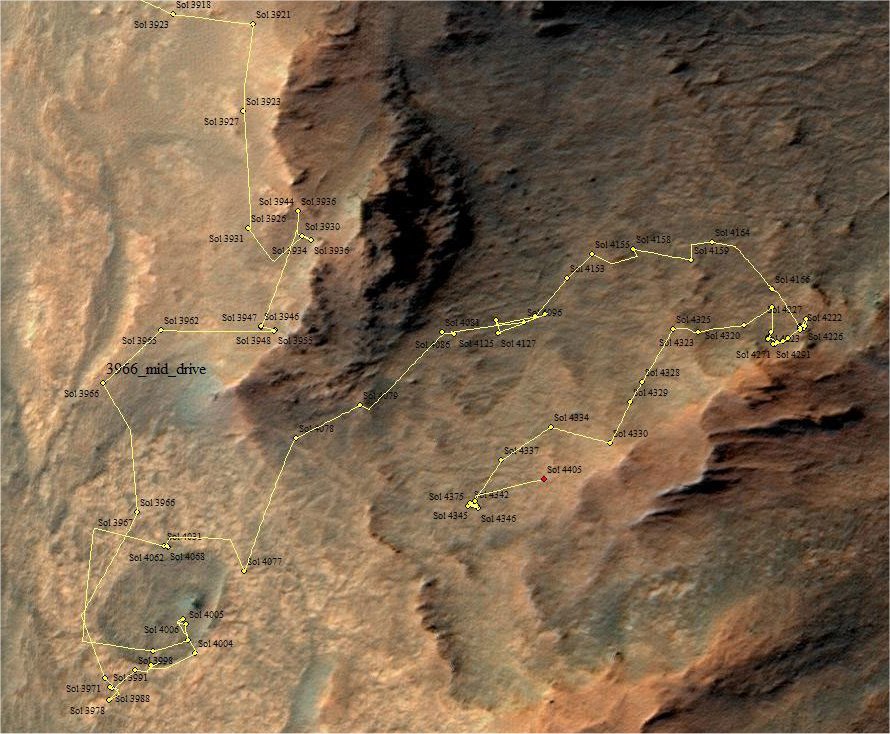
You can find maps of where Opportunity has traveled at Mars Exploration Rover Mission: Opportunity Traverse Map Archive. This map shows its recent path as of June 17, 2016:

Map-2016-06-17