The Astronomical Society of the Pacific sponsors the Silicon Valley Astronomy Lectures, include the recent talk by Dr. Ashwin Vasavada (Project Scientist for the Curiosity Mission to Mars at JPL) on the exploration of Mars. The title of the talk was “When Mars Was Like Earth: Five Years of Exploration with the Curiosity Rover”:
A short report from NASA JPL with the latest news from Mars:
And this longer video shows a talk by Troy Hudson of JPL about NASA’s Mars InSight Mission, which is scheduled to launch in May of this year and land on Mars in November. Hudson focused on using Insight’s sensors to investigate the interior of Mars:
The Mars rover Opportunity landed on the Red Planet on Jan. 25, 2004. Nearly 5000 Martian days later, the robust little robot continues to explore and make discoveries. Here are two items from NASA JPL about Opportunity:
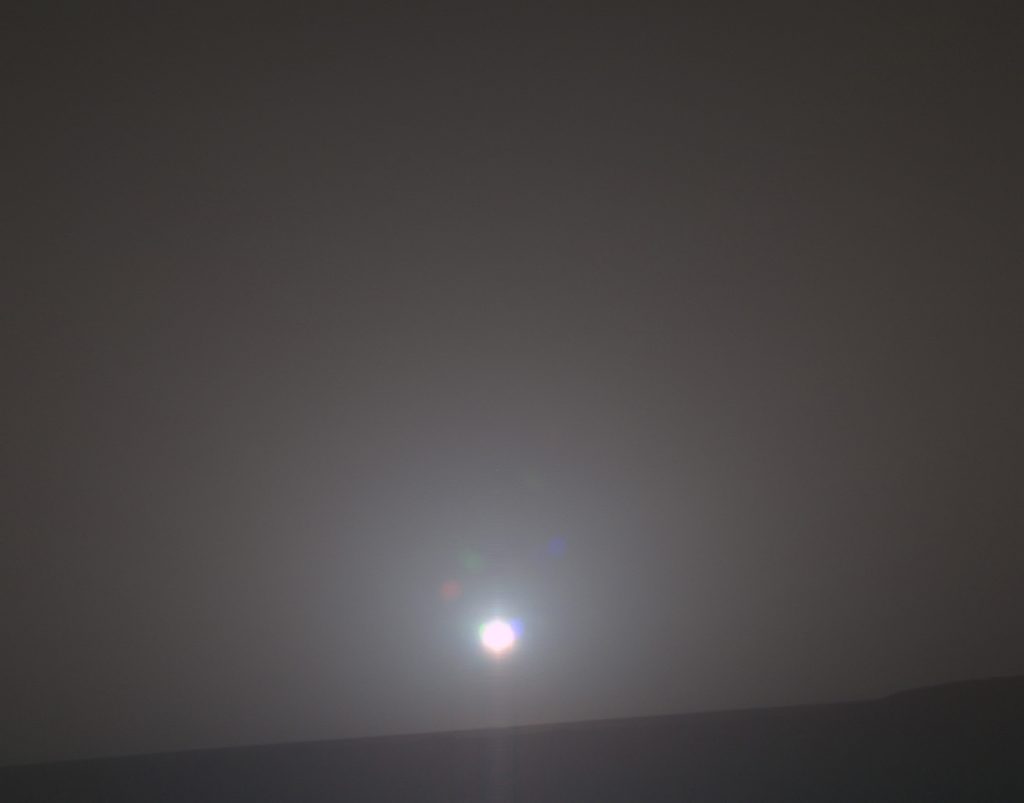
NASA’s Mars Exploration Rover Opportunity recorded the dawn of the rover’s 4,999th Martian day, or sol, with its Panoramic Camera (Pancam) on Feb. 15, 2018, yielding this processed, approximately true-color scene. The view looks across Endeavour Crater, which is about 14 miles (22 kilometers) in diameter, from the inner slope of the crater’s western rim. Opportunity has driven a little over 28.02 miles (45.1 kilometers) since it landed in the Meridiani Planum region of Mars in January, 2004, for what was planned as a 90-sol mission. A sol lasts about 40 minutes longer than an Earth day.
The Sun will rise on NASA’s solar-powered Mars rover Opportunity for the 5,000th time on Saturday, sending rays of energy to a golf-cart-size robotic field geologist that continues to provide revelations about the Red Planet.
“Five thousand sols after the start of our 90-sol mission, this amazing rover is still showing us surprises on Mars,” said Opportunity Project Manager John Callas, of NASA’s Jet Propulsion Laboratory, Pasadena, California.
A Martian “sol” lasts about 40 minutes longer than an Earth day, and a Martian year lasts nearly two Earth years. Opportunity’s Sol 1 was landing day, Jan. 25, 2004 (that’s in Universal Time; it was Jan. 24 in California). The prime mission was planned to last 90 sols. NASA did not expect the rover to survive through a Martian winter. Sol 5,000 will begin early Friday, Universal Time, with the 4,999th dawn a few hours later. Opportunity has worked actively right through the lowest-energy months of its eighth Martian winter.
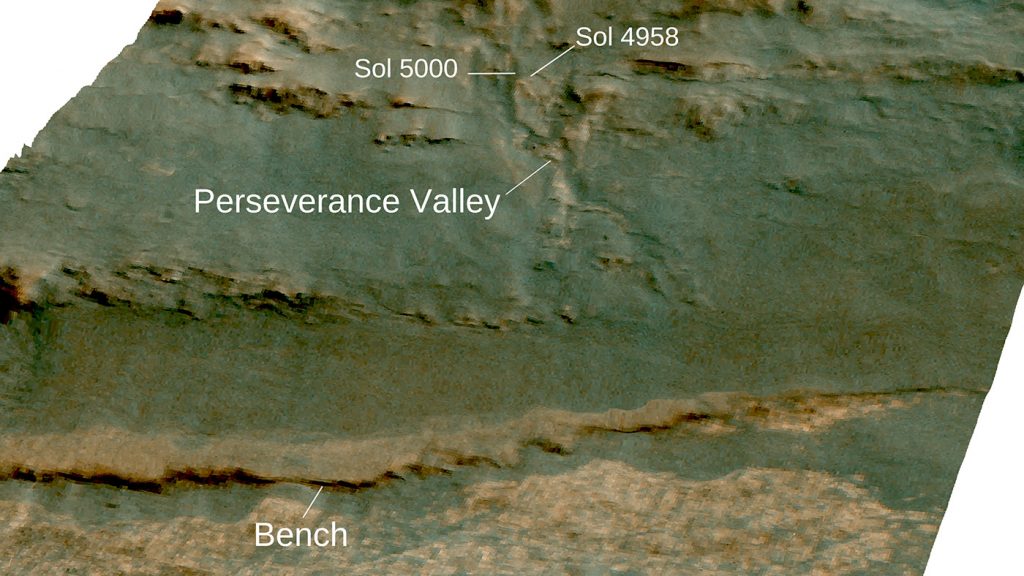
The channel descending a Martian slope in this perspective view is “Perseverance Valley,” the study area of NASA’s Mars rover Opportunity as the rover passes its 5,000th Martian day. The view overlays a HiRISE image onto a topographic model with five-fold vertical exaggeration, to show shapes. Credits: NASA/JPL-Caltech/Univ. of Arizona/WUSTL. Full image and caption
From the rover’s perspective on the inside slope of the western rim of Endeavour Crater, the milestone sunrise will appear over the basin’s eastern rim, about 14 miles (22 kilometers) away. Opportunity has driven over 28 miles (45 kilometers) from its landing site to its current location about one-third of the way down “Perseverance Valley,” a shallow channel incised from the rim’s crest of the crater’s floor. The rover has returned about 225,000 images, all promptly made public online.
“We’ve reached lots of milestones, and this is one more,” Callas said, “but more important than the numbers are the exploration and the scientific discoveries.”
The mission made headlines during its first months with the evidence about groundwater and surface water environments on ancient Mars. Opportunity trekked to increasingly larger craters to look deeper into Mars and father back into Martian history, reaching Endeavour Crater in 2011. Researchers are now using the rover to investigate the processes that shaped Perseverance Valley.
For more about Opportunity’s adventures and discoveries, see:
NASA’s Mars Exploration Rover Opportunity keeps providing surprises about the Red Planet, most recently with observations of possible “rock stripes.”
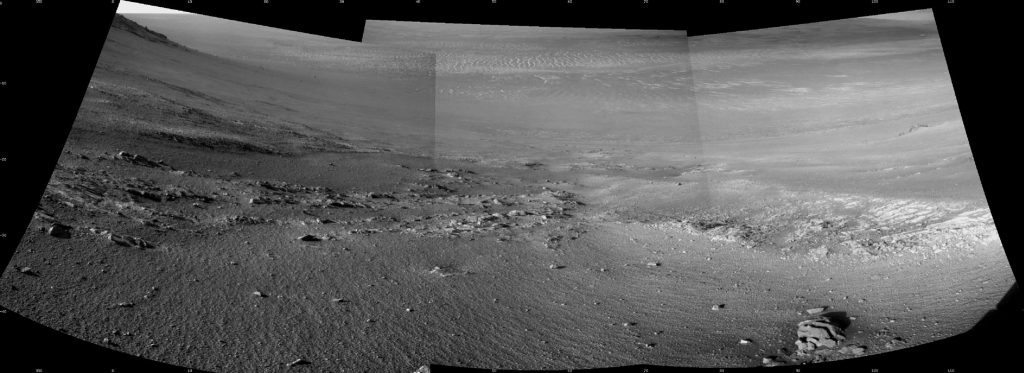
Textured rows on the ground in this portion of “Perseverance Valley” are under investigation by NASA’s Mars Exploration Rover Opportunity, which used its Navigation Camera to take the component images of this downhill-looking scene. The rover reaches its 5,000th Martian day, or sol, on Feb. 16, 2018. Image Credit: NASA/JPL-Caltech. Full Image and Caption
The ground texture seen in recent images from the rover resembles a smudged version of very distinctive stone stripes on some mountain slopes on Earth that result from repeated cycles of freezing and thawing of wet soil. But it might also be due to wind, downhill transport, other processes or a combination.
Opportunity landed on Mars in January 2004. As it reaches the 5,000th Martian day, or sol, of what was planned as a 90-sol mission, it is investigating a channel called “Perseverance Valley,” which descends the inboard slope of the western rim of Endeavour Crater.
“Perseverance Valley is a special place, like having a new mission again after all these years,” said Opportunity Deputy Principal Investigator Ray Arvidson of Washington University in St. Louis. “We already knew it was unlike any place any Mars rover has seen before, even if we don’t yet know how it formed, and now we’re seeing surfaces that look like stone stripes. It’s mysterious. It’s exciting. I think the set of observations we’ll get will enable us to understand it.”
On some slopes within the valley, the soil and gravel particles appear to have become organized into narrow rows or corrugations, parallel to the slope, alternating between rows with more gravel and rows with less.
This late-afternoon view from the front Hazard Avoidance Camera on NASA’s Mars Exploration Rover Opportunity shows a pattern of rock stripes on the ground, a surprise to scientists on the rover team. It was taken in January 2018, as the rover neared Sol 5000 of what was planned as a 90-sol mission. Image Credit: NASA/JPL-Caltech. Full Image and Caption.
The origin of the whole valley is uncertain. Rover-team scientists are analyzing various clues that suggest actions of water, wind or ice. They are also considering a range of possible explanations for the stripes, and remain uncertain about whether this texture results from processes of relatively modern Mars or a much older Mars.
Other lines of evidence have convinced Mars experts that, on a scale of hundreds of thousands of years, Mars goes through cycles when the tilt or obliquity of its axis increases so much that some of the water now frozen at the poles vaporizes into the atmosphere and then becomes snow or frost accumulating nearer the equator.
“One possible explanation of these stripes is that they are relics from a time of greater obliquity when snow packs on the rim seasonally melted enough to moisten the soil, and then freeze-thaw cycles organized the small rocks into stripes,” Arvidson said. “Gravitational downhill movement may be diffusing them so they don’t look as crisp as when they were fresh.”
Bernard Hallet of the University of Washington, Seattle, agrees the alignments seen in images of Perseverance Valley are not as distinctive as the stone stripes he has studied on Earth. Field measurements on Earth, near the summit of Hawaii’s Mauna Kea where the soil freezes every night but is often dry, have documented how those form when temperature and ground conditions are right: Soils with a mix of silt, sand and gravel expand more where the finer-grain material is most prevalent and retains more water. Freezing expands the soil, pushing larger particles up. If they move to the side, as well as down the general slope, due to gravity or wind, they tend to move away from the finer-grain concentrations and stretch out downslope. Where larger particles become more concentrated, the ground expands less. The process repeats hundreds or thousands of times, and the pattern self-organizes into alternating stripes.
Perseverance Valley holds rocks carved by sand blowing uphill from the crater floor, and wind might also be the key in sorting larger particles into rows parallel to the slope.
“Debris from relatively fresh impact craters is scattered over the surface of the area, complicating assessment of effects of wind,” said Opportunity science-team member Robert Sullivan of Cornell University, Ithaca, New York. “I don’t know what these stripes are, and I don’t think anyone else knows for sure what they are, so we’re entertaining multiple hypotheses and gathering more data to figure it out.”
Every sol Opportunity keeps working may add information to help solve some puzzles and find new ones.
Niamh is on Mars and a member of Crew 173, on a long duration mission to investigate new ways of growing food in this arid foreign land. As their 2 year mission comes to an end, one crucial experiment remains for Niamh. But will she overcome her personal struggles or put the whole crew and the mission in danger?
A highly visual exploration of future interplanetary human exploration, Shaw and her creative team create a new world order, reminding us of the power of the collective, the fragility of the solitary human and the united will behind all major breakthroughs. Because we may one day leave the cradle of Earth, but we will always be human.
The show about Niamh’s dream to go to Space has been inspired by Elon Musk’s grand design for a future interplanetary civilisation, testimonies of ESA employees, and Niamh’s personal space journey.
Created by Niamh Shaw & Sarah Baxter in collaboration with CIT Blackrock Castle Observatory, ESERO Ireland, European Space Agency & ESA Astronaut Centre. Funded by Science Foundation Ireland Discover Programme 2017.
===
Check out this marvelous panorama taken by the Curiosity rover as it takes a break from the trek up Mount Sharp and looks back from “Vera Rubin Ridge” at the route it has taken since landing in Gale Crater in August of 2012:
German physicist and engineer Christiane Heinicke describes her one year stay with five other people in the HI-SEAS (Hawai’i Space Exploration Analog and Simulation) habitat by the Mauna Loa volcano on Hawaii (see previous posts here about HI-SEAS): My Year on “Mars” – Scientific American –
Cut off from civilization, we were dependent on ourselves and on each other. We had to perform any work that needed doing and fix anything that broke. All we had was the material contained in the storage unit dubbed the “sea can.” The nearest supermarket was months away. We received news “from Earth” electronically – with a 20-minute delay. That is about how long it takes for signals to travel the maximum distance of 240 million miles between the two planets.
To be honest, it took weeks for me to realize just what I had gotten into.
She describes various difficulties and challenges that arose during the analog Mars mission but none were so terrible that they would discourage her from going to the Red Planet if she had the opportunity:
Studies such as HI-SEAS are designed to increase the chances that the first Mars crew will survive, and to create a setting in which its members can concentrate on seeking out signs of life rather than squandering their energies in conflicts and petty competition.
If it were possible for me to fly to Mars today, I wouldn’t hesitate – provided that I got along well with the crew and knew that I would get back in one piece. My year-long experience gave me a good understanding of the negative aspects of life away from Earth, and I know that I have what it takes. While my time on our Hawaiian Mars did not transform me into a completely new person, I have become much calmer in the face of enormous psychological stress. It now takes a lot to make me lose my equilibrium. For the privilege of delving into the secrets of an alien planet I would gladly forgo fresh raspberries for a few years.