Planetary Resources, Inc. recently pointed to this infographic on space mining made by Visual Capitalist:
Category Archives: Asteroids & Comets

New impact crater observed on Mars
Mars has been smacked by a meteoroid and has a new 30 meter wide crater: A Spectacular New Impact Crater and Its Ejecta – HiRISE/Univ.Arizona
—
NASA Mars Orbiter Examines Dramatic New Crater

A dramatic, fresh impact crater dominates this image taken by the High
Resolution Imaging Science Experiment (HiRISE) camera on NASA’s
Mars Reconnaissance Orbiter on Nov. 19, 2013.
Image Credit: NASA/JPL-Caltech/Univ. of Arizona
Full image and caption
Space rocks hitting Mars excavate fresh craters at a pace of more than 200 per year, but few new Mars scars pack as much visual punch as one seen in a NASA image released today.
The image from the High Resolution Imaging Science Experiment (HiRISE) camera on NASA’s Mars Reconnaissance Orbiter shows a crater about 100 feet (30 meters) in diameter at the center of a radial burst painting the surface with a pattern of bright and dark tones.
It is available online at uahirise.org/ESP_034285_1835 and www.nasa.gov/jpl/mro/martian-impact-crater-pia17932.
The scar appeared at some time between imaging of this location by the orbiter’s Context Camera in July 2010 and again in May 2012. Based on apparent changes between those before-and-after images at lower resolution, researchers used HiRISE to acquire this new image on Nov. 19, 2013. The impact that excavated this crater threw some material as far as 9.3 miles (15 kilometers).
The Mars Reconnaissance Orbiter Project is managed by NASA’s Jet Propulsion Laboratory, Pasadena, Calif., for NASA’s Science Mission Directorate, Washington. JPL is a division of the California Institute of Technology in Pasadena. HiRISE is operated by the University of Arizona, Tucson. The instrument was built by Ball Aerospace & Technologies Corp., Boulder, Colo. Malin Space Science Systems, San Diego, built and operates the Context Camera.
For more information about the Mars Reconnaissance Orbiter, which has been studying Mars from orbit since 2006, visit www.nasa.gov/mro .
ESO: Asteroid internal structure revealed
An announcement from the ESO (European Southern Observatory):
ESO’s New Technology Telescope (NTT) has been used to find the first evidence that asteroids can have a highly varied internal structure. By making exquisitely precise measurements astronomers have found that different parts of the asteroid Itokawa have different densities. As well as revealing secrets about the asteroid’s formation, finding out what lies below the surface of asteroids may also shed light on what happens when bodies collide in the Solar System, and provide clues about how planets form.
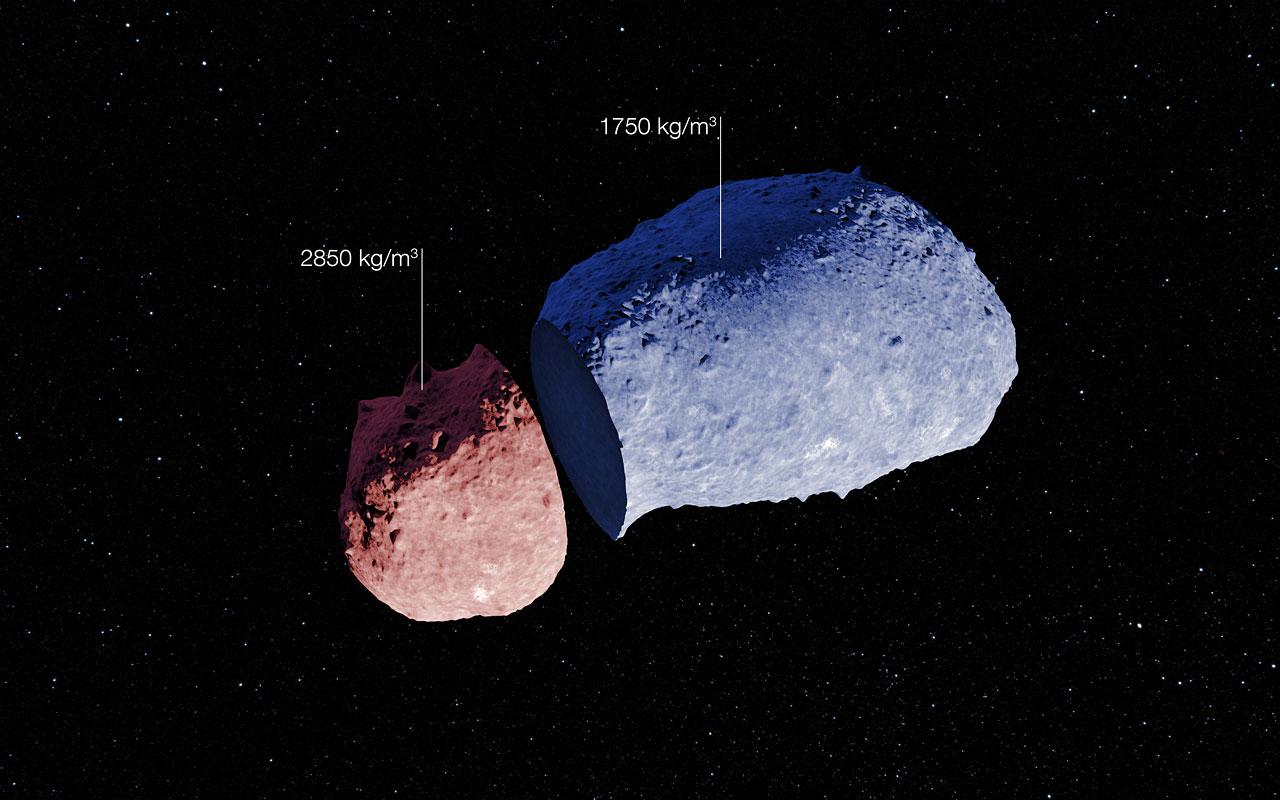
Using very precise ground-based observations, Stephen Lowry (University of Kent, UK) and colleagues have measured the speed at which the near-Earth asteroid (25143) Itokawa spins and how that spin rate is changing over time. They have combined these delicate observations with new theoretical work on how asteroids radiate heat.
This small asteroid is an intriguing subject as it has a strange peanut shape, as revealed by the Japanese spacecraft Hayabusain 2005. To probe its internal structure, Lowry’s team used images gathered from 2001 to 2013, by ESO’s New Technology Telescope (NTT) at the La Silla Observatory in Chile among others [1], to measure its brightness variation as it rotates. This timing data was then used to deduce the asteroid’s spin period very accurately and determine how it is changing over time. When combined with knowledge of the asteroid’s shape this allowed them to explore its interior — revealing the complexity within its core for the first time [2].
“This is the first time we have ever been able to to determine what it is like inside an asteroid,” explains Lowry. “We can see that Itokawa has a highly varied structure — this finding is a significant step forward in our understanding of rocky bodies in the Solar System.”
The spin of an asteroid and other small bodies in space can be affected by sunlight. This phenomenon, known as the Yarkovsky-O’Keefe-Radzievskii-Paddack (YORP) effect, occurs when absorbed light from the Sun is re-emitted from the surface of the object in the form of heat. When the shape of the asteroid is very irregular the heat is not radiated evenly and this creates a tiny, but continuous, torque on the body and changes its spin rate [3], [4].
Loading player…
This artist’s impression, based on detailed spacecraft observations, shows the strange peanut-shaped asteroid Itokawa. By making exquisitely precise timing measurements using ESO’s New Technology Telescope a team of astronomers has found that different parts of this asteroid have different densities. As well as revealing secrets about the asteroid’s formation, finding out what lies below the surface of asteroids may also shed light on what happens when bodies collide in the Solar System, and provide clues about how planets form.
Lowry’s team measured that the YORP effect was slowly accelerating the rate at which Itokawa spins. The change in rotation period is tiny — a mere 0.045 seconds per year. But this was very different from what was expected and can only be explained if the two parts of the asteroid’s peanut shape have different densities.
This is the first time that astronomers have found evidence for the highly varied internal structure of asteroids. Up until now, the properties of asteroid interiors could only be inferred using rough overall density measurements. This rare glimpse into the diverse innards of Itokawa has led to much speculation regarding its formation. One possibility is that it formed from the two components of a double asteroid after they bumped together and merged.
Lowry added, “Finding that asteroids don’t have homogeneous interiors has far-reaching implications, particularly for models of binary asteroid formation. It could also help with work on reducing the danger of asteroid collisions with Earth, or with plans for future trips to these rocky bodies.”
This new ability to probe the interior of an asteroid is a significant step forward, and may help to unlock many secrets of these mysterious objects.
===
Asteroid Ceres spouting water vapor
The European Hershel infrared space telescope has detected water vapor emissions from Ceres, the largest asteroid (it’s also called a dwarf planet):
- Herschel discovers water vapour around dwarf planet Ceres – Herschel/ ESA
- Herschel Telescope Detects Water on Dwarf Planet – Dawn
From the last item:
Scientists believe Ceres contains rock in its interior with a thick mantle of ice that, if melted, would amount to more fresh water than is present on all of Earth. The materials making up Ceres likely date from the first few million years of our solar system’s existence and accumulated before the planets formed.
Until now, ice had been theorized to exist on Ceres but had not been detected conclusively. It took Herschel’s far-infrared vision to see, finally, a clear spectral signature of the water vapor. But Herschel did not see water vapor every time it looked. While the telescope spied water vapor four different times, on one occasion there was no signature.
Here is what scientists think is happening: when Ceres swings through the part of its orbit that is closer to the sun, a portion of its icy surface becomes warm enough to cause water vapor to escape in plumes at a rate of about 6 kilograms (13 pounds) per second. When Ceres is in the colder part of its orbit, no water escapes.
 Artist’s impression of Ceres
NASA’s Dawn spacecraft will reach Ceres in the summer of 2015. Launched in September 2007, Dawn investigated the asteroid Vesta until July 2012 and then began moving towards Ceres, where it will have a lot of interesting science to pursue.
—-
Here’s a discussion of the Ceres finding and teh significance of so much water among the asteroids: Why It Matters That There’s So Much Water in the Asteroid Belt – Popular Mechanics
—-
Asteroid specialist Humberto Campins spoke about the Ceres findings with David Livingston and John Batchelor on Wednesday : John Batchelor Hotel Mars, Wednesday, 1-29-14 – Thespaceshow’s Blog
New book: Fury of the Fifth Angel
Chris Hoffman writes to tell me about the book Fury of the Fifth Angel written by him and his father, Albert. Here is a description of the book:
Summary: Nights skies reveal something is on its way that could affect the entire world, but nobody is talking about it in this new book released by Dog Ear Publishing. Two authors turn their experiences with electricity into a thriller of epic proportions.
(January 2014) NOBLESVILLE, Ind. – When well-respected astronomer Ben Cohen confirms his suspicions about an impending meteorite storm, even the president of the United States sits up and takes notice. That storm, which will have a catastrophic effect on the world, begins its work quietly at first, but eventually people start to notice, including electric power grid control operator John Halloran working in upstate New York. This new thriller draws on the authors’ insider knowledge of electricity, meshing technical know-how with a realistic story about the human instinct to survive.
[]
In “Fury of the Fifth Angel,” the president must make tough decisions about how to handle the threat of the storm. His task is made more difficult thanks to Rev. Randall Davis, a believer in signs who follows his heart and a heavenly authority who begins talking about end times. As John works to puzzle out what is happening to the power grid, he has help from a new acquaintance, Devon Grant of the National Oceanic and Atmospheric Administration. As the government moves in to cover up the severity of what the celestial sightings mean, John will need all of his instincts to prove what’s going on and what to do about this news that could signal the end of the world.
“The authors will open many eyes to both how a power system operates and the vulnerabilities of these systems,” writes O-T-S owner Mike Terbrueggen in the book’s forward.” “This is the first book I have ever read that combines a complex technical field (power systems), deep personal relationships, political intrigue, and old-time religion into one fast-paced story.” In a second forward, Edward Rhoads, an astrophysicist lecturer at Indianapolis University Purdue University in Indianapolis warns of the real-life dangers of objects from space. “It is not a matter of if but when, where, and how much damage. The events portrayed in this book will occur someday,” he writes, adding that readers need to choose leaders who will invest in equipment to detect space objects on a path to Earth.
Father-son writing team Albert James “Pat” Hoffman and Chris Hoffman both worked in the electric utility industry as well as visiting and working for many electric companies and organizations. Pat, now retired, lives with his wife in upstate New York during the summer and central Florida in the winter. Chris lives in central Indiana with his wife and four children. They already are working on a sequel to “Fury of the Fifth Angel.”