Category Archives: Asteroids & Comets

Asteroid passing earth has a companion

The asteroid I mentioned yesterday that was to fly past earth turned out to have an unusual feature:

Asteroid That Flew Past Earth Today Has Moon 

Scientists working with NASA’s 230-foot-wide (70-meter) Deep Space Network antenna at Goldstone, California, have released the first radar images of asteroid 2004 BL86. The images show the asteroid, which made its closest approach today (Jan. 26, 2015) at 8:19 a.m. PST (11:19 a.m. EST) at a distance of about 745,000 miles (1.2 million kilometers, or 3.1 times the distance from Earth to the moon), has its own small moon.

The 20 individual images used in the movie were generated from data collected at Goldstone on Jan. 26, 2015. They show the primary body is approximately 1,100 feet (325 meters) across and has a small moon approximately 230 feet (70 meters) across. In the near-Earth population, about 16 percent of asteroids that are about 655 feet (200 meters) or larger are a binary (the primary asteroid with a smaller asteroid moon orbiting it) or even triple systems (two moons). The resolution on the radar images is 13 feet (4 meters) per pixel.

The trajectory of asteroid 2004 BL86 is well understood. Monday’s flyby was the closest approach the asteroid will make to Earth for at least the next two centuries. It is also the closest a known asteroid this size will come to Earth until asteroid 1999 AN10 flies past our planet in 2027.

Asteroid 2004 BL86 was discovered on Jan. 30, 2004, by the Lincoln Near-Earth Asteroid Research (LINEAR) survey in White Sands, New Mexico.

Radar is a powerful technique for studying an asteroid’s size, shape, rotation state, surface features and surface roughness, and for improving the calculation of asteroid orbits. Radar measurements of asteroid distances and velocities often enable computation of asteroid orbits much further into the future than if radar observations weren’t available.

NASA places a high priority on tracking asteroids and protecting our home planet from them. In fact, the U.S. has the most robust and productive survey and detection program for discovering near-Earth objects (NEOs). To date, U.S. assets have discovered over 98 percent of the known NEOs.

In addition to the resources NASA puts into understanding asteroids, it also partners with other U.S. government agencies, university-based astronomers, and space science institutes across the country, often with grants, interagency transfers and other contracts from NASA, and also with international space agencies and institutions that are working to track and better understand these objects.

NASA’s Near-Earth Object Program at NASA Headquarters, Washington, manages and funds the search, study and monitoring of asteroids and comets whose orbits periodically bring them close to Earth. JPL manages the Near-Earth Object Program Office for NASA’s Science Mission Directorate in Washington. JPL is a division of the California Institute of Technology in Pasadena.

In 2016, NASA will launch a robotic probe to one of the most potentially hazardous of the known NEOs. The OSIRIS-REx mission to asteroid (101955) Bennu will be a pathfinder for future spacecraft designed to perform reconnaissance on any newly discovered threatening objects. Aside from monitoring potential threats, the study of asteroids and comets enables a valuable opportunity to learn more about the origins of our solar system, the source of water on Earth, and even the origin of organic molecules that led to the development of life.

NASA’s Goddard Space Flight Center in Greenbelt, Maryland, will provide overall mission management, systems engineering, and safety and mission assurance for OSIRIS-REx. Lockheed Martin Space Systems in Denver will build the spacecraft. OSIRIS-REx is the third mission in NASA’s New Frontiers Program. NASA’s Marshall Space Flight Center in Huntsville, Alabama, manages New Frontiers for the agency’s Science Mission Directorate in Washington.

NASA also continues to advance the journey to Mars through progress on the Asteroid Redirect Mission (ARM), which will test a number of new capabilities needed for future human expeditions to deep space, including to Mars. This includes advanced Solar Electric Propulsion — an efficient way to move heavy cargo using solar power, which could help pre-position cargo for future human missions to the Red Planet. As part of ARM, a robotic spacecraft will rendezvous with a near-Earth asteroid and redirect an asteroid mass to a stable orbit around the moon. Astronauts will explore the asteroid mass in the 2020’s, helping test modern spaceflight capabilities like new spacesuits and sample return techniques. Astronauts at NASA’s Johnson Space Center in Houston have already begun to practice the capabilities needed for the mission.

More information about asteroids and near-Earth objects is available at: neo.jpl.nasa.gov and www.jpl.nasa.gov/asteroidwatch

and via Twitter at www.twitter.com/asteroidwatch

More information about asteroid radar research is at: echo.jpl.nasa.gov/

More information about the Deep Space Network is at: deepspace.jpl.nasa.gov/dsn

For more information about the OSIRIS-REx mission, visit:


Asteroid to pass near Earth-Moon system on January 26th

An asteroid half a kilometer in diameter will pass near earth on Monday: Giant asteroid is about to give Earth a close call – Sen.com

Here is the original NASA JPL story:

Asteroid to Fly By Earth Safely on January 26 

Asteroid2004BL86-16(See GIF animation clip)
This graphic depicts the passage of asteroid 2004 BL86, which will come
no closer than about three times the distance from Earth to the moon
on Jan. 26, 2015. Due to its orbit around the sun, the asteroid is
currently only visible by astronomers with large telescopes who are
located in the southern hemisphere. But by Jan. 26, the space rock’s
changing position will make it visible to those in the northern hemisphere.
Image credit: NASA/JPL-Caltech

An asteroid, designated 2004 BL86, will safely pass about three times the distance of Earth to the moon on January 26. From its reflected brightness, astronomers estimate that the asteroid is about a third of a mile (0.5 kilometers) in size. The flyby of 2004 BL86 will be the closest by any known space rock this large until asteroid 1999 AN10 flies past Earth in 2027.

At the time of its closest approach on January 26, the asteroid will be approximately 745,000 miles (1.2 million kilometers) from Earth.

“Monday, January 26 will be the closest asteroid 2004 BL86 will get to Earth for at least the next 200 years,” said Don Yeomans, who is retiring as manager of NASA’s Near Earth Object Program Office at the Jet Propulsion Laboratory in Pasadena, California, after 16 years in the position. “And while it poses no threat to Earth for the foreseeable future, it’s a relatively close approach by a relatively large asteroid, so it provides us a unique opportunity to observe and learn more.”

One way NASA scientists plan to learn more about 2004 BL86 is to observe it with microwaves (http://www.jpl.nasa.gov/news/news.php?release=2006-00a ). NASA’s Deep Space Network antenna at Goldstone, California, and the Arecibo Observatory in Puerto Rico will attempt to acquire science data and radar-generated images of the asteroid during the days surrounding its closest approach to Earth.

“When we get our radar data back the day after the flyby, we will have the first detailed images,” said radar astronomer Lance Benner of JPL, the principal investigator for the Goldstone radar observations of the asteroid. “At present, we know almost nothing about the asteroid, so there are bound to be surprises.”

Asteroid 2004 BL86 was initially discovered on Jan. 30, 2004 by a telescope of the Lincoln Near-Earth Asteroid Research (LINEAR) survey in White Sands, New Mexico.

The asteroid is expected to be observable to amateur astronomers with small telescopes and strong binoculars.

“I may grab my favorite binoculars and give it a shot myself,” said Yeomans. “Asteroids are something special. Not only did asteroids provide Earth with the building blocks of life and much of its water, but in the future, they will become valuable resources for mineral ores and other vital natural resources. They will also become the fueling stops for humanity as we continue to explore our solar system. There is something about asteroids that makes me want to look up.”

NASA’s Near-Earth Object Program Office is experiencing its first transition in leadership since it was formed almost 17 years ago. On Jan. 9, after a 39-year-long career at JPL, Yeomans retired. Paul Chodas, a long-time member of Yeomans’ team at JPL, has been designated as the new manager.

NASA detects, tracks and characterizes asteroids and comets using both ground- and space-based telescopes. Elements of the Near-Earth Object Program, often referred to as “Spaceguard,” discover these objects, characterize a subset of them and identify their close approaches to determine if any could be potentially hazardous to our planet.

JPL manages the Near-Earth Object Program Office for NASA’s Science Mission Directorate in Washington. JPL is a division of the California Institute of Technology in Pasadena.

More information about asteroids and near-Earth objects is at: www.jpl.nasa.gov/asteroidwatch.

To get updates on passing space rocks, follow: twitter.com/asteroidwatch

Hi-Def images of Comet 67P/C-G from Resetta

The ESA Rosetta project has released some impressive high-resolution images of Comet 67P/Churyumov–Gerasimenko: Comet close-ups – ESA.

Getting to know Rosetta’s comet 

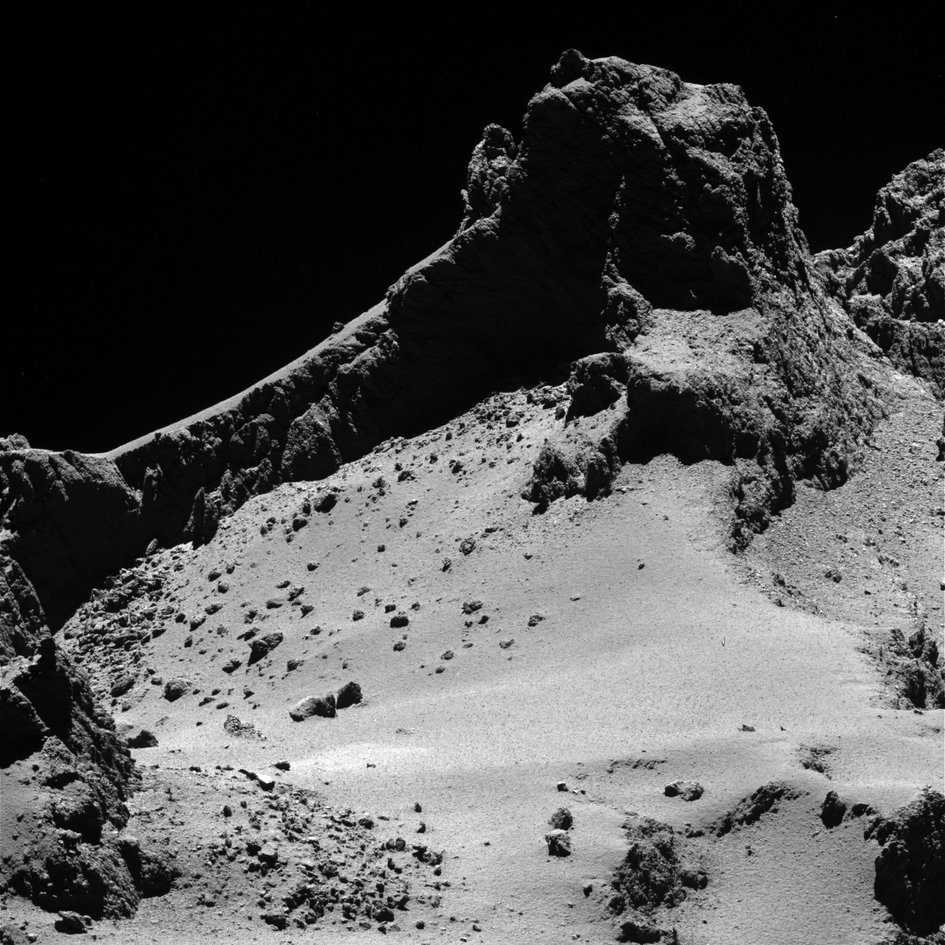
Comet_from_8_km_fullwidthComet from 8 km
A section of the smaller of Comet 67P/Churyumov–Gerasimenko’s
two lobes as seen through Rosetta’s narrow-angle camera from
a distance of about 8 km to the surface on 14 October 2014. The
resolution is 15 cm/pixel. The image is featured on the cover of
23 January 2014 issue of the journal Science.
Credit: ESA/Rosetta/MPS for OSIRIS Team

22 January 2015Rosetta is revealing its host comet as having a remarkable array of surface features and with many processes contributing to its activity, painting a complex picture of its evolution.

In a special edition of the journal Science, initial results are presented from seven of Rosetta’s 11 science instruments based on measurements made during the approach to and soon after arriving at Comet 67P/Churyumov–Gerasimenko in August 2014.

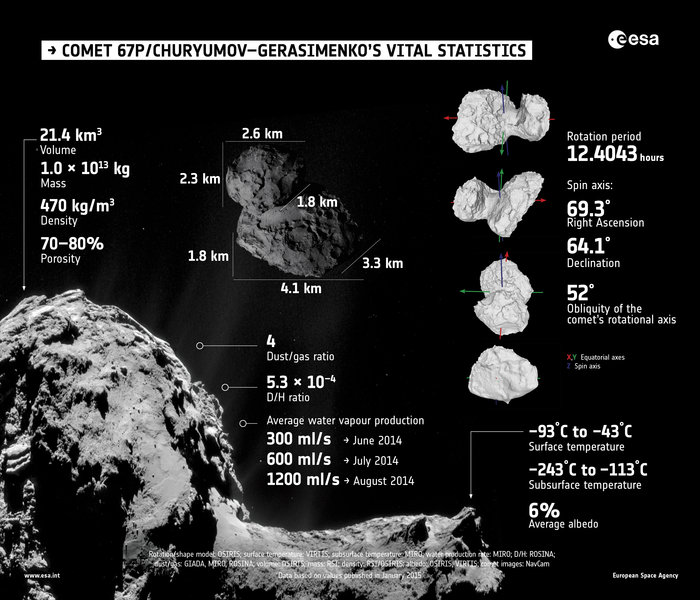
The familiar shape of the dual-lobed comet has now had many of its vital statistics measured: the small lobe measures 2.6 × 2.3 × 1.8 km and the large lobe 4.1 × 3.3 × 1.8 km. The total volume of the comet is 21.4 km3 and the Radio Science Instrument has measured its mass to be 10 billion tonnes, yielding a density of 470 kg/m3.

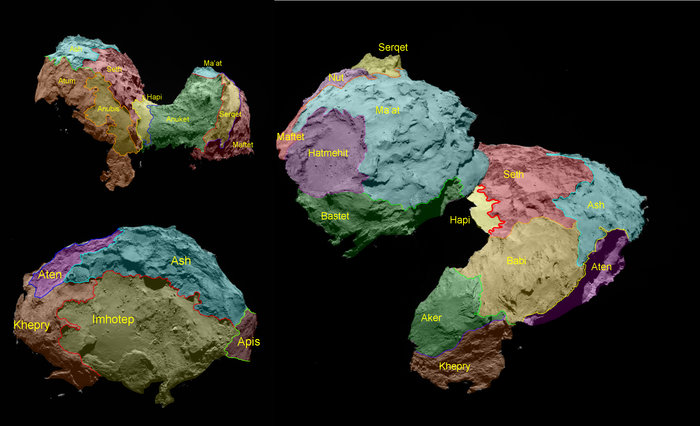
Comet_regional_maps_node_full_image_2Comet regional maps.

By assuming an overall composition dominated by water ice and dust with a density of 1500–2000 kg/m3, the Rosetta scientists show that the comet has a very high porosity of 70–80%, with the interior structure likely comprising weakly bonded ice-dust clumps with small void spaces between them.

The OSIRIS scientific camera, has imaged some 70% of the surface to date: the remaining unseen area lies in the southern hemisphere that has not yet been fully illuminated since Rosetta’s arrival.

The scientists have so far identified 19 regions separated by distinct boundaries and, following the ancient Egyptian theme of the Rosetta mission, these regions are named for Egyptian deities, and are grouped according to the type of terrain dominant within.

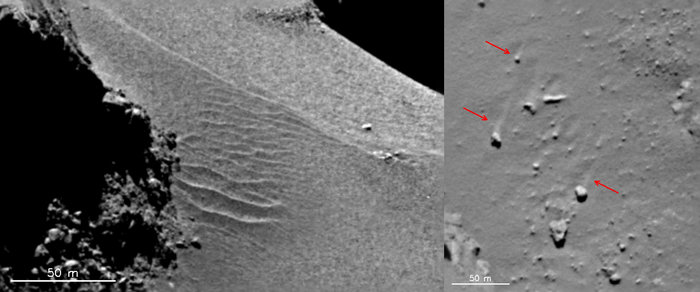
Ripples_and_wind-tails_node_full_image_2Ripples and wind-tails.

Five basic – but diverse – categories of terrain type have been determined: dust-covered; brittle materials with pits and circular structures; large-scale depressions; smooth terrains; and exposed more consolidated (‘rock-like’) surfaces.

Much of the northern hemisphere is covered in dust. As the comet is heated, ice turns directly into gas that escapes to form the atmosphere or coma. Dust is dragged along with the gas at slower speeds, and particles that are not travelling fast enough to overcome the weak gravity fall back to the surface instead.

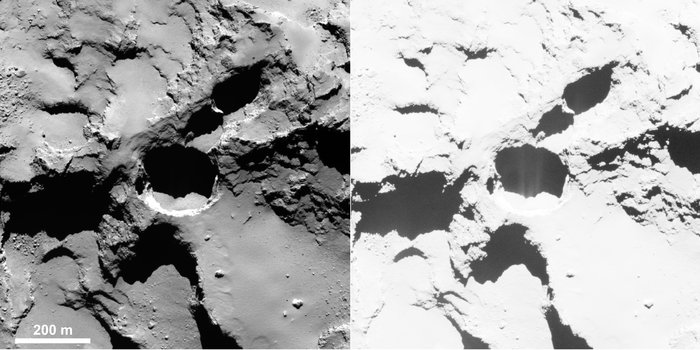
Some sources of discrete jets of activity have also been identified. While a significant proportion of activity emanates from the smooth neck region, jets have also been spotted rising from pits.

Active_pit_node_full_image_2Active pit

The gases that escape from the surface have also been seen to play an important role in transporting dust across the surface, producing dune-like ripples, and boulders with ‘wind-tails’ – the boulders act as natural obstacles to the direction of the gas flow, creating streaks of material ‘downwind’ of them.

The dusty covering of the comet may be several metres thick in places and measurements of the surface and subsurface temperature by the Microwave Instrument on the Rosetta Orbiter, or MIRO, suggest that the dust plays a key role in insulating the comet interior, helping to protect the ices thought to exist below the surface.

Icy_alcove_node_full_image_2Icy alcove

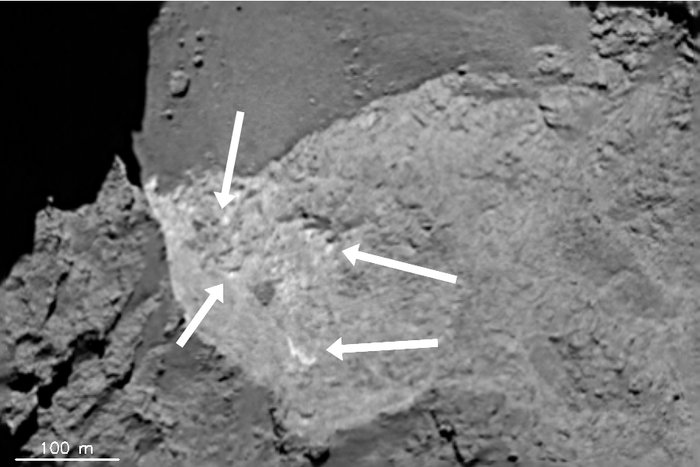
Small patches of ice may also be present on the surface. At scales of 15–25 m, Rosetta’s Visible, InfraRed and Thermal Imaging Spectrometer, or VIRTIS, finds the surface to be compositionally very homogenous and dominated by dust and carbon-rich molecules, but largely devoid of ice. But smaller, bright areas seen in images are likely to be ice-rich. Typically, they are associated with exposed surfaces or debris piles where collapse of weaker material has occurred, uncovering fresher material.

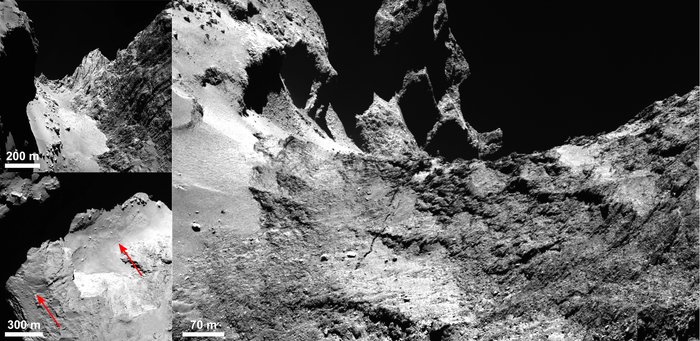
On larger scales, many of the exposed cliff walls are covered in randomly oriented fractures. Their formation is linked to the rapid heating–cooling cycles that are experienced over the course of the comet’s 12.4-hour day and over its 6.5-year elliptical orbit around the Sun. One prominent and intriguing feature is a 500 m-long crack seen roughly parallel to the neck between the two lobes, although it is not yet known if it results from stresses in this region.

A_crack_in_the_comet_node_full_image_2A crack in the comet.

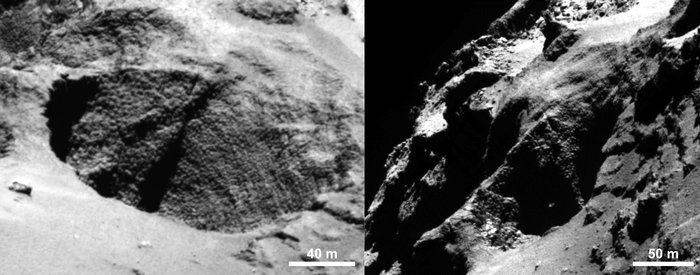
Some very steep regions of the exposed cliff faces are textured on scales of roughly 3 m with features that have been nicknamed ‘goosebumps’. Their origin is yet to be explained, but their characteristic size may yield clues as to the processes at work when the comet formed.

And on the very largest scale, the origin of the comet’s overall double-lobed shape remains a mystery. The two parts seem very similar compositionally, potentially favouring the erosion of a larger, single body. But the current data cannot yet rule out the alternative scenario: two separate comets formed in the same part of the Solar System and then merged together at a later date.

Comet_goosebumps_node_full_image_2Comet goosebumps.

This key question will be studied further over the coming year as Rosetta accompanies the comet around the Sun.

How to grow an atmosphere

Their closest approach to the Sun occurs on 13 August at a distance of 186 million kilometres, between the orbits of Earth and Mars. As the comet continues to move closer to the Sun, an important focus for Rosetta’s instruments is to monitor the development of the comet’s activity, in terms of the amount and composition of gas and dust emitted by the nucleus to form the coma.

Images from the scientific and navigation cameras have shown an increase in the amount of dust flowing away from the comet over the past six months, and MIRO showed a general rise in the comet’s global water vapour production rate, from 0.3 litres per second in early June 2014 to 1.2 litres per second by late August. MIRO also found that a substantial portion of the water seen during this phase originated from the comet’s neck.

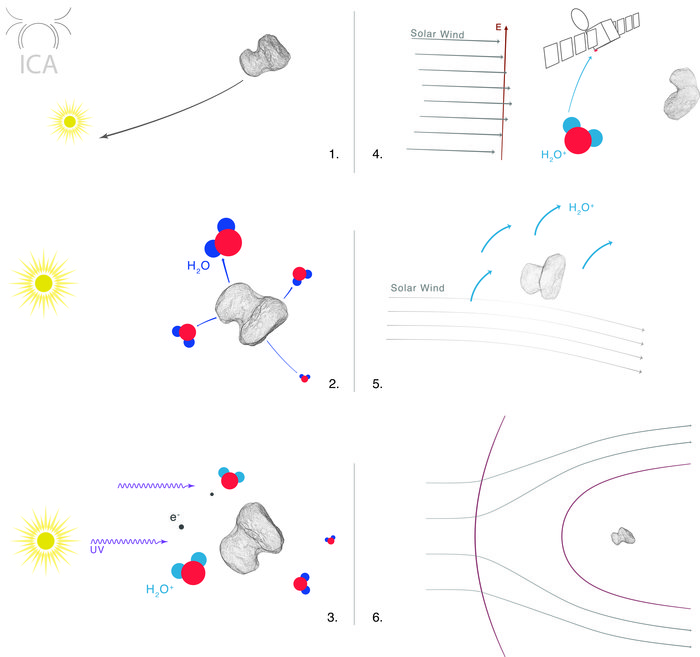
How_a_comet_grows_a_magnetosphere_node_full_image_2How a comet grows a magnetosphere.

Water is accompanied by other outgassing species, including carbon monoxide and carbon dioxide. The Rosetta Orbiter Spectrometer for Ion and Neutral Analysis, ROSINA, is finding large fluctuations in the composition of the coma, representing daily and perhaps seasonal variations in the major outgassing species. Water is typically the dominant outgassing molecule, but not always.

By combining measurements from MIRO, ROSINA and GIADA (Rosetta’s Grain Impact Analyzer and Dust Accumulator) taken between July and September, the Rosetta scientists have made a first estimate of the comet’s dust-to-gas ratio, with around four times as much mass in dust being emitted than in gas, averaged over the sunlit nucleus surface.

However, this value is expected to change once the comet warms up further and ice grains – rather than pure dust grains – are ejected from the surface.

GIADA has also been tracking the movement of dust grains around the comet, and, together with images from OSIRIS, two distinct populations of dust grains have been identified. One set is outflowing and is detected close to the spacecraft, while the other family is orbiting the comet no closer than 130 km from the spacecraft.

It is thought that the more distant grains are left over from the comet’s last closest approach to the Sun. As the comet moved away from the Sun, the gas flow from the comet decreased and was no longer able to perturb the bound orbits. But as the gas production rate increases again over the coming months, it is expected that this bound cloud will dissipate. However, Rosetta will only be able to confirm this when it is further away from the comet again – it is currently in a 30 km orbit.

As the gas–dust coma continues to grow, interactions with charged particles of the solar wind and with the Sun’s ultraviolet light will lead to the development of the comet’s ionosphere and, eventually, its magnetosphere. The Rosetta Plasma Consortium, or RPC, instruments have been studying the gradual evolution of these components close to the comet.

“Rosetta is essentially living with the comet as it moves towards the Sun along its orbit, learning how its behaviour changes on a daily basis and, over longer timescales, how its activity increases, how its surface may evolve, and how it interacts with the solar wind,” says Matt Taylor, ESA’s Rosetta project scientist.

“We have already learned a lot in the few months we have been alongside the comet, but as more and more data are collected and analysed from this close study of the comet we hope to answer many key questions about its origin and evolution.”

Comet_vital_statistics_node_full_image_2Comet 67P/C-G’s vital statistics.


Dawn nearing dwarf planet Ceres

NASA’s Dawn spacecraft is closing in on Ceres, the largest object in the asteroid belt and now classified as a dwarf planet:

 Dawn Delivers New Image of Ceres

NASA’s Dawn spacecraft closes in on Ceres, new images show the dwarf planet at 27 pixels across, about three times better than the calibration images taken in early December. These are the first in a series of images that will be taken for navigation purposes during the approach to Ceres.

pia19168[1]

The Dawn spacecraft observed Ceres for an hour on Jan. 13, 2015, from a distance of 238,000 miles (383,000 kilometers). A little more than half of its surface was observed at a resolution of 27 pixels. This animated GIF shows bright and dark features. Image Credit:  NASA/JPL-Caltech/UCLA/MPS/DLR/IDA/PSI

Over the next several weeks, Dawn will deliver increasingly better and better images of the dwarf planet, leading up to the spacecraft’s capture into orbit around Ceres on March 6. The images will continue to improve as the spacecraft spirals closer to the surface during its 16-month study of the dwarf planet.

“We know so much about the solar system and yet so little about dwarf planet Ceres. Now, Dawn is ready to change that,” said Marc Rayman, Dawn’s chief engineer and mission director, based at NASA’s Jet Propulsion Laboratory in Pasadena, California.

The best images of Ceres so far were taken by NASA’s Hubble Space Telescope in 2003 and 2004. This most recent images from Dawn, taken January 13, 2015, at about 80 percent of Hubble resolution, are not quite as sharp. But Dawn’s images will surpass Hubble’s resolution at the next imaging opportunity, which will be at the end of January.

“Already, the [latest] images hint at first surface structures such as craters,” said Andreas Nathues, lead investigator for the framing camera team at the Max Planck Institute for Solar System Research, Gottingen, Germany.]

pia19167_main[1]

This processed image, taken Jan. 13, 2015, shows the dwarf planet Ceres as seen from the Dawn spacecraft. The image hints at craters on the surface of Ceres. Dawn’s framing camera took this image at 238,000 miles (383,000 kilometers) from Ceres. Image Credit: NASA/JPL-Caltech/UCLA/MPS/DLR/IDA

Ceres is the largest body in the main asteroid belt, which lies between Mars and Jupiter. It has an average diameter of 590 miles (950 kilometers), and is thought to contain a large amount of ice. Some scientists think it’s possible that the surface conceals an ocean.

Dawn’s arrival at Ceres will mark the first time a spacecraft has ever visited a dwarf planet.

“The team is very excited to examine the surface of Ceres in never-before-seen detail,” said Chris Russell, principal investigator for the Dawn mission, based at the University of California, Los Angeles. “We look forward to the surprises this mysterious world may bring.”

The spacecraft has already delivered more than 30,000 images and many insights about Vesta, the second most massive body in the asteroid belt. Dawn orbited Vesta, which has an average diameter of 326 miles (525 kilometers), from 2011 to 2012. Thanks to its ion propulsion system, Dawn is the first spacecraft ever targeted to orbit two deep-space destinations.

JPL manages the Dawn mission for NASA’s Science Mission Directorate in Washington. Dawn is a project of the directorate’s Discovery Program, managed by NASA’s Marshall Space Flight Center in Huntsville, Alabama. The University of California at Los Angeles (UCLA) is responsible for overall Dawn mission science. Orbital Sciences Corp. in Dulles, Virginia, designed and built the spacecraft. UCLA is responsible for overall Dawn mission science. The Dawn framing cameras were developed and built under the leadership of the Max Planck Institute for Solar System Research, Gottingen, Germany, with significant contributions by German Aerospace Center (DLR), Institute of Planetary Research, Berlin, and in coordination with the Institute of Computer and Communication Network Engineering, Braunschweig. The Framing Camera project is funded by the Max Planck Society, DLR, and NASA/JPL. The Italian Space Agency and the Italian National Astrophysical Institute are international partners on the mission team.

More information about Dawn is online at dawn.jpl.nasa.gov.

Dawn probe moves closer to dwarf planet Ceres

NASA’s Dawn is getting closer to Ceres, the largest asteroid and now classified as a dwarf planet. Ceres is particularly interesting because it has a thick layer of water ice.

Dawn Spacecraft Begins Approach to Dwarf Planet Ceres

• Dawn has entered its approach phase toward Ceres
• The spacecraft will arrive at Ceres on March 6, 2015

NASA’s Dawn spacecraft has entered an approach phase in which it will continue to close in on Ceres, a Texas-sized dwarf planet never before visited by a spacecraft. Dawn launched in 2007 and is scheduled to enter Ceres orbit in March 2015.

PIA17650-1280x800[1]This artist’s concept shows NASA’s Dawn spacecraft heading
toward the dwarf planet Ceres. Image credit: NASA/JPL-Caltech

Dawn recently emerged from solar conjunction, in which the spacecraft is on the opposite side of the sun, limiting communication with antennas on Earth. Now that Dawn can reliably communicate with Earth again, mission controllers have programmed the maneuvers necessary for the next stage of the rendezvous, which they label the Ceres approach phase. Dawn is currently 400,000 miles (640,000 kilometers) from Ceres, approaching it at around 450 miles per hour (725 kilometers per hour).

The spacecraft’s arrival at Ceres will mark the first time that a spacecraft has ever orbited two solar system targets. Dawn previously explored the protoplanet Vesta for 14 months, from 2011 to 2012, capturing detailed images and data about that body.

“Ceres is almost a complete mystery to us,” said Christopher Russell, principal investigator for the Dawn mission, based at the University of California, Los Angeles. “Ceres, unlike Vesta, has no meteorites linked to it to help reveal its secrets. All we can predict with confidence is that we will be surprised.”

fulltraj[1]The trajectory of the Dawn spacecraft has it moves from
Vesta to Ceres. (Larger image)

The two planetary bodies are thought to be different in a few important ways. Ceres may have formed later than Vesta, and with a cooler interior. Current evidence suggests that Vesta only retained a small amount of water because it formed earlier, when radioactive material was more abundant, which would have produced more heat. Ceres, in contrast, has a thick ice mantle and may even have an ocean beneath its icy crust.

Ceres, with an average diameter of 590 miles (950 kilometers), is also the largest body in the asteroid belt, the strip of solar system real estate between Mars and Jupiter. By comparison, Vesta has an average diameter of 326 miles (525 kilometers), and is the second most massive body in the belt.

The spacecraft uses ion propulsion to traverse space far more efficiently than if it used chemical propulsion. In an ion propulsion engine, an electrical charge is applied to xenon gas, and charged metal grids accelerate the xenon particles out of the thruster. These particles push back on the thruster as they exit, creating a reaction force that propels the spacecraft. Dawn has now completed five years of accumulated thrust time, far more than any other spacecraft.

“Orbiting both Vesta and Ceres would be truly impossible with conventional propulsion. Thanks to ion propulsion, we’re about to make history as the first spaceship ever to orbit two unexplored alien worlds,” said Marc Rayman, Dawn’s chief engineer and mission director, based at NASA’s Jet Propulsion Laboratory in Pasadena, California.

The next couple of months promise continually improving views of Ceres, prior to Dawn’s arrival. By the end of January, the spacecraft’s images and other data will be the best ever taken of the dwarf planet.

The Dawn mission to Vesta and Ceres is managed by JPL, a division of the California Institute of Technology in Pasadena, for NASA’s Science Mission Directorate, Washington. UCLA is responsible for overall Dawn mission science.

More information about Dawn: dawn.jpl.nasa.gov.

Here’s a video showing Dawn’s images of Vesta in a manner that provides a 3D like view of the asteroid: