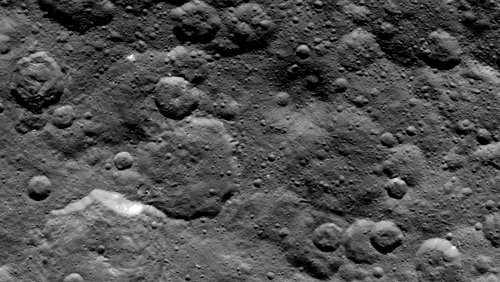
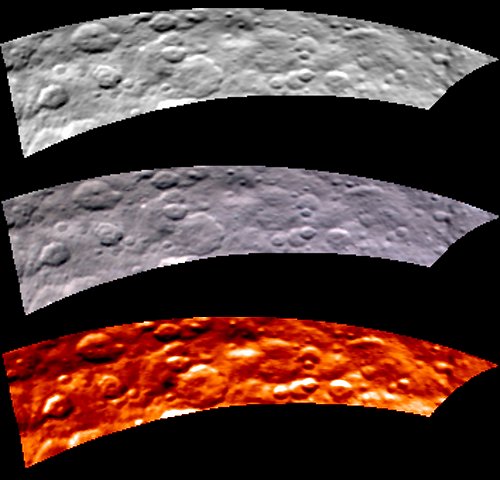
The Dawn spacecraft returns new photos of the dwarf planet Ceres:
Ceres Spots Continue to Mystify in Latest Dawn Images
The closer we get to Ceres, the more intriguing the distant dwarf planet becomes. New images of Ceres from NASA’s Dawn spacecraft provide more clues about its mysterious bright spots, and also reveal a pyramid-shaped peak towering over a relatively flat landscape.
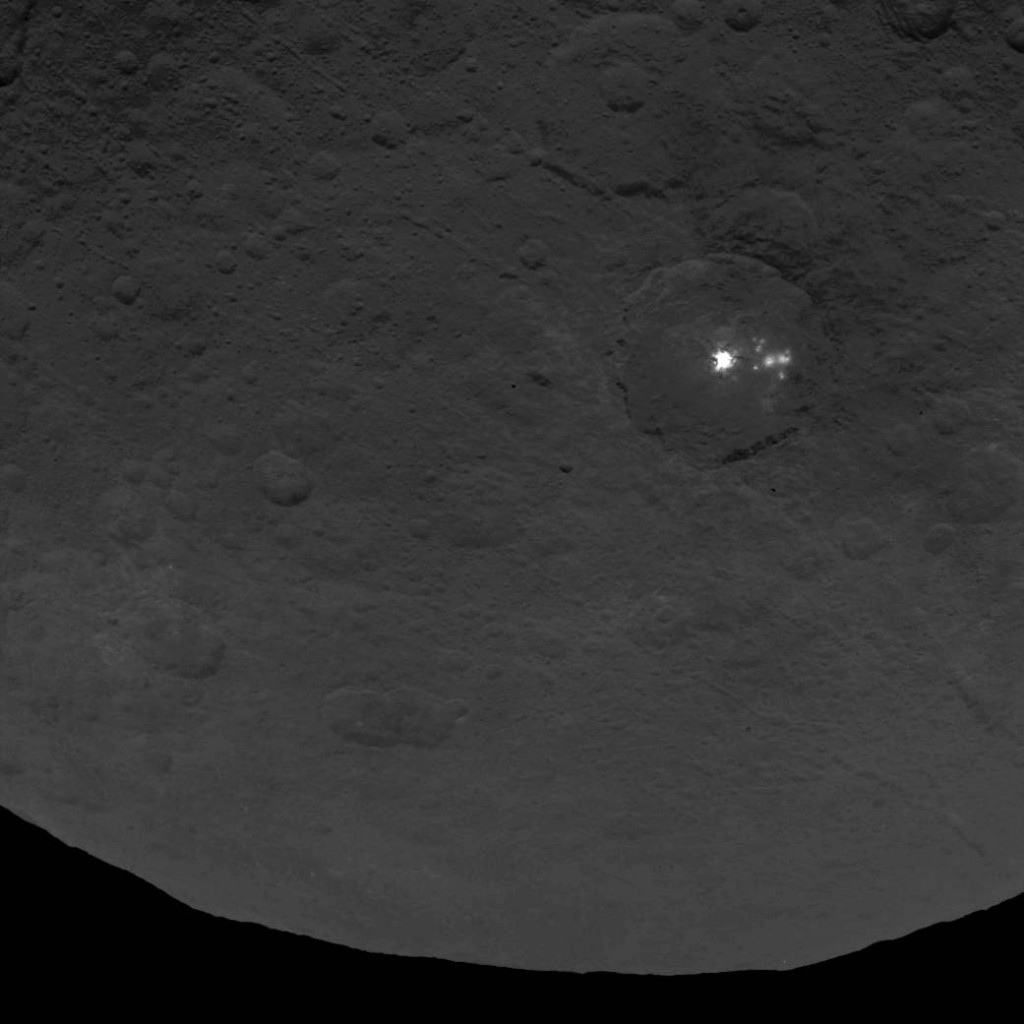
A cluster of mysterious bright spots on dwarf planet Ceres can be seen in this image, taken by NASA’s Dawn spacecraft from an altitude of 2,700 miles (4,400 kilometers). The image, with a resolution of 1,400 feet (410 meters) per pixel, was taken on June 9, 2015. Image Credit: NASA/ JPL-Caltech /UCLA /MPS /DLR /IDA
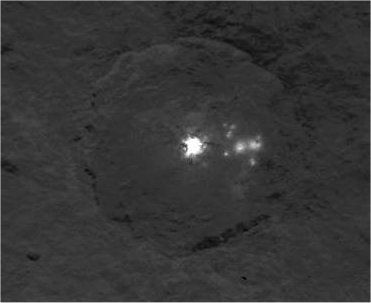 Close up of the bright spots.
“The surface of Ceres has revealed many interesting and unique features. For example, icy moons in the outer solar system have craters with central pits, but on Ceres central pits in large craters are much more common. These and other features will allow us to understand the inner structure of Ceres that we cannot sense directly,” said Carol Raymond, deputy principal investigator for the Dawn mission, based at NASA’s Jet Propulsion Laboratory in Pasadena, California.
Dawn has been studying the dwarf planet in detail from its second mapping orbit, which is 2,700 miles (4,400 kilometers) above Ceres. A new view of its intriguing bright spots, located in a crater about 55 miles (90 kilometers) across, shows even more small spots in the crater than were previously visible.
At least eight spots can be seen next to the largest bright area, which scientists think is approximately 6 miles (9 kilometers) wide. A highly reflective material is responsible for these spots — ice and salt are leading possibilities, but scientists are considering other options, too.
Dawn’s visible and infrared mapping spectrometer allows scientists to identify specific minerals present on Ceres by looking at how light is reflected. Each mineral reflects the range of visible and infrared-light wavelengths in a unique way, and this signature helps scientists determine the components of Ceres. So, as the spacecraft continues to send back more images and data, scientists will learn more about the mystery bright spots.
In addition to the bright spots, the latest images also show a mountain with steep slopes protruding from a relatively smooth area of the dwarf planet’s surface. The structure rises about 3 miles (5 kilometers) above the surface.
![pia19574-1041[1]](http://hobbyspace.com/Blog/wp-content/uploads/2015/06/pia19574-10411-1024x1024.jpg)
Among the fascinating features on dwarf planet Ceres is an intriguing mountain protruding from a relatively smooth area. Scientists estimate that this structure rises about 3 miles (5 kilometers) above the surface. NASA’s Dawn spacecraft took this image from an altitude of 2,700 miles (4,400 kilometers). The image, with a resolution of 1,400 feet (410 meters) per pixel, was taken on June 6, 2015. Image credit: NASA/JPL-Caltech/UCLA/MPS/DLR/IDA
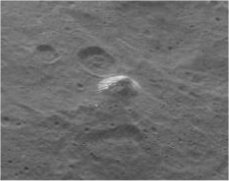 A crop of the image around the mountain.
Ceres also has numerous craters of varying sizes, many of which have central peaks. There is ample evidence of past activity on the surface, including flows, landslides and collapsed structures. It seems that Ceres shows more remnants of activity than the protoplanet Vesta, which Dawn studied intensively for 14 months in 2011 and 2012.
Dawn is the first mission to visit a dwarf planet, and the first to orbit two distinct targets in our solar system. It arrived at Ceres, the largest object in the main asteroid belt between Mars and Jupiter, on March 6, 2015.
![pia19577-1041[1]](http://hobbyspace.com/Blog/wp-content/uploads/2015/06/pia19577-10411-1024x1024.jpg)
A variety of craters and other geological features can be found on dwarf planet Ceres. NASA’s Dawn spacecraft took this image of Ceres from an altitude of 2,700 miles (4,400 kilometers). The image, with a resolution of 1,400 feet (410 meters) per pixel, was taken on June 5, 2015. Image credit: NASA/JPL- Caltech/ UCLA /MPS /DLR / IDA
Dawn will remain in its current altitude until June 30, continuing to take images and spectra of Ceres in orbits of about three days each. It then will move into its next orbit at an altitude of 900 miles (1,450 kilometers), arriving in early August.
Dawn’s mission is managed by JPL for NASA’s Science Mission Directorate in Washington. Dawn is a project of the directorate’s Discovery Program, managed by NASA’s Marshall Space Flight Center in Huntsville, Alabama. UCLA is responsible for overall Dawn mission science. Orbital ATK Inc., in Dulles, Virginia, designed and built the spacecraft. The German Aerospace Center, Max Planck Institute for Solar System Research, Italian Space Agency and Italian National Astrophysical Institute are international partners on the mission team.
![pia19578-1041[1]](http://hobbyspace.com/Blog/wp-content/uploads/2015/06/pia19578-10411-1024x1024.jpg)
This image, taken by NASA’s Dawn spacecraft, shows an intriguing mountain on dwarf planet Ceres protruding from a relatively smooth area. Scientists estimate that this structure rises about 3 miles (5 kilometers) above the surface. Dawn captured this image from an altitude of 2,700 miles (4,400 kilometers). The image, with a resolution of 1,400 feet (410 meters) per pixel, was taken on June 14, 2015. Image credit: NASA/JPL-Caltech/UCLA/MPS/DLR/IDA
For a complete list of mission participants, visit: dawn.jpl.nasa.gov/mission
More information about Dawn is available at: dawn.jpl.nasa.gov/ and www.nasa.gov/dawn
What are those unusual bright spots on Ceres? Cast your vote: www.jpl.nasa.gov/dawn/world_ceres/
![PIA19573_modest[1]](http://hobbyspace.com/Blog/wp-content/uploads/2015/06/PIA19573_modest1.jpg)
![PIA19574_modest[1]](http://hobbyspace.com/Blog/wp-content/uploads/2015/06/PIA19574_modest1.jpg)
![Philae_touchdown_large[1]](http://hobbyspace.com/Blog/wp-content/uploads/2015/06/Philae_touchdown_large1.jpg) From animation of the Philae lander.
From animation of the Philae lander.![pia19568_main-1041[1]](http://www.nasa.gov/sites/default/files/thumbnails/image/pia19568_main-1041.jpg)