Category Archives: Asteroids & Comets

Rosetta spots jet outburst from Comet 67P/C-G

The latest images from Rosetta at Comet 67P/Churyumov–Gerasimenko:

Comet’s firework display ahead of perihelion

Outburst_in_action_node_full_image_2[1]
A short-lived outburst from Comet 67P/Churyumov–Gerasimenko was captured by Rosetta’s OSIRIS narrow-angle camera on 29 July 2015. The image at left was taken at 13:06 GMT and does not show any visible signs of the jet. It is very strong in the middle image captured at 13:24 GMT. Residual traces of activity are only very faintly visible in the final image taken at 13:42 GMT. The images were taken from a distance of 186 km from the centre of the comet. The jet is estimated to have a minimum speed of 10 m/s and originates from a location on the comet’s neck, in the rugged Anuket region. Larger image.
In the approach to perihelion over the past few weeks, Rosetta has been witnessing growing activity from Comet 67P/Churyumov–Gerasimenko, with one dramatic outburst event proving so powerful that it even pushed away the incoming solar wind.

The comet reaches perihelion on Thursday, the moment in its 6.5-year orbit when it is closest to the Sun. In recent months, the increasing solar energy has been warming the comet’s frozen ices, turning them to gas, which pours out into space, dragging dust along with it.

The period around perihelion is scientifically very important, as the intensity of the sunlight increases and parts of the comet previously cast in years of darkness are flooded with sunlight.

Although the comet’s general activity is expected to peak in the weeks following perihelion, much as the hottest days of summer usually come after the longest days, sudden and unpredictable outbursts can occur at any time – as already seen earlier in the mission.

On 29 July, Rosetta observed the most dramatic outburst yet, registered by several of its instruments from their vantage point 186 km from the comet. They imaged the outburst erupting from the nucleus, witnessed a change in the structure and composition of the gaseous coma environment surrounding Rosetta, and detected increased levels of dust impacts.

Perhaps most surprisingly, Rosetta found that the outburst had pushed away the solar wind magnetic field from around the nucleus.

Discovery_of_diamagnetic_cavity_node_full_image_2[1]
The decrease in magnetic field strength measured by Rosetta’s RPC-MAG instrument during the outburst event on 29 July 2015. This is the first time a ‘diamagnetic cavity’ has been detected at Comet 67P/Churyumov–Gerasimenko and is thought to be caused by an outburst of gas temporarily increasing the gas flux in the comet’s coma, and pushing the pressure-balance boundary between it and incoming solar wind farther from the nucleus than expected under ‘normal’ levels of activity.
A sequence of images taken by Rosetta’s scientific camera OSIRIS show the sudden onset of a well-defined jet-like feature emerging from the side of the comet’s neck, in the Anuket region. It was first seen in an image taken at 13:24 GMT, but not in an image taken 18 minutes earlier, and has faded significantly in an image captured 18 minutes later. The camera team estimates the material in the jet to be travelling at 10 m/s at least, and perhaps much faster.

“This is the brightest jet we’ve seen so far,” comments Carsten Güttler, OSIRIS team member at the Max Planck Institute for Solar System Research in Göttingen, Germany.

“Usually, the jets are quite faint compared to the nucleus and we need to stretch the contrast of the images to make them visible – but this one is brighter than the nucleus.”

Soon afterwards, the comet pressure sensor of ROSINA detected clear indications of changes in the structure of the coma, while its mass spectrometer recorded changes in the composition of outpouring gases.

For example, compared to measurements made two days earlier, the amount of carbon dioxide increased by a factor of two, methane by four, and hydrogen sulphide by seven, while the amount of water stayed almost constant.

Gas_changes_during_29_July_outburst_node_full_image_2[1]
During an outburst of gas and dust from Comet 67P/Churyumov–Gerasimenko on 29 July 2015, Rosetta’s ROSINA instrument detected a change in the composition of gases compared with previous days. The graph shows the relative abundances of various gases after the outburst, compared with the measurements two days earlier. For example, the amount of carbon dioxide (CO2) increased by a factor of two, methane (CH4) by four, and hydrogen sulphide (H2S) by seven, while the amount of water (indicated by the horizontal black line) stayed almost constant.
“This first ‘quick look’ at our measurements after the outburst is fascinating,” says Kathrin Altwegg, ROSINA principal investigator at the University of Bern. “We also see hints of heavy organic material after the outburst that might be related to the ejected dust.“But while it is tempting to think that we are detecting material that may have been freed from beneath the comet’s surface, it is too early to say for certain that this is the case.”

Meanwhile, about 14 hours after the outburst, GIADA was detecting dust hits at rates of 30 per day, compared with just 1–3 per day earlier in July. A peak of 70 hits was recorded in one 4-hour period on 1 August, indicating that the outburst continued to have a significant effect on the dust environment for the following few days.

“It was not only the abundance of the particles, but also their speeds measured by GIADA that told us something ‘different’ was happening: the average particle speed increased from 8 m/s to about 20 m/s, with peaks at 30 m/s – it was quite a dust party!” says Alessandra Rotundi, principal investigator at the ‘Parthenope’ University of Naples, Italy.

Perhaps the most striking result is that the outburst was so intense that it actually managed to push the solar wind away from the nucleus for a few minutes – a unique observation made by the Rosetta Plasma Consortium’s magnetometer.

The solar wind is the constant stream of electrically charged particles that flows out from the Sun, carrying its magnetic field out into the Solar System. Earlier measurements made by Rosetta and Philae had already shown that the comet is not magnetised,  so the only source for the magnetic field measured around it is the solar wind.

29_July_outburst_context_node_full_image_2[1]
This image, taken on 12 April 2015 by the OSIRIS narrow-angle camera, identifies the source region of the outburst from Comet 67P/Churyumov–Gerasimenko observed by Rosetta’s instruments on 29 July.
But it doesn’t flow past unimpeded. Because the comet is spewing out gas, the incoming solar wind is slowed to a standstill where it encounters that gas and a pressure balance is reached.“The solar wind magnetic field starts to pile up, like a traffic jam, and eventually stops moving towards the comet nucleus, creating a magnetic field-free region on the Sun-facing side of the comet called a ‘diamagnetic cavity’,” explains Charlotte Götz, magnetometer team member at the Institute for Geophysics and extraterrestrial Physics in Braunschweig, Germany.

Diamagnetic cavities provide fundamental information on how a comet interacts with the solar wind, but the only previous detection of one associated with a comet was made at about 4000 km from Comet Halley as ESA’s Giotto flew past in 1986.

Rosetta’s comet is much less active than Halley, so scientists expected to find a much smaller cavity around it, up to a few tens of kilometres at most, and prior to 29 July, had not observed any sign of one.

But, following the outburst on that day, the magnetometer detected a diamagnetic cavity extending out at least 186 km from the nucleus. This was likely created by the outburst of gas, which increased the neutral gas flux in the comet’s coma, forcing the solar wind to ‘stop’ further away from the comet and thus pushing the cavity boundary outwards beyond where Rosetta was flying at the time.

“Finding a magnetic field-free region anyway in the Solar System is really hard, but here we’ve had it served to us on a silver platter – this is a really exciting result for us,” adds Charlotte.

“We’ve been moving Rosetta out to distances of up to 300 km in recent weeks to avoid problems with navigation caused by dust, and we had considered that the diamagnetic cavity was out of our grasp for the time being. But it seems that the comet has helped us by bringing the cavity to Rosetta,” says Matt Taylor, Rosetta Project Scientist.

“This is a fantastic multi-instrument event which will take time to analyse, but highlights the exciting times we’re experiencing at the comet in this ‘hot’ perihelion phase.”

Video: Cruising over the “Weird Ceres” dwarf planet

Check out this cool video from the Dawn mission showing the bright spots and a pyramid-shaped mountain on “Weird Ceres”:

Cruise Over Ceres in New Video

Striking 3-D detail highlights a towering mountain, the brightest spots and other features on dwarf planet Ceres in a new video from NASA’s Dawn mission.

A prominent mountain with bright streaks on its steep slopes is especially fascinating to scientists. The peak’s shape has been likened to a cone or a pyramid. It appears to be about 4 miles (6 kilometers) high, with respect to the surface around it, according to the latest estimates. This means the mountain has about the same elevation as Mount McKinley in Denali National Park, Alaska, the highest point in North America.

This mountain is among the tallest features we’ve seen on Ceres to date,” said Dawn science team member Paul Schenk, a geologist at the Lunar and Planetary Institute, Houston. “It’s unusual that it’s not associated with a crater. Why is it sitting in the middle of nowhere? We don’t know yet, but we may find out with closer observations.”

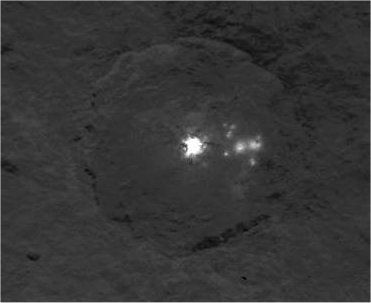
Also puzzling is the famous Occator (oh-KAH-tor) crater, home to Ceres’ brightest spots. A new animation simulates the experience of a close flyover of this area. The crater takes its name from the Roman agriculture deity of harrowing, a method of pulverizing and smoothing soil.

pia19617-16-640x350[1]

In examining the way Occator’s bright spots reflect light at different wavelengths, the Dawn science team has not found evidence that is consistent with ice. The spots’ albedo -­ a measure of the amount of light reflected -­ is also lower than predictions for concentrations of ice at the surface.

“The science team is continuing to evaluate the data and discuss theories about these bright spots at Occator,” said Chris Russell, Dawn’s principal investigator at the University of California, Los Angeles. “We are now comparing the spots with the reflective properties of salt, but we are still puzzled by their source. We look forward to new, higher-resolution data from the mission’s next orbital phase.”

An animation of Ceres’ overall geography, also available in 3-D, shows these features in context. Occator lies in the northern hemisphere, whereas the tall mountain is farther to the southeast (11 degrees south, 316 degrees east).

“There are many other features that we are interested in studying further,” said Dawn science team member David O’Brien, with the Planetary Science Institute, Tucson, Arizona. “These include a pair of large impact basins called Urvara and Yalode in the southern hemisphere, which have numerous cracks extending away from them, and the large impact basin Kerwan, whose center is just south of the equator.”

Ceres is the largest object in the main asteroid belt between Mars and Jupiter. Thanks to data acquired by Dawn since the spacecraft arrived in orbit at Ceres, scientists have revised their original estimate of Ceres’ average diameter to 584 miles (940 kilometers). The previous estimate was 590 miles (950 kilometers).

Dawn will resume its observations of Ceres in mid-August from an altitude of 900 miles (less than 1,500 kilometers), or three times closer to Ceres than its previous orbit.

On March 6, 2015, Dawn made history as the first mission to reach a dwarf planet, and the first to orbit two distinct extraterrestrial targets. It conducted extensive observations of Vesta in 2011-2012.

Dawn’s mission is managed by NASA’s Jet Propulsion Laboratory for NASA’s Science Mission Directorate in Washington. Dawn is a project of the directorate’s Discovery Program, managed by NASA’s Marshall Space Flight Center in Huntsville, Alabama. UCLA is responsible for overall Dawn mission science. Orbital ATK Inc., in Dulles, Virginia, designed and built the spacecraft. The German Aerospace Center, Max Planck Institute for Solar System Research, Italian Space Agency and Italian National Astrophysical Institute are international partners on the mission team. For a complete list of mission participants, visit: dawn.jpl.nasa.gov/mission

More information about Dawn is available at the following sites:

Some of Ceres’s bright spots covered with haze

While waiting for the Dawn spacecraft to spiral down to a closer look at the surface of Ceres, the situation with the bright spots has gotten more rather than less murky:

pia19579_main-1041_crop

From the Nature article:

Haze on Ceres would be the first ever observed directly in the asteroid belt. In 2014, researchers using the European Space Agency’s Herschel Space Observatory reported seeing water vapour spraying off Ceres, which suggested that it was geologically active1. At least one-quarter of Ceres’s mass is water, a much greater proportion than seen in most asteroids.

Bright spots pepper Ceres’s surface, but the haze has so far been seen in only one location — a crater named Occator, which has a large bright area at its centre and several smaller spots nearby. Mission scientists have been trying to work out whether the bright spots are made of ice, evaporated salts or other minerals, or something else entirely.

Some team members had been leaning towards the salt explanation, but the discovery of haze suggests the presence of sublimating ice. “At noontime, if you look at a glancing angle, you can see what seems to be haze,” Russell says. “It comes back in a regular pattern.” The haze covers about half of the crater and stops at the rim.

Dawn spacecraft descending to lower orbit above Ceres

The Dawn spacecraft is moving to an orbit closer to Ceres and will get a better look of those famous bright patches and other features on the surface:

Dawn Maneuvering to Third Science Orbit

Mission Status Report

NASA’s Dawn spacecraft is using its ion propulsion system to descend to its third mapping orbit at Ceres, and all systems are operating well. The spiral maneuvering over the next five weeks will take the spacecraft to an altitude of about 900 miles (less than 1,500 kilometers) above the dwarf planet.

PIA19597_hires[1]Dawn survey orbit 29, July 17, 2015 (Larger image).

The spacecraft experienced a discrepancy in its expected orientation on June 30, triggering a safe mode. Engineers traced this anomaly to the mechanical gimbal system that swivels ion engine #3 to help control the spacecraft’s orientation during ion-thrusting. Dawn has three ion engines and uses only one at a time.

Dawn’s engineering team switched to ion engine #2, which is mounted on a different gimbal, and conducted tests with it from July 14 to 16. They have confirmed that the spacecraft is ready to continue with the exploration of Ceres.

By the end of the day on July 17, Dawn will have descended to an altitude of about 2,400 miles (3,900 kilometers). After arrival at its next mapping orbit — called the High-Altitude Mapping Orbit, or HAMO — in August, Dawn will begin taking images and other data at unprecedented resolution.

More information on the Dawn mission is online at:


Dawn at Ceres: Safe mode recovery + White spots may be salt

While the attention of space fans is riveted on Pluto this week, another dwarf planet continues to tease the world with its peculiar features: The weird white spots on Ceres might not be ice after all – The Washington Post.

New Horizons had a Safe Mode incident last week and so did Dawn and it recovered as well:

Dawn Holding in Second Mapping Orbit

NASA’s Dawn spacecraft is healthy and stable, after experiencing an anomaly in the system that controls its orientation. It is still in its second mapping orbit 2,700 miles (4,400 kilometers) above dwarf planet Ceres.

On June 30, shortly after turning on its ion engine to begin the gradual spiral down to the next mapping orbit, its protective software detected the anomaly. Dawn responded as designed by stopping all activities (including thrusting), reconfiguring its systems to safe mode and transmitting a radio signal to request further instructions. On July 1 and 2, engineers made configuration changes needed to return the spacecraft to its normal operating mode. The spacecraft is out of safe mode, using the main antenna to communicate with Earth.

Dawn will remain at its current orbital altitude until the operations team has completed an analysis of what occurred and has updated the flight plan.

Because of the versatility of Dawn’s ion propulsion system and the flexibility of the mission’s plan for exploring Ceres, there is no special “window” for starting or completing the spiral to the third mapping orbit. The plans for the third and fourth mapping orbits can be shifted to new dates without significant changes in objectives or productivity.

More information on the Dawn mission is online at: