NASA’s Near-Earth Object Wide-field Survey Explorer (NEOWISE) mission has released its second year of survey data. The spacecraft has now characterized a total of 439 NEOs since the mission was re-started in December 2013. Of these, 72 were new discoveries.
Near-Earth Objects (NEOs) are comets and asteroids that have been nudged by the gravitational attraction of the giant planets in our solar system into orbits that allow them to enter Earth’s neighborhood. Eight of the objects discovered in the past year have been classified as potentially hazardous asteroids (PHAs), based on their size and how closely their orbits approach Earth.
With the release to the public of its second year of data, NASA’s NEOWISE spacecraft completed another milestone in its mission to discover, track and characterize the asteroids and comets that approach closest to Earth.
Since beginning its survey in December 2013, NEOWISE has measured more than 19,000 asteroids and comets at infrared wavelengths. More than 5.1 million infrared images of the sky were collected in the last year. A new movie, based on the data collected, depicts asteroids and comets observed so far by NEOWISE.
“By studying the distribution of lighter- and darker-colored material, NEOWISE data give us a better understanding of the origins of the NEOs, originating from either different parts of the main asteroid belt between Mars and Jupiter or the icier comet populations,” said James Bauer, the mission’s deputy principal investigator at NASA’s Jet Propulsion Laboratory in Pasadena, California.
Originally called the Wide-field Infrared Survey Explorer (WISE), the spacecraft was launched in December 2009. It was placed in hibernation in 2011 after its primary mission was completed. In September 2013, it was reactivated, renamed NEOWISE and assigned a new mission: to assist NASA’s efforts to identify the population of potentially hazardous near-Earth objects. NEOWISE also is characterizing previously known asteroids and comets to provide information about their sizes and compositions.
“NEOWISE discovers large, dark, near-Earth objects, complementing our network of ground-based telescopes operating at visible-light wavelengths. On average, these objects are many hundreds of meters across,” said Amy Mainzer of JPL, NEOWISE principal investigator. NEOWISE has discovered 250 new objects since its restart, including 72 near-Earth objects and four new comets.
NASA’s Jet Propulsion Laboratory in Pasadena, California, manages the NEOWISE mission for NASA’s Science Mission Directorate in Washington. The Space Dynamics Laboratory in Logan, Utah, built the science instrument. Ball Aerospace & Technologies Corp. of Boulder, Colorado, built the spacecraft. Science operations and data processing take place at the Infrared Processing and Analysis Center at the California Institute of Technology in Pasadena. Caltech manages JPL for NASA.
Scientists from NASA’s Dawn mission unveiled new images from the spacecraft’s lowest orbit at Ceres, including highly-anticipated views of Occator Crater, at the 47th annual Lunar and Planetary Science Conference in The Woodlands, Texas, on Tuesday.
Occator Crater, measuring 57 miles (92 kilometers) across and 2.5 miles (4 kilometers) deep, contains the brightest area on Ceres. Image Credit: NASA/JPL-Caltech/UCLA/MPS/DLR/IDA/PSI. Full Image and caption.Occator Crater, measuring 57 miles (92 kilometers) across and 2.5 miles (4 kilometers) deep, contains the brightest area on Ceres, the dwarf planet that Dawn has explored since early 2015. The latest images, taken from 240 miles (385 kilometers) above the surface of Ceres, reveal a dome in a smooth-walled pit in the bright center of the crater. Numerous linear features and fractures crisscross the top and flanks of this dome. Prominent fractures also surround the dome and run through smaller, bright regions found within the crater.
“Before Dawn began its intensive observations of Ceres last year, Occator Crater looked to be one large bright area. Now, with the latest close views, we can see complex features that provide new mysteries to investigate,” said Ralf Jaumann, planetary scientist and Dawn co-investigator at the German Aerospace Center (DLR) in Berlin. “The intricate geometry of the crater interior suggests geologic activity in the recent past, but we will need to complete detailed geologic mapping of the crater in order to test hypotheses for its formation.”
Ceres’ Haulani Crater (21 miles, 34 kilometers wide) is shown in these views from the visible and infrared mapping spectrometer (VIR) aboard NASA’s Dawn spacecraft. These views reveal variations in the region’s brightness, mineralogy and temperature at infrared wavelengths. The image at far left shows brightness variations in Haulani. Light with a wavelength of 1200 nanometers is shown in blue, 1900 nanometers in green and 2300 nanometers in red. The view at center is a false color image, highlighting differences in the types of rock and ejected material around the crater. Scientists see this as evidence that the material in this area is not uniform, and that the crater’s interior has a different composition than its surroundings. This is what scientists call a color ratio image (blue: 3200/3300 nanometers, green: 2900/3100 nanometers, red: 2600/2700 nanometers). The image at right shows information related to temperature. Bluer regions are colder zones and redder regions are warmer. The colors demonstrate that the interior of Haulani appears colder than its surroundings. Light with a wavelength of 2700 nanometers is shown in blue, 2000 nanometers in green and 5000 nanometers in red.Color Differences
The team also released an enhanced color map of the surface of Ceres, highlighting the diversity of surface materials and their relationships to surface morphology. Scientists have been studying the shapes of craters and their distribution with great interest. Ceres does not have as many large impact basins as scientists expected, but the number of smaller craters generally matches their predictions. The blue material highlighted in the color map is related to flows, smooth plains and mountains, which appear to be very young surface features.
The bright central spots near the center of Occator Crater are shown in enhanced color in this view from NASA’s Dawn spacecraft. Such views can be used to highlight subtle color differences on Ceres’ surface. Lower resolution color data have been overlaid onto a higher resolution view (see PIA20350) of the crater. The view was produced by combining the highest resolution images of Occator obtained in February 2016 (at image scales of 35 meters, or 115 feet, per pixel) with color images obtained in September 2015 (at image scales of 135 meters, or about 440 feet, per pixel). The three images used to produce the color were taken using spectral filters centered at 438, 550 and 965 nanometers (the latter being slightly beyond the range of human vision, in the near-infrared). The crater measures 57 miles (92 kilometers) across and 2.5 miles (4 kilometers) deep. Dawn’s close-up view reveals a dome in a smooth-walled pit in the bright center of the crater. Numerous linear features and fractures crisscross the top and flanks of this dome.“Although impact processes dominate the surface geology on Ceres, we have identified specific color variations on the surface indicating material alterations that are due to a complex interaction of the impact process and the subsurface composition,” Jaumann said. “Additionally, this gives evidence for a subsurface layer enriched in ice and volatiles.”
This global map shows the surface of Ceres in enhanced color, encompassing infrared wavelengths beyond human visual range. Images taken using infrared (965 nanometers), green (555 nanometers) and blue (438 nanometers) spectral filters were combined to create this view. This type of map is known as an elliptical, or Mollweide, projection and has a resolution of 460 feet (140 meters) per pixel. Some areas near the poles are black where Dawn’s color imaging coverage is incomplete. The images used to make this map were taken from Dawn’s high-altitude mapping orbit (HAMO), at a distance of 915 miles (1,470 kilometers) from Ceres.Counting Neutrons
Data relevant to the possibility of subsurface ice is also emerging from Dawn’s Gamma Ray and Neutron Detector (GRaND), which began acquiring its primary data set in December. Neutrons and gamma rays produced by cosmic ray interactions with surface materials provide a fingerprint of Ceres’ chemical makeup. The measurements are sensitive to elemental composition of the topmost yard (meter) of the regolith.
This map shows a portion of the northern hemisphere of Ceres with neutron counting data acquired by the gamma ray and neutron detector (GRaND) instrument aboard NASA’s Dawn spacecraft. These data reflect the concentration of hydrogen in the upper yard (or meter) of regolith, the loose surface material on Ceres. The color information is based on the number of neutrons detected per second by GRaND. Counts decrease with increasing hydrogen concentration. The color scale of the map is from blue (lowest neutron count) to red (highest neutron count). Lower neutron counts near the pole suggest the presence of water ice within about a yard (meter) of the surface at high latitudes. The GRaND data were acquired from Dawn’s low-altitude mapping orbit (LAMO) at Ceres, a distance of 240 miles (385 kilometers) from the dwarf planet. Ceres’ north pole is marked with a white line. The longitude is centered on Occator Crater.In Dawn’s lowest-altitude orbit, the instrument has detected fewer neutrons near the poles of Ceres than at the equator, which indicates increased hydrogen concentration at high latitudes. As hydrogen is a principal constituent of water, water ice could be present close to the surface in polar regions.
“Our analyses will test a longstanding prediction that water ice can survive just beneath Ceres’ cold, high-latitude surface for billions of years,” said Tom Prettyman, the lead for GRaND and Dawn co-investigator at the Planetary Science Institute, Tucson, Arizona.
Observations made using the HARPS spectrograph at ESO’s La Silla Observatory in Chile have revealed unexpected changes in the bright spots on the dwarf planet Ceres. Although Ceres appears as little more than a point of light from the Earth, very careful study of its light shows not only the changes expected as Ceres rotates, but also that the spots brighten during the day and also show other variations. These observations suggest that the material of the spots is volatile and evaporates in the warm glow of sunlight.
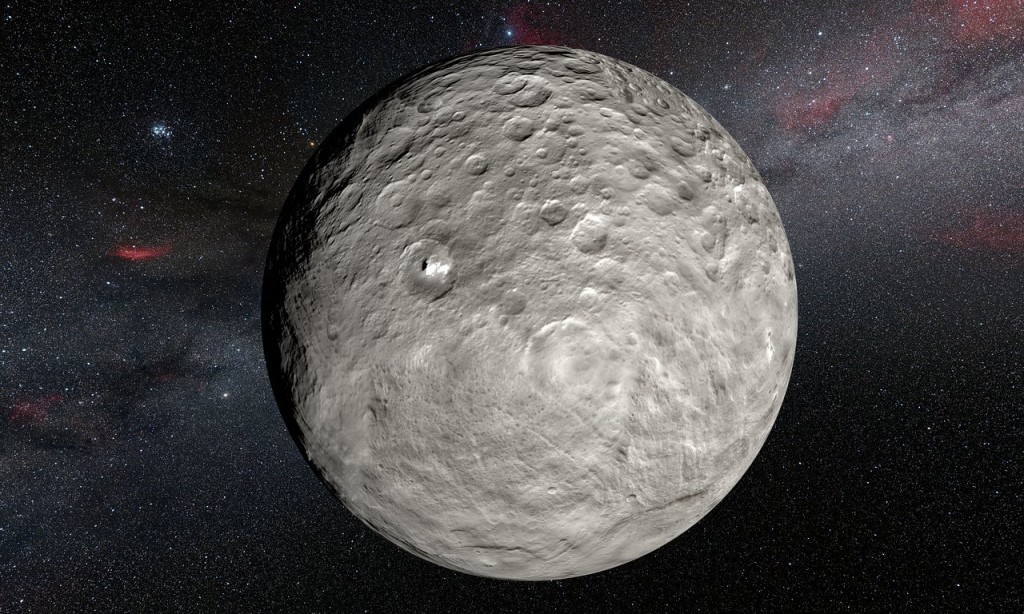
This artist’s impression is based on a detailed map of the surface compiled from images taken from NASA’s Dawn spacecraft in orbit around the dwarf planet Ceres. It shows the very bright patches of material in the crater Occator and elsewhere. New observations using the HARPS spectrograph on the ESO 3.6-metre telescope at La Silla in Chile have revealed unexpected daily changes on these spots, suggesting that they change under the influence of sunlight as Ceres rotates.
Ceres is the largest body in the asteroid belt between Mars and Jupiter and the only such object classed as a dwarf planet. NASA’s Dawn spacecraft has been in orbit around Ceres for more than a year and has mapped its surface in great detail. One of the biggest surprises has been the discovery of very bright spots, which reflect far more light than their much darker surroundings [1]. The most prominent of these spots lie inside the crater Occator and suggest that Ceres may be a much more active world than most of its asteroid neighbours.
This artist’s impression video [click here for higher resolution versions] is based on a detailed map of the surface compiled from images taken from NASA’s Dawn spacecraft in orbit around the dwarf planet Ceres. It shows the very bright patches of material in the crater Occator and elsewhere. New observations using the HARPS spectrograph on the ESO 3.6-metre telescope at La Silla in Chile have revealed unexpected daily changes on these spots, suggesting that they change under the influence of sunlight as Ceres rotates.
This illustration shows how the features in the spectrum of the light reflected from the bright spots is alternately red and blue shifted slightly compared to the average light of Ceres as it rotates. This very subtle effect has been measured from the ground using the HARPS spectrograph on the ESO 3.6-metre telescope at La Silla in Chile. The effect has been greatly exaggerated to make it visible and excludes the much brighter light coming from the rest of the disc of Ceres. Credit: ESO/L.Calçada/NASA/JPL-Caltech/UCLA/MPS/DLR/IDA/Steve Albers
New and very precise observations using the HARPS spectrograph at the ESO 3.6-metre telescope at La Silla, Chile, have now not only detected the motion of the spots due to the rotation of Ceres about its axis, but also found unexpected additional variations suggesting that the material of the spots is volatile and evaporates in sunlight.
This image taken from NASA’s Dawn spacecraft in orbit around the dwarf planet Ceres shows the very bright patches of material in the crater Occator and elsewhere. New observations using the HARPS spectrograph on the ESO 3.6-metre telescope at La Silla in Chile have revealed unexpected daily changes on these spots, suggesting that they change under the influence of sunlight. Credit: NASA/JPL-Caltech/UCLA/MPS/DLR/IDAThe lead author of the new study, Paolo Molaro, at the INAF–Trieste Astronomical Observatory, takes up the story:
“As soon as the Dawn spacecraft revealed the mysterious bright spots on the surface of Ceres, I immediately thought of the possible measurable effects from Earth. As Ceres rotates the spots approach the Earth and then recede again, which affects the spectrum of the reflected sunlight arriving at Earth.”
Ceres spins every nine hours and calculations showed that the effects due to the motion of the spots towards and away from the Earth caused by this rotation would be very small, of order 20 kilometres per hour. But this motion is big enough to be measurable via the Doppler effect with high-precision instruments such as HARPS.
This artist’s impression video is based on a detailed map of the surface compiled from images taken from NASA’s Dawn spacecraft in orbit around the dwarf planet Ceres. It shows the very bright patches of material in the crater Occator and elsewhere. New observations using the HARPS spectrograph on the ESO 3.6-metre telescope at La Silla in Chile have revealed unexpected daily changes on these spots, suggesting that they change under the influence of sunlight as Ceres rotates. Credit: ESO/L.Calçada/NASA/JPL-Caltech/UCLA/MPS/DLR/IDA/Steve Albers
The team observed Ceres with HARPS for a little over two nights in July and August 2015. “The result was a surprise,”adds Antonino Lanza, at the INAF–Catania Astrophysical Observatory and co-author of the study.
“We did find the expected changes to the spectrum from the rotation of Ceres, but with considerable other variations from night to night.”
The team concluded that the observed changes could be due to the presence of volatile substances that evaporate under the action of solar radiation [2]. When the spots inside the Occator crater are on the side illuminated by the Sun they form plumes that reflect sunlight very effectively. These plumes then evaporate quickly, lose reflectivity and produce the observed changes. This effect, however, changes from night to night, giving rise to additional random patterns, on both short and longer timescales.
If this interpretation is confirmed Ceres would seem to be very different from Vesta and the other main belt asteroids. Despite being relatively isolated, it seems to be internally active [3]. Ceres is known to be rich in water, but it is unclear whether this is related to the bright spots. The energy source that drives this continual leakage of material from the surface is also unknown.
Dawn is continuing to study Ceres and the behaviour of its mysterious spots. Observations from the ground with HARPS and other facilities will be able to continue even after the end of the space mission.
Notes
[1] Bright spots were also seen, with much less clarity, in earlier images of Ceres from the NASA/ESA Hubble Space Telescope taken in 2003 and 2004.
[2] It has been suggested that the highly reflective material in the spots on Ceres might be freshly exposed water ice or hydrated magnesium sulphates.
[3] Many of the most internally active bodies in the Solar System, such as the large satellites of Jupiter and Saturn, are subjected to strong tidal effects due to their proximity to the massive planets.
The mysterious mountain Ahuna Mons is seen in this mosaic of images from NASA’s Dawn spacecraft. Dawn took these images from its lowest-altitude orbit. Image Credit: NASA/JPL-Caltech/UCLA/MPS/DLR/IDAOne year ago, on March 6, 2015, NASA’s Dawn spacecraft slid gently into orbit around Ceres, the largest body in the asteroid belt between Mars and Jupiter. Since then, the spacecraft has delivered a wealth of images and other data that open an exciting new window to the previously unexplored dwarf planet.
“Ceres has defied our expectations and surprised us in many ways, thanks to a year’s worth of data from Dawn. We are hard at work on the mysteries the spacecraft has presented to us,” said Carol Raymond, deputy principal investigator for the mission, based at NASA’s Jet Propulsion Laboratory, Pasadena, California.
This side-perspective view of Ceres’ mysterious mountain Ahuna Mons was made with images from NASA’s Dawn spacecraft. Dawn took these images from its low-altitude mapping orbit, 240 miles (385 kilometers) above the surface, in December 2015. The resolution of the component images is 120 feet (35 meters) per pixel. A 3-D (anaglyph) view is also availableAmong Ceres’ most enigmatic features is a tall mountain the Dawn team named Ahuna Mons. This mountain appeared as a small, bright-sided bump on the surface as early as February 2015 from a distance of 29,000 miles (46,000 kilometers), before Dawn was captured into orbit. As Dawn circled Ceres at increasingly lower altitudes, the shape of this mysterious feature began to come into focus. From afar, Ahuna Mons looked to be pyramid-shaped, but upon closer inspection, it is best described as a dome with smooth, steep walls.
Dawn’s latest images of Ahuna Mons, taken 120 times closer than in February 2015, reveal that this mountain has a lot of bright material on some of its slopes, and less on others. On its steepest side, it is about 3 miles (5 kilometers) high. The mountain has an average overall height of 2.5 miles (4 kilometers). It rises higher than Washington’s Mount Rainier and California’s Mount Whitney.
Scientists are beginning to identify other features on Ceres that could be similar in nature to Ahuna Mons, but none is as tall and well-defined as this mountain.
“No one expected a mountain on Ceres, especially one like Ahuna Mons,” said Chris Russell, Dawn’s principal investigator at the University of California, Los Angeles. “We still do not have a satisfactory model to explain how it formed.”
About 420 miles (670 kilometers) northwest of Ahuna Mons lies the now-famous Occator Crater. Before Dawn arrived at Ceres, images of the dwarf planet from NASA’s Hubble Space Telescope showed a prominent bright patch on the surface. As Dawn approached Ceres, it became clear that there were at least two spots with high reflectivity. As the resolution of images improved, Dawn revealed to its earthly followers that there are at least 10 bright spots in this crater alone, with the brightest area on the entire body located in the center of the crater. It is not yet clear whether this bright material is the same as the material found on Ahuna Mons.
“Dawn began mapping Ceres at its lowest altitude in December, but it wasn’t until very recently that its orbital path allowed it to view Occator’s brightest area. This dwarf planet is very large and it takes a great many orbital revolutions before all of it comes into view of Dawn’s camera and other sensors,” said Marc Rayman, Dawn’s chief engineer and mission director at JPL.
Researchers will present new images and other insights about Ceres at the 47th Lunar and Planetary Science Conference, during a press briefing on March 22 in The Woodlands, Texas.
When it arrived at Ceres on March 6, 2015, Dawn made history as the first mission to reach a dwarf planet, and the first to orbit two distinct extraterrestrial targets. The mission conducted extensive observations of Vesta in 2011-2012.
Dawn’s mission is managed by JPL for NASA’s Science Mission Directorate in Washington. Dawn is a project of the directorate’s Discovery Program, managed by NASA’s Marshall Space Flight Center in Huntsville, Alabama. UCLA is responsible for overall Dawn mission science. Orbital ATK Inc., in Dulles, Virginia, designed and built the spacecraft. The German Aerospace Center, Max Planck Institute for Solar System Research, Italian Space Agency and Italian National Astrophysical Institute are international partners on the mission team. For a complete list of mission participants, visit: http://dawn.jpl.nasa.gov/mission
More information about Dawn is available at the following sites:
The OSIRIS-REx mission aims to explore an asteroid and bring back a sample of it back to earth. If you submit “a sketch, photograph, graphic, poem, song, short video or other creative or artistic expression” to the We The Explorers outreach program and it will be digitized and sent along with the spacecraft in a memory chip.
NASA is calling all space enthusiasts to send their artistic endeavors on a journey aboard NASA’s Origins, Spectral Interpretation, Resource Identification, Security-Regolith Explorer (OSIRIS-REx) spacecraft. This will be the first U.S. mission to collect a sample of an asteroid and return it to Earth for study.
OSIRIS-REx is scheduled to launch in September and travel to the asteroid Bennu. The #WeTheExplorers campaign invites the public to take part in this mission by expressing, through art, how the mission’s spirit of exploration is reflected in their own lives. Submitted works of art will be saved on a chip on the spacecraft. The spacecraft already carries a chip with more than 442,000 names submitted through the 2014 “Messages to Bennu” campaign.
“The development of the spacecraft and instruments has been a hugely creative process, where ultimately the canvas is the machined metal and composites preparing for launch in September,” said Jason Dworkin, OSIRIS-REx project scientist at NASA’s Goddard Space Flight Center in Greenbelt, Maryland. “It is fitting that this endeavor can inspire the public to express their creativity to be carried by OSIRIS-REx into space.”
A submission may take the form of a sketch, photograph, graphic, poem, song, short video or other creative or artistic expression that reflects what it means to be an explorer. Submissions will be accepted via Twitter and Instagram until March 20. For details on how to include your submission on the mission to Bennu, go to:
“Space exploration is an inherently creative activity,” said Dante Lauretta, principal investigator for OSIRIS-REx at the University of Arizona, Tucson. “We are inviting the world to join us on this great adventure by placing their art work on the OSIRIS-REx spacecraft, where it will stay in space for millennia.”
The spacecraft will voyage to the near-Earth asteroid Bennu to collect a sample of at least 60 grams (2.1 ounces) and return it to Earth for study. Scientists expect Bennu may hold clues to the origin of the solar system and the source of the water and organic molecules that may have made their way to Earth.
Goddard provides overall mission management, systems engineering and safety and mission assurance for OSIRIS-REx. The University of Arizona, Tucson leads the science team and observation planning and processing. Lockheed Martin Space Systems in Denver is building the spacecraft. OSIRIS-REx is the third mission in NASA’s New Frontiers Program. NASA’s Marshall Space Flight Center in Huntsville, Alabama, manages New Frontiers for the agency’s Science Mission Directorate in Washington.
How might life have come to Earth? Why is asteroid Bennu an important key to answering this question? Journey with us through the story of Bennu and see how it may help us unlock this timeless mystery. Bennu’s Journey combines the latest scientific theories on the origin of the solar system with stunning computer graphics from the Goddard Space Flight Center Conceptual Image Lab and an original score from Tucson composer Ian Zickler. The result is a blend of art and science that tells the story of how asteroid Bennu arrived in near-Earth space and highlights the questions that the OSIRIS-REx mission seeks to answer.
![PIA20350-16-640x350[1]](http://hobbyspace.com/Blog/wp-content/uploads/2016/03/PIA20350-16-640x3501.jpg)
![PIA20352_ip[1]](http://hobbyspace.com/Blog/wp-content/uploads/2016/03/PIA20352_ip1-1024x576.jpg)
![PIA20355_ip[1]](http://hobbyspace.com/Blog/wp-content/uploads/2016/03/PIA20355_ip1-1024x522.jpg)
![PIA20351_ip[1]](http://hobbyspace.com/Blog/wp-content/uploads/2016/03/PIA20351_ip1-1024x525.jpg)
![PIA20353_ip[1]](http://hobbyspace.com/Blog/wp-content/uploads/2016/03/PIA20353_ip1-1024x576.jpg)
![eso1609b[1]](http://hobbyspace.com/Blog/wp-content/uploads/2016/03/eso1609b1-1024x1024.jpg)
![PIA20348-16-640x350[1]](http://hobbyspace.com/Blog/wp-content/uploads/2016/03/PIA20348-16-640x3501.jpg)
![PIA20349-640x350[1]](http://hobbyspace.com/Blog/wp-content/uploads/2016/03/PIA20349-640x3501.jpg)
![WeTheExplorers-NASAgovOREx[1]](http://hobbyspace.com/Blog/wp-content/uploads/2016/02/WeTheExplorers-NASAgovOREx1.png)
![16-019[1]](http://hobbyspace.com/Blog/wp-content/uploads/2016/02/16-0191.png)