Category Archives: Exoplanets

Masking out a star to see its planets

Masking out the intense bright light a star so that the dim reflected light of its planets, especially small earth-like ones, can be seen is no easy task. As mentioned in an earlier post, a starshade is a specially designed occulter that blocks a star’s light in a way that greatly reduces the diffraction around its edges. A starshade would be placed in space so that a telescope thousands of kilometers from it could observe planets around a distant star.

New Worlds Mission is a starshade project that has done early studies but has not been funded for implementation of an exoplanet observation system. This article provides more details on starshades: Incredible Technology: Giant Starshade Could Help Find an Alien Earth | Space.com

As it stands now, the assumed $1 billion mission would be able to target about 55 bright stars in a three-year span. [Sara Seager], the chair of NASA’s science and technology definition team for the starshade project, thinks it’s possible to find Earth-like planets orbiting 22 of those 55 stars targeted by the mission. 

One major advantage to the starshade is that astronomers won’t need to couple it with a large, extremely expensive space telescope. By blocking out the light of a star before that light ever reaches the telescope, the starshade eliminates the need for a huge telescope, Seager said.

“You don’t need a very fancy telescope that’s highly thermally and mechanically stable,” Seager told Space.com. “You can use any old space telescope. We can buy a telescope. That’s what we’re thinking of. … It sounds a little funny, but any telescope will do.”

More at

Kepler exoplanet artwork invitation

The SETI Institute is sponsoring the Kepler Art of Discovery program:

Are you a space artist? An astronomer? Or a student interested in astronomy and our fascinating galaxy? You are cordially invited to create art that illustrates what the hundreds of newly discovered exoplanets (planets outside our solar system) might look like. Or your might create an image that captures other aspects of the Kepler Mission, such as how the spacecraft looks from the Earth as it orbits the Sun and captures the light emitted by these other stars.

Middle school students through adults are invited to submit images of these other Keplerworlds. Art of Discovery aims to bring people’s creative ideas to this question: What do the exoplanets look like that the Kepler Mission has discovered? And what other subjects has the Kepler Mission inspired artistically? For information about the Kepler Mission, see the Kepler website.

All submitted images of artwork will be acknowledged, and The Top 100 will be displayed in the Gallery of the Art of Discovery website. These will be selected by a combination of the number of popular votes AND scores from a distinguished panel of judges.

See Rules at Kepler Art of Discovery for details on submitting your rendition of an exoplanet. Registration period: March 10–May 5, 2014

kepler-9b[1]

SETI Institute video: Patterns of Sunlight on Extra-Solar Planets

Many of the exoplanets discovered so far are close to their stars and therefore, like our planet Mercury, will have their rotations and orbits locked together by the tidal forces on them. (Mercury rotates three times for every two orbits around the sun. ) In this video, Tony Dobrovolskis of NASA Ames and the SETI Institute discusses how such orbital/rotation synchronization will affect the conditions on the planets and what it could mean for seeing the planets directly:

Exoplanets discovered to date show a wide range of orbital eccentricities; the angles between their spin equators and orbital planes are still quite unknown, but these “obliquities” may range widely as well. Both eccentricity and obliquity can have profound effects on a planet’s seasons, as well as on its cycle of night and day. Remarkable patterns of insolation occur on synchronously-rotating planets, and on those in other spin-orbit states, with implications for their climates, detectability, and habitability.

http://www.youtube.com/watch?v=8_XQ_wSmg2s&feature=share

NASA Kepler mission confirms over 700 new exoplanets

Despite the suspension of observations with the Kepler planet-finder telescope, lots of planets continue to be found in the massive amount of data that was collected while it was working.

NASA’s Kepler Mission Announces a Planet Bonanza, 715 New Worlds

NASA’s Kepler mission announced Wednesday the discovery of 715 new planets. These newly-verified worlds orbit 305 stars, revealing multiple-planet systems much like our own solar system.

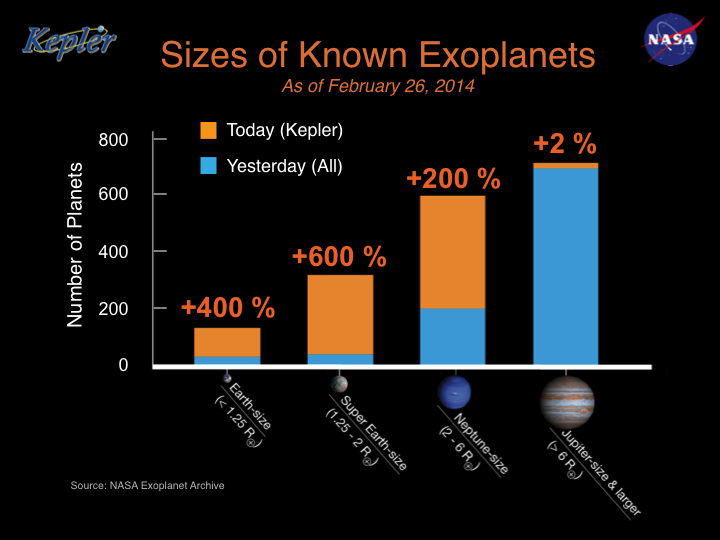
Nearly 95 percent of these planets are smaller than Neptune, which is almost four times the size of Earth. This discovery marks a significant increase in the number of known small-sized planets more akin to Earth than previously identified exoplanets, which are planets outside our solar system.

The artist concept depicts multiple-transiting planet systems, which are
stars with more than one planet. The planets eclipse or transit their host
star from the vantage point of the observer. This angle is called edge-on.
Image Credit:  NASA

“The Kepler team continues to amaze and excite us with their planet hunting results,” said John Grunsfeld, associate administrator for NASA’s Science Mission Directorate in Washington. “That these new planets and solar systems look somewhat like our own, portends a great future when we have the James Webb Space Telescope in space to characterize the new worlds.”

Since the discovery of the first planets outside our solar system roughly two decades ago, verification has been a laborious planet-by-planet process. Now, scientists have a statistical technique that can be applied to many planets at once when they are found in systems that harbor more than one planet around the same star.

knownexoplanetsThe histogram shows the number of planets by size for all known exoplanets.
The blue bars on the histogram represents all the exoplanets known, by size,
before the Kepler Planet Bonanza announcement on Feb. 26, 2014. The gold
bars on the histogram represent Kepler’s newly-verified planets.
Image Credit: NASA Ames/W Stenzel

To verify this bounty of planets, a research team co-led by Jack Lissauer, planetary scientist at NASA’s Ames Research Center in Moffett Field, Calif., analyzed stars with more than one potential planet, all of which were detected in the first two years of Kepler’s observations — May 2009 to March 2011.

The research team used a technique called verification by multiplicity, which relies in part on the logic of probability. Kepler observes 150,000 stars, and has found a few thousand of those to have planet candidates. If the candidates were randomly distributed among Kepler’s stars, only a handful would have more than one planet candidate. However, Kepler observed hundreds of stars that have multiple planet candidates. Through a careful study of this sample, these 715 new planets were verified.

This method can be likened to the behavior we know of lions and lionesses. In our imaginary savannah, the lions are the Kepler stars and the lionesses are the planet candidates. The lionesses would sometimes be observed grouped together whereas lions tend to roam on their own. If you see two lions it could be a lion and a lioness or it could be two lions. But if more than two large felines are gathered, then it is very likely to be a lion and his pride. Thus, through multiplicity the lioness can be reliably identified in much the same way multiple planet candidates can be found around the same star.

“Four years ago, Kepler began a string of announcements of first hundreds, then thousands, of planet candidates –but they were only candidate worlds,” said Lissauer. “We’ve now developed a process to verify multiple planet candidates in bulk to deliver planets wholesale, and have used it to unveil a veritable bonanza of new worlds.”

These multiple-planet systems are fertile grounds for studying individual planets and the configuration of planetary neighborhoods. This provides clues to planet formation.

Four of these new planets are less than 2.5 times the size of Earth and orbit in their sun’s habitable zone, defined as the range of distance from a star where the surface temperature of an orbiting planet may be suitable for life-giving liquid water.

One of these new habitable zone planets, called Kepler-296f, orbits a star half the size and 5 percent as bright as our sun. Kepler-296f is twice the size of Earth, but scientists do not know whether the planet is a gaseous world, with a thick hydrogen-helium envelope, or it is a water world surrounded by a deep ocean.

“From this study we learn planets in these multi-systems are small and their orbits are flat and circular — resembling pancakes — not your classical view of an atom,” said Jason Rowe, research scientist at the SETI Institute in Mountain View, Calif., and co-leader of the research. “The more we explore the more we find familiar traces of ourselves amongst the stars that remind us of home.”

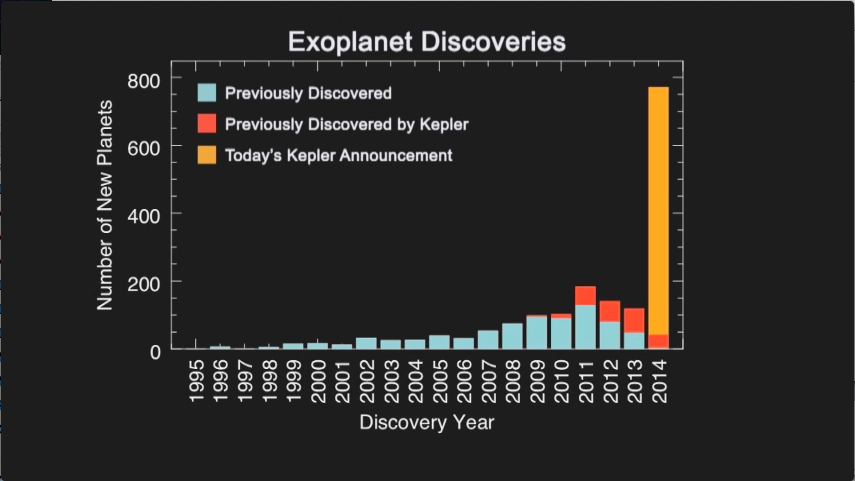
exoplanetdiscoverieshistogramThe histogram shows the number of planet discoveries by year for roughly the
past two decades of the exoplanet search. The blue bar shows previous planet
discoveries, the red bar shows previous Kepler planet discoveries, the gold
bar displays the 715 new planets verified by multiplicity.
Image Credit: NASA Ames/SETI/J Rowe

This latest discovery brings the confirmed count of planets outside our solar system to nearly 1,700. As we continue to reach toward the stars, each discovery brings us one step closer to a more accurate understanding of our place in the galaxy.

Launched in March 2009, Kepler is the first NASA mission to find potentially habitable Earth-size planets. Discoveries include more than 3,600 planet candidates, of which 961 have been verified as bona-fide worlds.

The findings papers will be published March 10 in The Astrophysical Journal and are available for download at: http://www.nasa.gov/ames/kepler/digital-press-kit-kepler-planet-bonanza

Ames is responsible for the Kepler mission concept, ground system development, mission operations and science data analysis. NASA’s Jet Propulsion Laboratory in Pasadena, Calif., managed Kepler mission development. Ball Aerospace & Technologies Corp. in Boulder, Colo., developed the Kepler flight system and supports mission operations with the Laboratory for Atmospheric and Space Physics at the University of Colorado in Boulder. The Space Telescope Science Institute in Baltimore archives, hosts and distributes Kepler science data. Kepler is NASA’s 10th Discovery Mission and was funded by the agency’s Science Mission Directorate.

For more information about the Kepler space telescope, visit: http://www.nasa.gov/kepler

PLATO exoplanet finder mission selected by ESA

ESA has selected the PLATO (PLAnetary Transits and Oscillations of stars) exoplanet search space observatory as a new mission that will launch in 2024 time frame: ESA selects planet-hunting PLATO mission – ESA

Here is a description of the project:

Space eye with 34 telescopes will investigate one million stars
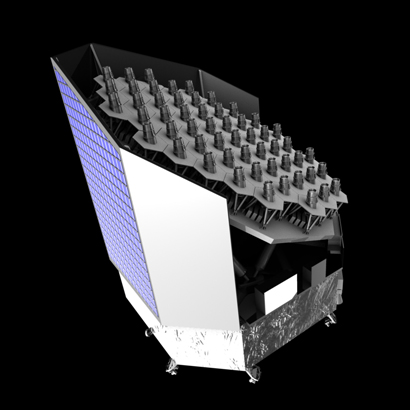
One of the possible designs for the PLATO spacecraft.

The exploration of planets around stars other than the Sun, known as extrasolar planets or ‘exoplanets’, is one of the most exciting topics of 21st century science. One of the key goals of this research is to discover and learn the properties of Earth-like worlds in the Sun’s neighbourhood. ESA, the European Space Agency, will do this in preparing a new space mission named PLATO. The mission’s launch is scheduled for 2024, and firm discoveries of Earth-like planets at Earth-like distances from stars similar to our Sun will be produced after three years of observational data have been collected. ESA’s Science Programme Committee voted for PLATO at its regular meeting in Paris on 19th and 20th February, 2014, where it was one of five proposed space projects for a so-called “M” mission.

Not a single Earth-like exoplanet in a habitable zone around a star similar to our Sun has been found and characterized yet. PLATO will be a pioneer in finding new worlds for humanity to explore.

The PLATO Science consortium is led by Don Pollacco from the University of Warwick who comments “This is fantastic news for  Europe, PLATO will allow the first systematic survey of nearby planets for indications from advanced life forms (as well as slime). A few years ago this would have been science fiction and now its coming to pass as science fact.” The UK also has major roles in the instrument itself supplying the CCD sensors (e2V Technology and UCL), much of the image processing software (Cambridge) and Public Outreach (Open University).

The PLATO mission itself is led by Dr Heike Rauer at DLR, the German Aerospace Center. “PLATO will begin a completely new chapter in the exploration of extrasolar Planets” Dr Rauer confidently predicts. “We will find planets that orbit their star in the life-sustaining ‘habitable’ zone: planets where liquid water is expected, and where life as we know it can be maintained.”

PLATO will measure the sizes, masses, and ages of the planetary systems it finds, so detailed comparisons with our own Solar System can be made. “In the last 20 years more than one thousand exoplanets have been discovered, with quite a few multi-planetary systems among them”, Rauer explains. “But almost all of these systems differ significantly from our Solar System in their properties, because they are the easiest-to-find examples. PLATO firmly will establish whether systems like our own Solar System, and planets like our own Earth are common in the Galaxy.”
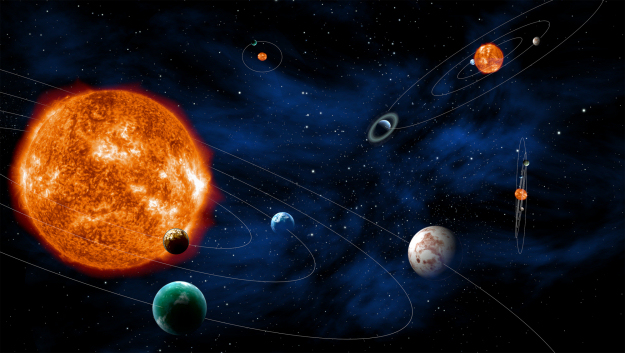
PLATO, is an acronym for PLanetary Transits and Oscillations of Stars. PLATO will find planets through the periodic dimming of the detected starlight caused by a planet orbiting in front of the star, blocking PLATO’s view of a fraction of the starlight. PLATO will also measure tiny changes in detected starlight caused by small vibrations in the host stars, performing so-called astroseismology. Just as in seismology of the Earth, these vibrations reveal the interior structure of the vibrating body. Astroseismology allows us to learn the age of the vibrating star and the planets orbiting around it.

A new type of space telescope

PLATO is a completely new type of space telescope: it will use an array of telescopes rather than a single lens or mirror. PLATO will use top quality cameras, and will have the advantage of observing continuously from space, without the interruption of sunrise, or the blurring caused by the Earth’s atmosphere. This will allow PLATO to discover planets smaller than Earth, and planets at distances from their host stars similar to the Earth-Sun distance. So far, only a few small exoplanets are known at star-planet distances comparable to or greater than Earth’s. Unlike previous missions, PLATO will focus on these planets, which are expected to resemble our own Solar System planets.

Europe will take on a leading role in the search for extrasolar planets

PLATO is a lively and vigorous European collaboration – many European research institutions and hundreds of European researchers are working together, with scientists from all over the world completing the team. The catalogue of potentially habitable planets provided by PLATO will be the basis for follow-up measurements to confirm discoveries of new planets, using the European Southern Observatory’s European Extremely Large Telescope (E-ELT), or the next generation of large space telescopes, like the James Webb Space Telescope. With PLATO, Europe will be leading the search for habitable exoplanets.

So far only a few exoplanets have had their mass, radius and age determined precisely. This is needed to properly describe a planet. “The observation of planets in many different states of their evolution will give us clues for the past and the future of our own planetary system”, Dr Rauer remarked. “By no means do we know all about the youth of our Solar System.”

Pioneering work in the search for a candidate “second Solar System”

Only a measurement of both the radius and the mass of a planet allows us to distinguish between a “mini-Neptune” with a high gas content, but a low density – like the two outermost planets in the Solar System – or a rocky planet with an iron core, like the Earth. Without this information the habitability of a planet cannot be determined. Some known extrasolar planets are “super-Earths” with sizes and masses somewhat larger than the Earth’s. These two fundamental parameters are not known with sufficient precision for most exoplanets.

Key facts:

During its six year long planned mission, PLATO will observe one million stars, leading to the likely discovery and characterisation of thousands of new planets circling other stars. PLATO will scan and observe about half the sky, including the brightest and nearest stars.

PLATO consists of an array of 34 individual telescopes mounted on an observing platform in the space probe. The satellite will be positioned at one of the so-called Lagrangian Points , where the gravitational pull of the Sun and the Earth cancel each other out so the satellite will stay at a fixed position in space. Each of the 34 telescopes has an aperture of 12 centimetres.

The individual telescopes can be combined in many different modes and bundled together, leading to unprecedented capabilities to simultaneously observe both bright and dim objects.

PLATO will be equipped with the largest camera-system sensor ever flown in space, comprising 136 charge-coupled devices (CCDs) that have a combined area of 0.9 square metres.

The accuracy of PLATO’s astroseismological measurements will be higher than with previous planet-searching programmes, allowing for a better characterisation of the stars, particularly those stellar-planetary configurations similar to our Solar System.

The scientific objective is based on previous successful projects, like the French-European space telescope CoRoT or NASA’s Kepler mission. It will also take into account the mission concepts that are currently under preparation which will “fill the gap” between now and PLATO’s launch in 2024 – NASA’s Kepler-2, and TESS missions and ESA’s ChEOPS mission.

Dr Heike Rauer from DLR’s Institute of Planetary Research in Berlin is a professor for astrophysics at Berlin’s Technical University. Rauer is leading the international consortium that will provide the payload and perform all scientific investigations with the data.