Category Archives: Exoplanets

Video: Intro. astronomy class on exoplanets, solar system origin, & formation

Bruce Betts of the Planetary Society continues with his on line introductory astronomy course. In this session he talks with Debra Fischer of Yale University about exoplanets: Intro Astronomy 2014. Class 11: Exoplanets and Solar System Origin and Formation – The Planetary Society

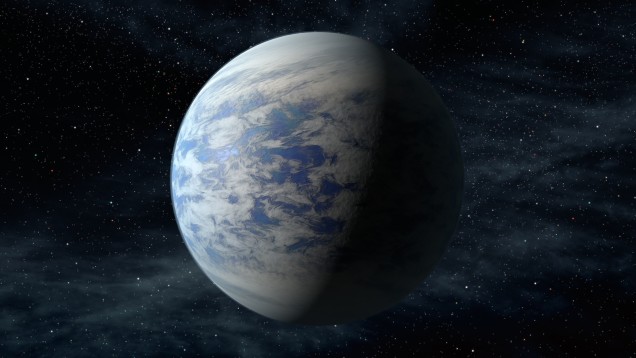
Exoplanet art

I mentioned earlier here that artist renderings of exoplanets can’t be taken too seriously. However, while their appearances are fictional, such works can still be quite pleasing to peruse and ponder. Check out this great gallery of exo-Earths: Visit the Super-Earths We’ve Found, in These Gorgeous Artworks – io9.

Kepler_69C_NASAJPL

Kepler 69C – NASA JPL

Kepler’s second and third acts + Sara Seager’s drive to find distant earths

The Kepler space telescope continues to look for exoplanets while its data continues to be mined for new worlds : Earth II? – PJ Media

===

A profile of exoplanet finder Sara Seager of MIT : Sara Seager’s Tenacious Drive to Discover Another Earth – Smithsonian

 pia17999-640

Update: And here is an item about not taking too seriously artists’ visions of how exoplanets might look close up : Envisioning Alien Worlds – Centauri Dreams


Kepler space telescope finds first earth-size planet in habitable zone

An announcement from the NASA Kepler mission:

NASA’s Kepler Telescope Discovers First
Earth-Size Planet in ‘Habitable Zone’

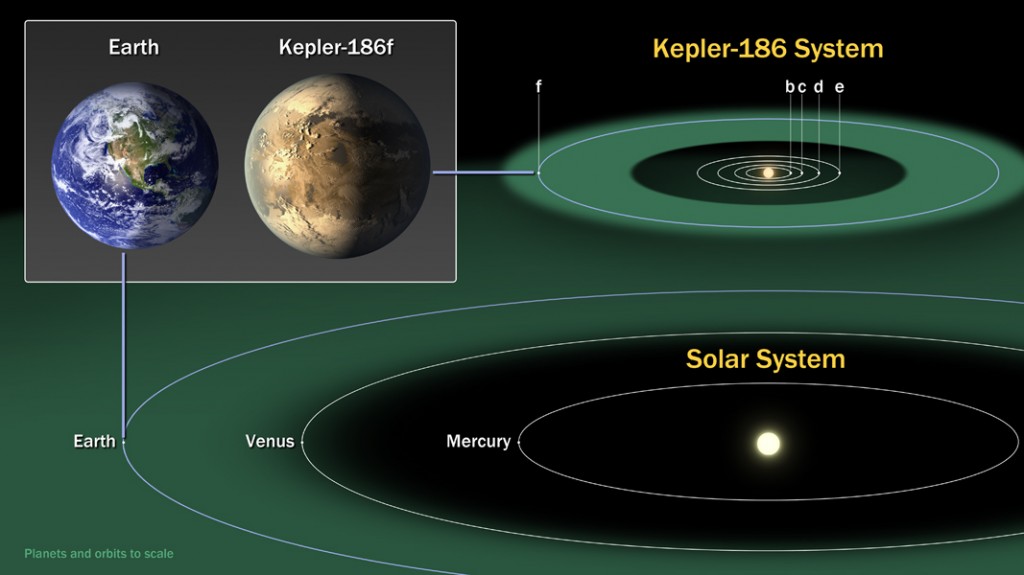
Using NASA’s Kepler Space Telescope, astronomers have discovered the first Earth-size planet orbiting a star in the “habitable zone” — the range of distance from a star where liquid water might pool on the surface of an orbiting planet. The discovery of Kepler-186f confirms that planets the size of Earth exist in the habitable zone of stars other than our sun.

PIA18000_ip

The diagram compares the planets of our inner solar system to Kepler-186,
a five-planet star system about 500 light-years from Earth in the constellation
Cygnus. Image credit: NASA Ames/SETI Institute/JPL-Caltech

› Full image and caption

While planets have previously been found in the habitable zone, they are all at least 40 percent larger in size than Earth, and understanding their makeup is challenging. Kepler-186f is more reminiscent of Earth.

“The discovery of Kepler-186f is a significant step toward finding worlds like our planet Earth,” said Paul Hertz, NASA’s Astrophysics Division director at the agency’s headquarters in Washington. “Future NASA missions, like the Transiting Exoplanet Survey Satellite and the James Webb Space Telescope, will discover the nearest rocky exoplanets and determine their composition and atmospheric conditions, continuing humankind’s quest to find truly Earth-like worlds.”

pia17999-640The artistic concept of Kepler-186f is the result of scientists and artists
collaborating to imagine the appearance of these distant worlds.
 › Full image and caption
Image credit: NASA Ames/SETI Institute/JPL-Caltech

Although the size of Kepler-186f is known, its mass and composition are not. Previous research, however, suggests that a planet the size of Kepler-186f is likely to be rocky.

“We know of just one planet where life exists — Earth. When we search for life outside our solar system, we focus on finding planets with characteristics that mimic that of Earth,” said Elisa Quintana, research scientist at the SETI Institute at NASA’s Ames Research Center in Moffett Field, Calif., and lead author of the paper published today in the journal Science. “Finding a habitable zone planet comparable to Earth in size is a major step forward.”

Kepler-186f resides in the Kepler-186 system, about 500 light-years from Earth in the constellation Cygnus. The system is also home to four companion planets, which orbit a star half the size and mass of our sun. The star is classified as an M dwarf, or red dwarf, a class of stars that makes up 70 percent of the stars in the Milky Way galaxy.

“M dwarfs are the most numerous stars,” said Quintana. “The first signs of other life in the galaxy may well come from planets orbiting an M dwarf.”

Kepler-186f orbits its star once every 130 days and receives one-third the energy from its star that Earth gets from the sun, placing it nearer the outer edge of the habitable zone. On the surface of Kepler-186f, the brightness of its star at high noon is only as bright as our sun appears to us about an hour before sunset.

“Being in the habitable zone does not mean we know this planet is habitable. The temperature on the planet is strongly dependent on what kind of atmosphere the planet has,” said Thomas Barclay, research scientist at the Bay Area Environmental Research Institute at Ames, and co-author of the paper. “Kepler-186f can be thought of as an Earth-cousin rather than an Earth-twin. It has many properties that resemble Earth.”

The four companion planets, Kepler-186b, Kepler-186c, Kepler-186d and Kepler-186e, whiz around their sun every four, seven, 13 and 22 days, respectively, making them too hot for life as we know it. These four inner planets all measure less than 1.5 times the size of Earth.

The next steps in the search for distant life include looking for true Earth-twins — Earth-size planets orbiting within the habitable zone of a sun-like star — and measuring their chemical compositions. The Kepler Space Telescope, which simultaneously and continuously measured the brightness of more than 150,000 stars, is NASA’s first mission capable of detecting Earth-size planets around stars like our sun.

Ames is responsible for Kepler’s ground system development, mission operations, and science data analysis. NASA’s Jet Propulsion Laboratory in Pasadena, Calif., managed Kepler mission development. Ball Aerospace & Technologies Corp. in Boulder, Colo., developed the Kepler flight system and supports mission operations with the Laboratory for Atmospheric and Space Physics at the University of Colorado in Boulder. The Space Telescope Science Institute in Baltimore archives, hosts and distributes Kepler science data. Kepler is NASA’s 10th Discovery Mission and was funded by the agency’s Science Mission Directorate.

The SETI Institute is a private, nonprofit organization dedicated to scientific research, education and public outreach. The mission of the SETI Institute is to explore, understand and explain the origin, nature and prevalence of life in the universe.

For more information about the Kepler mission, visit: http://www.nasa.gov/kepler

===

Here’s an animation of the Kepler 186 system:

Update May.3.14: Here is another video about Kepler 186f plus two other small planets in the habitable zones of their planets:

Wobbling has its advantages for life on Earth-size exoplanets

Our Moon helps to reduce the earth’s wobbling, i.e. the variation in the tilt of the earth’s rotational axis relative to the plane of the earth’s orbit around the sun. This stabilizing effect, particularly with respect to climate, has been often presented as a necessary condition for the emergence and evolution of life on earth. However, a new paper is out that argues that an earth-like exoplanet without a big moon would benefit from the resultant wobbling because it would mean more even heating of that world and therefore less chance of freezing over. This is particularly important at greater distances from an exoplanet’s star and so the effect will expand outward the size habitable zones.

Here is a press release about the paper:

Astronomers: ‘Tilt-a-worlds’ could harbor life

A fluctuating tilt in a planet’s orbit does not preclude the possibility of life, according to new research by astronomers at the University of Washington, Utah’s Weber State University and NASA. In fact, sometimes it helps.

That’s because such “tilt-a-worlds,” as astronomers sometimes call them — turned from their orbital plane by the influence of companion planets — are less likely than fixed-spin planets to freeze over, as heat from their host star is more evenly distributed.
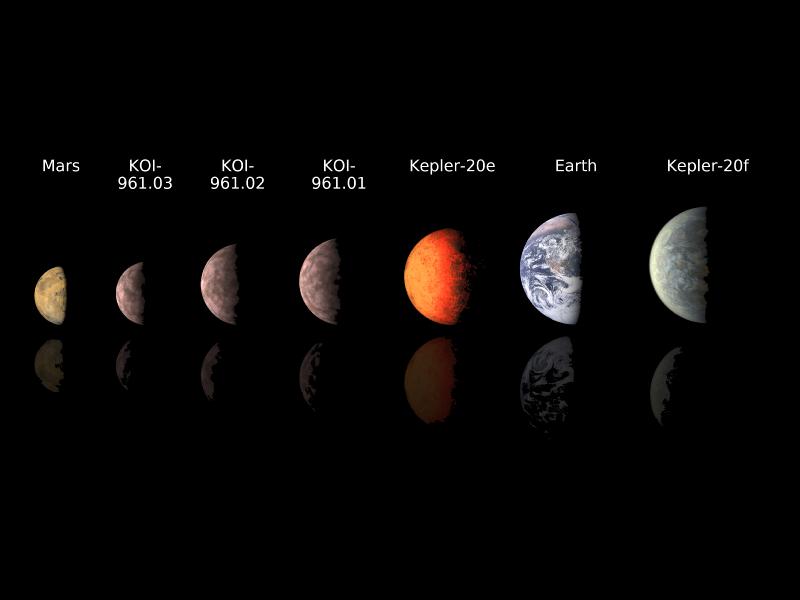
615242main_PlanetLineup_4x3_800-600A comparison to earth and Mars of small exoplanets discovered
by the Kepler Observatory 

This happens only at the outer edge of a star’s habitable zone, the swath of space around it where rocky worlds could maintain liquid water at their surface, a necessary condition for life. Further out, a “snowball state” of global ice becomes inevitable, and life impossible.

The findings, which are published online and will appear in the April issue of Astrobiology, have the effect of expanding that perceived habitable zone by 10 to 20 percent.

And that in turn dramatically increases the number of worlds considered potentially right for life.

Such a tilt-a-world becomes potentially habitable because its spin would cause poles to occasionally point toward the host star, causing ice caps to quickly melt.
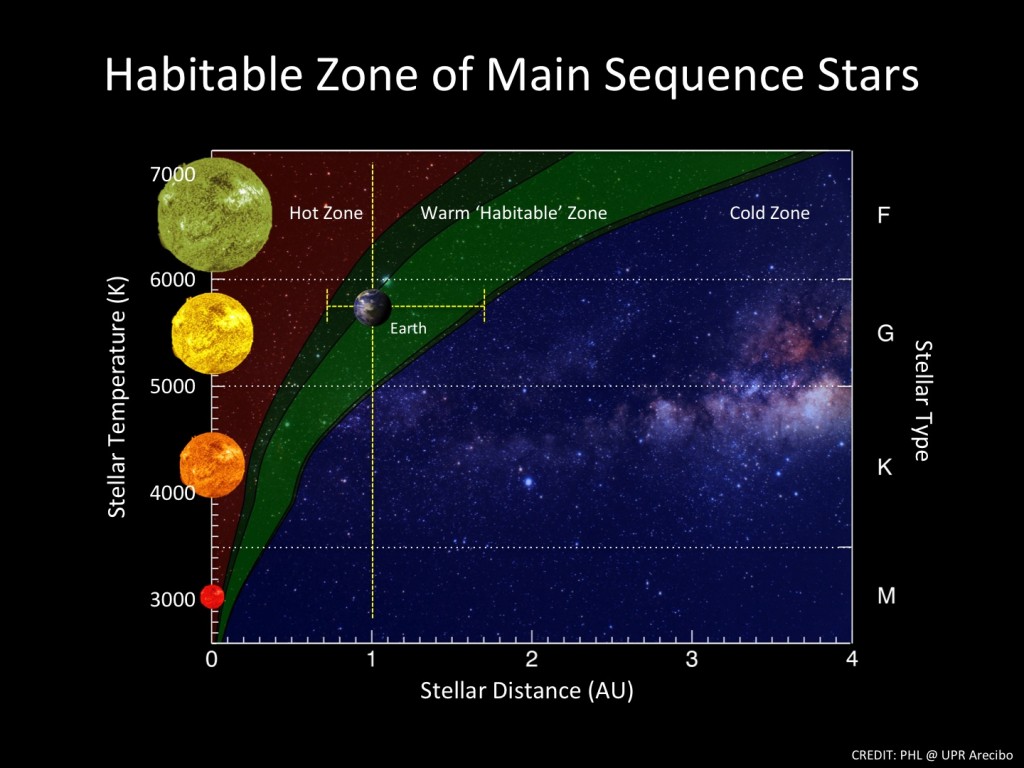
Habitable_ZoneA plot showing star temperatures vs distance from the star
for the habitable zone. Credit: PHL@UPR Arecibo

“Without this sort of ‘home base’ for ice, global glaciation is more difficult,” said UW astronomer Rory Barnes. “So the rapid tilting of an exoplanet actually increases the likelihood that there might be liquid water on a planet’s surface.”

Barnes is second author on the paper. First author is John Armstrong of Weber State, who earned his doctorate at the UW.

Earth and its neighbor planets occupy roughly the same plane in space. But there is evidence, Barnes said, of systems whose planets ride along at angles to each other. As such, “they can tug on each other from above or below, changing their poles’ direction compared to the host star.”

The team used computer simulations to reproduce such off-kilter planetary alignments, wondering, he said, “what an Earthlike planet might do if it had similar neighbors.”

Their findings also argue against the long-held view among astronomers and astrobiologists that a planet needs the stabilizing influence of a large moon — as Earth has — to have a chance at hosting life.

“We’re finding that planets don’t have to have a stable tilt to be habitable,” Barnes said. Minus the moon, he said, Earth’s tilt, now at a fairly stable 23.5 degrees, might increase by 10 degrees or so. Climates might fluctuate, but life would still be possible.

“This study suggests the presence of a large moon might inhibit life, at least at the edge of the habitable zone.”

The work was done through the UW’s Virtual Planetary Laboratory, an interdisciplinary research group that studies how to determine if exoplanets — those outside the solar system — might have the potential for life.

“The research involved orbital dynamics, planetary dynamics and climate studies. It’s bigger than any of those disciplines on their own,” Barnes said.

Armstrong said that expanding the habitable zone might almost double the number of potentially habitable planets in the galaxy.

Applying the research and its expanded habitable zone to our own celestial neighborhood for context, he said, “It would give the ability to put Earth, say, past the orbit of Mars and still be habitable at least some of the time — and that’s a lot of real estate.”

Barnes’ UW co-authors are Victoria Meadows, Thomas Quinn and Jonathan Breiner. Shawn Domagal-Goldman of NASA’s Goddard Space Flight Center is also a co-author. The research was funded by a grant from the NASA Astrobiology Institute.

===

Here’s a recent NASA article about an extreme case of a wobbly world: Kepler captures a weird, wildly wobbling world – NASA PlanetQuest –

The planet, designated Kepler-413b, precesses, or wobbles, wildly on its spin axis, much like a child’s top. The tilt of the planet’s spin axis can vary by as much as 30 degrees over 11 years, leading to rapid and erratic changes in seasons. In contrast, Earth’s rotational precession is 23.5 degrees over 26,000 years. Researchers are amazed that this far-off planet is precessing on a human timescale.