Category Archives: Exoplanets

Misc. science: Curiosity back to work + Hydrothermal Enceladus + Earth size exoplanet next door + Pluto history and near-future

The Curiosity rover is back to work on Mars after being idle for a couple of weeks while NASA JPL engineers figured out what caused a brief electric short during an operation with the sample drill: over Arm Delivers Rock Powder Sample – NASA JPL.

NASA’s Curiosity Mars rover used its robotic arm Wednesday, March 11, to sieve and deliver a rock-powder sample to an onboard instrument. The sample was collected last month before the team temporarily suspended rover arm movement pending analysis of a short circuit.

The Chemistry and Mineralogy (CheMin) analytical instrument inside the rover received the sample powder. This sample comes from a rock target called “Telegraph Peak,” the third target drilled during about six months of investigating the “Pahrump Hills” outcrop on Mount Sharp. With this delivery completed, the rover team plans to drive Curiosity away from Pahrump Hills in coming days.

“That precious Telegraph Peak sample had been sitting in the arm, so tantalizingly close, for two weeks. We are really excited to get it delivered for analysis,” said Curiosity Project Scientist Ashwin Vasavada of NASA’s Jet Propulsion Laboratory, Pasadena, California.

PIA19148_ip[1]

…area at the base of Mount Sharp on Mars includes a pale outcrop on the right, “Pahrump Hills,” where NASA’s Curiosity Mars rover worked for nearly six months, and the “Artist’s Drive” route toward higher layers of the mountain….

Continue… 

===

Mentioned here earlier the findings that indicate Jupiter’s moon Ganymede has an ocean beneath a thick crust of ice. Now comes a new report that Saturn’s moon Enceladus periodically shoots out sprays of hot water from its own underground ocean : Spacecraft Data Suggest Saturn Moon’s Ocean May Harbor Hydrothermal Activity – NASA JPL

NASA’s Cassini spacecraft has provided scientists the first clear evidence that Saturn’s moon Enceladus exhibits signs of present-day hydrothermal activity which may resemble that seen in the deep oceans on Earth. The implications of such activity on a world other than our planet open up unprecedented scientific possibilities.

“These findings add to the possibility that Enceladus, which contains a subsurface ocean and displays remarkable geologic activity, could contain environments suitable for living organisms,” said John Grunsfeld, astronaut and associate administrator of NASA’s Science Mission Directorate in Washington. “The locations in our solar system where extreme environments occur in which life might exist may bring us closer to answering the question: are we alone in the universe.”

Hydrothermal activity occurs when seawater infiltrates and reacts with a rocky crust and emerges as a heated, mineral-laden solution, a natural occurrence in Earth’s oceans. According to two science papers, the results are the first clear indications an icy moon may have similar ongoing active processes.

Continue…

===

Alpha Centauri B, just next door at 4.3 light years distnace from us, has at least one planet near our size, though it is close to the sun and out of the habitable zone: Closest exoplanet is remarkably Earth-sized – Science/AAAS.

… as other astronomers report in work submitted to The Astrophysical Journal, computer simulations of the planet’s history indicate that the orbit isn’t face-on, which in turn means the world is only one to three times as massive as Earth. This implies that the planet may have a terrestrial composition. Before you snap up any real estate here, though, be forewarned that the planet’s day side is hot enough to melt lead.

===

A brief pictorial history of the (dwarf) planet Pluto: Pluto’s long, strange history — in pictures – Nature News & Comment

06_ALT_Pluto_and_its_satellites_(2005)%20copy[1]

Pluto and its Moons.

Meanwhile, the New Horizons probe closes in on Pluto for its fly-by in July: A Record Day for New Horizons – New Horizons

Next exit: Pluto!

After more than nine years in space, on a voyage taking it farther to its primary destination than any mission before it, NASA’’s New Horizons spacecraft is within one astronomical unit of Pluto – meaning it’s closer to Pluto than the Earth is to the Sun.
Planet found in quadruple star system

Luke Skywalker could see two suns in the sky over his home planet. There are planets, however, with three and four ‘suns’ in view:

Planet ‘Reared’ by Four Parent Stars

Astronomers have discovered the second known case of a planet residing in a quadruple star system.

— The planet was known before, but was thought to have only three stars, not four.

— The findings help researchers understand how multiple star systems can influence the development and fate of planets.

One Planet, Four Stars: The second known case of a planet in a q

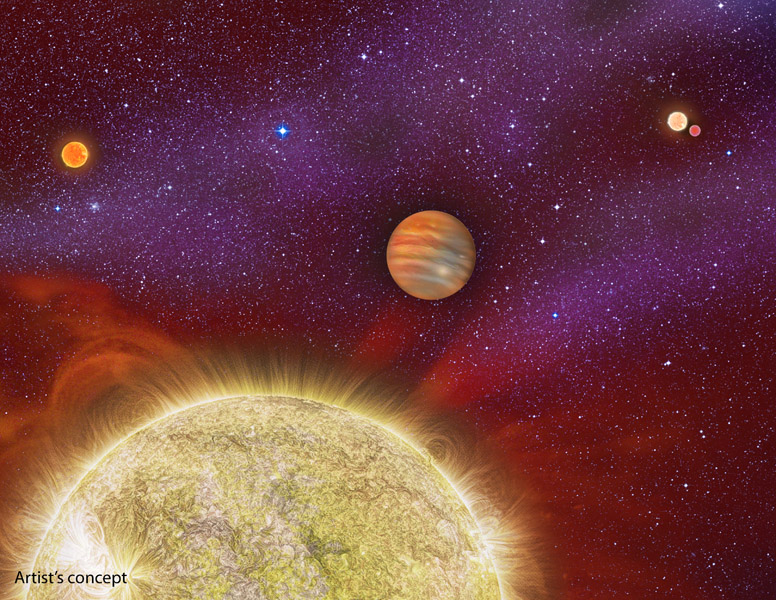
This artist’s conception shows the 30 Ari system, which includes four stars and a planet. The planet, a gas giant, orbits its primary star (yellow) in about a year’s time. The primary star, called 30 Ari B, has a companion — the small “red dwarf” star shown at upper left. This pair of stars is itself locked in a long-distance orbit with another pair of stars (upper right), known as 30 Ari A. Researchers using instruments at the Palomar Observatory near San Diego, Calif., recently discovered the red star at upper left, bringing the total number of known stars in the system from three to four.

Growing up as a planet with more than one parent star has its challenges. Though the planets in our solar system circle just one star — our sun — other more distant planets, called exoplanets, can be reared in families with two or more stars. Researchers wanting to know more about the complex influences of multiple stars on planets have come up with two new case studies: a planet found to have three parents, and another with four.

The discoveries were made using instruments fitted to telescopes at the Palomar Observatory in San Diego: the Robo-AO adaptive optics system, developed by the Inter-University Center for Astronomy and Astrophysics in India and the California Institute of Technology in Pasadena, and the PALM-3000 adaptive optics system, developed by NASA’s Jet Propulsion Laboratory in Pasadena, California, and Caltech.

This is only the second time a planet has been identified in a quadruple star system. While the planet was known before, it was thought to have only three stars, not four. The first four-star planet, KIC 4862625, was discovered in 2013 by citizen scientists using public data from NASA’s Kepler mission.

The latest discovery suggests that planets in quadruple star systems might be less rare than once thought. In fact, recent research has shown that this type of star system, which usually consists of two pairs of twin stars slowly circling each other at great distances, is itself more common than previously believed.

QuadStarSystem-30Ari

“About four percent of solar-type stars are in quadruple systems, which is up from previous estimates because observational techniques are steadily improving,” said co-author Andrei Tokovinin of the Cerro Tololo Inter-American Observatory in Chile.

The newfound four-star planetary system, called 30 Ari, is located 136 light-years away in the constellation Aries. The system’s gaseous planet is enormous, with 10 times the mass of Jupiter, and it orbits its primary star every 335 days. The primary star has a relatively close partner star, which the planet does not orbit. This pair, in turn, is locked in a long-distance orbit with another pair of stars about 1,670 astronomical units away (an astronomical unit is the distance between Earth and the sun). Astronomers think it’s highly unlikely that this planet, or any moons that might circle it, could sustain life.

Were it possible to see the skies from this world, the four parent stars would look like one small sun and two very bright stars that would be visible in daylight. One of those stars, if viewed with a large enough telescope, would be revealed to be a binary system, or two stars orbiting each other.

In recent years, dozens of planets with two or three parent stars have been found, including those with “Tatooine” sunsets reminiscent of the Star Wars movies. Finding planets with multiple parents isn’t too much of a surprise, considering that binary stars are more common in our galaxy than single stars.

“Star systems come in myriad forms. There can be single stars, binary stars, triple stars, even quintuple star systems,” said Lewis Roberts of JPL, lead author of the new findings appearing in the journal Astronomical Journal. “It’s amazing the way nature puts these things together.”

Roberts and his colleagues want to understand the effects that multiple parent stars can have on their developing youthful planets. Evidence suggests that stellar companions can influence the fate of planets by changing the planets’ orbits and even triggering some to grow more massive. For example, the “hot Jupiters” — planets around the mass of Jupiter that whip closely around their stars in just days — might be gently nudged closer to their primary parent star by the gravitational hand of a stellar companion.

In the new study, the researchers describe using the automated Robo-AO system on Palomar Observatory to scan the night skies, searching hundreds of stars each night for signs of stellar companions. They found two candidates hosting exoplanets: the four-star system 30 Ari, and a triple-star planetary system called HD 2638. The findings were confirmed using the higher-resolution PALM-3000 instrument, also at Palomar Observatory.

The new planet with a trio of stars is a hot Jupiter that circles its primary star tightly, completing one lap every three days. Scientists already knew this primary star was locked in a gravitational tango with another star, about 0.7 light-years away, or 44,000 astronomical units. That’s relatively far apart for a pair of stellar companions. The latest discovery is of a third star in the system, which orbits the primary star from a distance of 28 astronomical units — close enough to have influenced the hot Jupiter’s development and final orbit.

“This result strengthens the connection between multiple star systems and massive planets,” said Roberts.

In the case of Ari 30, the discovery brought the number of known stars in the system from three to four. The fourth star lies at a distance of 23 astronomical units from the planet. While this stellar companion and its planet are closer to each other than those in the HD 2638 system, the newfound star does not appear to have impacted the orbit of the planet. The exact reason for this is uncertain, so the team is planning further observations to better understand the orbit of the star and its complicated family dynamics.

JPL is managed for NASA by the California Institute of Technology in Pasadena.


Video: New Universe Daily report on earth-like exoplanets and lunar mining

A report from New Universe Daily on earth-like exoplanets and on prospects for mining the Moon:

The report references the article One step from Earth – physicsworld.com (req. free registration).

Update on Kepler exoplanet finding mission

Dr. William Borucki, the force behind the Kepler exo-planet finding observatory, gave an update last night on the John Batchelor radio program: John Batchelor Hotel Mars, Wednesday, 2-4-15 – Thespaceshow’s Blog –

David Livingston, who co-hosts the weekly Hotel Mars segment on the John Batchelor show, gave this summary of the show:

John Batchelor and I welcomed Dr. William (Bill) Borucki back to the show to discuss the recently announced discovery of the small five planet system 11.2 billion years old, Kepler-444. This is approximately 2.5 times older than the Earth. We discussed the exoplanet search, rocky planets and their early formation, the surprises contained within the discovery of Kepler-444, and life detection in the habitable zone. As it turns out, the five small planets orbit their sun in 10 days so they are far too hot for life. However, Dr. Borucki did at one point during our discussion estimate the number of planetary candidates that were possible in the habitable zone. One can see Kepler-444 with binoculars so I asked our guest where to look to find it. He also said it was a triple star system! Among the surprises included the discover of dust and metal that early and the discovery that stars formed so very early at all.

Review: “Five Billion Years of Solitude” by Lee Billings

Zooming in on the universe has not been easy or quick. Humans watched the night sky for tens of thousands of years so that by the time early civilizations arose in areas like Mesopotamia, China, and Pre-Colombian America, amazingly detailed knowledge had been gained of the movements of the planets and other heavenly objects visible to the naked eye.

It was not until 1610 that a newfangled gadget called the telescope allowed Galileo to go beyond the limits of the eye and make his famous observations of four moons orbiting Jupiter.

Over the next three centuries, ever larger and more sophisticated telescopes focused in on new planets (Uranus in 1781, Neptune in 1841, Pluto in 1930), asteroids, and moons in our solar system.

Many discoveries were also made of the universe beyond our solar system but it still was not until 1923 that telescopic instruments advanced to a sufficiently sensitive level to allow Edwin Hubble to discover that many of those stellar lights were not stars but galaxies, i.e. conglomerations of billions of stars  just like our own Milky Way.

And it wasn’t until the mid-1990s that a star was resolved by a telescope as a disc rather than a point blur of light. The star was the red super-giant Betelgeuse, whose diameter is about as big as the orbit of Jupiter. Only a handful of similar giants have been subsequently resolved .

So making the next step and zooming in on planets around other stars is clearly a terrifically difficult task. I think it is fair to say that most people, including most astronomers, assumed up until the 1980s that such discoveries would require gigantic telescopes not available until far into the future; at least for spotting planets significantly smaller than Jupiter.

In Five Billion Years of Solitude: The Search for Life Among the Stars, Lee Billings tells the story of how astronomers successfully developed methods to detect planets around other stars without seeing them directly. The trick is to detect the effects of an exoplanet on its host star.

The first method to find an exoplanet successfully involves measuring shifts in the frequency of a star’s light as a planet orbits the star. The orbiting planet causes the star to wobble and this wobble results in an increase in the frequency of light when the star moves towards us and a decrease when the star moves away from us. This is a very tiny effect but by monitoring hundreds of spectral lines for the telltale signs of Doppler shifts, the combined statistics of the shifts in all those lines creates a significant signal in the data as more and more orbits of the planet are observed. Groups in Canada, Switzerland and the US found the first exoplanets using this method in the early 1990s.

(In the book, Billings touches on the professional rivalries and squabbles that have arisen in the highly competitive exoplanet-finding field. Here is an article by him about one such battle: The Ugly Battle Over Who Really Discovered the First Earth-Like Planet – WIRED.)

This Doppler shift method (officially referred to as the radial-velocity method)  is biased towards big exoplanets orbiting close to their stars. While our sun has little Mercury as its closest inner planet, it turns out that there are many stars out there with massive exoplanets orbiting much closer to their stars than Mercury is to the Sun. Over time this method has gotten increasingly refined and smaller planets, farther out from their star have been observed.

Another method is to look for the slight dimming of a star when one of its planets passes between us and the star. This transit method requires that the plane of the planet’s orbit is oriented edge on from out point of view. This would seem to be very rare but there are so many stars out there that it happens often enough to give us plenty of cases to observe.

The Kepler space observatory has been spectacularly successful using the transit method. The Kepler team has accumulated a list of about 1000 confirmed exoplanets and over 4000 candidates are still under study. Most of the Kepler exoplanets are also large and too close to the stars to allow for life as we know it. However, a small subset of rocky planets similar in scale to the earth have been detected in “habitable zones” in which their orbits receive sufficient energy from their suns to allow for liquid water if the planets have dense enough atmospheres. That a handful of such candidate rocky exo-earth candidates have been detected is an enormous accomplishment.

The book, however, is not a technical guide to exoplanet detection. As the full name of the book implies, Billings puts the exoplanet discoveries in the broader context of the search for life beyond earth and for extraterrestrial intelligence (SETI). He focuses particularly on Frank Drake, the leading pioneer in SETI, who published his famous Drake Equation in the 1960s for estimating the number of advanced civilizations in the galaxy. Or guesstimating is more accurate. Most of the parameters in the equation, such as the probability that a star has planets and the fraction of such planets that could support life, were poorly known or not known at all.  The exoplanet discoveries finally provide hard data to determine some of these parameters.

Billings also reviews the formation of the solar system and the geologic and biologic history of the earth.  Earth’s development provides provide clues as to what to look for when seeking exoplanets with life.

Zooming in on earth-like planets and seeing them directly remains a key goal for exoplanet searchers. The most straight-forward way to do this is to build observatories in space and use special techniques to mask out the tremendous glare of the star so that the meager reflected light from the exoplanet can be examined. Most of the designs for such observatories will take considerable resources and Billings laments the lack of funding for such projects. He fears that just as we are finally gaining the capability to see and study distant earths, the implementation of that capability is receding into the future as NASA’s budget remains flat or falls.

(Recently Billings wrote about designs for relatively low cost space observatories specialized to see earth-sized planets around nearby stars if such planets exist : Planet Hunters Bet Big on a Small Telescope to See Alien Earths – Scientific American.)

It has been nearly five billion years since the formation of our solar system and our earth. Billings message is that we have now proven that earth is not the only rocky planet in the Milky Way. The next step is to study these exo-earths and determine if humans remain in solitude or have companions in our galaxy as well.