Category Archives: Exoplanets

Kepler spots first earth-size planet in habitable zone of its star system

Here is the Kepler announcement:

NASA’s Kepler Mission Discovers Bigger, Older Cousin to Earth

NASA’s Kepler mission has confirmed the first near-Earth-size planet in the “habitable zone” around a sun-like star. This discovery and the introduction of 11 other new small habitable zone candidate planets mark another milestone in the journey to finding another “Earth.”

452b_artistconcept_comparisonwithearth[1]Click for larger image

This artist’s concept compares Earth (left) to the new planet, called Kepler-452b, which is about 60 percent larger in diameter.
Credits: NASA/JPL-Caltech/T. Pyle

The newly discovered Kepler-452b is the smallest planet to date discovered orbiting in the habitable zone — the area around a star where liquid water could pool on the surface of an orbiting planet — of a G2-type star, like our sun. The confirmation of Kepler-452b brings the total number of confirmed planets to 1,030.

“On the 20th anniversary year of the discovery that proved other suns host planets, the Kepler exoplanet explorer has discovered a planet and star which most closely resemble the Earth and our Sun,” said John Grunsfeld, associate administrator of NASA’s Science Mission Directorate at the agency’s headquarters in Washington. “This exciting result brings us one step closer to finding an Earth 2.0.”

452b_system_comparison[1]Click for larger image.

This size and scale of the Kepler-452 system compared alongside the Kepler-186 system and the solar system. Kepler-186 is a miniature solar system that would fit entirely inside the orbit of Mercury. Credits: NASA/JPL-CalTech/R. Hurt

Kepler-452b is 60 percent larger in diameter than Earth and is considered a super-Earth-size planet. While its mass and composition are not yet determined, previous research suggests that planets the size of Kepler-452b have a good chance of being rocky.

While Kepler-452b is larger than Earth, its 385-day orbit is only 5 percent longer. The planet is 5 percent farther from its parent star Kepler-452 than Earth is from the Sun. Kepler-452 is 6 billion years old, 1.5 billion years older than our sun, has the same temperature, and is 20 percent brighter and has a diameter 10 percent larger.

fig10-new_kepler_planet_cand[1]Click for larger image.

There are 4,696 planet candidates now known with the release of the seventh Kepler planet candidate catalog – an increase of 521 since the release of the previous catalog in January 2015. Credits: NASA/W. Stenzel

“We can think of Kepler-452b as an older, bigger cousin to Earth, providing an opportunity to understand and reflect upon Earth’s evolving environment,” said Jon Jenkins, Kepler data analysis lead at NASA’s Ames Research Center in Moffett Field, California, who led the team that discovered Kepler-452b. “It’s awe-inspiring to consider that this planet has spent 6 billion years in the habitable zone of its star; longer than Earth. That’s substantial opportunity for life to arise, should all the necessary ingredients and conditions for life exist on this planet.”

To help confirm the finding and better determine the properties of the Kepler-452 system, the team conducted ground-based observations at the University of Texas at Austin’s McDonald Observatory, the Fred Lawrence Whipple Observatory on Mt. Hopkins, Arizona, and the W. M. Keck Observatory atop Mauna Kea in Hawaii. These measurements were key for the researchers to confirm the planetary nature of Kepler-452b, to refine the size and brightness of its host star and to better pin down the size of the planet and its orbit.

fig6-surfacetemperaturevsenergy[1]Click for a larger image.

Since Kepler launched in 2009, twelve planets less than twice the size of Earth have been discovered in the habitable zones of their stars. Credits: NASA/N. Batalha and W. Stenzel

The Kepler-452 system is located 1,400 light-years away in the constellation Cygnus. The research paper reporting this finding has been accepted for publication in The Astronomical Journal.

In addition to confirming Kepler-452b, the Kepler team has increased the number of new exoplanet candidates by 521 from their analysis of observations conducted from May 2009 to May 2013, raising the number of planet candidates detected by the Kepler mission to 4,696. Candidates require follow-up observations and analysis to verify they are actual planets.

Twelve of the new planet candidates have diameters between one to two times that of Earth, and orbit in their star’s habitable zone. Of these, nine orbit stars that are similar to our sun in size and temperature.

452b_artistconcept_beautyshot[1]Click for the image.

This artist’s concept depicts one possible appearance of the planet Kepler-452b, the first near-Earth-size world to be found in the habitable zone of star that is similar to our sun. Credits: NASA/JPL-Caltech/T. Pyle

“We’ve been able to fully automate our process of identifying planet candidates, which means we can finally assess every transit signal in the entire Kepler dataset quickly and uniformly,” said Jeff Coughlin, Kepler scientist at the SETI Institute in Mountain View, California, who led the analysis of a new candidate catalog. “This gives astronomers a statistically sound population of planet candidates to accurately determine the number of small, possibly rocky planets like Earth in our Milky Way galaxy.”

These findings, presented in the seventh Kepler Candidate Catalog, will be submitted for publication in the Astrophysical Journal. These findings are derived from data publically available on the NASA Exoplanet Archive.

Scientists now are producing the last catalog based on the original Kepler mission’s four-year data set. The final analysis will be conducted using sophisticated software that is increasingly sensitive to the tiny telltale signatures of Earth-size planets.

Ames manages the Kepler and K2 missions for NASA’s Science Mission Directorate. NASA’s Jet Propulsion Laboratory in Pasadena, California, managed Kepler mission development. Ball Aerospace & Technologies Corporation operates the flight system with support from the Laboratory for Atmospheric and Space Physics at the University of Colorado in Boulder.

For more information about the Kepler mission, visit: www.nasa.gov/kepler
Latest Kepler exoplanet finding to be announced

NASA is going to make an announcement today at 12:00 noon EDT about the latest discovery by the Kepler  space observatory:

NASA News Audio

The first exoplanet orbiting another star like our sun was discovered in 1995. Exoplanets, especially small Earth-size worlds, belonged within the realm of science fiction just 21 years ago. Today, and thousands of discoveries later, astronomers are on the cusp of finding something people have dreamed about for thousands of years — another Earth.

The briefing participants are:

  • John Grunsfeld, associate administrator for NASA’s Science Mission Directorate in Washington
  • Jon Jenkins, Kepler data analysis lead at NASA’s Ames Research Center in Moffett Field, California
  • Jeff Coughlin, Kepler research scientist at SETI Institute in Mountain View, California
  • Didier Queloz, professor of astrophysics at Cambridge University, United Kingdom

Broadcast live streaming video on Ustream

William Borucki, leader of Kepler exoplanet finder, wins $1M Shaw Prize

After leading a multi-decade struggle to get the Kepler Observatory funded, built, launched into space, and successfully finding exoplanets, it’s good to see William Borucki receiving well-deserved recognition and reward:

From Space News:

What’s cooler than discovering thousands of exoplanets?

Winning a prestigious $1 million astronomy prize for discovering thousands exoplanets.

Cooler, still, considering that the prize winner, Kepler Science Principal Investigator William Borucki, was in NASA’s dog house two years before his planet-hunting telescope finally launched in 2009.

Borucki won the $1 million Shaw Prize in Astronomy on Monday (June 2) for his work discovering extrasolar planets and studying solar interiors. Dubbed the “Asian Nobel,” the $1 million prize is funded by Hong Kong businessman and philanthropist Run Run Shaw, who also awards prizes in the life sciences and mathematics.

Kepler, a life-long labor of love for the 76-year-old Borucki, has discovered more than 4,000 exoplanets since launching in March 2009.


ESO: First measurement of an exoplanet’s visible light spectrum

A new report from ESO (European Southern Observatory):

First Exoplanet Visible Light Spectrum
New technique paints promising picture for future

Astronomers using the HARPS planet-hunting machine at ESO’s La Silla Observatory in Chile have made the first-ever direct detection of the spectrum of visible light reflected off an exoplanet. These observations also revealed new properties of this famous object, the first exoplanet ever discovered around a normal star: 51 Pegasi b. The result promises an exciting future for this technique, particularly with the advent of next generation instruments, such as ESPRESSO, on the VLT, and future telescopes, such as the E-ELT.

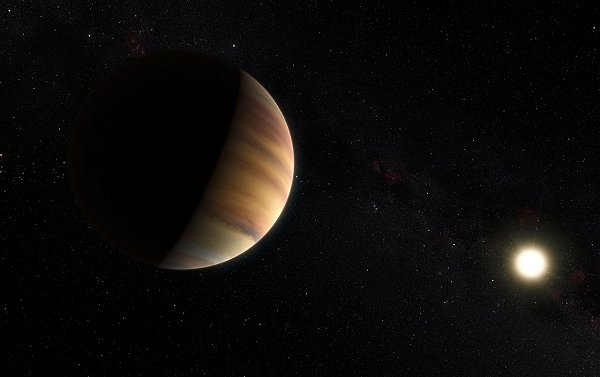
eso1517a_600x377

This artist’s view shows the hot Jupiter exoplanet 51 Pegasi b, sometimes referred to as Bellerophon, which orbits a star about 50 light-years from Earth in the northern constellation of Pegasus (The Winged Horse). This was the first exoplanet around a normal star to be found in 1995. Twenty years later this object was also the first exoplanet to be be directly detected spectroscopically in visible light. Credit: ESO/M. Kornmesser/Nick Risinger (skysurvey.org)

The exoplanet 51 Pegasi b [1] lies some 50 light-years from Earth in the constellation of Pegasus. It was discovered in 1995 and will forever be remembered as the first confirmed exoplanet to be found orbiting an ordinary star like the Sun [2]. It is also regarded as the archetypal hot Jupiter — a class of planets now known to be relatively commonplace, which are similar in size and mass to Jupiter, but orbit much closer to their parent stars.

Since that landmark discovery, more than 1900 exoplanets in 1200 planetary systems have been confirmed, but, in the year of the twentieth anniversary of its discovery, 51 Pegasi b returns to the ring once more to provide another advance in exoplanet studies.

The team that made this new detection was led by Jorge Martins from the Instituto de Astrofísica e Ciências do Espaço (IA) and the Universidade do Porto, Portugal, who is currently a PhD student at ESO in Chile. They used the HARPS instrument on the ESO 3.6-metre telescope at the La Silla Observatory in Chile.

Currently, the most widely used method to examine an exoplanet’s atmosphere is to observe the host star’s spectrum as it is filtered through the planet’s atmosphere during transit — a technique known as transmission spectroscopy. An alternative approach is to observe the system when the star passes in front of the planet, which primarily provides information about the exoplanet’s temperature.

The new technique does not depend on finding a planetary transit, and so can potentially be used to study many more exoplanets. It allows the planetary spectrum to be directly detected in visible light, which means that different characteristics of the planet that are inaccessible to other techniques can be inferred.

The host star’s spectrum is used as a template to guide a search for a similar signature of light that is expected to be reflected off the planet as it describes its orbit. This is an exceedingly difficult task as planets are incredibly dim in comparison to their dazzling parent stars.

The signal from the planet is also easily swamped by other tiny effects and sources of noise [3]. In the face of such adversity, the success of the technique when applied to the HARPS data collected on 51 Pegasi b provides an extremely valuable proof of concept.

Jorge Martins explains: “This type of detection technique is of great scientific importance, as it allows us to measure the planet’s real mass and orbital inclination, which is essential to more fully understand the system. It also allows us to estimate the planet’s reflectivity, or albedo, which can be used to infer the composition of both the planet’s surface and atmosphere.”

51 Pegasi b was found to have a mass about half that of Jupiter’s and an orbit with an inclination of about nine degrees to the direction to the Earth [4]. The planet also seems to be larger than Jupiter in diameter and to be highly reflective. These are typical properties for a hot Jupiter that is very close to its parent star and exposed to intense starlight.

HARPS was essential to the team’s work, but the fact that the result was obtained using the ESO 3.6-metre telescope, which has a limited range of application with this technique, is exciting news for astronomers. Existing equipment like this will be surpassed by much more advanced instruments on larger telescopes, such as ESO’s Very Large Telescope and the future European Extremely Large Telescope [5].

We are now eagerly awaiting first light of the ESPRESSO spectrograph on the VLT so that we can do more detailed studies of this and other planetary systems,” concludes Nuno Santos, of the IA and Universidade do Porto, who is a co-author of the new paper.

Here is the paper: Evidence for a spectroscopic direct detection of reflected light from 51 Peg b, J. H. C. Martins et al, Astronomy & Astrophysics, April 2015 (pdf).

TESS will hunt for exoplanets starting in 2017

The Kepler space observatory proved the effectiveness of the transit technique in finding exoplanets. After losing one reaction wheel too many, it was assumed that Kepler was an ex-exoplanet finder. However, the clever Kepler scientists and engineers found a way to use solar radiation pressure to keep the telescope steady in its viewing of distant stars. Now renamed the Kepler K2 mission, the observatory continues its planet spotting, albeit less efficiently than before.

So Kepler keeps adding to the list of exoplanets for now but a whole new improved exoplanet hunter is expected to go to space in August 2017. TESS (Transiting Exoplanet Survey Satellite) will monitor more stars than Kepler and it should also do better at finding small planets, i.e. earth-sized ones, orbiting around them. TESS will monitor

the brightnesses of more than 500,000 stars during a two year mission, searching for temporary drops in brightness caused by planetary transits. Transits occur when a planet’s orbit carries it directly in front of its parent star as viewed from Earth. TESS is expected to catalog more than 3000 transiting exoplanet candidates, including a sample of ∼500 Earth-sized and ‘Super Earth’ planets, with radii less than twice that of the Earth. TESS will detect small rock-and-ice planets orbiting a diverse range of stellar types and covering a wide span of orbital periods, including rocky worlds in the habitable zones of their host stars.

Here’s a video overview of the project:

We can also hope it has much better and more numerous reaction wheels…