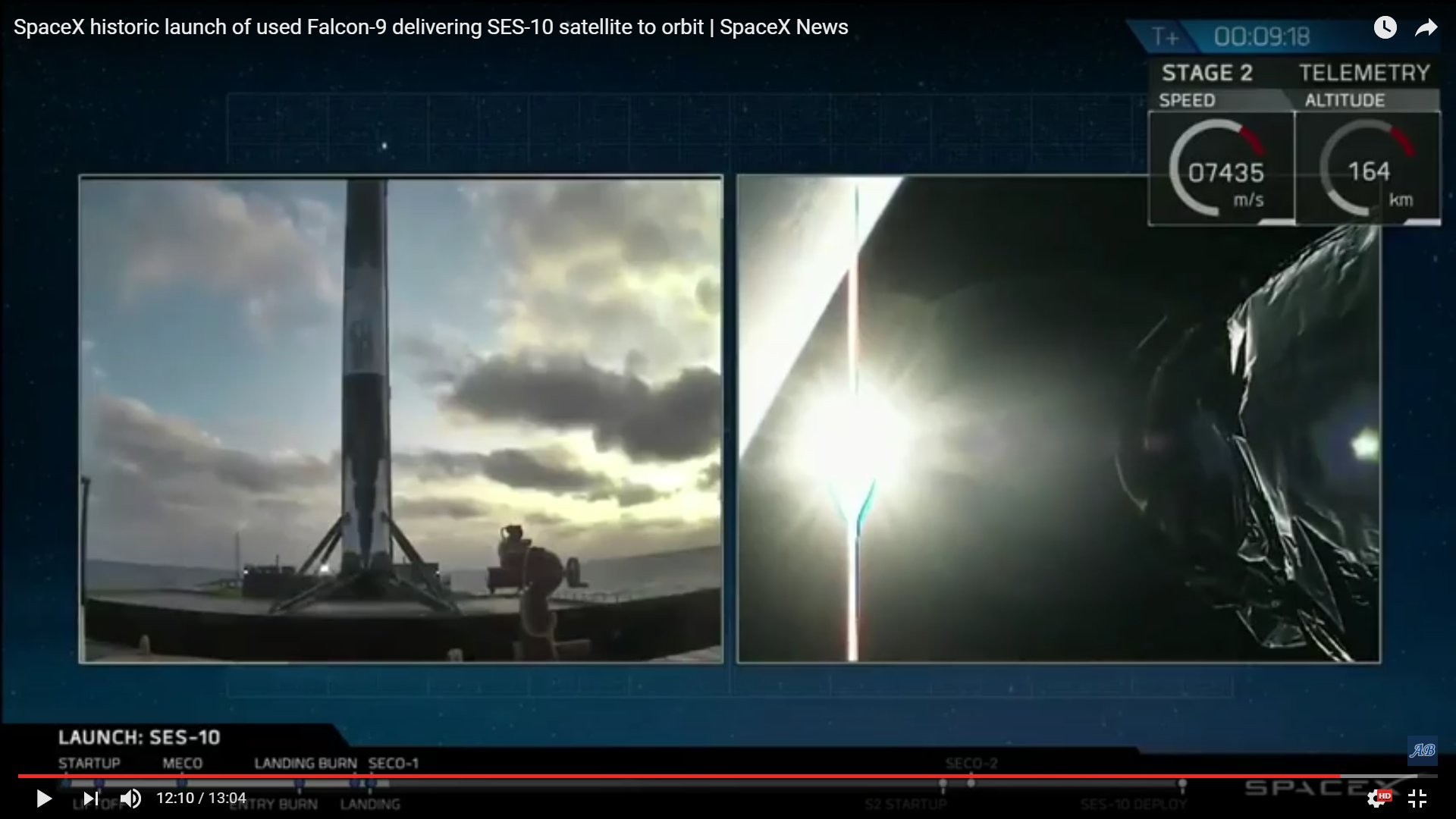
SpaceX today successfully launched a communications satellite into orbit and also flew the first stage booster back down for a safe landing onto a floating platform at sea. This launch and landing are historic because the booster had flown once before (April 2016). This was the first time an orbital rocket booster had been re-flown.
Screen capture of SpaceX webcast shows the booster shortly after it landed on the company’s floating platform in the Atlantic Ocean.
Here is a video clip from the webcast showing video from the booster as it came down towards the sea. The video transmission dropped out briefly (the antenna on the platform is shaken by the plume of the rocket) but then the image comes of the rocket in the center of the ship:
Some words from Elon Musk about the successful mission:
SpaceX announced on Monday that two private persons will ride a Crew Dragon spacecraft launched by a Falcon Heavy on a trip around the Moon. The target date for the flight is late 2018. TMRO.tv‘s Lisa Stojanovsk gives an overview of the endeavor:
The first launch of the Falcon Heavy is planned for this summer. All three cores will fly back for landings.
The Falcon Heavy system will have flown three or four times before this Moon flyby happens. The Crew Dragon will have flown both unmanned and manned to the ISS before the trip as well.
SpaceX to Send Privately Crewed Dragon Spacecraft
Beyond the Moon Next Year
We are excited to announce that SpaceX has been approached to fly two private citizens on a trip around the moon late next year. They have already paid a significant deposit to do a moon mission. Like the Apollo astronauts before them, these individuals will travel into space carrying the hopes and dreams of all humankind, driven by the universal human spirit of exploration. We expect to conduct health and fitness tests, as well as begin initial training later this year. Other flight teams have also expressed strong interest and we expect more to follow. Additional information will be released about the flight teams, contingent upon their approval and confirmation of the health and fitness test results.
Most importantly, we would like to thank NASA, without whom this would not be possible. NASA’s Commercial Crew Program, which provided most of the funding for Dragon 2 development, is a key enabler for this mission. In addition, this will make use of the Falcon Heavy rocket, which was developed with internal SpaceX funding. Falcon Heavy is due to launch its first test flight this summer and, once successful, will be the most powerful vehicle to reach orbit after the Saturn V moon rocket. At 5 million pounds of liftoff thrust, Falcon Heavy is two-thirds the thrust of Saturn V and more than double the thrust of the next largest launch vehicle currently flying.
Later this year, as part of NASA’s Commercial Crew Program, we will launch our Crew Dragon (Dragon Version 2) spacecraft to the International Space Station. This first demonstration mission will be in automatic mode, without people on board. A subsequent mission with crew is expected to fly in the second quarter of 2018. SpaceX is currently contracted to perform an average of four Dragon 2 missions to the ISS per year, three carrying cargo and one carrying crew. By also flying privately crewed missions, which NASA has encouraged, long-term costs to the government decline and more flight reliability history is gained, benefiting both government and private missions.
Once operational Crew Dragon missions are underway for NASA, SpaceX will launch the private mission on a journey to circumnavigate the moon and return to Earth. Lift-off will be from Kennedy Space Center’s historic Pad 39A near Cape Canaveral – the same launch pad used by the Apollo program for its lunar missions. This presents an opportunity for humans to return to deep space for the first time in 45 years and they will travel faster and further into the Solar System than any before them.
Designed from the beginning to carry humans, the Dragon spacecraft already has a long flight heritage. These missions will build upon that heritage, extending it to deep space mission operations, an important milestone as we work towards our ultimate goal of transporting humans to Mars.
The Space Nation Astronaut Program aims to involve the public in space flight. Their first initiative is a space flight training app for cell phones with
which people all around the world can compete in challenges to gain a deeper understanding of space exploration and the science and technology behind human spaceflight. Candidates earn points by completing tasks and advance through multiple merit levels to earn the ultimate mission: a trip to space.
The trip to space will be on a suborbital rocket vehicle.
The Finland base project is a collaboration of four companies – Cohu Experience, Axiom Space (commercial space station builder), Fun Academy, and Edge of Space (high alt balloons) – who plan “to create concrete ways to make space travel dreams possible for everyone”.
A crowd-funding campaign has raised over 2,350,000 euros in just the first few days. Here is a video outlining the Space Nation plan:
Blue Origin, the space company owned by Amazon.com CEO Jeff Bezos, flew their New Shepard reusable suborbital rocket yesterday. The goal was to test the abort system for the crew capsule. At about 45 seconds after liftoff, the crew capsule separated and flew off from the booster. It was expected that the booster would be damaged and blown off course by the rocket plume of the crew capsule but in fact it continued to fly normally and came back down for a safe landing.
On October 5, 2016, New Shepard performed an in-flight test of the capsule’s full-envelope escape system, designed to quickly propel the crew capsule to safety if a problem is detected with the booster. At T+0:45 and 16,053 feet (4,893 meters), the capsule separated and the escape motor fired, pushing the capsule safely away from the booster. Reaching an apogee of 23,269 feet (7,092 meters), the capsule then descended under parachutes to a gentle landing on the desert floor. After the capsule escape, the booster continued its ascent, reaching an apogee of 307,458 feet (93,713 meters). At T+7:29, the booster executed a controlled, vertical landing back at the West Texas Launch Site, completing its fifth and final mission.
[ Update: Here is a slow motion view of the separation of the crew capsule
]
===
This was the fifth flight of the booster and crew capsule, both of which will now go to a museum. Test flights will continue with new improved boosters and crew capsules as they move towards carrying people for the first time next year. Commercial flights with paying customers should start in 2018. Already, the vehicle has been carrying science experiments and engineering R&D payloads commercially.
===
Here is the complete webcast with the liftoff starting at 1:05:52. It shows more of the flight of the booster and crew capsule than the above video:
Blue Origin, the space company owned by Jeff Bezos of Amazon.com fame, flew their New Shepard reusable suborbital rocket vehicle for the third time last Saturday. The rocket takes off with the rocket booster and crew capsule connected together but just above 100 km in altitude the two separate. The crew capsule falls back to earth for a parachute landing while the booster does a vertical tail-first powered return using its liquid hydrogen, liquid oxygen engine.
In this test flight they decided to wait till the booster was at low altitude before turning on the engine. As you will see in the video, it comes down really fast and then brakes smoothly for a soft landing:
A University of Central Florida experiment designed to mimic impacts between objects in microgravity is flying aboard the next flight of Blue Origin’s reusable New Shepard space vehicle. Principal Investigator: Dr. Joshua Colwell
A Southwest Research Institute experiment designed to better understand the rocky soil on small, near-Earth asteroids is flying aboard the next flight of Blue Origin’s reusable New Shepard space vehicle. Principal Investigator: Dr. Dan Durda