Former NFL Pro Bowl linebacker Ken Harvey and aerospace engineer Allen Herbert have sought ways to excite young people’s interest in technology and spaceflight and one of the concepts they have developed is a team sport that would be played in microgravity. Called FloatBall, it combines elements of football, basketball and freefall. It was described in this 2008 NY Times article: Marketing Sports as the Next Phase of Space Tourism – NYTimes.com.
Obviously such a game requires sizable facilities in space and low cost transport to support the building and populating of such facilities. Such transport isn’t available yet and may not be for awhile. So they are pursuing a way to keep the idea alive by bringing it first to a comic book world. They have recruited a team of artists and seek to raise $30k on Kickstarter by June 21st to launch the FloatBall comic book series:
Harvey says:
Combining our talents, we came up with a game that would be fun, ferocious and factual. Since society has not yet achieved the level of space proficiency needed to play our new game, we decided that next best step would be to create a comic book about the sport. Not just any comic, but one that is cool and fun like Marvel or DC Comics, and also factually based on scientific possibilities.
FloatBall, like the original Star Trek, will help ignite the reality of today while fueling the imagination of tomorrow. This is where we need your help. We’d like to ask your assistance with funding this project.
Here is a video about the Kickstarter project:
Harvey also says:
If you are a fan of comics, space, sports, or science, then this is the comic for you. We need to raise enough money to produce and distribute the first issue. You can be in on the beginning of something great. Years into the future, your name will be associated with the beginning of a new age of sports in space.
Our goal is to create the first of a series of illustrated comic books delving into the world of FloatBall, the sport of the future. Who knows, with any luck the story will become a movie!
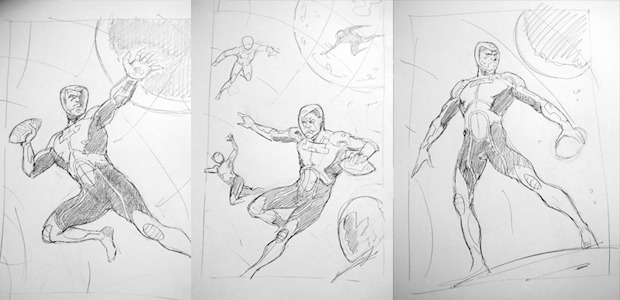 “Preproduction sketches of FloatBall players by the FutureDude team.”